
Viet Nam: As Ho Chi Minh City extends Covid-19 restrictions, militarized response must respect human rights

The Vietnamese authorities must take urgent steps to avert a looming humanitarian and human rights crisis on top of the country’s Covid-19 battle, as strict lockdown measures increasingly harm society’s most vulnerable, Amnesty International’s Deputy Regional Director for Research Emerlynne Gil said today:

“Military-enforced lockdowns are preventing many vulnerable people, especially in Ho Chi Minh City, from accessing enough food to survive during a devastating public health crisis.”

“The government must not allow a two-pronged tragedy of Covid-19 deaths and unendurable hunger to envelop a population where many were already suffering serious economic hardship before lockdowns began.”

“We are alarmed by credible reports that huge numbers of people have received next to nothing in terms of food. If the country is to carry out military-enforced lockdowns, sustenance supplied by the army must reach vulnerable people and meet nutritional needs.”

“Amid this period of intense suffering, police have also fined and arrested people who criticize the state’s handling of the crisis on social media and unleashed a disproportionate criminal crackdown on individuals caught spreading Covid-19.”

“Heavy-handed measures to enforce public health restrictions risk undermining the effectiveness of Viet Nam’s Covid-19 response. Instead of relying on punishment and other coercive approaches, Vietnamese authorities should implement a response rooted in respect for human rights.”

“The Vietnamese authorities must ensure that Covid-19 restrictions are the minimum necessary and proportionate to the aim of protecting public health as defined under international human rights law. Lengthy prison terms for Covid-19 spreaders and lockdowns that prevent people from accessing food clearly do not pass this test.”

Background

Viet Nam is battling its deadliest outbreak of Covid-19 since the pandemic began. After initially proving a success story in its response to the pandemic, recording fewer than 1,500 Covid-19 cases and only 35 deaths by the end of 2020, cases have since skyrocketed to over 570,000, with just over 15,000 deaths. The majority of new cases and deaths have been reported in Ho Chi Minh City.

In response, Vietnamese authorities have enacted strict lockdowns in the nation’s hardest-hit regions. On 23 August 2021, officials in Ho Chi Minh City, the nation’s most populous urban area, imposed a severe, military-enforced lockdown that prevents people from leaving their homes even to access food. People must wait for the military to deliver supplies to their homes, a system that has failed to consistently fulfil the right to food for the city’s most vulnerable people, leaving many in a position of severe food shortages and hunger. The restrictions are expected to remain in place until the end of September.

Harrowing images and videos of hardship and suffering – and calls for help – have spread across social media, yet those caught criticizing the government’s handling of the pandemic have faced fines and arrest.

On 2 September 2021, police in Ho Chi Minh City fined Facebook user Nguyen Thuy Duong VND 5 million (approximately $210) after she shared a post online saying the authorities had neglected city residents and allowed them to go hungry during the lockdown. In early August, police arrested 33-year-old Tran Hoang Huan for sharing criticism of the government’s Covid-19 response on Facebook.

On 6 September 2021, Viet Nam sentenced 28-year-old Le Van Tri to five years for breaking Covid-19 restrictions and spreading the virus. On 30 March 2021, a court handed a two-year suspended prison term to a flight attendant under the same charges. 

Vietnam is a party to the UN International Covenant on Economic, Social and Cultural Rights, which guarantees amongst others the rights to health and to food. The UN Committee on Economic, Social and Cultural Rights’, which monitors states’ compliance with the Covenant, states in its General Comment 14 that any restrictions and limitations on the grounds of public health “must be in accordance with the law, including international human rights standards, compatible with the nature of the rights protected by the Covenant, in the interest of legitimate aims pursued, and strictly necessary for the promotion of the general welfare in a democratic society”. They should be of limited duration, subject to review, and the least restrictive alternative must be adopted where several types of limitations are available. The Committee has also emphasized in the context of the pandemic that authorities must ensure sufficient food supplies reach all those in need.

The post Viet Nam: As Ho Chi Minh City extends Covid-19 restrictions, militarized response must respect human rights appeared first on Amnesty International.
Niger: Increasing number of children killed and recruited by armed groups in Sahel’s tri-border area – new report

Increasing numbers of children are being killed and targeted for recruitment by armed groups in conflicts raging at Niger’s borders with Mali and Burkina Faso, Amnesty International said in a new report published today.

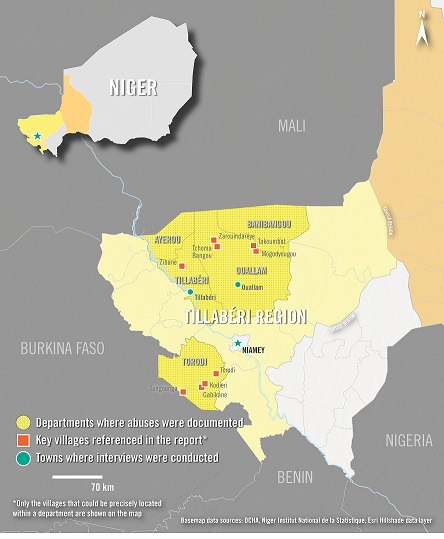
The 57-page report, ‘I Have Nothing Left Except Myself’: The Worsening Impact on Children of Conflict in the Tillabéri Region of Niger, documents the devastating impact on children of the conflict in Niger, involving armed groups Islamic State in the Greater Sahara (ISGS) and the al-Qaida-affiliated Jama’at Nusrat al-Islam wal-Muslimin (JNIM).

Both ISGS and JNIM have committed war crimes and other abuses in the conflict, including the murder of civilians and targeting of schools. Many children are experiencing trauma after witnessing deadly attacks on their villages. In some areas, women and girls have been barred from activities outside the home, and risk abduction or forced marriage to fighters.

In Niger’s Tillabéri region, an entire generation is growing up surrounded by death and destruction

Matt Wells

“In Niger’s Tillabéri region, an entire generation is growing up surrounded by death and destruction. Armed groups have repeatedly attacked schools and food reserves, and are targeting children for recruitment,” said Matt Wells, Amnesty International’s Crisis Response Deputy Director – Thematic Issues.

© Amnesty International

“The Nigerien government and its international partners must urgently take action to monitor and prevent further abuses and protect the basic rights of all those affected by this deadly conflict – especially children.”

The Nigerien authorities have failed to protect civilians. Witnesses to attacks described how, despite their urgent calls, Niger’s Defense and Security Forces (FDS) frequently arrived long after killing and looting had ended.

Amnesty International considers the situation in Niger a non-international armed conflict, given the intensity of violence and level of organization of both ISGS and JNIM.

Targeted killing of civilians

The conflict in Tillabéri has escalated significantly since the start of this year. According to the Armed Conflict Location & Event Data Project, violence against civilians has led to 544 conflict-related deaths between 1 January and 29 July 2021 in Niger, already exceeding the 397 people killed in 2020.

Armed groups have killed more than 60 children in Niger’s tri-border area in 2021. ISGS, which operates primarily on the border with Mali, appears responsible for most of the large-scale killing.

Amnesty spoke to 16 boys who had narrowly survived ISGS attacks on their villages. They described how masked attackers on motorbikes opened fire, particularly targeting men and older boys. One boy, aged around 13 or 14, said: “We all are used to hearing gunshots and to seeing [dead] people layered on top of [dead] people.”

Sometimes I have nightmares of being chased by people on motorbikes or seeing Wahab pleading with the [attackers] again.

A boy who witnessed the murder of his 12-year-old friend

Another boy, who witnessed the murder of his 12-year-old friend Wahab in March 2021, said: “I think of Wahab and how he was killed. Sometimes I have nightmares of being chased by people on motorbikes or seeing Wahab pleading with the [attackers] again.”

Fighters have fired into homes, killing or injuring civilians attempting to hide. One woman and her baby daughter suffered gunshot wounds while hiding at home during a likely ISGS attack.

The FDS withdrew from some border areas after suffering losses to ISGS and JNIM in late 2019, leading to an absence of state authorities. Witnesses to attacks said the FDS often failed to respond, as killing and looting unfolded over several hours.

A 50-year-old man, in words echoed by many others, told Amnesty International: “We have been abandoned.”

Recruitment of children

The recruitment of children by JNIM has increased significantly this year in Torodi department, near the Burkina Faso border.

Witnesses said JNIM has targeted younger men and boys aged between 15 and 17, and possibly younger. JNIM members offer incentives such as food, money, and clothes to attract recruits.

Recruits reportedly receive weapons training for periods ranging from one week to three months. JNIM is also known to use children as spies, scouts, and lookouts, among other functions defined as participation in hostilities under international law.

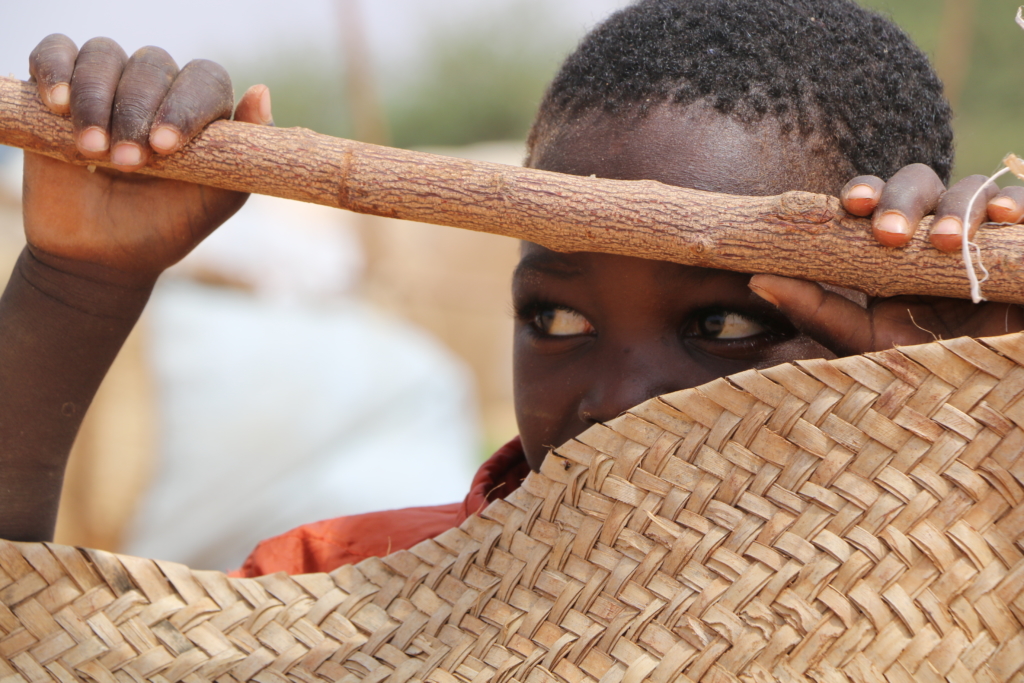
A boy living in a displacement camp in Tillabéri region, Niger © Mamoudou L. Kane / Amnesty International

Attacks on education and healthcare

As part of their opposition to education they consider ‘Western’, ISGS and JNIM have burned schools and threatened teachers, resulting in widespread school closures. As of June 2021, at least 377 schools in the Tillabéri region had closed, depriving more than 31,000 children of access to education.

Amnesty International documented armed group attacks which targeted and burned schools in at least four departments of Tillabéri region. In rural areas, most school structures are made from straw, making them easy to burn.

Teachers have also been threatened for their work. One 15-year-old boy from Mogodyougou said: “The teachers… left. They’d be killed [if they stayed].”

School closures have left many children from conflict-affected areas without access to education for extended periods. A 14-year-old boy said: “We didn’t like that the school closed… After our school closed, we stayed at home. There wasn’t anything for us.”

Under international humanitarian law, attacks against schools are prohibited unless the school building is being used for military purposes. As such, attacks against schools or other buildings dedicated to education documented by Amnesty International constitute war crimes.

The conflict has significantly undermined children’s access to healthcare, as armed groups have looted health facilities, and the Nigerien authorities have restricted civilians’ movement and impeded aid access at times. Immunization rates have plummeted, and diseases such as measles are on the rise.

Attacks on food security

During attacks, ISGS has burned grain stores and looted shops and livestock, leaving families destitute and without adequate food. Children face heightened risks of malnutrition and related illness.

A woman with seven children told Amnesty International that ISGS fighters torched her family’s granaries during an attack on Zibane village. She said: “Everything was burned… I have nothing left, except myself.”

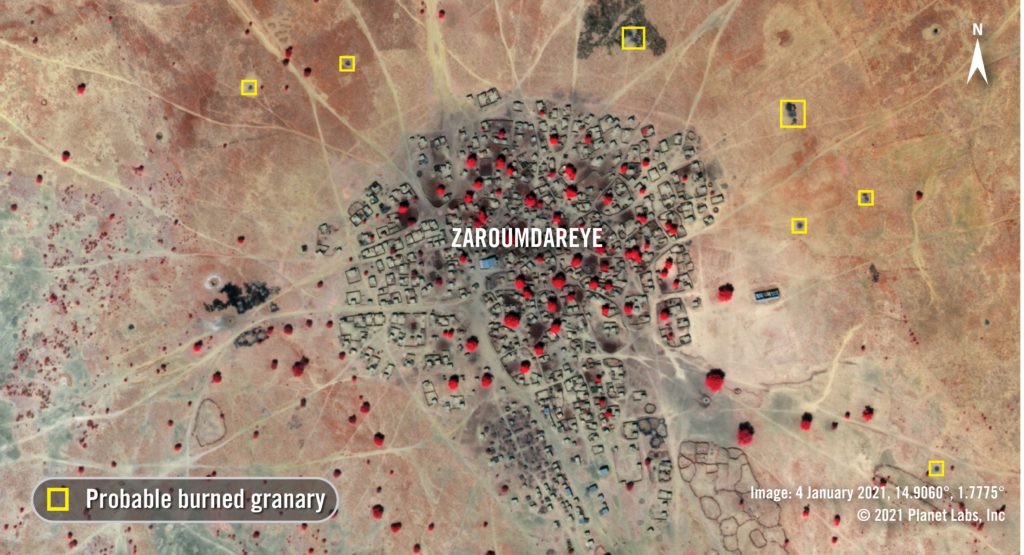
Through satellite imagery analysis, Amnesty International corroborated the targeted burning of grain stores. Such attacks have forcibly displaced tens of thousands of people, often emptying entire villages due to lack of food. 

Both ISGS and JNIM also regularly impose ‘taxes’ on communities, often enforced through violence. Humanitarian agencies have predicted that an estimated 2.3 million people in the region are likely to suffer from food insecurity due to the attacks, as well as from drought and floods.

Throughout the Zaroumdareye area, 21 probable and 2 possible granaries appear burned. © 2021, Planet Labs, Inc

Psychosocial impact on children

The relentless attacks have had a profound impact on children’s mental health and wellbeing. Very few children interviewed had received psychosocial support.

Amnesty International documented symptoms of trauma and distress among children, including nightmares, disturbed sleep patterns, fear, anxiety, and loss of appetite. Many reported how the sound of motorbikes triggered memories of attacks.

The Nigerien authorities and international partners must take urgent steps to ensure children are better equipped to build a future for themselves

Matt Wells

One 15-year-old boy who had been displaced from his village told Amnesty International: “What I want is the true return of peace. And [the government] need[s] to pay attention to our lives, even here [in the IDP camp] in terms of food and water. And school. We need to go to school.”

“The Nigerien authorities must take swift action to ensure conflict-affected children across Tillabéri region have access to school and psychosocial care,” said Matt Wells.

“Niger is at a precipice. The Nigerien authorities and international partners must take urgent steps to ensure children are better equipped to build a future for themselves.”

Background

Conflict erupted in Mali in 2012, and has since spilled into neighbouring Burkina Faso and Niger. Armed groups have competed for control in the border areas, and frequently clashed with the Nigerien military, and forces from countries including Chad, Mali, Burkina Faso, and France.

An estimated 13.2 million people in the three countries will need humanitarian assistance this year, and around 1.9 million people have been internally displaced.

Methodology

Amnesty International interviewed 119 people, including 22 children, three young adults between 18 and 20, and 36 parents and other individuals affected by the conflict. Other individuals interviewed included staff from NGOs and humanitarian agencies, UN officials and government officials.

The post Niger: Increasing number of children killed and recruited by armed groups in Sahel’s tri-border area – new report appeared first on Amnesty International.
Russia: Journalist arrested over his call for “smart voting” against the ruling party

Responding to the arrest on “extremism” charges of Rostov-on-Don journalist, Igor Khoroshilov, who appealed in a post on Facebook for “smart voting” against the ruling United Russia party, Natalia Zviagina, Amnesty International’s Moscow Office Director, said:

“This is a blatant violation of the right to freedom of expression. Anyone should be able to express their views about the upcoming parliamentary election and candidates. The Russian authorities’ attempts to silence any dissent – be it on the streets, in the independent media or social media – have reached the point of absurdity.

The Russian authorities’ attempts to silence any dissent – be it on the streets, in the independent media or social media – have reached the point of absurdity

Natalia Zviagina, Amnesty International’s Moscow Office Director

“This arrest shows the authorities are determined to shut down public support for prisoner of conscience Aleksei Navalny and his “smart voting” campaign.

“Igor Khoroshilov must be released immediately and unconditionally. The authorities must stop their shameless persecution of Aleksei Navalny’s supporters and other dissenters.”

Background

Igor Khoroshilov, editor-in-chief of the independent online news outlet Golos, from Rostov-on-Don in southern Russia, was detained by police on the morning of 10 September. In a Facebook post, he said he had been accused of disseminating “extremist materials” (Article 20.3 of the Code of Administrative Violations) in connection with a previous Facebook post that referred to ‘smart voting’. He was later put under administrative arrest for 10 days.

Aleksei Navalny, the prominent jailed critic of the Kremlin, has urged Russians to vote tactically in parliamentary elections scheduled for 17-19 September. However his “Smart Voting” website and mobile app has since been banned by Russia’s Roskomnadzor communications regulator, which also blocked 49 websites associated with Navalny and his Anti-Corruption Foundation in June 2021, for being “extremist”.  

By early September, over 1,000 Russians who had registered with the “Smart Voting” platform, and whose personal information had been leaked online, were visited by the police and warned that supporting Aleksei Navalny’s organizations could lead to criminal prosecution.

On 5 September, the Moscow Arbitration Court ordered Google and its Russian counterpart Yandex to stop displaying the term “smart voting” in its search results.

The post Russia: Journalist arrested over his call for “smart voting” against the ruling party appeared first on Amnesty International.

Syria/Jordan: UN-led return operation will put refugees at risk of abuses in Syria

The UN and the Syrian Arab Red Crescent (SARC) must halt plans to transfer refugees from Rukban camp back to Syria, Amnesty International said today. The operation would put returnees at risk of arbitrary detention, enforced disappearance, and torture and other ill-treatment, including sexual violence, as Amnesty International documented in a report this week. Rukban is an informal settlement, located in an isolated and inhospitable area between the Syrian and Jordanian borders known as “the berm”. Living conditions in the camp are dire, and residents lack access to medical care, sanitation and clean water.

Our research shows that the Syrian authorities have specifically targeted returnees from Rukban, accusing them of ‘terrorism’ before subjecting them to serious human rights violations.

Marie Forestier, Researcher on Refugee and Migrants Rights

Amnesty International received information that beginning in September, the UN plans to facilitate the transfer of people from Rukban to “shelters” in Homs, where they will be quarantined for 14 days. Amnesty has documented how these so-called shelters have been used by Syrian authorities to detain and interrogate returnees. Some of these returnees were then transferred to intelligence centres where they were arbitrarily detained and in some cases, tortured and forcibly disappeared. It is not clear how many people will be moved from Rukban if the UN-led return operation goes ahead.

“We are urging the UN and SARC not to proceed with these returns, which will undoubtedly put the women, men and children who have been living in Rukban in danger. Our research shows that the Syrian authorities have specifically targeted returnees from Rukban, accusing them of ‘terrorism’ before subjecting them to serious human rights violations,” said Marie Forestier, Researcher on Refugee and Migrants Rights at Amnesty International.

“Quarantine requirements in government-controlled facilities will essentially give the Syrian authorities 14 days to interrogate returnees. These returns must not go ahead; instead, the Syrian and Jordanian governments, as well as all parties to the conflict, must urgently ensure unfettered access of humanitarian aid to Rukban.”

Not safe

Amnesty International’s report “You’re going to your death” found that Syrian authorities have targeted returnees precisely because they sought asylum abroad. Out of the 66 cases documented in the report, Syrian security officials detained all 10 individuals who returned from Rukban camp. Three were subjected to torture or other ill-treatment, and two were forcibly disappeared.

Samer, who lived in Rukban for six years before returning to Homs in 2019, said: “[The Syrian authorities] hate people from Rukban. They think that they all have links with terrorism and should be mistreated.” Samer said that intelligence members arbitrarily detained and forcibly disappeared him for nine months, during which time they tortured him.

The evidence that Syria is not safe for returns is overwhelming – this return operation must not proceed.

Marie Forestier

Under the plan seen by Amnesty International, leaving the quarantine site in Homs would be subject to approval by the Syrian government, giving authorities the power to detain returnees for even longer periods without judicial oversight.

The last humanitarian convoy allowed into the berm by the Syrian government was in September 2019. In March 2020, Jordan announced it would not allow aid to pass through its territory, citing COVID-19 concerns. The head of the Rukban local council told Amnesty International that camp residents have expressed anger that the only convoys coming to Rukban are transferring people to Syrian government-controlled areas, rather than bringing aid.

“The evidence that Syria is not safe for returns is overwhelming – this return operation must not proceed,” said Marie Forestier.

Background

In early 2015, tens of thousands of people seeking safety from the conflict in Syria ended up stranded in the border area known as “the berm”, after Jordanian authorities sealed off border crossings. Around 10,000 people currently live in the camp there.  An estimated 75% of the berm’s population have returned to Syria since mid-2015, largely due to dire living conditions.

The post Syria/Jordan: UN-led return operation will put refugees at risk of abuses in Syria appeared first on Amnesty International.

New investigation exposes global misuse of police batons

Amnesty International and the Omega Research Foundation today called on governments to support a UN-led process to regulate the trade in law enforcement equipment, highlighting how ubiquitous weapons like police batons are routinely misused in ways which can constitute torture and other ill-treatment. 

In a new investigation, Blunt Force, the organizations catalogued 188 incidents where law enforcement officials have misused striking weapons such as batons, which are currently traded with little to no regulation. The investigation draws on open-source photo and video evidence from 35 countries, and includes examples from violent crackdowns on protests in Belarus, Colombia, France, India and Myanmar. Videos show law enforcement officials using batons and similar weapons like lathis and sjamboks to inflict punishment, beat people who are already restrained, deliver unjustified dangerous blows to the head, or choke people in neck holds.  

Batons can cause serious injury and even death when used improperly, yet they are traded with little to no regulation.  

Verity Coyle, Advisor on Military, Security and Policing at Amnesty International

As a UN process to create an international regulatory framework moves ahead, Amnesty and Omega are calling for tighter controls on the trade in “less lethal” law enforcement weapons, as well as an outright ban on certain types of inherently abusive equipment used for torture or the death penalty. 

“Batons can cause serious injury and even death when used improperly. Yet the trade in law enforcement equipment like this continues to benefit from a shocking absence of regulation. Governments should be obliged to conduct rigorous risk assessments before allowing this equipment to be exported,” said Verity Coyle, Advisor on Military, Security and Policing at Amnesty International.  

“States should also ensure that law enforcement agencies are trained and instructed in human rights compliant policing, including in the context of public assemblies, where many of the violations we documented took place. There are international standards governing how police can use force, but our investigation shows these being flouted all over the world – with profoundly dangerous consequences.” 

Stop the unlawful use of police batons

Commonly used – and abused

Striking devices are the most common type of less-lethal weapon, carried by police and security forces worldwide. These include batons, lathis (long sticks) and sjamboks (rigid whips). The widespread deployment of this equipment means it is also among the most frequently abused, especially in the context of crackdowns on protests.  

Some less lethal weapons and equipment can have a legitimate use in law enforcement, if employed correctly and in line with international standards. Law enforcement officials face a wide variety of situations which require instantaneous decisions, often in highly stressful and even dangerous circumstances. But the use of force must only be resorted to with the utmost respect for the law, and with due consideration for the serious impact it can have on a range of human rights.


A growing number of states have recognised the need to address the trade in law enforcement weapons and equipment, as part of the global fight against torture and other ill-treatment.

Dr Michael Crowley, Omega Research Foundation

Under the UN Basic Principles on the Use of Force and Firearms by Law Enforcement Officials (BPUFF), police may only use force for a legitimate law enforcement purpose, and may not use more force than needed to achieve this objective. Any potential harm caused by police using force must not outweigh the harm they want to prevent.  Furthermore, as with other means of force, batons must never be used for the purpose of punishment. These rules also apply in the context of policing public assemblies.  

Blunt Force shows how law enforcement officials routinely act against international human rights law and standards by attacking protesters who present no threat of violence.  

Amnesty International’s Crisis Evidence Lab and Digital Verification Corps analysed more than 500 videos of protests between 2011 and 2021, identifying and verifying 188 incidents of baton misuse. Videos of five illustrative cases are available here, with Amnesty and Omega’s analysis of how international standards have been breached in each case.  

For example, a video from Hong Kong shows a young male protester being repeatedly hit with batons by several officers. One of the officers strikes the protester on the head, causing bleeding. Strikes to the head are particularly dangerous and can even be fatal, and putting another life at risk is prohibited under international law and standards, if it is not unavoidable and in response to a similarly serious threat. Crucially, the video shows that officers clearly had other, less harmful options at their disposal to achieve their aim of arresting the protester.  

Footage from Belarus shows riot police leading a protester down some stairs. An officer strikes the protester on the back of the legs even though he is not resisting arrest; while being held by one officer, the protester is then struck on the back of the head with a baton and punched in the face and stomach. Baton strikes while a subject is under control are unnecessary and disproportionate, and amount to using batons punitively – which amounts to torture or other cruel, inhuman and degrading treatment or punishment, a violation of international law. 

UN Process

The UN Secretary General has tasked a group of experts to develop proposals with the aim of creating an international framework to regulate the trade in equipment that can be used for torture or in the death penalty. This includes less-lethal equipment like batons and tear gas. They must report back to the UN General Assembly in 2022. 

Given the clear risk of common law enforcement weapons being misused, any global framework to regulate the trade must cover the broadest possible scope of equipment. 

Dr Michael Crowley, Research Associate at the Omega Research Foundation, said: 

“A growing number of states have recognised the need to address the trade in law enforcement weapons and equipment, as part of the global fight against torture and other ill-treatment. The ongoing UN process to develop common international standards is a once-in-a-generation opportunity to regulate a trade which has been out of control for decades. 

“We call on all states to support the creation of a global, legally binding instrument which bans inherently abusive equipment and weapons and places strict controls on the trade in standard law enforcement equipment, to ensure it is never sent to those who will use it for torture or other ill-treatment. To make a real difference, such regulation must cover the types of weapons, such as batons, that are most regularly misused by law enforcement officials around the world.” 

The post New investigation exposes global misuse of police batons appeared first on Amnesty International.