Iya Volcano Volcanic Ash Advisory: VA TO FL030 REPORTED AT 01/0513Z EST VA DTG: 01/0620Z to 3000 ft (900 m)

Explosive activity continues. Volcanic Ash Advisory Center (VAAC) Darwin warned about a volcanic ash plume that rose up to estimated 3000 ft (900 m) altitude or flight level 030 and is moving at 10 kts in NW direction.
The full report is as follows:

FVAU04 at 06:43 UTC, 01/05/26 from ADRM
VA ADVISORY
DTG: 20260501/0643Z
VAAC: DARWIN
VOLCANO: IYA 264110
PSN: S0853 E12138
AREA: INDONESIA
SOURCE ELEV: 618M AMSL
ADVISORY NR: 2026/1
INFO SOURCE: CVGHM, HIMAWARI-9
ERUPTION DETAILS: VA TO FL030 REPORTED AT 01/0513Z
EST VA DTG: 01/0620Z
EST VA CLD: SFC/FL030 S0857 E12138 – S0852 E12133 – S0846
E12134 – S0847 E12140 – S0854 E12142 MOV NW 10KT
FCST VA CLD +6 HR: 01/1220Z NO VA EXP
FCST VA CLD +12 HR: 01/1820Z NO VA EXP
FCST VA CLD +18 HR: 02/0020Z NO VA EXP
RMK: MINOR VA EMISSION REPORTED IN CVGHM VONA AT 01/0513Z.
VA NOT IDENTIFIABLE ON SATELLITE IMAGERY DUE TO MET CLOUD.
HEIGHT AND MOVEMENT BASED ON GROUND REPORT AND MODEL
GUIDANCE.
NXT ADVISORY: NO LATER THAN 20260501/1243Z=

Dukono Volcano Volcanic Ash Advisory: VA TO FL070 OBS AT 01/0040Z MOV N OBS VA DTG: 01/0040Z to 7000 ft (2100 m)

Satellite image of Dukono volcano on 1 May 2026

Explosive activity continues. Volcanic Ash Advisory Center (VAAC) Darwin warned about a volcanic ash plume that rose up to estimated 7000 ft (2100 m) altitude or flight level 070 .
The full report is as follows:

FVAU03 at 00:59 UTC, 01/05/26 from ADRM
VA ADVISORY
DTG: 20260501/0100Z
VAAC: DARWIN
VOLCANO: DUKONO 268010
PSN: N0142 E12754
AREA: INDONESIA
SOURCE ELEV: 1229M AMSL
ADVISORY NR: 2026/185
INFO SOURCE: HIMAWARI-9, CVGHM
ERUPTION DETAILS: VA TO FL070 OBS AT 01/0040Z MOV N
OBS VA DTG: 01/0040Z
OBS VA CLD: SFC/FL070 N0135 E12759 – N0135 E12749 – N0220
E12725 – N0314 E12749 – N0308 E12823 MOV N 05KT
FCST VA CLD +6 HR: 01/0640Z SFC/FL070 N0144 E12743 – N0222
E12759 – N0216 E12832 – N0146 E12836 – N0131 E12752
FCST VA CLD +12 HR: 01/1240Z SFC/FL070 N0145 E12743 – N0234
E12818 – N0222 E12855 – N0144 E12853 – N0131 E12752
FCST VA CLD +18 HR: 01/1840Z SFC/FL070 N0145 E12743 – N0240
E12811 – N0214 E12858 – N0126 E12850 – N0131 E12752
RMK: CONTINUOUS VA IDENTIFIABLE ON SATELLITE IMAGERY. VA
HEIGHT AND MOVEMENT BASED ON SATELLITE IMAGERY AND MODEL
GUIDANCE.
NXT ADVISORY: NO LATER THAN 20260501/0700Z=

Popocatépetl Volcano Volcanic Ash Advisory: VA MOVG SSW to 20000 ft (6100 m)

Explosive activity continues. Volcanic Ash Advisory Center (VAAC) Washington warned about a volcanic ash plume that rose up to estimated 20000 ft (6100 m) altitude or flight level 200 .
The full report is as follows:

FVXX24 at 00:18 UTC, 01/05/26 from KNES
VA ADVISORY
DTG: 20260501/0015Z

VAAC: WASHINGTON

VOLCANO: POPOCATEPETL 341090
PSN: N1901 W09837

AREA: MEXICO

SOURCE ELEV: 17693 FT AMSL

ADVISORY NR: 2026/169

INFO SOURCE: GOES-19. WEBCAM. NWP MODELS.

ERUPTION DETAILS: VA MOVG SSW

OBS VA DTG: 01/0001Z

OBS VA CLD: SFC/FL200 N1902 W09837 – N1901 W09836
– N1808 W09838 – N1820 W09918 – N1902 W09837 MOV
SW 10KT

FCST VA CLD +6HR: 01/0600Z SFC/FL200 N1902 W09837
– N1901 W09836 – N1754 W09821 – N1754 W09855 –
N1902 W09837

FCST VA CLD +12HR: 01/1200Z SFC/FL200 N1902
W09837 – N1815 W09815 – N1811 W09847 – N1901
W09838 – N1902 W09837

FCST VA CLD +18HR: 01/1800Z SFC/FL200 N1901
W09837 – N1901 W09837 – N1826 W09820 – N1821
W09844 – N1901 W09837

RMK: VA PLUME DRIFTING SW IS STARTING TO MOV MORE
S. VA EMS OBS IN STLT IMAGERY AND WEBCAM APPRX
50NM SSW FM SUMMIT. VA FCST THRU T+18 HRS BASED
ON RCNT STLT IMAGERY. NWP MDLS SUGGEST LGT/VRBL
FL WIND. …COVERDALE

NXT ADVISORY: WILL BE ISSUED BY 20260501/0615Z

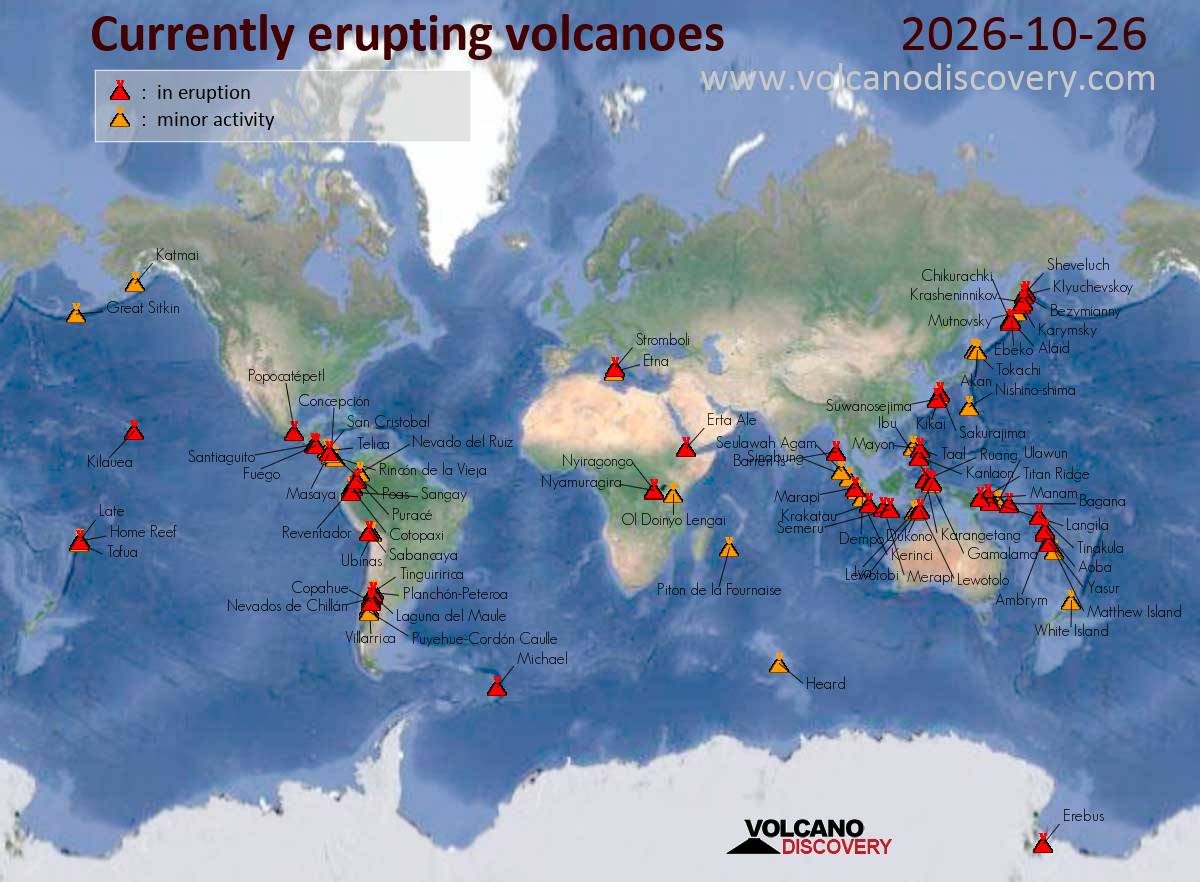
Volcanic activity worldwide 30 Apr 2026: Santiaguito volcano, Pacaya, Fuego, Popocatépetl, Krakatau…

Map of today's active volcanoes

Map of today’s active volcanoes

Canlaon (Central Philippines): The Philippine Institute of Volcanology and Seismology (PHIVOLCS) reported that the eruption continued at Kanlaon on 29 April 2026 (local). Tremor episodes were recorded 1 times. Volcanic seismicity was recorded 4 times. Sulfur dioxide (SO₂) emissions averaged 974 tonnes per day on 29 April. The alert level remained at „2 – Moderate Level of Volcanic Unrest“ (on a 0–5 level scale). Activity also included: inflationary deformation, tremor, volcanic seismicity.
Source: Philippine Institute of Volcanology and Seismology (PHIVOLCS)
… [read more]

Taal (Luzon, Philippines): The Philippine Institute of Volcanology and Seismology (PHIVOLCS) reported that the eruption continued at Taal on 29 April 2026 (local). There were 3 phreatic explosions reported. Tremor episodes were recorded 5 times. Sulfur dioxide (SO₂) emissions averaged 858 tonnes per day on 29 April. The alert level remained at „1 – Low-Level Unrest“ (on a 0–5 level scale). Activity also included: inflationary deformation, tremor.
Source: Philippine Institute of Volcanology and Seismology (PHIVOLCS)
… [read more]

Mayon (Luzon Island, Philippines): The Philippine Institute of Volcanology and Seismology (PHIVOLCS) reported that the eruption continued at Mayon on 29 April 2026 (local). Lava effusion continued from the summit crater. As of 29 April, lava flow lengths remained at 3.8 km in the Basud Gully (E flank), 3.2 km in the Bonga Gully (SE flank), and 1.6 km in the Mi-isi Gully (S flank). Minor episodic Strombolian activity was observed. Short-lived lava fountaining was observed. Plume(s) rose to a maximum of 300 m (984 ft) above the vent. Volcanic seismicity was recorded 45 times. Tremor episodes were recorded 32 times. There were 307 seismically detected rockfalls. Crater glow was visible to the naked eye. Sulfur dioxide (SO₂) emissions averaged 2,087 tonnes per day on 29 April. Ground deformation indicated short-term deflation across the volcanic edifice, with shorter-term inflation localized on the NE flank. The alert level remained at „3 – Increased Tendency Towards Hazardous Eruption“ (on a 0–5 level scale). Activity also included: tremor, volcanic seismicity.
Source: Philippine Institute of Volcanology and Seismology (PHIVOLCS)
… [read more]

Bulusan (Luzon Island, Philippines): The Philippine Institute of Volcanology and Seismology (PHIVOLCS) reported that unrest continued at Bulusan on 29 April 2026 (local). Plume(s) rose to a maximum of 50 m (164 ft) above the vent. Volcanic seismicity was recorded 127 times. The alert level remained at „1 – Low Level of Volcanic Unrest“ (on a 0–5 level scale). Activity also included: inflationary deformation, volcanic seismicity.
Source: Philippine Institute of Volcanology and Seismology (PHIVOLCS)
… [read more]

Gamalama (Halmahera): The Center for Volcanology and Geological Hazard/Pusat Vulkanologi dan Mitigasi Bencana Geologi (CVGHM/PVMBG) reported that unrest continued at Gamalama on 29 April 2026 (local). Gas and vapor plume(s) rose to a maximum of 100 m (328 ft) above the vent. The alert level remained at „Level 2 – Alert“ (on a 4-level scale).
Source: Center for Volcanology and Geological Hazard/Pusat Vulkanologi dan Mitigasi Bencana Geologi (CVGHM/PVMBG)
… [read more]

Ibu (Halmahera, Indonesia): The Center for Volcanology and Geological Hazard/Pusat Vulkanologi dan Mitigasi Bencana Geologi (CVGHM/PVMBG) reported that the eruption continued at Ibu on 29 April 2026 (local). Gas and vapor plume(s) rose to a maximum of 200 m (656 ft) above the vent. There were 116 explosions reported, with plumes rising to a maximum of 500 m (1,640 ft) above the vent. There was 1 seismically detected rockfall. The alert level remained at „Level 2 – Alert“ (on a 4-level scale).
Source: Center for Volcanology and Geological Hazard/Pusat Vulkanologi dan Mitigasi Bencana Geologi (CVGHM/PVMBG)
… [read more]

Lewotobi (Flores): The Center for Volcanology and Geological Hazard/Pusat Vulkanologi dan Mitigasi Bencana Geologi (CVGHM/PVMBG) reported that the eruption continued at Lewotobi (Laki-Laki) on 29 April 2026 (local). Gas and vapor plume(s) rose to a maximum of 100 m (328 ft) above the vent. The alert level remained at „Level 2 – Alert“ (on a 4-level scale).
Source: Center for Volcanology and Geological Hazard/Pusat Vulkanologi dan Mitigasi Bencana Geologi (CVGHM/PVMBG)
… [read more]

Lewotolo (Lesser Sunda Islands): The Center for Volcanology and Geological Hazard/Pusat Vulkanologi dan Mitigasi Bencana Geologi (CVGHM/PVMBG) reported that the eruption continued at Lewotolok on 29 April 2026 (local). Ash and gas plume(s) rose to a maximum of 100 m (328 ft) above the vent. There were 45 seismically detected explosions reported. Faint to moderate rumbling sounds were reported. There were 3 seismically detected rockfalls. The alert level remained at „Level 2 – Alert“ (on a 4-level scale).
Source: Center for Volcanology and Geological Hazard/Pusat Vulkanologi dan Mitigasi Bencana Geologi (CVGHM/PVMBG)
… [read more]

Krakatau (Sunda Strait, Indonesia): The Center for Volcanology and Geological Hazard/Pusat Vulkanologi dan Mitigasi Bencana Geologi (CVGHM/PVMBG) reported that unrest continued at Krakatau on 29 April 2026 (local). The alert level remained at „Level 2 – Alert“ (on a 4-level scale).
Source: Center for Volcanology and Geological Hazard/Pusat Vulkanologi dan Mitigasi Bencana Geologi (CVGHM/PVMBG)
… [read more]

Merapi (Central Java, Indonesia): The Center for Volcanology and Geological Hazard/Pusat Vulkanologi dan Mitigasi Bencana Geologi (CVGHM/PVMBG) reported that the eruption continued at Merapi on 29 April 2026 (local). Gas and vapor plume(s) rose to a maximum of 300 m (984 ft) above the vent. There were 20 hot rockfalls, traveling up to 2,000 m. There were 154 seismically detected rockfalls. The alert level remained at „Level 3 – Standby“ (on a 4-level scale).
Source: Center for Volcanology and Geological Hazard/Pusat Vulkanologi dan Mitigasi Bencana Geologi (CVGHM/PVMBG)
… [read more]

Semeru (East Java, Indonesia): The Center for Volcanology and Geological Hazard/Pusat Vulkanologi dan Mitigasi Bencana Geologi (CVGHM/PVMBG) reported that the eruption continued at Semeru on 29 April 2026 (local). There were 71 explosions reported, with plumes rising to a maximum of 600 m (1,969 ft) above the vent. There were 2 seismically detected rockfalls. The alert level remained at „Level 3 – Standby“ (on a 4-level scale).
Source: Center for Volcanology and Geological Hazard/Pusat Vulkanologi dan Mitigasi Bencana Geologi (CVGHM/PVMBG)
… [read more]

Marapi (Western Sumatra, Indonesia): The Center for Volcanology and Geological Hazard/Pusat Vulkanologi dan Mitigasi Bencana Geologi (CVGHM/PVMBG) reported that the eruption continued at Marapi on 29 April 2026 (local). The alert level remained at „Level 2 – Alert“ (on a 4-level scale).
Source: Center for Volcanology and Geological Hazard/Pusat Vulkanologi dan Mitigasi Bencana Geologi (CVGHM/PVMBG)
… [read more]

Dukono (Halmahera): The Center for Volcanology and Geological Hazard/Pusat Vulkanologi dan Mitigasi Bencana Geologi (CVGHM/PVMBG) reported that the eruption continued at Dukono on 29 April 2026 (local). There were 87 explosions reported, with plumes rising to a maximum of 1,200 m (3,937 ft) above the vent. The alert level remained at „Level 2 – Alert“ (on a 4-level scale).
Source: Center for Volcanology and Geological Hazard/Pusat Vulkanologi dan Mitigasi Bencana Geologi (CVGHM/PVMBG)
… [read more]

Kerinci (Sumatra): The Center for Volcanology and Geological Hazard/Pusat Vulkanologi dan Mitigasi Bencana Geologi (CVGHM/PVMBG) reported that unrest continued at Kerinci on 29 April 2026 (local). Gas and vapor plume(s) rose to a maximum of 200 m (656 ft) above the vent. Tremor episodes were recorded 1 times. The alert level remained at „Level 2 – Alert“ (on a 4-level scale). Activity also included: tremor.
Source: Center for Volcanology and Geological Hazard/Pusat Vulkanologi dan Mitigasi Bencana Geologi (CVGHM/PVMBG)
… [read more]

Kilauea (Hawai’i): The United States Geological Survey – Hawaiian Volcano Observatory (USGS-HVO) reported that there was a pause in eruptive activity at Kilauea between 28 April 2026 (local) and 29 April 2026 (local). Webcam footage captured consistent glow from both the north and south vents overnight, although glow from the south vent appeared notably brighter. Over the past day, seismicity at the summit increased, with 96 small earthquakes recorded (all below M2.0), primarily occurring within Halemaʻumaʻu Crater and to the S and SW of the caldera. Both the north and south vents sometimes produced flames. The alert level remained at „Advisory“ (level 2 on a 4-level scale). The aviation alert level remained at „Yellow“ (level 2 on a 4-level scale).
Source: United States Geological Survey – Hawaiian Volcano Observatory (USGS-HVO)
… [read more]

Shishaldin (Aleutian Islands, Alaska): The United States Geological Survey – Alaska Volcano Observatory (USGS-AVO) reported that unrest continued at Shishaldin between 28 April 2026 (local) and 29 April 2026 (local). The alert level remained at „Advisory“ (level 2 on a 4-level scale). The aviation alert level remained at „Yellow“ (level 2 on a 4-level scale).
Source: United States Geological Survey – Alaska Volcano Observatory (USGS-AVO)
… [read more]

Great Sitkin (United States, Aleutian Islands): The United States Geological Survey – Alaska Volcano Observatory (USGS-AVO) reported that the eruption continued at Great Sitkin between 28 April 2026 (local) and 29 April 2026 (local). Lava continued to slowly erupt in the summit crater. Rockfalls generated by the growing lava dome were seismically recorded. The alert level remained at „Watch“ (level 3 on a 4-level scale). The aviation alert level remained at „Orange“ (level 3 on a 4-level scale).
Source: United States Geological Survey – Alaska Volcano Observatory (USGS-AVO)
… [read more]

Popocatépetl (Central Mexico): The Centro Nacional de Prevención de Desastres (CENAPRED) reported that the eruption continued at Popocatépetl between 28 April 2026 (local) and 29 April 2026 (local). A total of 134 low-intensity exhalations were documented, in addition to exhalation sequences totaling 133 minutes in duration. During some of the exhalation sequences, incandescent fragments were ejected a short distance from the crater. Plumes of ash, gas, and steam accompanied the exhalations. On the morning of 29 April, The State Coordination of Civil Protection in Morelos reported minor ash fall in Tetela del Volcán (18 km SW). The alert level remained at „Yellow Alert – Phase 2“ (level 4 on a 7-level scale).
Source: Centro Nacional de Prevención de Desastres (CENAPRED)
… [read more]

Santiaguito (Guatemala): The Instituto Nacional de Sismología, Vulcanología, Meteorología e Hidrología (INSIVUMEH) reported that the eruption continued at Santa María between 28 April 2026 (local) and 29 April 2026 (local). A second episode of PDCs began around 1400 on 28 April, with PDCs continuing to extend to the base of the Caliente Dome (2,000–4,000 m). Ash from PDCs dispersed as far as 100 km to the SW and W. Increases in Real-time Seismic-Amplitude Measurement (RSAM) data were recorded during the PDC events. There were explosions reported, occurring at a rate of up to 3 per hour with plumes rising to a maximum of 3,400 m (11,155 ft) above sea level. Gas and vapor plume(s) rose to a maximum of 500 m (1,640 ft) above the vent.
Source: Instituto Nacional de Sismología, Vulcanología, Meteorología e Hidrología (INSIVUMEH)
… [read more]

Pacaya (Guatemala): The Instituto Nacional de Sismología, Vulcanología, Meteorología e Hidrología (INSIVUMEH) reported that unrest continued at Pacaya between 28 April 2026 (local) and 29 April 2026 (local). Activity also included: fumarolic activity.
Source: Instituto Nacional de Sismología, Vulcanología, Meteorología e Hidrología (INSIVUMEH)
… [read more]

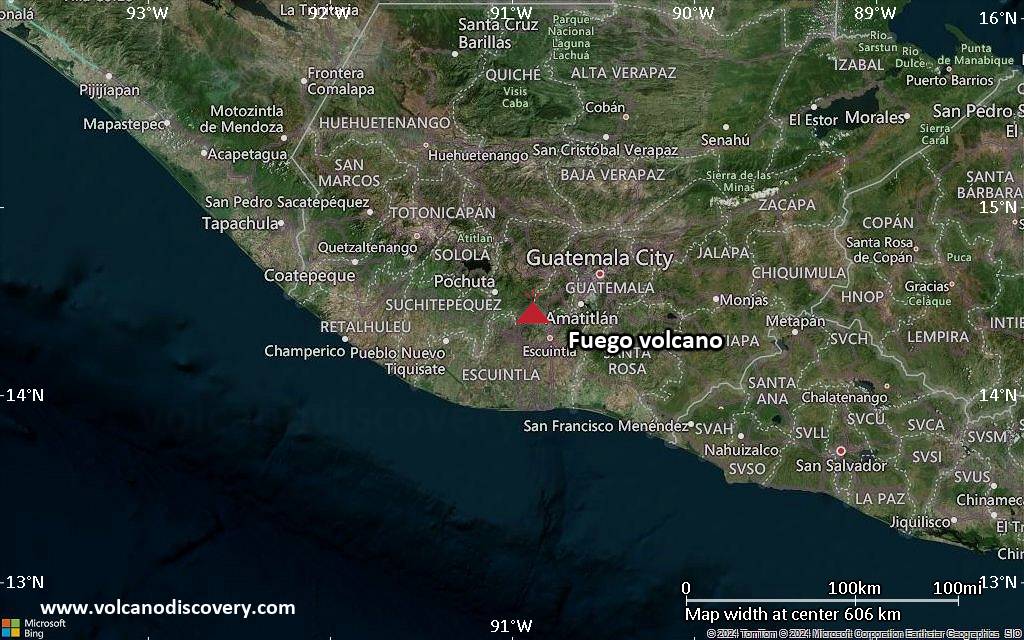
Fuego (Guatemala): Volcanic Ash Advisory Center Washington (VAAC) issued the following report: VA EMS LIKELY ONGOING
…30 Apr:
The Instituto Nacional de Sismología, Vulcanología, Meteorología e Hidrología (INSIVUMEH) reported that the eruption continued at Fuego between 28 April 2026 (local) and 29 April 2026 (local). There were explosions reported, occurring at a rate of up to 13 per hour, with plumes rising to a maximum of 1,037 m (3,402 ft) above the vent. At night, incandescent material was ejected in pulses above the crater. There were incandescent rockfalls. Fine ash fall was reported in Panimaché Uno and Panimaché Dos, Finca La Asunción, Morelia, and El Porvenir. Gas and vapor plume(s) rose to a maximum of 537 m (1,762 ft) above the vent. Activity also included: audible sounds (e.g., booms, rumbling), shockwave.
Source: Instituto Nacional de Sismología, Vulcanología, Meteorología e Hidrología (INSIVUMEH)
… [read more]

Turrialba (Costa Rica): The Observatorio Vulcanológico y Sismológico de Costa Rica – Universidad Nacional (OVSICORI-UNA) reported that unrest continued at Turrialba between 28 April 2026 (local) and 29 April 2026 (local). The alert level remained at „Level 2 – Warning“ (on a 0–4 level scale). The aviation alert level remained at „Yellow“ (level 2 on a 4-level scale).
Source: Observatorio Vulcanológico y Sismológico de Costa Rica – Universidad Nacional (OVSICORI-UNA)
… [read more]

Rincón de la Vieja (Costa Rica): The Observatorio Vulcanológico y Sismológico de Costa Rica – Universidad Nacional (OVSICORI-UNA) reported that unrest continued at Rincón de la Vieja between 28 April 2026 (local) and 29 April 2026 (local). The alert level remained at „Level 2 – Warning“ (on a 0–4 level scale). The aviation alert level remained at „Yellow“ (level 2 on a 4-level scale).
Source: Observatorio Vulcanológico y Sismológico de Costa Rica – Universidad Nacional (OVSICORI-UNA)
… [read more]

Poas (Costa Rica): The Observatorio Vulcanológico y Sismológico de Costa Rica – Universidad Nacional (OVSICORI-UNA) reported that the eruption continued at Poás between 28 April 2026 (local) and 29 April 2026 (local). The alert level remained at „Level 2 – Warning“ (on a 0–4 level scale). The aviation alert level remained at „Yellow“ (level 2 on a 4-level scale).
Source: Observatorio Vulcanológico y Sismológico de Costa Rica – Universidad Nacional (OVSICORI-UNA)
… [read more]

Sangay (Ecuador): The Instituto Geofísico-Escuela Politécnica Nacional (IG-EPN) reported that the eruption continued at Sangay between 28 April 2026 (local) and 29 April 2026 (local). There were 378 seismically detected explosions reported. Ash and gas plume(s) rose to a maximum of 1,800 m (5,906 ft) above the vent. There were incandescent rockfalls, descending 1,400 m below the crater. The alert level remained at „2 – Yellow“ (on a 4-level scale). Activity also included: thermal anomaly(ies).
Source: Instituto Geofísico-Escuela Politécnica Nacional (IG-EPN)
… [read more]

Reventador (Ecuador): The Instituto Geofísico-Escuela Politécnica Nacional (IG-EPN) reported that the eruption continued at Reventador between 28 April 2026 (local) and 29 April 2026 (local). There were 80 seismically detected explosions reported. Ash and gas plume(s) rose to a maximum of 1,600 m (5,249 ft) above the vent. On the morning of 29 April, a pyroclastic density current (PDC), or pyroclastic flow, was observed descending the SW flank. There were incandescent rockfalls, descending 1,000 m below the crater. The alert level remained at „3 – Orange“ (on a 4-level scale). Activity also included: thermal anomaly(ies).
Source: Instituto Geofísico-Escuela Politécnica Nacional (IG-EPN)
… [read more]

Sabancaya (Peru): Volcanic Ash Advisory Center Buenos Aires (VAAC) issued the following report: UNABLE TO DETECT
…30 Apr:
The Centro Vulcanológico Nacional del Instituto Geofísico del Perú (CENVUL-IGP) reported that the eruption continued at Sabancaya between 28 April 2026 (local) and 29 April 2026 (local). Ash, gas, and vapor plume(s) rose to a maximum of 2,200 m (7,218 ft) above the vent. A total of 3 earthquakes related to the movement of magma and gases were recorded. Thermal anomalies were detected 4 times. The alert level remained at „Orange“ (level 3 on a 4-level scale). Activity also included: thermal anomaly(ies).
Source: Centro Vulcanológico Nacional del Instituto Geofísico del Perú (CENVUL-IGP)
… [read more]

When Rights Are Quietly Disappeared: Resisting Authoritarian Practices Through Human Rights Education

Imagine this scenario….

Imagine waking up one day to find that certain topics can no longer be discussed openly. Schools avoid difficult conversations. Journalists tread more carefully. Your news feed shows fewer critical voices. Public spaces feel less safe for protest or dissent. 

Nothing dramatic happened overnight! There are no obvious turning points, just a gradual shift. Yet over time, the space for dialogue, disagreement, and public participation has narrowed. You may have heard the term authoritarian practices in the news, in history lessons, or in conversations. But what does it really mean? What is considered an authoritarian practice, and what falls outside of it?  What do they actually look like in everyday life for ordinary people like you and me? How can we spot and resist these practices that seriously undermine human rights?  

Would you notice? And more importantly, if you did, would you know how to respond? 

For many people around the world, this scenario is not hypothetical. This is a lived reality, experienced by growing numbers of people around the globe. Authoritarian practices that violate human rights rarely arrive at once. More often, they emerge gradually, introduced through policies, narratives, and practices that might even seem reasonable in isolation. Measures limiting the rights to freedom of expression, peaceful assembly, or access to information are often justified in the language of security, stability, or national interest. These justifications can make restrictions feel necessary, at times even protective. 

Over time, repeated exposure to these narratives can normalize limitations on rights.  This gradual normalization is what makes such developments difficult to detect, and even harder to challenge. This makes them easy to overlook. When change is gradual, it rarely triggers immediate resistance. Instead, it reshapes expectations; what people believe is acceptable, possible, or safe.  This scenario reflects a broader global reality. Across the world, civic space is shrinking, and the rule of law is being weakened. Governments and other powerful actors are employing practices that limit what people can say, share, or challenge, while they undermine the institutions intended to keep a check on power. 

At a time like this, strengthening our knowledge and understanding of human rights is not optional. It is essential. Without that understanding, it becomes much harder to spot the signs showing the expansion of authoritarian practices, and recognize when human rights are being unduly restricted to respond effectively when they are. This erosion of our rights is often subtle and systemic. It does not always look like repression in its most obvious form. Instead, it works through discouragement, fear, and the quiet reshaping of what is considered “normal”. When people lose the ability to question, organize, or speak freely, the effects reach far beyond individuals. Entire societies are affected as powerful actors intend to unduly build, exercise, and entrench power for the benefit of a narrow group.  

But we can resist! The first step in resisting is learning; this is why human rights education becomes a powerful tool of resistance. 

Police officers arrest an 89-year-old protester at a “Lift The Ban” demonstration in support of the proscribed group Palestine Action, calling for the recently imposed ban to be lifted, in Parliament Square, central London, on August 9, 2025.

Making sense of authoritarian practices through education  

Understanding these developments is not always straightforward. Authoritarian practices are rarely presented as such. Instead, they are embedded in complex political, economic, social, and cultural dynamics. They are not only about laws or policies; they are also about narratives, what people fear, what they believe, and what they accept as “normal”. This is not about which political affiliation or government system is best. It is about understanding how fear and division are used politically, how narratives are manipulated to justify authoritarian practices, and how we can start to question the systems and stories that allow injustice to grow.1 Without the resources and tools to critically analyze these narratives, it becomes difficult to understand how rights are being restricted and eroded for the sake of concentrating power, or how to respond. This is where awareness becomes crucial.  

Recognizing patterns, questioning assumptions, and understanding human rights and the protections they give to keep power in check are key steps in responding effectively. Learning to ask questions about who benefits, what is being framed as a threat, and whose voices are being excluded is an essential part of this process. Critical awareness, therefore, is not automatic; it must be learned. This is where education in human rights plays a crucial role. Education can enable us to translate complex global issues into accessible and practical knowledge to act.  

Tools and Resources to Understand and Resist 

Amnesty International’s Rights Revealed: Human Rights and the Escalation of Authoritarian Practices Around the World is designed with this purpose in mind. This two-part educational resource is aimed at anyone seeking to understand how fear, division, and narratives are used to silence, control, and erode human rights. It’s not about political affiliations or governance systems. It focuses on the tactics themselves and how we can recognize and challenge them.  

The educational resources include: 

Part 1: Unpacking Authoritarian Narratives of Fear, Repression, and Control 

Complementary resource:  U.S.-specific Case Cards on Unpacking Authoritarian Narratives Rights of Fear, Repression and Control U.S.-specific Case Cards on Unpacking Authoritarian Narratives Rights of Fear, Repression and Control – Amnesty International 

Part 2: Resisting Authoritarian Practices in Defence of Human Rights 

It is available in English, Arabic, French, and Spanish. 

Amnesty Human Rights Education Rights Reveal Part 1

They aim to support learners, educators, and communities in making sense of these issues. This makes them relevant not only in classrooms, but also in community discussions, public spaces, or personal reflections. 

In a world where rights can be gradually restricted to further entrench power, being informed is a form of resistance. Education plays a crucial role in this. It equips individuals with the knowledge and confidence to question, to engage, and to challenge injustice in their everyday experiences.  

Act! Take the Next Step 

Understanding is the first step, but it should not be the last. Rights are not sustained by laws and institutions alone. They depend on individuals who are aware, engaged, and willing to act. 

You don’t need to be an expert to engage with these issues. 

Start by exploring Amnesty’s educational resources. Use them in your classroom, your work, or your community. Share them, discuss them, and question them. Reflect on how these issues appear in your own context. Ask questions. Share what you learn. The more informed and engaged we are, the stronger those rights become. You can: 

  • Use them in teaching, workshops, or conversations 
  • Reflect on how these issues appear in your own context 
  • Engage in conversations about rights and responsibilities 
  • You can explore the interactive quiz on Authoritarian Practices on Kahoot Quiz here  

Because when human rights are either quietly or openly undermined and eroded to concentrate power in a few hands, understanding and action matter more than ever. 

Footnote

  1.  Amnesty International, Rights revealed: Human rights and the escalation of authoritarian practices around the world: Part 1 – Unpacking authoritarian narratives of fear, repression and control (2025), p. 1, https://www.amnesty.org/en/documents/pol32/0336/2025/en/ ↩

The post When Rights Are Quietly Disappeared: Resisting Authoritarian Practices Through Human Rights Education appeared first on Amnesty International.