Philippines: ICC launches probe into deadly “war on drugs”, seeks to end impunity

Responding to the International Criminal Court (ICC) pre-trial chamber’s announcement that it has opened an investigation into the killings during the Philippine government’s deadly “war on drugs” and those in Davao City by the alleged Davao Death Squad (DDS) from 2011 to 2016, Amnesty International’s Secretary General Agnes Callamard said:

“Amnesty International welcomes the ICC pre-trial chamber’s decision to authorize an investigation into crimes against humanity committed during the horrific “war on drugs”. Thousands have been murdered by the police and militias aligned with the government, and the killers have enjoyed almost complete impunity.”

“The ICC pre-trial chamber’s announcement sends a clear message to the perpetrators and architects of these crimes that they will not escape accountability. No one is above the law. Duterte’s government must immediately end the cycle of killings, remove those involved from the ranks of the police and bring all those suspected of criminal responsibility to trial.”

“For decades, the Philippines has been beset by a pervasive culture of impunity, but this has worsened under the Duterte administration with the widespread and systematic killing of thousands of alleged drug suspects since 2016. This probe finally offers victims a chance to obtain justice.”

Over the past year, there has been an upsurge of human rights violations in the Philippines, including waves of killings, threats, arbitrary arrests and detention of activists and human rights defenders. Recently, two lawyers were killed by unidentified men; Rex Fernandez was shot dead in Cebu City on 26 August 2021, while Juan Macababbad was killed on 15 September 2021 in South Cotabato. Fernandez was a founding member of the National Union of People’s Lawyers (NUPL), of which Macababbad was also an official.

“With the Philippines gearing up for its next presidential elections in 2022, this announcement from the ICC comes at a pivotal time. Human rights should be at the centre of discussions when the Philippines chooses its next leaders.”

“It is now crucial that the international community steps up. It must reinforce the ICC’s investigation and mandate a comprehensive, UN-led investigation into the deeply ominous human rights situation in the country.”

Background

The International Criminal Court (ICC) pre-trial chamber announced on 15 September 2021 that it has authorized the Office of the Prosecutor to open an investigation into crimes against humanity including murders committed in the context of the deadly “war on drugs” under the administration of President Duterte and also those in Davao City by the alleged Davao Death Squad (DDS) from 2011 to 2016.

Since the beginning of the Duterte administration in June 2016, thousands of people, mostly from poor and marginalized communities, have been killed by the police – or by armed individuals suspected to have links to the police – during the government’s so-called “war on drugs”.

Amnesty International has published major investigations detailing ongoing extrajudicial executions and other human rights violations by police and their superiors. The organization has determined that the crimes reach the threshold of crimes against humanity. The killings continue unabated.

Despite condemnation from the international community and local and international human rights groups, President Duterte continues to explicitly encourage police to kill and has promised them immunity. Rather than facing justice, implicated police chiefs have received promotions.

While the Philippines government has the primary obligation to conduct genuine investigations into allegations of crimes against humanity, it has repeatedly failed to do so.

Amnesty International and other civil society groups have repeatedly expressed concerns over the UN Human Rights Council’s failure to address the situation and the dangerous message it sends.

The post Philippines: ICC launches probe into deadly “war on drugs”, seeks to end impunity appeared first on Amnesty International.

USA: Federal and state lawmakers must protect access to abortion after extreme ban in Texas

The US Congress must protect access to abortion in federal law, while lawmakers in Texas must repeal the extreme abortion ban (Texas law SB8) that will have a devastating impact on the sexual and reproductive health and human rights of women and girls, and other people who can get pregnant in the state, Amnesty International said today.

“The ban seriously endangers lives by penalising the provision of a vital health care. By arbitrarily outlawing healthcare providers from terminating a pregnancy beyond six weeks, this law effectively bans all abortions before women and girls even realize they are pregnant. It must be condemned unequivocally for undoing decades of safeguards for their well-being and rights. Lawmakers in Texas need to repeal this terrible legislation and focus on providing support, not punishment, to women, girls and other people who are pregnant,” said Agnès Callamard, Secretary General of Amnesty International.

“Amnesty International is extremely concerned not only that this ban will have dire consequences for abortion access in Texas but also that it sets a dangerous precedent for other states to follow. It is part of a long-term strategy by anti-abortion advocates to deprive women, girls, and other people who can get pregnant of their reproductive autonomy and sexual and reproductive rights. Faced with this threat, Congress must urgently act to protect access to abortion in federal law.”

In a 5-4 decision, the US Supreme Court refused to block the Texas abortion law from taking effect, citing that that their decision was based on procedural grounds, not the constitutionality of the law, and that other appeals could be pursued.  The Texas abortion ban has now become the most restrictive abortion law in the country. The ban comes into effect at a crucial moment when the Supreme Court is about to hear another major abortion case later this year.

The refusal of the US Supreme Court to intervene sets a dangerous precedent that abortion opponents will capitalize on in other states to effectively circumvent Roe v. Wade, the Supreme Court decision that ensures the right to access safe and legal abortion.

A near total abortion ban

The law bans abortion as early as six weeks of pregnancy, before most people even know they are pregnant.

It also includes an unprecedented provision that allows any private individual to file lawsuits to enforce the ban. It provides for financial compensation of $10,000 plus legal fees for any member of the public who successfully sues an abortion provider or those who “aid and abet” someone getting an abortion after six weeks of pregnancy.

Amnesty International is extremely concerned not only that this ban will have dire consequences for abortion access in Texas but also that it sets a dangerous precedent for other states to follow

Agnès Callamard, Secretary General of Amnesty International

This means clinics and their staff could be sued, as well as patients’ family members or friends, or anyone who drives a person seeking abortion to a clinic, provides financial assistance or counselling, or even “intends” to do any of those actions. In effect, the Texas legislature has deputized the state’s citizens as bounty hunters, offering them cash prizes for initiating civil actions to punish their neighbours’ medical procedures. 

“By authorizing private citizens to sue anyone who ‘aids or abets’ an abortion after the six-week stage, the law penalizes doctors, abortion rights activists, family members, friends and others providing support to women, girls and other people seeking abortions. It also creates a climate of fear and intimidation by encouraging citizens to seek monetary rewards for policing the rights of others,” said Agnès Callamard. 

US is backsliding on abortion rights

Over the last 25 years, more than50 countries have changed their laws to allow for greater access to abortion, at times recognizing the vital role that access to safe abortion plays in protecting the lives, health, and human rights of women, girls and all people who can get pregnant.

“While countries like Argentina and Ireland have made historic progress in upholding women’s sexual and reproductive rights by decriminalizing abortion in recent years, followed by the Mexico Supreme Court’s progressive ruling on 7 September, the United States has gone backwards,” said Agnès Callamard.

Since the US Supreme Court ruled in 1973 that abortion was legal in the landmark case Roe v. Wade, anti-choice activists and politicians have been working to overturn this decision by creating financial and logistical barriers that make it difficult or impossible for people to get abortions – despite what the law says.

While countries like Argentina and Ireland have made historic progress in upholding women’s sexual and reproductive rights by decriminalizing abortion in recent years, followed by the Mexico Supreme Court’s progressive ruling on 7 September, the United States has gone backwards

Agnès Callamard, Secretary General of Amnesty International

States passing radical abortion bans that are clearly in violation of Roe v. Wade is the latest tactic of the anti-choice activists, as part of a deliberate strategy to advance these cases to the US Supreme Court, with the view that an increasingly conservative Court may undermine or even overturn Roe.

Anti-abortion laws do not stop or reduce abortions, but they do make them dangerous. The US has the highest maternal mortality rate of any developed nation, and states with more restrictive abortion laws already have higher rates of both infant and maternal mortality. That’s why these new laws are a recipe for disaster for pregnant people’s health.

The ban is a flagrant violation of human rights

The Texas abortion ban violates the right to access safe and legal abortion, and a range of other internationally recognised human rights, such as the rights to life, health, privacy, and the rights to be free from discrimination, violence, torture and cruel, inhuman and degrading treatment.

Access to abortion is a human right and key to protecting and upholding the full range of human rights of women, girls and others who can become pregnant. Being able to control one’s reproduction and to exercise reproductive autonomy affects all spheres of lives of women, girls and all those who can become pregnant. Criminalizing, restricting or otherwise denying access to safe abortion services has a cascading effect on the quality and course of people’s lives. Forcing someone to carry on an unwanted pregnancy, or to seek out an unsafe abortion, is a violation of their human rights, including the rights to equality, privacy and bodily autonomy.

Evolving international human rights law and standards increasingly recognise abortion as an integral component of sexual and reproductive healthcare, which is key to realizing individuals’ reproductive autonomy and their full range of human rights. UN human rights bodies and independent experts are also positioning abortion access as fundamental to achieving gender equality and social and economic justice and critiquing abortion laws that restrict and undermine pregnant persons’ rights to make autonomous decisions. To this end, the UN Committee on Economic, Social and Cultural Rights has explicitly identified increased access to abortion, as well as other sexual and reproductive health services, as part of states’ obligation to respect the right of women to make autonomous decisions about their health. UN experts have also noted that restrictive abortion laws and policies not only contravene human rights law, but also negate individuals’ autonomy in decision-making about their own bodies.

“The only person who should ever make decisions about a pregnancy is the person who is pregnant. Yet this ban violently strips away people’s ability to do so. Instead of trying to control people’s bodies, authorities must protect the rights of women, girls and others, including their right to abortion,” said Agnès Callamard.

It has a disproportionate impact on low-income people and on providers

The Texas abortion ban directly affects seven million women of reproductive age in Texas. But its disproportionate impact falls on people of low income, including teenagers, people of colour, migrants and refugees, who already struggle to access healthcare.

Abortion clinics in Texas will be unable to provide abortions as early as six weeks into a pregnancy, and do so under threat of reprisal as they are targeted for even being “suspected” of having violated the new abortion ban. According to providers and abortion rights advocates, the bill effectively bans 85% of abortions currently sought in Texas.

Instead of trying to control people’s bodies, authorities must protect the rights of women, girls and others, including their right to abortion

Agnès Callamard, Secretary General of Amnesty International

The Guttmacher Institute says that the average one-way driving distance to obtain abortion outside the state will now increase 20 times. This involves also increased investment of costs and time needed, which may result in huge delays for people who are not able to easily afford travel due to financial and other barriers.

The law will result in increased legal costs for clinics as they must hire lawyers to defend their staff from lawsuits they expect to face. If they lose a lawsuit, the state can shut the clinic in addition to them having to pay the legal fees of their opponents. If they win, the law prevents them from recovering their own legal fees. Most clinics will likely stop providing abortion services for fear of such lawsuits and access to abortion will be drastically reduced.

Access to abortion has been already limited in Texas due to the HB2 law passed in 2013, which significantly increased administrative requirements for clinics that provide abortion services. As a result of this law, half of the abortion clinics shut down and never reopened, even after it was ruled unconstitutional by the Supreme Court in 2016.

For more information or to arrange an interview, contact Duncan Tucker: duncan.tucker@amnesty.org

The post USA: Federal and state lawmakers must protect access to abortion after extreme ban in Texas appeared first on Amnesty International.

Iran: A decade of deaths in custody unpunished amid systemic impunity for torture

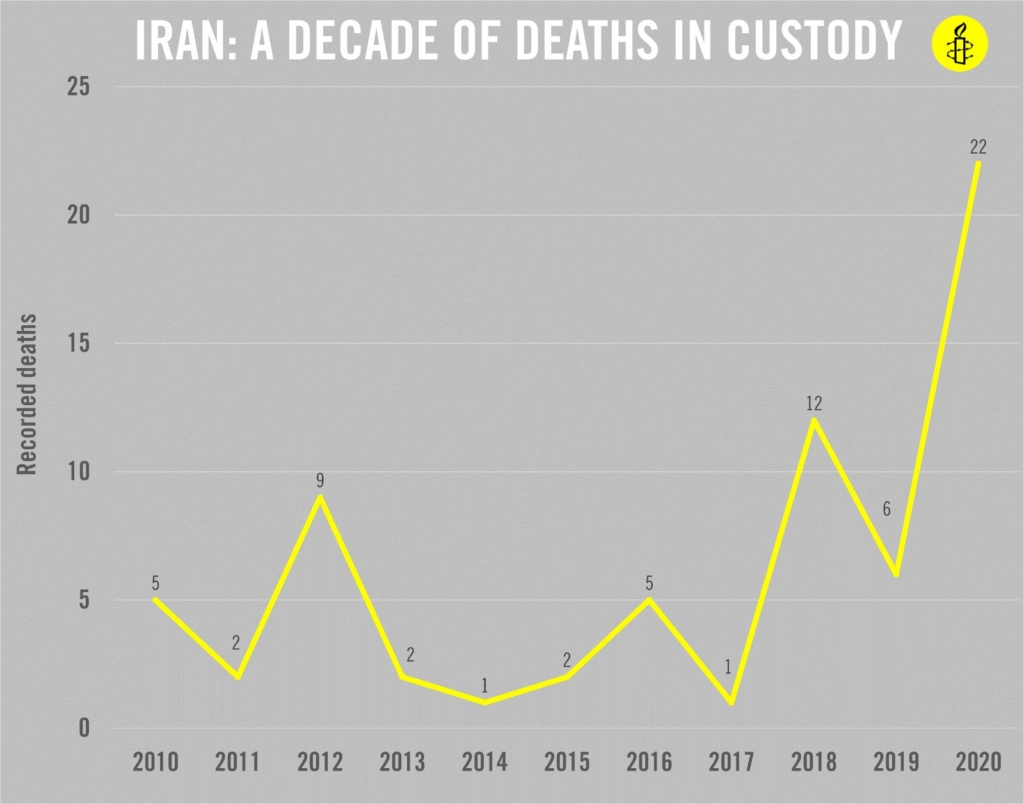
Iranian authorities have failed to provide accountability for at least 72 deaths in custody since January 2010, despite credible reports that they resulted from torture or other ill-treatment or the lethal use of firearms and tear gas by officials, said Amnesty International following yesterday’s reports of yet another suspicious death in custody.  

The findings, which are based on Amnesty International’s long-term research and a comprehensive review of reporting by credible human rights groups and media outlets, reveal that since January 2010, at least 72 deaths occurred at 42 prisons and detention centres in 16 provinces across the country. The latest documented case concerns Yaser Mangouri, aged 31, whose death was reported to his family by ministry of intelligence officials in Urumieh, West Azerbaijan province on 8 September 2021. Not a single official has since been held to account for these deaths, reflecting Iran’s long-standing crisis of impunity where allegations of torture and unlawful killings consistently go uninvestigated and unpunished. Only a few weeks ago, leaked video footage from the infamous Evin prison offered disturbing evidence of beatings, sexual harassment, and other ill-treatment of prisoners by prison officials.

“Yesterday’s reports of the death of Yaser Mangouri in suspicious circumstances further exposes how the prevailing climate of impunity further emboldens security forces to violate prisoners’ right to life without any fear of consequence or accountability. The authorities’ systemic refusal to conduct any independent investigations into these deaths in custody is a grim reflection of the normalisation of the arbitrary deprivation of life by state authorities,” said Heba Morayef, Middle East and North Africa Regional Director at Amnesty International.

“Ensuring respect for people’s right to life requires that officials suspected of torturing prisoners to death are criminally investigated, and if enough admissible evidence against them is found, prosecuted. Lack of investigations constitutes in and of itself a violation of the right to life.”

In 46 of the deaths in custody cases, informed sources including the relatives and/or fellow inmates of the deceased reported that the death resulted from physical torture or other ill-treatment at the hands of intelligence and security agents or prison officials. A further 15 followed the lethal use of firearms and/or tear gas by prison security guards to suppress prison protests over Covid-19 safety fears, according to credible sources. In the remaining 11 cases, the deaths occurred in suspicious circumstances, but no further details about potential causes were available. The majority of deaths recorded took place since 2015.

Amnesty International has issued a list of the names of those who have died in custody along with their reported age and the date and location of death. The list excludes dozens of cases of deaths in custody with suspected links to the denial of medical care, which the organization is in the process of investigating.

In 31 cases, Amnesty International documented the deaths in custody, including by speaking directly to primary sources impacted by the deaths, such as relatives, fellow inmates and acquaintances. In 41 other cases, it recorded the deaths based on the reporting of credible media outlets and trusted human rights groups working with informed sources on the ground.

Amnesty International believes that the real number of deaths in custody is likely much higher given the lack of transparency in Iran’s justice system and the fact that many human rights violations go unreported due to widespread fear of reprisal and systematic repression of civil society.

Deaths early on in custody

Of the 46 deaths in custody involving reports of physical torture or other ill-treatment, at least 36 took place during the preliminary investigation stage. The majority (28) died in custody within a few days of their arrest and detention. One died immediately after arrest and before even being transferred to a detention centre.

According to information compiled by Amnesty International, at least nine people died in facilities run by the investigation unit of Iran’s police (Agahi), 11 in facilities run by the ministry of intelligence, two in facilities run by regular city police, two in facilities run by border or immigration guards, and one person each in facilities run by Iran’s Cyber Police (FATA) and the Revolutionary Guards, respectively.

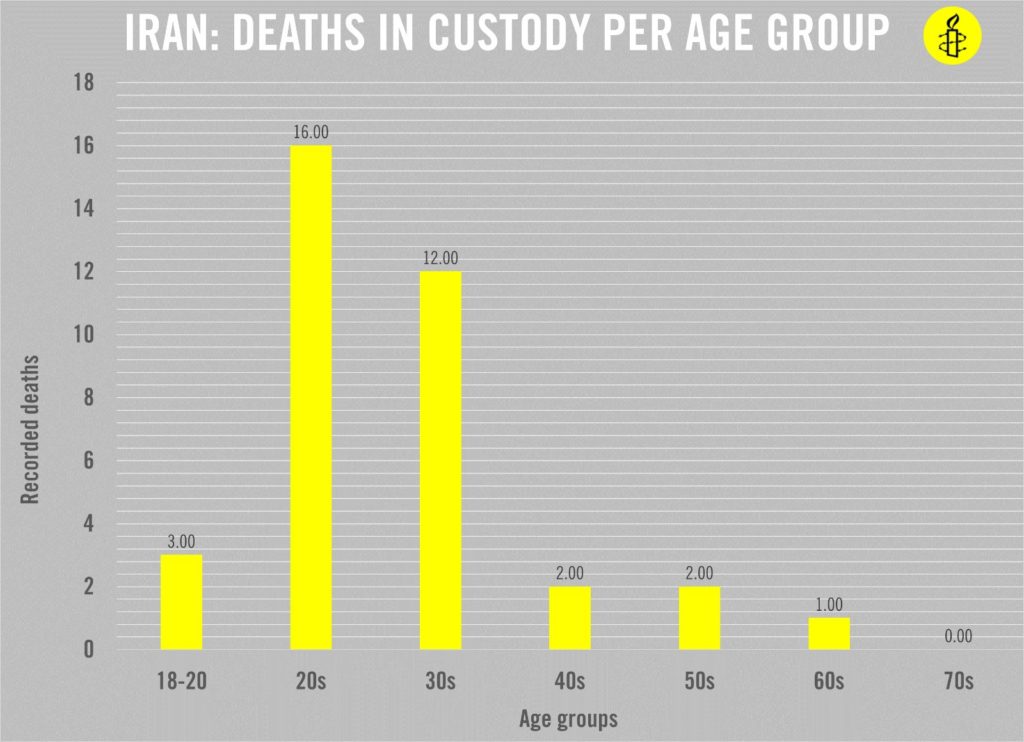
For 36 of the 46 alleged victims, information about their exact or approximate age was available. According to this information, 16 were in their twenties, 12 in their thirties, and three between 18 and 20 years of age, which means, based on known age, younger people constitute 86% of the deceased.

State denials and cover up

Iranian authorities typically blame deaths in custody on suicide, drug overdose or illness in a rushed manner and without conducting any independent and transparent investigations. 

Amnesty International has found that in at least 24 of the 46 cases of deaths in custody involving reports of physical torture or other ill-treatment, the authorities announced shortly thereafter that the deaths were the result of suicide (7), strokes, heart attacks or other illnesses (12), drug overdose (3) or exchange of fire during arrest (2). Similarly, in three of the 11 deaths reported as suspicious, the authorities claimed that suicide (1), drug use (1) or illness (1) were the cause of death.

Years of documentation and monitoring by Amnesty International shows that family members of people who die in custody in suspicious circumstances are routinely subjected to various forms of harassment and intimidation by intelligence and security officers, particularly when publicly disputing the authorities’ claims about the circumstances surrounding the deaths of their loved ones or seeking legal redress. Lawyers have also received threats for pursuing legal action or even faced persecution and imprisonment. Iranian authorities also have a documented track-record of pressuring families to bury their loved ones immediately and without an independent autopsy.

Amnesty International shares the serious concerns of the UN Special Rapporteur on Iran regarding “the absence of domestic remedies … for gross human rights violations in the Islamic Republic of Iran” and echoes the latest call in his July 2021 report on the international community to fulfil its “important role in ensuring accountability.”

Amnesty International together with nine other human rights organizations have urged member states of the UN Human Rights Council to establish an investigative and accountability mechanism to collect, preserve and analyse evidence of the most serious crimes under international law committed in Iran to facilitate fair criminal proceedings.

Background

Yaser Mangouri was arrested and forcibly disappeared by ministry of intelligence officials in Urumieh, West Azerbaijan province on 17 July 2021, according to the human rights group Hengaw. On 8 September 2021, the ministry of intelligence in Urumieh informed his family that he had died due to exchange of fire during arrest. His family rejects this explanation and maintains that he was arrested shortly after leaving his house while unarmed. As of 14 September 2021, when the news of his death in custody was publicized, the authorities had refused to return his body to his family. 

Amnesty International has previously documented how Iranian security and intelligence officials routinely subject men, women and children behind bars to torture or other ill-treatment, including floggings, suspension, electric shocks, mock executions, force-feeding of chemical substances, and deliberate deprivation of medical care.

The post Iran: A decade of deaths in custody unpunished amid systemic impunity for torture appeared first on Amnesty International.

Afghanistan: Continued presence of UN mission essential to monitor and report on abuses

The United Nations Security Council (UNSC) must extend the UN’s mission in Afghanistan (UNAMA), and the UN must supply the staff and resources it needs to monitor, investigate, and report on human rights abuses on the ground in the country, said Amnesty International, ahead of a 17 September vote on renewing the mission’s mandate, which is due to expire that day.

Present in the country since 2002, UNAMA’s responsibilities include a pivotal role in monitoring the country’s human rights situation and providing oversight through the Office of the High Commissioner for Human Rights (OHCHR).

“The Taliban takeover poses grave risks to vulnerable groups, especially journalists, ethnic minorities, women and girls, and those who worked with the former government, foreign states, and contractors,” said Lawrence Moss, Senior Advocate for Amnesty International at the UN.

It is essential that UN human rights monitors remain on the ground and show support for the rights of Afghans at this perilous time

Lawrence Moss, Senior Advocate for Amnesty International at the UN

“It is essential that UN human rights monitors remain on the ground and show support for the rights of Afghans at this perilous time.”

In a resolution adopted on 30 August, the UNSC called on the Taliban to:

  • Uphold human rights, including those of women, children, and minorities
  • Ensure the full, equal, and meaningful participation of women in an inclusive political settlement
  • Adhere to the rule of law
  • Allow Afghans to travel abroad, leave Afghanistan anytime they want to, and to exit Afghanistan via any border crossing, both air and ground
  • Respect international humanitarian law, including protection of civilians

“To enforce its own expectations, the Security Council urgently needs the immediate monitoring and reporting function provided by the very mission it established,” said Lawrence Moss. “UNAMA should brief the Council at least monthly on the human rights situation in Afghanistan.”

Amnesty International further calls on the United Nations to supply the additional staff and resources necessary for UNAMA to amplify its human rights monitoring. UNAMA’s international human rights staff are now out of the country, primarily in Almaty, Kazakhstan, and the work of its domestic human rights staff is greatly limited by fear of reprisals.  The UN has allowed humanitarian and political staff to remain in Afghanistan, but not its human rights monitors. 

“The UN should show support for the people of Afghanistan by returning international human rights monitors to the country, subject to the same security protocols as for humanitarian staff, and the UNSC should demand the Taliban respect the work of the UN’s domestic human rights staff and refrain from any reprisals,” said Lawrence Moss.

Panjshir Valley reports underscore need for human rights monitoring

Alarming reports are emerging from the Panjshir Valley, where fighting between the Taliban and resistance fighters is ongoing. BBC Persian has shared a video which claims to show a wilful killing in the area, while the BBC has further reported that the Taliban have killed civilians. According to sources interviewed by Amnesty International on Sunday 12 September, the Taliban have also been blockading food and essential supplies from entering the region.

An increasingly dire picture is emerging from the Panjshir Valley

Lawrence Moss

“An increasingly dire picture is emerging from the Panjshir Valley. This deeply disturbing footage and reports of other human rights abuses in the region underscore the immediate need for the international community to guarantee effective oversight of what’s happening in Afghanistan,” said Lawrence Moss.

Background

UNAMA’s mandate is reviewed on an annual basis by the UN Security Council – for further information, see here. For further information about its human rights work, see here.

Amnesty International is also calling on the UN Human Rights Council (UNHRC) to establish a complementary Fact-Finding Mission or similar independent investigative mechanism for Afghanistan. A special session of the UNHRC in Geneva in August failed to authorize such a mechanism, and Amnesty International has joined more than 50 national, regional, and international organizations to urge UN member states to do so at its 48th regular session, which runs from 13 September – 8 October 2021. 

The post Afghanistan: Continued presence of UN mission essential to monitor and report on abuses appeared first on Amnesty International.
Global: Facebook giving powerful users free rein to harass others, make false claims, and incite violence

Internal documents obtained by the Wall Street Journal reportedly show that Facebook is using a system that exempts high-profile users from some or all of the platform’s terms of use. Responding to the reports, Agnès Callamard, Secretary General of Amnesty International, said:  

“These shocking allegations show, once again, how Facebook’s platform fuels the spread of harmful and abusive content globally.  

“Facebook claims it ‘does not profit from hate’. Yet according to company documents provided by an anonymous whistleblower, it has created a system that gives powerful users free rein to harass others, make false claims, and incite violence. 

“The message from Facebook is clear – if you’re influential enough, they’ll let you get away with anything.  

“The fact these internal documents seem to contradict the assurances that Facebook has made publicly also calls into question how much we can trust the company and what they tell us. 

“Ultimately, we need to fix the root cause of this problem: Facebook’s surveillance advertising business model, that relies on aggressive data harvesting and profiling on a vast scale. Facebook’s algorithms amplify misinformation and divisive content and fuel racism, because such content is most likely to keep us engaged for longer and increase their advertising revenues. 

“Urgent government regulation is needed to ensure the online world is one in which human rights are effectively protected. These disclosures underscore the fact that we simply cannot rely on companies to self-regulate.” 

Background 

Facebook’s programme of “Cross-check”, or “X-check”, was intended to provide an additional layer of internal review before Facebook made enforcement decisions on high-profile accounts. 

However, the Wall Street Journal has obtained documents from a whistle blower that suggest Facebook did not follow through with these reviews. This is reportedly because Facebook used X-Check to “white-list” high profile users and make them immune from any punitive action if and when they violated the platform’s terms of use, including harassment or incitement to violence. 

Facebook responded to the newspaper, saying: “We remove content from Facebook, no matter who posts it, when it breaks our standards.” 

The post Global: Facebook giving powerful users free rein to harass others, make false claims, and incite violence appeared first on Amnesty International.