Cuba: The State represses women human rights defenders

The Cuban government must put an end to institutional gender-based violence against women human rights defenders, journalists, and activists, Amnesty International said today as it launched its new report “They Want Us Silent, But We Keep Resisting: Authoritarian Practices and State Violence Against Women in Cuba.”

Amnesty International is calling on the Cuban authorities to end authoritarian practices and state gender-based violence against women human rights defenders. The report reveals that the Cuban state has implemented a systematic pattern of repression targeting women engaged in activism, journalism, and human rights defence. Such practices include arbitrary detention, unlawful surveillance, unjust criminalisation, enforced disappearance, and other forms of institutional violence — all within an environment marked by impunity for human rights violations and a lack of judicial safeguards.

“Women defenders in Cuba are punished not only for speaking out, but also for being mothers, journalists, and community leaders,” said Ana Piquer, Amnesty International’s Regional Director for the Americas. “The state wields gender-based violence as a tool of repression — seeking to break their dignity, their families, and their collective strength,” she added.

“The state wields gender-based violence as a tool of repression — seeking to break their dignity, their families, and their collective strength,”.

Ana Piquer, Amnesty International’s Regional Director for the Americas.

State Violence Rooted in Gender

Covering incidents between 2014 and 2025, the report finds that beyond authoritarian control, women are subjected to specific forms of repression by state agents that constitute gender-based state violence. These include forced nudity and invasive body searches, gendered, age-based and homophobic stigmatisation, and the use of motherhood, caregiving roles, and threats against relatives as mechanisms of intimidation and control.

One defender told Amnesty International:

“The treatment I’ve received has been harsher because I’m a woman and a mother. They threaten me through my children, shout at me in public, and try to weaponise guilt. It’s a deliberate cruelty towards women who dare to speak up.”

“The treatment I’ve received has been harsher because I’m a woman and a mother. They threaten me through my children, shout at me in public, and try to weaponise guilt. It’s a deliberate cruelty towards women who dare to speak up.”

Another recounted how a state agent assaulted her during detention and subjected her to sexualised comments:

“The disgust I felt is indescribable.”

The report features testimonies from women such as Yenisey Taboada, mother of a political prisoner; Luz Escobar, an independent journalist; and María Matienzo, a human rights defender — all illustrating how physical, digital, and psychological harassment has become a tool to silence Cuban women.

This pattern of violence is neither isolated nor accidental; it is structural and sustained. Black women, single mothers, and women of diverse sexual orientations face heightened risks, demanding an urgent intersectional response. These abuses occur in a context of deep restrictions on human rights work, where the subordination of the judiciary to political power, the lack of reporting and redress mechanisms, and the absence of a comprehensive law against gender-based violence perpetuate impunity.

A Call for International Action

Amnesty International warns that this repression does not occur in a vacuum. The absence of strong international condemnation has allowed the Cuban state to continue its policy of control and repression with impunity.

“The international community can no longer remain silent in the face of the gendered repression suffered by women in Cuba,” Piquer stressed. “It is time for states — particularly those that have long championed human rights in Cuba, such as the inter-American bodies and the European Union and its member states — — to demand concrete protection measures. The state’s repression of women activists and defenders in Cuba constitutes a form of institutional gender-based violence that must be exposed and publicly condemned.” — to demand concrete protection measures. The state’s repression of women activists and defenders in Cuba constitutes a form of institutional gender-based violence that must be exposed and publicly condemned.”

The state’s repression of women activists and defenders in Cuba constitutes a form of institutional gender-based violence that must be exposed and publicly condemned.”

Ana Piquer, Amnesty International’s Regional Director for the Americas.

Amnesty International is demanding an immediate end to institutional gender-based violence against women defenders, journalists, and activists in Cuba — violations that manifest through harassment, arbitrary detention, and enforced disappearance, among others. The organisation is also urging the adoption of a comprehensive law on gender-based violence, including specific protections for women human rights defenders, and calling for a sustained international commitment to monitor the situation of women defenders in the country.

Launch of a Global Petition

In response to these findings, Amnesty International is today launching a global petition inviting people worldwide to urge President Miguel Díaz-Canel and the Cuban authorities to end the harassment and urgently adopt a comprehensive law on gender-based violence.

Each signature collected will amplify the voices of women defenders — strengthening international pressure and demonstrating that they are not alone.

For more information or to arrange an interview, please contact press@amnesty.org

The post Cuba: The State represses women human rights defenders appeared first on Amnesty International.

Tunisia: Conviction of human rights defenders confirms criminalization of civil society work

Responding to news that the Tunis Court of First Instance convicted human rights defenders Mustapha Djemali and Abderrazek Krimi yesterday evening, and released them due to the time already served after they have spent more than 18 months in arbitrary detention, Deputy Regional Director for the Middle East and North Africa, Sara Hashash said: 

“Their release is a huge relief for families who will be celebrating being reunited with their loved ones after more than 18 months in arbitrary detention. However, it is still outrageous that Mustapha Djemali and Abderrazek Krimi have been detained and now convicted for their humanitarian work for the Tunisian Council for Refugees. These two human rights defenders and humanitarian workers have been arbitrarily detained and subjected to a bogus criminal investigation, simply for doing their jobs. Their organization was carrying out essential work assisting refugees and asylum seekers in partnership with the UN Refugee Agency (UNHCR) and the Tunisian authorities.

These two human rights defenders and humanitarian workers have been arbitrarily detained and subjected to a bogus criminal investigation, simply for doing their jobs.

Sara Hashash, Deputy Regional Director for MENA

“Mustapha Djemali, 81, and Abderrazek Krimi, 61, should never have been investigated, let alone prosecuted. Providing shelter and assistance to people at risk is a human rights imperative. The charges against them, including ‘forming an organization’ to ‘assist the clandestine entry’ of migrants, are a misuse of anti-smuggling laws to stifle civic space. This verdict sends a chilling message to human rights defenders and organizations working in Tunisia, suggesting that they risk arrest and imprisonment for fulfilling their mandate.

“This case is a stark example of the wider crackdown by Tunisian authorities on civil society and the rights of refugees and migrants, marked by arbitrary arrests, racially discriminatory practices, and xenophobic rhetoric. The authorities must quash the conviction.

“The Tunisian government must respect its obligations under international law, including the rights to freedom of association and expression. Instead of criminalizing human rights defenders, the authorities must enable them to carry out their vital work free from any fear of reprisal, arrest or prosecution.”

Background

Mustapha Djemali and Abderrazek Krimi are respectively the founder and project manager of the Tunisian Council for Refugees (CTR), a Tunisian NGO which worked with the UNHCR and Tunisian authorities to pre-register asylum seekers and provide essential assistance to those in precarious situations. Police arrested them in Tunis on 3 and 4 May 2024.

On 24 November, the Tunis Court of First Instance sentenced them to two years in prison, while suspending the remainder of their sentence after taking into account the 18 months in pre-trial detention already served. They were released last night. The court acquitted the three other CTR staff also on trial. A fourth employee had his appealed his indictment and is not being tried yet. Tunisian authorities have increasingly escalated their crackdown on human rights defenders and independent non-governmental organizations (NGOs) through arbitrary arrests, detention, asset freezes, bank restrictions and court-ordered suspensions. 

The post Tunisia: Conviction of human rights defenders confirms criminalization of civil society work appeared first on Amnesty International.

Sudan: El Fasher survivors tell of deliberate RSF killings and sexual violence – new testimony

  • 28 survivors tell of killings, beatings, rape and sexual assault
  • RSF fighters responsible for attacks on civilians must be held accountable
  • United Arab Emirates’ support for the RSF responsible for facilitating violence

Survivors who escaped El Fasher in Sudan’s North Darfur State have detailed to Amnesty International how fighters with the Rapid Support Forces (RSF) executed scores of unarmed men and raped dozens of women and girls as they captured the city.

Amnesty International researchers interviewed survivors who described witnessing groups of men shot or beaten, and taken hostages for ransom. Female survivors described how they were subjected to sexual violence by RSF fighters, as were some of their daughters. Many interviewees described seeing hundreds of dead bodies left lying in El Fasher’s streets and on the main roads out of the city.

The harrowing testimonies are some of the first from eyewitnesses who fled El Fasher after the fall of the city. Amnesty International interviewed 28 survivors who managed to reach safety in the towns of Tawila, to the west of El Fasher, and Tina, on the border with Chad, after fleeing as the RSF surrounded and then entered El Fasher on 26 October. Three interviews were conducted in-person in Chad, and the rest remotely by mobile devices.

“The world must not look away as more details emerge about the RSF’s brutal attack on El Fasher. The survivors we interviewed told of the unimaginable horrors they faced as they escaped the city,” said Agnès Callamard, Amnesty International’s Secretary General.

This persistent, widespread violence against civilians constitutes war crimes and may also constitute other crimes under international law

Agnès Callamard, Amnesty International’s Secretary General

“In the coming weeks, more evidence will emerge of the violence committed by RSF fighters in El Fasher. This persistent, widespread violence against civilians constitutes war crimes and may also constitute other crimes under international law. All those responsible must be held accountable for their actions.

“These atrocities were facilitated by the United Arab Emirates’ support for the RSF. The UAE’s ongoing backing of the RSF is fuelling the relentless cycle of violence against civilians in Sudan. The international community and the UN Security Council must demand that the UAE disengages from supporting the RSF.

“It is imperative that the UN Human Rights Council’s Sudan Fact-Finding Mission has the resources required to meaningfully fulfil its mandate, and to investigate violations and abuses in Sudan, including those taking place in El Fasher. The UN Security Council, which had referred the situation in Darfur to the International Criminal Court, must now imperatively extend the referral to the rest of Sudan.

“Amnesty International also urges all external actors to take necessary measures to end the sale or supply of arms and related materials to all parties to the conflict, as per the arms embargo established by the UN Security Council; an embargo which must be extended to the whole country.”

Amnesty International is also calling on the international and regional actors – including the UAE, Saudi Arabia, the UN Security Council, the EU and its member states, the African Union, the Intergovernmental Authority on Development, the United Kingdom, United States, Russia, China – to put urgent diplomatic pressure on the RSF leadership to end their attacks on civilians including sexual violence against women and girls.

“As the conflict continues, the survivors’ stories provide further proof of the failure of the international community in Sudan. It must step up efforts to ensure accountability, protect those at risk, and demand that all states that are either directly backing or enabling the RSF change course immediately,” said Agnès Callamard.

“The RSF were killing people as if they were flies”

On 26 October, the day El Fasher fell, an estimated 260,000 civilians were still trapped in the city. Ahmed*, 21, attempted to escape with his wife, two young children and his older brother by following a group of Sudanese Armed Forces (SAF) soldiers who had abandoned their posts.

After his wife was killed by shrapnel from a nearby explosion and he became separated from his children, Ahmed* was forced to continue moving north with his brother. Along the way they picked up two girls, aged three and four, whose parents had apparently been killed. When the group reached Golo, on the outskirts of the city, together with three other men and an older woman, they were ambushed by RSF fighters.

Ahmed* said: “They asked us, ‘Are you soldiers, or are you civilians?’, and we told them we are civilians. They said, ‘In El Fasher, there are no civilians, everybody is a soldier’.” The RSF fighters then ordered his brother and the other three men to lie down. He said: “When they lied down, they executed them.”

The fighters let Ahmed*, the two young girls and the older woman go, for reasons that remain unclear to them. Three days later, Ahmed* reached Tawila, approximately 60km away, with the two girls. However, the older woman died on the journey, likely from dehydration.

Sudanese refugees ride donkeys on the road between the lake and Oure Cassoni camp in Chad, on November 14, 2025. (Photo by Joris Bolomey / AFP) (Photo by JORIS BOLOMEY/AFP via Getty Images)

Daoud*, 19, fled El Fasher with seven neighbourhood friends. He said they all were killed after RSF fighters captured them at the berm that surrounded the city: “They shot at us from all directions… I watched my friends die in front of me.”

Khalil*, 34, escaped El Fasher on 27 October. He described how after initially managing to get past the berm, he and approximately 20 others were soon caught by RSF fighters in cars: “The RSF fighters… asked us to lie down on the ground… Two RSF fighters opened fire on us… They killed 17 of the 20 men I was fleeing with.”

Khalil* said he only survived after pretending to be dead: “The RSF were killing people as if they were flies. It was a massacre. None of the people killed that I have seen were armed soldiers.”

“They were enjoying it, they were laughing”

Badr*, 26, had remained in El Fasher until 26 October with his uncle, who had been recovering in the Saudi Hospital from a gunshot wound to the leg. On 27 October, he organized a donkey cart to transport his uncle, two other older patients and their relatives out of the city at around 1am. When they reached the village of Shagara, approximately 20km west of El Fasher, they were encircled by RSF vehicles.

Badr* told Amnesty International that RSF fighters bound their hands and told the younger, uninjured men to get into the back of their pickup truck. They demanded that the three older men, all aged over 50 and suffering from serious injuries, also get in.

Badr* said: “They could see that these people are elderly, that they will need to be picked up and put in the pickup… They thought that they were wasting their time… One of them who had an automatic machine gun, he got down [from the truck] and… opened fire. He killed them, and then he killed the donkeys… They were enjoying it, they were laughing.”

Badr* was then blindfolded and taken along with five other remaining captives to a nearby village. After three days they were moved to another location about a four-hour drive away. Badr* was allowed to call his relatives, and the RSF demanded they pay more than 20 million Sudanese pounds (approximately $8,880 USD) for his release.

Whilst captive, Badr* witnessed an RSF soldier filming the execution of one man during a call with relatives. The man was one of three detained brothers whose family had not yet paid a ransom for their release. Badr* said: “They shot one in the head on camera, and told them [his relatives]: ‘Look, if you don’t send the money as soon as possible, the other two will be killed and you won’t even be told that they have been killed’.”

Sexual violence against women and girls

Ibtisam* left the Abu Shouk neighbourhood of El Fasher with her five children on the morning of 27 October. Along with a group of neighbours, they headed west towards Golo, where they were stopped by three RSF fighters.

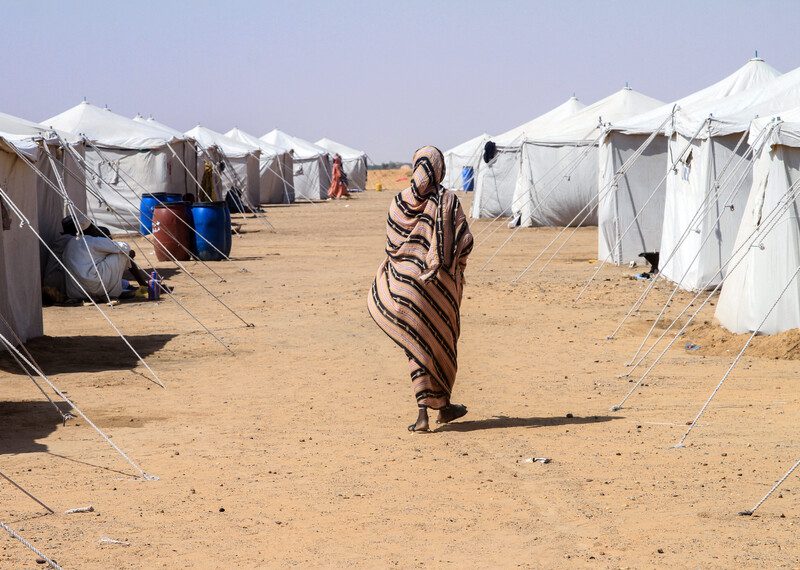
A Sudanese woman who fled El-Fasher walks past tents at a camp for displaced people in the northern town of Al-Dabba on November 13, 2025. (Photo by AFP via Getty Images)

Ibtisam* said: “One of them forced me to go with them, cut my Jalabiya [a traditional robe], and raped me. When they left, my 14-year-old daughter came to me. I found that her clothes had blood and were cut into pieces. Her hair at the back of her head was full of dust.”

Ibtisam* told Amnesty International that her daughter remained silent for the next few hours until she saw her mother crying: “She came to me and said, ‘Mum, they raped me too, but do not tell anyone.’ After the rape, my daughter really became sick… When we reached Tawila, her health deteriorated, and she died at the clinic.”

She came to me and said, ‘Mum, they raped me too, but do not tell anyone’

Ibtisam*, a survivor who escaped El Fasher

Khaltoum*, 29, attempted to escape El Fasher in the afternoon of 26 October with her 12-year-old daughter. Together with more than 150 others, they reached the “Babul Amal” gate on the western side of the city. They were stopped by RSF fighters who separated the men from the women, and killed five men.

Khaltoum* was then taken with her daughter and around 20 other women to Zamzam internally displaced camp – more than 10km away – on foot. There, RSF fighters separated the younger women and told them to queue to be searched.

Khaltoum* told Amnesty International: “They selected about eleven of us… I was taken to a Rakuba [makeshift shelter], and an armed RSF fighter and another who was not armed accompanied me. They searched me and then the unarmed man raped me while the other one watched. He kept me there the whole day. He raped me three times. My daughter was not raped, but the other 10 women they selected for the search were all raped.”

Background

The ongoing conflict between the RSF and the SAF in Sudan began in April 2023. It has killed tens of thousands of people and displaced over 12 million, making it the world’s largest humanitarian crisis.

Amnesty International has documented war crimes by the RSF and allied Arab militias where they jointly carried out ethnically targeted attacks against the Masalit and other non-Arab communities in West Darfur. The organization has also documented widespread sexual violence by the RSF across the country that amounted to war crimes and possible crimes against humanity.

Amnesty International has also previously documented how the conflict in Sudan is being fuelled by a constant flow of weapons into the country, in flagrant breach of the existing arms embargo on Darfur, with the UAE in particular supplying weapons and ammunition to the RSF.

The post Sudan: El Fasher survivors tell of deliberate RSF killings and sexual violence – new testimony appeared first on Amnesty International.

Global: How human rights defenders can pushback against their criminalization

To counter the increasing criminalization of human rights defenders, activists and journalists across the world, Amnesty International, the African Policing Civilian Oversight Forum (APCOF) and Suara Rakyat Malaysia (SUARAM) will publish a briefing on 27 November, outlining a series of legal and advocacy strategies to protect critical voices from discrimination, harassment, prosecution and imprisonment.

The briefing, “Dissent on Trial: Strategies to Counter Rising Criminalization of Activism”— developed in the context of the Campaign to Decriminalize Poverty, Status and Activism — documents the alarming global trend of punishing civil disobedience and peaceful activism by using national security and organized crime laws, defamation laws and Strategic Lawsuits against Public Participation (SLAPPs).  It also provides concrete strategies to resist and counter criminalization at different stages of the legal process – before charges are pressed; during criminal proceedings; and at the sentencing stage.

It’s increasingly important also to build on and amplify specific strategies that could protect human rights defenders facing trials

“Human rights defenders from across are world are facing threats and imprisonment just for speaking out against the climate crisis, the genocide in Gaza or homophobia and transphobia. Our work has long focused on repealing problematic laws that are abused by governments. However, it’s increasingly important also to build on and amplify specific strategies that could protect defenders facing trials,” said Marco Perolini, Amnesty International’s policy expert on the criminalization of dissent.

“Dissent on Trial highlights how specific arguments such as the necessity defence, freedom of expression, and the right to a healthy environment can be successfully used in courts to protect individuals who engage in civil disobedience from harsh criminal sanctions.”

The briefing features stories of human rights defenders from around the world, including Argentina, Australia, Belgium, Canada, Chile, Colombia, France, Indonesia, Peru, South Africa, Thailand, the United Kingdom, and the United States.

Grégoire is an environmental defender who was arrested and prosecuted for spraying washable orange paint on the Prefecture of Nantes in France, to demand policies to address the use of poor insulation in buildings. Grégoire, who was eventually acquitted, but is currently being prosecuted for another act of civil disobedience, said:

“It’s important to develop legal tools to protect activists who mobilize at the height of the climate emergency. An environmental state of necessity could be one such tool.”

To mark the launch of the briefing, Amnesty International will host a webinar on 27 November, from Johannesburg, at 16:00 SAT. The panel will feature Marco Perolini from Amnesty International, Sithuthukile Mkhize, senior attorney from Centre for Applied Legal Studies, Louise Edwards, director of research and programmes at the African Policing Civilian Oversight Forum, as well as Grégoire. The event will be hosted by the Centre for Applied Legal Studies at Witts University.

To join the webinar, please sign up here:

In person (Johannesburg): https://forms.gle/376Gxgw9i8x5ex19A;

Online: https://forms.gle/QT5PARkQJmREcDRd9

The post Global: How human rights defenders can pushback against their criminalization appeared first on Amnesty International.