Kazakhstan: Four activists’ mobile devices infected with Pegasus Spyware

Amnesty International’s Security Lab has confirmed that at least four Kazakhstani civil society activists have had their mobile devices infected with NSO Group’s Pegasus spyware. A forensic analysis shows that all four activists had been targeted and their devices infected from as early as June 2021, Amnesty International said today.

“This case adds to an already mounting pile of evidence that NSO’s spyware is the weapon of choice for governments seeking to silence social movements and crush dissent. States across the globe must immediately implement a moratorium on the export, sale and use of surveillance equipment until a human rights-compliant regulatory framework is in place,” Marie Struthers, Amnesty International’s Director for Eastern Europe and Central Asia, said.

This case adds to an already mounting pile of evidence that NSO’s spyware is the weapon of choice for governments seeking to silence social movements and crush dissent

Marie Struthers, Amnesty International’s Director for Eastern Europe and Central Asia

Amnesty International’s Security Lab conducted forensic analysis on the phones of nine Kazakhstani human rights activists. Amnesty International was able to confirm that four individuals’ devices were infected with the Pegasus spyware. Three of the victims, Tamina Ospanova, Dimash Alzhanov and Aizat Abilseit, had previously received a “state-sponsored attacker” warning from Apple on 24 November. Apple sent these notifications to individuals they believed may have been targeted by NSO Group’s Pegasus spyware. The fourth victim, Darkhan Sharipov, did not receive this notification, which suggests that the notified individuals represent only a fraction of the human rights activists targeted with the Pegasus spyware in Kazakhstan.

All of the victims belong to the civic youth movement “Oyan, Qazaqstan” (Wake Up, Kazakhstan). The victims are friends of Temirlan Ensebek, whose satirical blogging on Instagram is under criminal investigation.

The mobile devices of all four activists were infected with the spyware between 3 and 5 June 2021. On 5 June, “Oyan, Qazaqstan” was hosting one of their public #Seruen events where activists could meet face-to-face in public spaces. The surveillance campaign continued until at least July 2021. 

“The unlawful hacking of these activists not only violates their right to privacy, but also their right to freedom of expression and association. The Kazakhstani authorities must immediately conduct a thorough and transparent investigation into this intrusion and bring those responsible for unlawful surveillance of activists to account,” said Marie Struthers.

The Kazakhstani authorities must immediately conduct a thorough and transparent investigation into this intrusion and bring those responsible for unlawful surveillance of activists to account

Marie Struthers, Amnesty International’s Director for Eastern Europe and Central Asia

Background

NSO Group’s spyware has been used to facilitate human rights violations around the world on a massive scale, according to a major investigation into the leak of 50,000 phone numbers of potential surveillance targets. These include heads of state, activists and journalists. According to media reports, nearly 2,000 phone numbers are from Kazakhstan.

The Pegasus Project is a ground-breaking collaboration by more than 80 journalists from 17 media organizations in 10 countries, coordinated by Forbidden Stories, a Paris-based media non-profit, with the technical support of Amnesty International, who conducted cutting- edge forensic tests on mobile phones to identify traces of the spyware.

“Oyan, Qazaqstan” (Wake up, Kazakhstan) is a grassroots civil society movement formed in June 2019 in response to the arrest of local activists Beybarys Tolymbekov and Asiya Tolesova. They were arrested for putting up a poster on Al-Farabi Avenue in Almaty during the 2019 marathon, which stated “You can’t escape the truth,” and included a call for fair presidential elections. “Oyan, Qazaqstan” demands greater civil rights and a parliamentary republic, and voices socially progressive positions in support of LGBTQI rights and gender equality.

The post Kazakhstan: Four activists’ mobile devices infected with Pegasus Spyware appeared first on Amnesty International.

Honduras: Amnesty International urges authorities to immediately release eight prisoners of conscience

José Daniel Márquez, Kelvin Alejandro Romero, José Abelino Cedillo, Porfirio Sorto Cedillo, Ewer Alexander Cedillo, Orbin Nahún Hernández, Arnol Javier Alemán and Jeremías Martínez Díaz, environmental defenders from the municipality of Tocoa in northern Honduras, known as the “Guapinol eight”,are prisoners of conscience who have been wrongfully imprisoned for more than two years solely for peacefully defending the right to clean water, Amnesty International said today. 

“Having reviewed all the evidence available, including the criminal proceedings against the Guapinol eight and videos related to the case, and spoken to witnesses as well as to the human rights community in Honduras, Amnesty International considers that they are being detained only because of their activities in defense of the right to clean water and a safe environment,” said Erika Guevara-Rosas, Americas director at Amnesty International.

The eight men are part of the Municipal Committee for the Defence of Common and Public Goods (Comité Municipal en Defensa de los Bienes Comunes y Públicos, CMDBCP), an organization that has mobilized communities in and around Tocoa since 2015 to peacefully challenge the legality of iron mining concessions granted to Inversiones Los Pinares (ILP), because they argue it affects the quality of the Guapinol and San Pedro river waters. The concessions are in the protected Montaña de Botaderos Carlos Escaleras National Park.   

The newly elected government of Xiomara Castro must send a clear message that the violence and criminalisation against human right defenders will not be tolerated any longer.

-Erika Guevara-Rosas, Americas director at Amnesty International

Seven of the CMDBCP members have been in pretrial detention since August 2019, accused of the crime of deprivation of liberty (privación ilegal de la libertad) and aggravated arson (incendio agravado), after they voluntarily handed themselves to judicial authorities to contest criminal charges against them arising from a protest encampment in 2018. The eighth man, Jeremias Martínez, has been detained on the same charges since November 2018.

After rigorous analysis, Amnesty International determined that the case file shows multiple flaws in the investigation, including what appears to be a lack of due diligence by the prosecutors to properly clarify the facts, conduct an impartial and independent investigation and provide concrete evidence that could link these men with the charges they are accused of. Instead, the authorities have handpicked these eight human rights and environmental defenders and actively contributed to building a narrative that the Guapinol eightare criminals, having misused the criminal justice system to keep them in pretrial detention as a way to hinder their activism. These irregularities coincide with a wider pattern of criminalization of environmental defenders that we have documented in the region for years.

In 2020, the UN Working Group on Arbitrary Detention found the detention of the human rights defenders to be arbitrary and called for their immediate release. Nevertheless, the Honduran authorities have refused to recognise the injustice inflicted on the men and their families, or to remedy the situation.

The Honduran authorities must urgently put an end to these unfair practices that jeopardise the right to defend human rights.

-Erika Guevara-Rosas, Americas director at Amnesty International

The trial of the Guapinol eight begins immediately after the presidential elections in Honduras.

“The newly elected government of Xiomara Castro must send a clear message that the violence and criminalisation against human right defenders will not be tolerated any longer. This context offers the opportunity to break this cycle of attacks against environmental and other human rights defenders. Amnesty International demands the immediate and unconditional release of these eight prisoners of conscience and calls on the Attorney General’s Office to drop the charges against them,” said Erika Guevara-Rosas.

“Unfortunately, in Honduras, those who speak out and protest to protect the environment face frequent threats and attacks, as in the murder of Berta Cáceres, or unjust criminalization, particularly where powerful vested economic interests are involved. The authorities continue to misuse the criminal justice system to silence and imprison human rights defenders. The Honduran authorities must urgently put an end to these unfair practices that jeopardise the right to defend human rights.”

More information

Amnesty International defines as prisoners of conscience people who are imprisoned or subjected to other restrictions on their liberty due to their religious, political or other beliefs, their ethnic origin, sex, colour, language, national or social origin, sexual orientation or gender identity, or other status, and that have not used violence or advocated violence and hatred.

In 2018, as construction work on the mining project began to impact the Guapinol and San Pedro rivers, local residents joined the CMDBCP to demand that national and local authorities respond to their concerns, filing legal actions and holding protests. As the authorities failed to respond, the CMDBCP established a protest encampment on the access road to the mines. The peaceful encampment lasted for 88 days, with local communities, church pastoral activists and other civil society organizations all participating. Negotiations were held with government officials, but in October 2018, the police and the military violently evicted those in the encampment.

The prosecution case against the eight defenders relates to a dispute that took place on 7 September 2018 near to a protest encampment, in which a ILP security staff reportedly shot one of the protesters and in response, protesters retained a contractor before handing him over to police. The shooting of the protester was never investigated, but the ILP reported the retention of the contractor and the burning of a rented car and two ILP shipping containers during the disturbances.

For more information or to arrange an interview, contact: duncan.tucker@amnesty.org

The post Honduras: Amnesty International urges authorities to immediately release eight prisoners of conscience appeared first on Amnesty International.

Hong Kong: Tiananmen vigil convictions an affront to human rights and international law

Responding to the convictions of three Hong Kong pro-democracy figures – Jimmy Lai, Gwyneth Ho and Chow Hang-tung – over their involvement in the city’s annual Tiananmen vigil on 4 June 2020, Amnesty International’s Deputy Secretary General Kyle Ward said: 

“The Hong Kong government has once again flouted international law by convicting activists simply for their involvement in a peaceful, socially distanced vigil for those killed by Chinese troops on 4 June 1989. 

“The authorities have deemed the vigil ‘unlawful’ because the police did not approve it, but peaceful assembly does not need government approval. These convictions merely underline the pattern of the Hong Kong authorities’ extreme efforts to exploit the law to press multiple trumped-up charges against prominent activists.  

“People should be free to peacefully mourn and remember the victims of the Tiananmen crackdown – and to prosecute people for doing so is an egregious attack on the rights to freedom of expression and assembly.” 

Background 

Jimmy Lai and Chow Hang-tung were today convicted of inciting others to take part in the “unauthorized” Tiananmen crackdown vigil in Hong Kong’s Victoria Park on 4 June 2020. Chow Hang-tung was also found guilty of taking part in an “unauthorized” assembly, while Gwyneth Ho was convicted of taking part in an “unauthorized” assembly. 

Several who pleaded guilty to charges of participating in an “unauthorized assembly” have already been sentenced to up to 10 months in prison. 

Like many other prominent political activists in Hong Kong, Lai, Chow and Ho are facing multiple charges – some that could bring potential life imprisonment under the territory’s national security law. They are currently held in prolonged pre-trial detention without bail. 

Jimmy Lai, founder of defunct newspaper Apple Daily, has been held in pre-trial detention for nearly a year and is the subject of a string of prosecutions. 

He was arrested in August 2020 for colluding with foreign forces, sedition, and fraud. In April 2021, he was sentenced to 14 months’ imprisonment for organizing and joining illegal assemblies on 18 and 31 August 2019.  

The same month, he was additionally charged with colluding with foreign forces and conspiracy to obstruct the course of justice. In May 2021, he was sentenced to a further 14 months’ imprisonment for organizing an unauthorized assembly on 1 October 2019.  

Chow Hang-tung is a former leader of the Hong Kong Alliance in Support of Patriotic Democratic Movements of China (the Alliance), which disbanded after authorities used the annual Tiananmen candlelight vigil it has organized for 30 years as evidence of the group “endangering national security”. 

In September 2021, she was charged with “inciting subversion of state power” under the national security law, along with two other [former] Alliance leaders. In the same month, Chow was also charged under the national security law with three former leaders of the Alliance after they refused to comply with the authorities’ request to submit information about the Alliance’s members, staff and partner organizations. She was also arrested in June 2021 for “advertising or publicizing unauthorized assembly” after she posted on social media asking people to individually commemorate the Tiananmen crackdown that year as the public vigil was banned again.  

Gwyneth Ho, a journalist turned activist, is one of 47 opposition politicians prosecuted earlier this year under the national security law for running in election “primaries” in July 2020. She has been held in pre-trial detention for nearly a year for “conspiring to subvert state power”. 

On the evening of 3–4 June 1989, hundreds – possibly thousands – of people were killed in Beijing when troops opened fire on students and workers who had been peacefully calling for political and economic reforms as well as an end to corruption. An unknown number of people were killed and jailed in similar crackdowns throughout the country. No one knows the exact number of fatalities since the Chinese authorities have stifled and censored discussion of the crackdown for the past three decades. 

Hongkongers attending an annual Tiananmen vigil in the city’s Victoria Park since 1990 have called on the Chinese authorities to reveal the truth about what happened and take responsibility for the killings. The vigil has been banned for the past two years, ostensibly on Covid-19 grounds. 

Under Hong Kong’s Public Order Ordinance, permission from police is required to stage an assembly or procession. Without it, the event is considered “unauthorized” and organizers and participants can be fined or imprisoned. This runs counter to international law, which makes clear that state authorities cannot require prior approval, but only notification, to help facilitate orderly assemblies. 

The post Hong Kong: Tiananmen vigil convictions an affront to human rights and international law appeared first on Amnesty International.

South Sudan: Survivors describe killings, mass displacement and terror amid fighting in Western Equatoria

• First human rights analysis of recent wave of violence in Western Equatoria
• Dozens of civilians killed and more than 80,000 displaced
• Politicians stoked ethnic tensions and fighting

Dozens of civilians in South Sudan were killed and tens of thousands displaced amid fighting between armed groups in Western Equatoria state from June to October this year, Amnesty International said today, after carrying out an in-person investigation and interviewing dozens of survivors.

Clashes which erupted between competing local groups aligned with forces affiliated to the government’s South Sudan People’s Defence Forces (SSPDF) on the one hand and the Sudan People’s Liberation Army-In Opposition (SPLA-IO) on the other, have centred around Tambura county.

In the first detailed human rights analysis of the conflict, Amnesty International documented potential war crimes and other violations committed by all parties against members of the Azande and Balanda communities who had previously lived in harmony and intermarried for generations.

A trail of death, destruction and division ensued after politicians whipped up ethnic hatred and mobilized youth to fight. The testimonies we have gathered speak of unimaginable violence, including civilians killed as they fled and bodies set on fire and mutilated.

Deprose Muchena, Amnesty International’s Director for East and Southern Africa.

“A trail of death, destruction and division ensued after politicians whipped up ethnic hatred and mobilized youth to fight. The testimonies we have gathered speak of unimaginable violence, including civilians killed as they fled and bodies set on fire and mutilated,” said Deprose Muchena, Amnesty International’s Director for East and Southern Africa.

“That the attacks not only involved local groups, but also fighters affiliated to government and opposition forces, indicates this is much more than inter-communal violence.”

Amnesty International interviewed 76 people, including internally displaced persons (IDPs), humanitarians, government officials, activists and others. Fifty of those interviewed were Azande, Balanda, and ethnically mixed survivors who had been forced to flee and were sheltering in Wau, Yambio and Tambura town, the previous epicentre of the violence.

Abductions, unlawful killings and other civilian harm

Survivors gave harrowing accounts of escaping indiscriminate gunfire that lasted for hours and of entire neighbourhoods being set alight. Thirteen witnesses, some of whom were briefly abducted, described incidents where fighters from both sides summarily killed civilians by shooting them or slitting their throats. Deliberately targeting civilians and the murder of captives are war crimes.

Stray bullets landed in homes and IDP shelters, injuring civilians, including a 10-year-old girl whose case Amnesty International documented. Many civilians were killed as they attempted to flee to safety or after coming out of hiding to seek food or better shelter. The vast majority of IDPs who were interviewed spoke of having lost a loved one, and in some cases multiple relatives, due to the violence.

Many said they saw bodies of civilians brought for burial or along the road while fleeing. Several survivors spoke of family members who have been missing and presumed dead for months. According to local government figures, around 300 people were killed.

A 20-year-old Balanda woman described how three Azande-speaking armed men wearing face coverings showed up at her house in Tambura town at night on 2 September and killed her 27-year-old husband as she and their three-year-old daughter watched. “I, my husband and child were sleeping… One of them came in and took my husband out by force… they sat him near the door and shot him… in front of me. My husband fell down,” she told Amnesty International.

A 41-year-old Zande woman said she and an older sister were captured in the bush in September, as they attempted to flee from Tambura town to Ezo after their brother was shot dead. Armed men took them and other civilians captive and proceeded to kill some of them.

“They ordered us to sit down and said they were going to slice us like a pumpkin,” she said. She said the fighters had tied their hands behind their backs and placed her 18-month-old son next to her. One of the fighters “put his leg on [my sister’s] head and cut her neck with a knife,” she said. She and her son were spared when pro-Azande forces arrived and started shooting at the men holding them.

They ordered us to sit down and said they were going to slice us like a pumpkin. [One of the fighters] put his leg on [my sister’s] head and cut her neck with a knife.

A 41-year-old Zande woman.

One witness described seeing fighters burn the body of her brother after they decapitated him in Mupoi in August; her husband and three of her children were abducted and killed weeks prior. Another woman said she heard the screams of her two brothers pleading for their lives as she hid nearby, shortly before seeing their slashed-up bodies with a severed ear each. “When I remember what they did to my brothers, I cannot sleep at night… I have so much fear; if anything comes near me, I jump,” the 42-year-old said of the incident that took place in June in Nabiapai.

Seven witnesses described seeing what appears to be one or more cases of a pregnant woman’s disembowelled body alongside her slain foetus. Eight survivors lamented that the bodies of their loved ones were left to decompose without burial, in some cases due to armed men apparently awaiting to target anyone coming back.

Survivors mentioned that some older people with limited mobility were left behind and killed. One witness described seeing armed men beating to death a woman with a mental health condition before setting her body on fire.

Looting and destruction

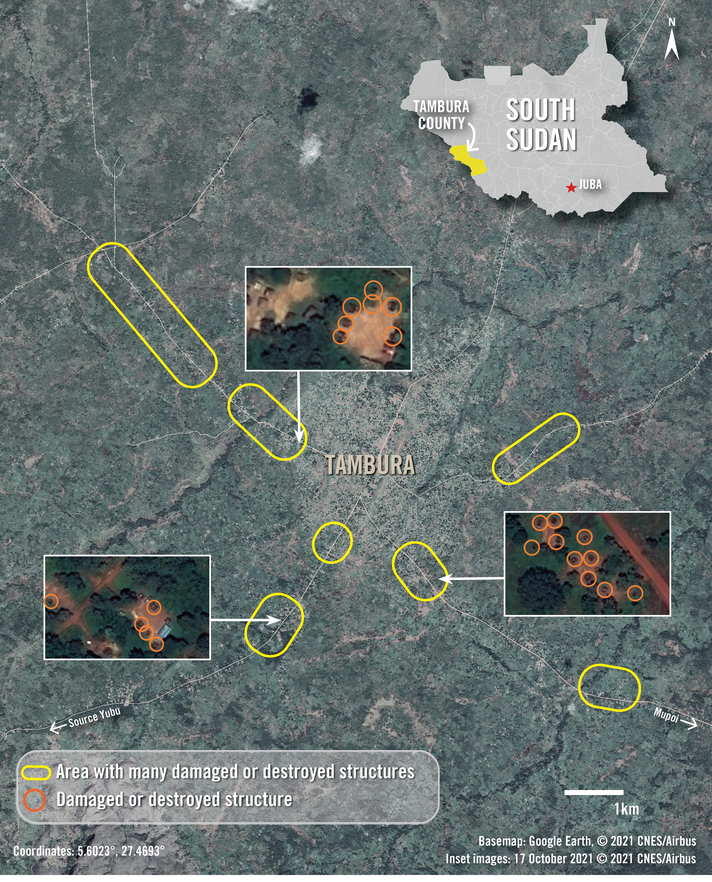
Most of those interviewed said their homes were looted or burned, and crops were left unharvested due to the insecurity, impacting many of them who farm for a living. Satellite imagery analysed by Amnesty International illustrates widespread damage or destruction of structures between June and October across the county, including in and around Tambura town and Mupoi and the vicinity of Source Yubu.

Armed men also ransacked and looted health facilities, depriving civilians of crucial care and violating international law. A senior humanitarian worker told Amnesty International in November that 13 out of 20 medical facilities across Tambura county were rendered unusable after being vandalized, and the rest are “barely functional”.

Another humanitarian worker said that out of 53 schools in the county, only eight were open at the time of the interview in November. Practically all displaced people with school-age children who spoke to Amnesty International said their children had been out of school for months.
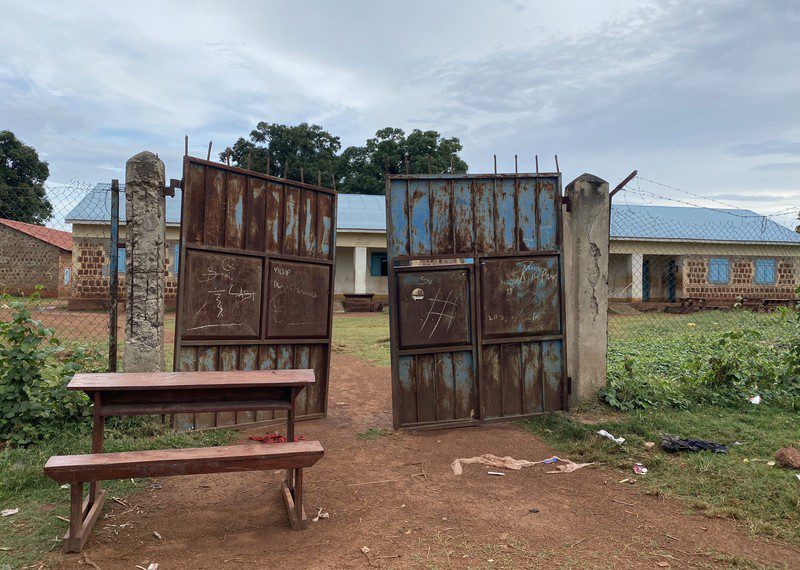
IDP site in Tambura town, Western Equatoria state, South Sudan.
Fighters temporarily occupied Renzi school in Tambura town. © Amnesty International

Seven witnesses told Amnesty International that pro-Azande, SSPDF-affiliated fighters had used a primary school in Tambura town as barracks for several weeks during the fighting, until late October when government officials finally coaxed them into leaving. Such use of schools by armed actors runs contrary to the global Safe Schools Declaration, which the South Sudanese government endorsed in 2015, and undermines international human rights and humanitarian law.

Displacement and humanitarian crisis

According to government figures verified by the UN, the fighting has displaced more than 80,000 people. Some moved to makeshift displacement sites within Tambura town, including a church and a camp protected by UN peacekeepers, which Amnesty International visited. Others travelled as far south as the state capital Yambio and all the way north to Wau in Western Bahr el Ghazal state, often walking between three and 10 days.

IDP site in Tambura town, Western Equatoria state, South Sudan.
Damaged and destroyed structures around Tambura town. Basemap: Google Earth, © 2021 CNES/Airbus; Inset images: 17 October 2021 © 2021 CNES/Airbus

Families were separated as people fled in different directions, with some still unable to reunite months later. Travelling with just the clothes on their backs, many went without food for days in the bush. One woman said her 15-year-old gave birth along the way, another said her three-year-old daughter died from medical complications during the journey.

Displaced people in both camps and host communities said they lacked food and medicine and suffered dismal shelter conditions, which Amnesty International researchers witnessed. The vast majority said they had received either no humanitarian relief or just a one-off 15-day ration of basic food items.

My child at home is very sick and there is no money for treatment… We don’t have food. We don’t even have money for rent. We are going to die from hunger.

A 42-year-old woman displaced to Yambio with seven of her children.

“My child at home is very sick and there is no money for treatment… We don’t have food. We don’t even have money for rent. We are going to die from hunger,” said a 42-year-old woman who was displaced in July from the outskirts of Tambura town to Yambio with seven of her children.

Survivors said despite announcements that the fighting has ended, they remained fearful of lingering fighters and politicians who had stoked the inter-communal enmity. They also said they had nothing to return to with their houses, crops and properties destroyed. Many highlighted their urgent need for speedy assistance, including psychosocial support.

“The government must expedite reconstruction efforts; facilitate assistance and provision of essential services for the displaced; establish conditions for their safe, voluntary and sustainable return; and ensure that those responsible for war crimes and other violations are held to account,” said Deprose Muchena.

“The violence in Western Equatoria is yet another stark reminder that a holistic accountability process is needed, including truth-telling, reforms, compensation and working with the African Union Commission to establish the Hybrid Court for South Sudan. Meanwhile the UN Security Council must maintain its arms embargo to stem the flow of weapons to warring parties.”

Background

The recent violence in Western Equatoria can be traced to the allocation of the state to the Sudan People’s Liberation Movement-In Opposition (SPLM-IO) in May 2020 as part of a power-sharing agreement between parties to the 2018 peace deal. The First Vice-President Riek Machar’s subsequent appointment of a governor angered key figures in the political elite among the Azande community.

Despite the creation of a transitional government of national unity in early 2020, violence persists in various pockets across South Sudan, pitting parties to the conflict, as well as local groups aligned with them, against each other. Key provisions of the peace deal, including some pertaining to accountability and security, remain unfulfilled.

The post South Sudan: Survivors describe killings, mass displacement and terror amid fighting in Western Equatoria appeared first on Amnesty International.

Lebanon: Release Detained Journalist

Lebanon’s General Security should immediately release Nada Homsi, a journalist from the US, who was arrested on November 16, 2021, and whose detention is now arbitrary, Human Rights Watch and Amnesty International said today. General Security should also promptly, thoroughly, independently, transparently, and effectively investigate the due process violations she faced since her arrest, and bring to justice anyone suspected to be responsible.

General Security officers raided Homsi’s apartment on November 16 without a judicial order, where they found a small amount of cannabis, said Homsi’s lawyer, Diala Chehade. Chehade said the officers then called the public prosecutor, who issued an arrest warrant for Homsi and her partner. The officers also confiscated her electronics and other documents. Although the public prosecutor ordered her release on November 25, General Security issued a deportation order for her and continues to detain her arbitrarily. 

“Not only did General Security officers raid Homsi’s apartment without producing a judicial warrant, but they also violated her rights in detention by denying her access to a lawyer,” said Aya Majzoub, Lebanon researcher at Human Rights Watch. “General Security’s refusal to release Homsi despite the public prosecution’s order is a blatant abuse of power and a very worrying indication of the security agency’s lack of respect for the rule of law.”

Homsi is a US freelance journalist who has worked with several Arab and international outlets, including most recently, the US-based National Public Radio (NPR). 

The reasons for the raid on Homsi’s house remain unknown, but General Security officers told Chehade that the raid was based on security intelligence gathered by their Information Unit. General Security officers continue to insist that Homsi is being detained “for security reasons,” but they have failed to provide any details to Chehade to allow her to prepare a defense. No security or military charges have been filed against Homsi, but she was charged for drug consumption. 

General Security officers did not allow Homsi to contact her family or a lawyer for six days after her arrest. They also interrogated her without the presence of a lawyer, in violation of article 47 of the Code of Criminal Procedure. When she insisted on her right to a lawyer, she was told that “these rights do not apply at General Security,” Chehade said. After her interrogation, General Security officers made Homsi sign an interrogation report that she could not read. Under Lebanese law, a person may be detained without charge for a maximum of 96 hours and then must be released if no charges have been filed. 

Chehade filed a request to release Homsi on November 25, and on the same day, the Beirut Public Prosecutor ordered her release. However, General Security continued to detain Homsi under the pretext that she was working in the country without a proper work permit, and they issued a deportation order for her around two weeks ago, Chehade said. 

Under Lebanon’s drug law, a person accused of drug use should be transferred to a specialized “addiction committee” for treatment, and legal procedures against them should be halted if they agree to treatment. On June 25, 2018, the then-Cassation Public Prosecutor Samir Hammoud issued a circular prohibiting pretrial detention for people accused of using drugs. Chehade confirmed to Human Rights Watch and Amnesty International that Homsi did not overstay her three-month visa. 

“General Security should immediately release Homsi and allow her a meaningful opportunity to challenge her deportation in a competent, independent, and credible court,” said Diala Haidar, Lebanon Campaigner at Amnesty International. “They must refrain from detaining any individuals in relation to their immigration status, and promptly identify and hold to account those suspected to be responsible within its structure for violating Homsi’s due process rights.”

General Security should immediately release Homsi and allow her a meaningful opportunity to challenge her deportation in a competent, independent, and credible court.

Diala Haidar, Lebanon Campaigner at Amnesty International

On December 1, Amnesty International and Human Rights Watch sent a letter to the head of General Security, Major General Abbas Ibrahim, urging him to release Homsi and investigate his subordinates’ conduct. The groups have not received a response.

Human Rights Watch and Amnesty International have frequently documented due process violations during arrest and interrogation, and accountability for such abuses remains elusive.

Journalists and activists in Lebanon are increasingly under attack by state and non-state actors. According to the Samir Kassir Eyes Center for Media and Cultural Freedom (SKeyes), a media and press freedom watchdog in Beirut, more than 100 media workers have come under assault from non-state actors between the start of the uprising in October 2019 and November 2021. 

State agencies have also participated in the crackdown on journalists. Security agencies regularly assault journalists who are doing their jobs, especially during coverage of protests. But instead of holding the abusers accountable, Lebanese authorities have used the broad jurisdiction of the military courts to silence and punish any peaceful dissent or criticism of the security agencies. 

On November 26, the military court sentenced journalist Radwan Murtada, a reporter for Al-Akhbar, to 13 months in prison for allegedly insulting the military. On November 24, the military court summoned for trial a comedian and activist, Shaden Fakih, on charges of insulting and harming the reputation of the Internal Security Forces.

The post Lebanon: Release Detained Journalist appeared first on Amnesty International.