In memory of PETA member Regan Russell—who was killed by a pig-transport truck during a peaceful protest outside locally based Fearmans Pork—PETA has raised seven sky-high tributes near the slaughterhouse that read, “I’m ME, Not MEAT.” The billboards honor Regan, who saw pigs as individuals and was trying to help relieve their suffering by giving them sips of water just prior to her death, by sharing the message that everyone can make a difference for animals by choosing not to eat them.
“Regan had been an animal advocate since 1979, attended vigils weekly for years, and cared deeply about protecting the vulnerable,” says PETA President Ingrid Newkirk. “PETA encourages everyone to honor her legacy of compassion by going vegan and getting others to join them.”
In the meat industry, workers chop off piglets’ tails, cut their teeth with pliers, and castrate the males—all without pain relief. At the slaughterhouse, workers hang pigs upside down, sometimes while they’re still conscious, and bleed them to death. About 10,000 pigs are trucked to and slaughtered at Fearmans Pork every day, but by going vegan, each person can save nearly 200 animals a year.
PETA’s billboards are located near these intersections:
Fairview Street and Drury Lane
Harvester Road and Cumberland Avenue
Upper Middle Road and Heron Way
PETA—whose motto reads, in part, that “animals are not ours to eat” and which opposes speciesism, a human-supremacist worldview—offers a free vegan starter kit. For more information, please visit PETA.org or follow the group on Twitter, Facebook, or Instagram.
“Free-Range Organic Human!” That’s what the banner will proclaim on Wednesday, when a trio of PETA “aliens” will beam downtown to dine on a “blood”-smeared human. The out-of-this-world “lunch-in” is part of PETA’s “Veganuary” efforts to encourage everyone to go vegan for 2022 and beyond.
Where:The intersection of Dauphin and N. Joachim streets, Mobile
When:Wednesday, January 19, 12 noon
“If aliens visit, we’d all better hope they don’t cage us, kill us, and chop up our bodies the way humans have done to other species,” says PETA Executive Vice President Tracy Reiman. “PETA is asking everyone to make the galaxy a kinder place by keeping our fellow Earthlings off our plates.”
PETA—whose motto reads, in part, that “animals are not ours to eat”—opposes speciesism, a human-supremacist worldview.
The dairy industry clearly knows that today’s consumers don’t want cruelty on their plates—or in their glasses. But instead of switching to growing plants for humane, animal-free milk and letting cows be cows, one farmer is forcing the animals to wear VR headsets—giving them just a glimpse of the kind of sunny pastures they’d love to be in while they’re still trapped in cramped, dirty lots.
It looks like an episode of Black Mirror, but it’s all too real:
A farmer in Turkey has fitted his cows with virtual reality goggles to make them think they are outside in summer pastures. Izzet Kocak found out the pleasant scenes make the cows happier and produce more milk.Future is metaverse! pic.twitter.com/DNZze8Wm5n
The farm asserts that the VR goggles “make the cows happier to produce more milk.” But underneath that far-fetched claim appears to be an admission that conditions in the dairy industry are so miserable that cows need to be tricked just so farmers can continue exploiting them.
The dairy industryalready forcibly impregnates female cows, doses them with growth hormones, and puts them through grueling milking regimes to make their bodies produce far more milk than they naturally should. The average cow today produces more than four times as much milk as cows did in 1950. Strapping toys to their heads and taunting them with scenes of the lives they’re being denied only adds insult to injury.
The Good Place actress Jameela Jamil even condemned the bleak practice, saying “This is the bad place.” And she’s absolutely right.
There is no humane way to treat mother cows like milk machines. Even if they do get some access to a pasture, farmers still steal their milk and kidnap their calves, depriving mothers and their precious young of everything that matters to them most. But YOU can help cows and others suffering in the meat and dairy industries. All you have to do is choose vegan.
Get started today by participating in PETA’s 3-week vegan challenge:
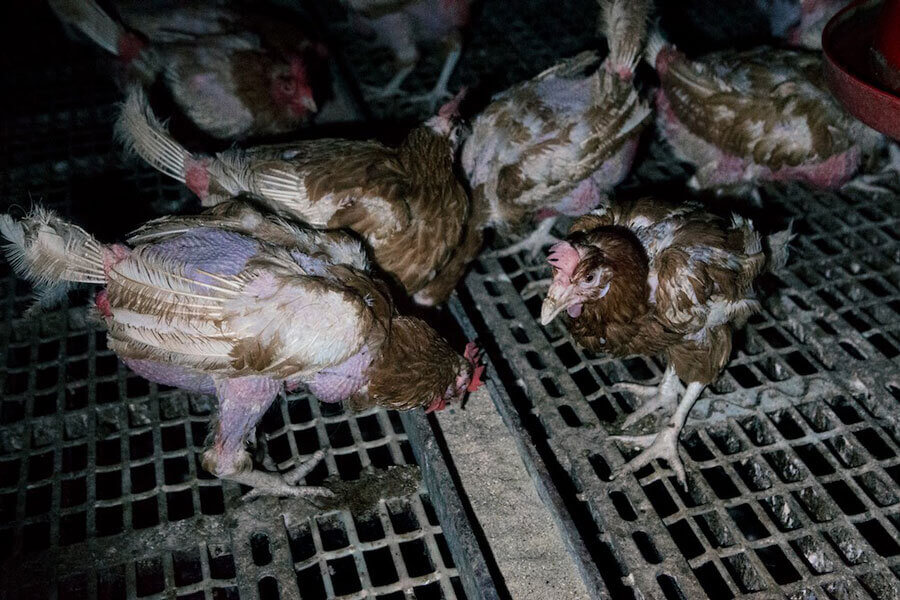
Happy cows and chickens on sprawling, grassy farms may smile at you from packages of “humanely raised,” “free-range,” “cage-free,” and “pasture-raised” meat, eggs, and milk at the grocery store, but animals are suffering for these foods. Ninety-nine percent of animals used for food in the U.S. are confined on massive, industrial factory farms. They’re crammed by the thousands into wire cages, metal crates, or other restrictive enclosures, often inside foul, reeking, windowless buildings. Animals exploited for foods with “humane” labels are also often subjected to cramped, filthy conditions—making it clear that there’s simply no such thing as “ethical” meat, eggs, or milk—or anything else that’s taken from an animal.
PETA needs your help to stop misleading “humane” claims and to help animals whose misery is funded by unsuspecting consumers. We need to hear from shoppers like you who may have been duped by “humane” meat, egg, and dairy items.
“Humane” meat, eggs, and dairy are a myth and a marketing scheme that often dupes well-meaning consumers into feeling better about buying inherently cruelly produced items.
Animals used for food have very few protections, and existing “humane” certifications fail to prevent suffering. Humane Farm Animal Care certification, for example, allows producers to cut off young chicks’ beaks and obtain chicks from hatcheries that kill newborn male chicks in devices that resemble meat grinders because they don’t profit the industry, and it doesn’t require that “laying hens” have access to the outdoors at all.
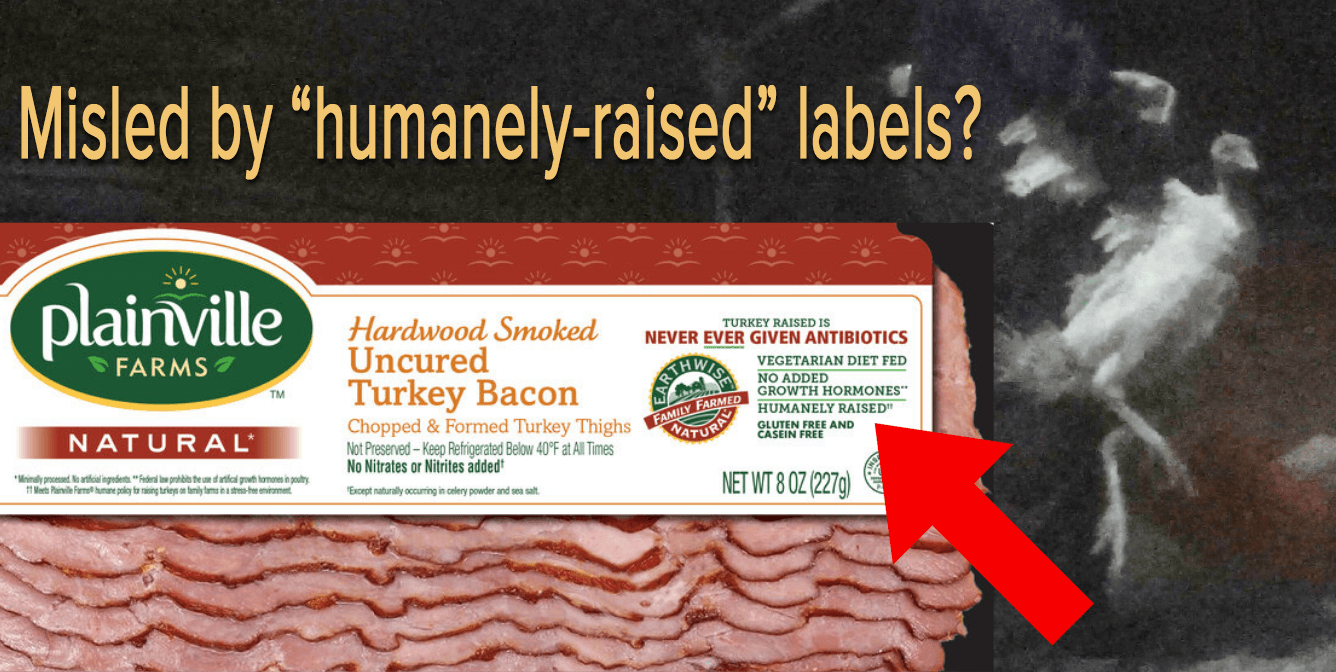
At Plainville Farms—a former Whole Foods supplier that claims to produce “humane” turkey in a “stress-free environment” and is expected to meet higher welfare standards under its (now suspended) Global Animal Partnership certification—PETA uncovered turkeys who were thrown, kicked, and beaten.
At a supplier for Nellie’s Free Range Eggs—which claims to use “certified humane” eggs—PETA eyewitness video footage revealed that roughly 20,000 hens had been crammed into a single shed with just 1.2 square feet of space per bird, which is barely enough room for their bodies.
Cows used for milk, regardless of the “humane” labels on the packages, are separated from their babies, often within a day of their birth, and the strong emotional bond between mother and calf is traumatically severed. Mother cows will often cry out for their babies for days after they’ve been kidnapped.
Have You Unwittingly Funded Cruelty?
Have you purchased foods with labels like “free-range,” “humane,” or “grass-fed”? Do you opt for the more expensive brand with “humane” statements on the package and believe that you were misled? If you care about the way animals are treated and regret buying items with humane-washed phrases that you understood to represent the actual conditions on the farm and believe that you were misled, we want to hear from you!
By submitting this form, you are agreeing to our collection, storage, use, and disclosure of your personal info in accordance with our privacy policy as well as to receiving e-mails from us.
Do You Buy ‘Free-Range’ or ‘Cage-Free’ Eggs?
All fields in bold are mandatory.
FormBuilder Form - 3846
By submitting this form, you are agreeing to our collection, storage, use, and disclosure of your personal info in accordance with our privacy policy as well as to receiving e-mails from us.
Got ‘Humane’ Milk? Tell Us More
All fields in bold are mandatory.
FormBuilder Form - 3965
By submitting this form, you are agreeing to our collection, storage, use, and disclosure of your personal info in accordance with our privacy policy as well as to receiving e-mails from us.
It’s called “poling,” and in the wake of a damning video investigation revealing that German Olympic show jumper Ludger Beerbaum engaged in this cruel and likely illegal practice of striking a horse’s legs with a heavy stick to force the animal to jump higher, PETA rushed a letter this morning to Thomas Bach, president of the International Olympic Committee (IOC), asking him to pull equestrian events from the Games. In addition, PETA Germany has filed a criminal complaint against Beerbaum.
PETA first urged the IOC to ban equestrian sports in August 2021 after Jet Set, a horse ridden by a Swiss competitor in the Tokyo Olympics, was injured and had to be euthanized and after an Irish competitor forced a horse named Kilkenny to finish the course, even though he had blood pouring from his nostrils. Pentathlon competitor Annika Schleu was caught on camera whipping and trying to force a terrified horse onto the course. This latest revelation is the last straw.
“Whacking a horse’s shins with a wooden rod to force him to jump higher is abuse—and it’s apparently routine at the highest levels of this entertainment disguised as sport. PETA is calling on the IOC to keep all cruelty out of the Olympic Games and leave the competition to willing human participants only.”
—PETA Senior Vice President Kathy Guillermo.
Leave the Olympics to the Willing Participants
Horses don’t care about gold medals. And unlike humans, they don’t choose to participate in dangerous events—they’re forced to. Show jumping, dressage, cross country, and other equine “sports” can be extremely cruel.
Please join our call: Urge the International Olympic Committee to remove all equestrian events immediately.
 (@jameelajamil)