
The Race Is On for the Biggest Horse Racing Drug Scandal of 2022—and It’s Only January

Horse racing scandals are not new. Racehorses are the victims of a money-driven industry that frequently uses drugs to push the horses to peak performance and hide their injuries and sometimes end their racing or breeding “careers” by sending them to slaughter. From problems with anti-doping regulations to a three-year prison sentence for a disgraced veterinarian, the recent drug-related scandals of the horse racing industry have become its mane event.

Here are five big drug-related horse racing scandals so far in 2022:

1. Anti-Doping Agreements Fall Apart

When it was announced that the U.S. Anti-Doping Agency (USADA) would be serving as the Horseracing Integrity and Safety Authority’s independent enforcement agency, hopes were high that positive change was coming for horses used in the racing industry. Federal legislation mandating national medication oversight in horse racing by the USADA is something PETA has long pushed for, and it was introduced following our undercover investigation into trainer Steve Asmussen. The USADA is the national anti-doping organization in the U.S. for the Olympic, Paralympic, Pan American, and Parapan American Games—an impressive résumé. But now, despite months of negotiations, it has been announced that the Horseracing Integrity and Safety Authority and the USADA are unable to reach an agreement in line with the requirements of the Horseracing Integrity and Safety Act of 2020 and maintain a credible, effective program. This spells disaster for the legislation and calls into question the Horseracing Integrity and Safety Authority’s goals—does it want to get the drugs out of racing or simply appear to be making a change? Both groups should come back to the table immediately and make a plan to protect horses.

Each year, horses are forced to train and race with painful preexisting injuries that should warrant pulling them from competition. In the weeks leading up to a race, horses are often administered a cocktail of anti-inflammatories, painkillers, sedatives, hormones, stimulants, diuretics, and muscle relaxants, either to mask their pain or to enhance their performance. This can lead to broken bones and death. If a horse needs to be on medication, they should not be racing.

2. Bob Baffert Under Fire for Kentucky Derby Positive and Medina Spirit’s Death

Infamous horse trainer Bob Baffert has accrued more than 30 drug violations throughout his career, five in the last two years alone. Medina Spirit, a horse trained by Baffert, tested positive for betamethasone after finishing first at the Kentucky Derby. Before that scandal could be resolved, Medina Spirit died at just 3 years old.

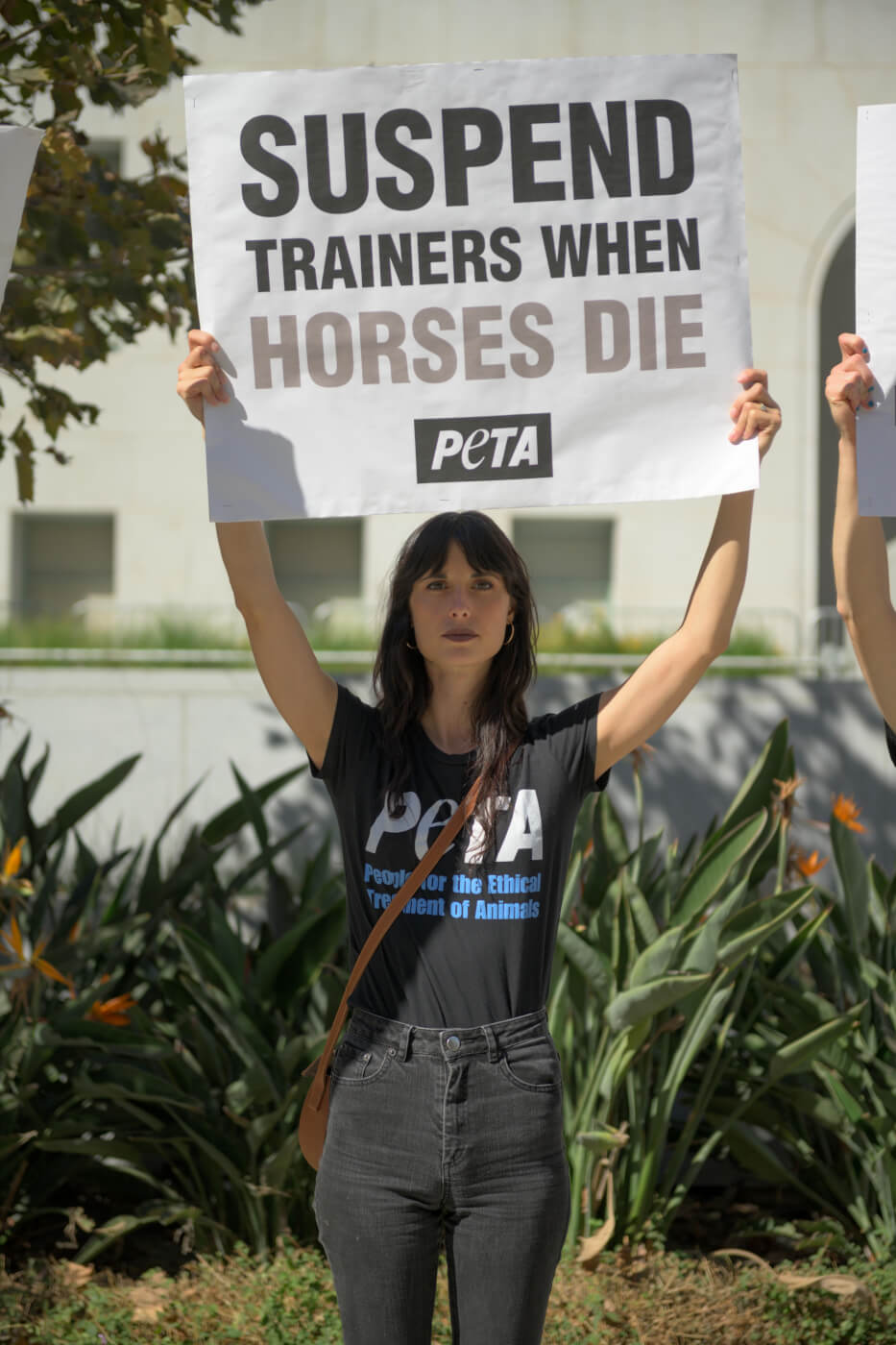
According to information gathered from public records, as many as 2,000 racehorses die at tracks each year in the U.S.—while racing, training, or on the grounds. Meanwhile, their trainers and owners pocket the riches—Baffert’s career earnings amount to over $329 million. He must be held accountable for his actions, and the horses in his barns need protection. While the death of Medina Spirit is being investigated, PETA is pushing for Baffert to be banned from having unsupervised contact with these horses, and an independent state-appointed veterinarian should make medical decisions concerning them. But ultimately, racing needs to boot Baffert out.

Bob Baffert PETA Protest

3. Vet Suspended Pending Investigation

The license for Jeff Blea, equine medical director for the California Horse Racing Board, has been temporarily suspended by the state’s veterinary medical board and he has been placed on administrative leave from the University of California–Davis, where he also works. Blea allegedly prescribed medications to 3,225 horses in 67 working days, medicating on average a whopping 48 horses per day. According to allegations that led to his suspension, he administered medications, including controversial thyroxine, without establishing a veterinarian-client-patient relationship, an examination, or sometimes even a diagnosis. A veterinarian’s responsibility is to their patients—the horses, not the rich humans who buy or train them.

According to experts, the widespread use of nontherapeutic drugs (legal and illegal) is one of the leading causes of injuries and fatal breakdowns on racetracks. In 2013, a PETA investigation into trainer Steve Asmussen found that nearly every horse in his care had been given an array of drugs and “treatments.” Following PETA’s investigation, Asmussen was fined $10,000 by the New York State Gaming Commission for recklessly administering thyroxine. However, it is clear that top trainers with muddled records, like, apparently, Baffert, will continue abusing drugs in racing to turn a profit—and they must be stopped.
these 10 simple new racetrack rules from PETA will save lives

4. Baffert’s Vet Under Investigation

In addition to Blea, two other veterinarians in Southern California are under investigation by the state’s veterinary medical board. Baffert’s veterinarian, Vince Baker, is one of them. It’s alleged that Baker prescribed medication—including thyroxine—to horses he had not examined. And this is after seven of Baffert’s horses died mysteriously during a 16-month period starting in 2011 that was suspiciously linked to his reckless and routine habit of administering the powerful hormone thyroxine to horses without thyroid conditions. Baker faces 15 causes for discipline, which could result in the suspension or revocation of his license.

5. Vet Involved in Massive Racehorse-Doping Scheme Goes to Jail

After pleading guilty to distributing performance-enhancing drugs to horses in his care and then hiding the activity from regulators, Dr. Kristian Rhein received three years in prison and a financially devastating $1 million in forfeitures—with more costly fines likely to follow. He’s just one of more than two dozen individuals indicted for connections to the doping scheme, many of whom likely face or have received similar sentences. While it’s a costly punishment for Rhein, the horses placed under his care are the ones who paid the real price for his unethical actions—and the laws need to be reformed now.

Ending Many Horse Racing Scandals Is Doable

3 horses take off at the gate

Many of the scandals occurring in the horse racing industry could be resolved if authorities would heed PETA’s advice and implement lifesaving rules like banning medications before races, cracking down on trainers who have multiple medical infractions, and requiring horses who are injured or sore to have sufficient time to recover before they are trained or raced.

PETA’s Simple Rules to Help Race Horses

The post The Race Is On for the Biggest Horse Racing Drug Scandal of 2022—and It’s Only January appeared first on PETA.

Free-Speech Lawsuit Over Shore Transit’s PETA Ad Rejection to Proceed

On Tuesday, the United States District Court for the District of Maryland rejected a motion to dismiss PETA’s lawsuit challenging the Tri-County Council for the Lower Eastern Shore of Maryland and one of its divisions, Shore Transit, over their refusal to run PETA’s ads on their buses, allowing the lawsuit to move forward.

In its refusal to run PETA’s ads, Shore Transit stated that the ads—which read, “No One Needs to Kill to Eat,” and call for the closure of slaughterhouses—were “too offensive for [its] market and political in nature.” PETA’s lawsuit argues that the policy prohibiting “political,” “offensive,” or “controversial” ads—as well as the Tri-County Council and Shore Transit’s refusal to run PETA’s ads under that policy—violates PETA’s rights under the First and 14th amendments, as the policy is unconstitutionally vague, inherently discriminatory, and at the discretion of government officials. The court has agreed that PETA’s lawsuit states a valid claim, noting that “[w]hile the Court is certainly sympathetic that Defendants may have an interest in limiting graphic or gory imagery on its buses, the manner in which Defendants allegedly have done so appears to be neither viewpoint neutral nor reasonable.”

“Shore Transit’s unconstitutional ad policy lets officials decide what’s too ‘offensive’ for the public to see, even if it’s just a simple appeal to go vegan,” says PETA Foundation Director of Litigation Asher Smith. “This policy must be struck down in the name of free speech, and PETA must be allowed to advocate for animals through its ads on Shore Transit.”

PETA is represented by Brian Hauss with the American Civil Liberties Union’s Speech, Privacy, & Technology Project and Robin Cockey of Cockey, Brennan & Maloney, P.C.

PETA—whose motto reads, in part, that “animals are not ours to eat”—opposes speciesism, a human-supremacist worldview. For more information, please visit PETA.org or follow the group on Twitter, Facebook, or Instagram.

The post Free-Speech Lawsuit Over Shore Transit’s PETA Ad Rejection to Proceed appeared first on PETA.

Deaths of Dog, Rabbit, and Guinea Pig at the University of Utah: PETA Statement

Please see PETA Senior Vice President Kathy Guillermo’s statement regarding a just-posted inspection report documenting numerous violations of the federal Animal Welfare Act at the University of Utah:

The University of Utah rakes in millions of dollars for experiments on animals but can’t manage to abide by minimal animal welfare regulations. A just-released government document obtained by PETA reveals that the clinic was cited for obscene incompetence and neglect resulting in animal deaths. A dog who suffered from experimentally inflicted heart failure died after he wasn’t properly monitored. A rabbit suffocated to death while under anesthesia after workers neglected to open a valve to permit the animal to breathe. And a guinea pig died of an anesthetic overdose after laboratory staff gave the animal 10 times the correct dose. The university was also cited for the failure of its animal experimentation oversight body to properly review the anesthetic regimen in an experimental protocol.

The University of Utah has a long history of violating the federal Animal Welfare Act (AWA). In 2020, the school was cited after two marmoset monkeys died of overheating and distress when they were left overnight in their nest box, and three marmosets died after they were used in experimental surgeries but not given adequate veterinary care. In 2016, a macaque monkey was negligently burned during a surgical procedure and subsequently euthanized. In 2009, PETA released video footage from its undercover investigation of the school’s laboratories. As a result of this investigation, the U.S. Department of Agriculture cited the university for multiple violations of the AWA.

In 2020, the University of Utah received more than $228 million in taxpayer money from the National Institutes of Health, half of which is estimated to fund experiments on animals. Studies show that a staggering 90% of basic research—most of which involves animals, like the type of experiments conducted at the University of Utah—fails to lead to treatments for humans. The university should redirect its resources toward modern, non-animal research methodologies that will actually help humans, and we urge officials there to adopt PETA’s Research Modernization Deal.

For more information on PETA’s investigative newsgathering and reporting, please visit PETA.org or follow the group on Twitter, Facebook, or Instagram.

The post Deaths of Dog, Rabbit, and Guinea Pig at the University of Utah: PETA Statement appeared first on PETA.

No Tiger Tent After PETA, CWI Pull Up the Pegs

Clark County Commissioner Tick Segerblom announced this morning that Jay Owenhouse has withdrawn his land use application to confine three tigers to a parking lot near the Las Vegas Strip for a year-long magic show. The announcement comes just a day before the Clark County Board of County Commissioners was scheduled to vote on his application and follows stiff opposition from PETA, locally based CompassionWorks International (CWI), and many local residents as well as recommendations from the Winchester Town Advisory Board and county planning staff that the project be denied.

Below, please find a statement from PETA Foundation Director of Captive Animal Law Enforcement Rachel Mathews:

After PETA, CompassionWorks International, and a groundswell of local residents roared that tigers aren’t magic-show props, this beleaguered exhibitor realized that his application to exploit big cats was doomed. Today’s news that big cats won’t be confined to metal cages in the Nevada desert is helping 2022 begin on a high note.

Please also see the following statement from CWI Executive Director Carrie LeBlanc:

By overwhelmingly opposing Jay Owenhouse’s cruel and dangerous tiger magic show, the people of Clark County have shown that wild-animal shows aren’t welcome here, and our community is a safer and kinder place for it.

PETA—whose motto reads, in part, that “animals are not ours to use for entertainment”—opposes speciesism, a human-supremacist worldview. For more information on PETA’s newsgathering and reporting, please visit PETA.org or follow the group on Twitter, Facebook, or Instagram.

The post No Tiger Tent After PETA, CWI Pull Up the Pegs appeared first on PETA.

CODE BLUE! PETA Issues Survival Tips for Animals During Cold Weather

Because temperatures are dropping below freezing in your area, PETA is tips for keeping animals safe. They are especially vulnerable in cold weather and winter storms, which lead to multiple deaths, injuries, and near-miss rescues each year. (And most incidents aren’t even reported.) That’s why PETA works with law-enforcement officials in North Carolina to get charges filed against people who illegally leave their animals outside in extreme weather and offers free straw bedding to residents upon request by calling PETA at 1-800-566-9768.

The following steps can go a long way toward helping animals survive the freezing temperatures coming to your area:

  • Bring Them Indoors

Companion animals should live indoors with their human families. Dogs left chained up outside—like those featured in Breaking the Chain, the documentary produced by Oscar winner Anjelica Huston—and “outdoor cats” often go without adequate food, water, shelter, and veterinary care. Their water turns to ice, their food turns to mush if left out in the rain, and these animals are no better equipped to survive freezing temperatures or extreme weather conditions than humans are. They can suffer terribly from frostbite and die of exposure.

  • Report Animals Left Outside

Many chained dogs are pit bulls, whose short hair leaves them particularly vulnerable. Please be on the lookout for any dog kept chained or penned outside 24/7 or without adequate shelter from the elements and alert local law-enforcement authorities immediately.

  • Change the Law

If your town or county allows the continuous chaining of dogs, work with local officials to get a ban passed—and contact PETA for help.

A glimpse of just some of the dogs PETA’s fieldworkers have found suffering in the cold can be seen here.

PETA has released a cold-weather public service announcement. For more information, please visit PETA.org or follow us on Twitter, Facebook, or Instagram.

The post CODE BLUE! PETA Issues Survival Tips for Animals During Cold Weather appeared first on PETA.