This morning, PETA fired off a letter to Christian Øverland, the director and CEO of the Wisconsin Historical Society, which operates the old Circus World Museum, reminding him that the rest of the country has moved on, recognizing elephants as highly intelligent beings deserving of our respect, not of servitude, and urging him to right a historical wrong by ending the annual summer circus’s demeaning, abusive wild-animal acts.
The action follows a PETA investigation revealing that two elderly elephants, Isa and Viola, were forced to perform at Circus World every day, despite showing signs of foot and joint problems. Both elephants shifted weight off their hind legs for significant periods, which could indicate discomfort caused by arthritis or other conditions. The video shows that their hind feet were often swollen, and Isa had misshapen toenails, which can be a serious problem for elephants. Painful foot and joint problems are among the leading reasons why captive elephants are euthanized. Regardless, Isa was forced to give rides before and after every show observed by PETA’s investigator, while a handler threatened her with a bullhook (a weapon resembling a fireplace poker with a sharp metal hook on one end). A worker admitted on video that the elephants were kept chained throughout the night.
“Forcing geriatric elephants to perform stupid tricks, haul people on their backs, and stand on hard concrete all night while chained by their legs is no way to treat elders of any species,” says PETA Foundation Director of Captive Animal Law Enforcement Rachel Mathews. “PETA is calling out the Wisconsin Historical Society, as it’s time to stop exploiting elephants and step into the 21st century with a show featuring only willing human performers.”
Isa and Viola come from Carson & Barnes Circus, whose head trainer was caught on camera instructing other trainers to sink a bullhook into elephants’ flesh and twist it until they scream. Carson & Barnes has racked up over 100 violations of the federal Animal Welfare Act, including while at Circus World, where it used an elephant who was so thin that her hip bones were protruding and failed to notice that another elephant was lame.
PETA—whose motto reads, in part, that “animals are not ours to use for entertainment”—opposes speciesism, a human-supremacist worldview. For more information on PETA’s newsgathering and reporting, please visit PETA.org or follow the group on Twitter, Facebook, or Instagram.
At Tahayghen Elementary School in British Columbia, a class of students in fourth through seventh grade watched as their teacher’s guest reportedly broke the neck of a live rabbit before dissecting the animal right in front of them.
After the gruesome event evidently upset parents—prompting the school to apologize to the community—TeachKind, PETA’s humane education division, sent a letter to the school offering to help replace all dissection exercises in its curriculum with modern, animal-free teaching methods.
Killing and dissecting a defenseless rabbit in front of impressionable students isn’t a “science” lesson—it’s a cruel display of violence that desensitizes young learners to animal suffering. Moreover, research has shown that a significant number of students at every educational level are uncomfortable with the use of animals in dissection and experimentation.
While it’s too late to help this rabbit or erase the violence that these students witnessed, the school can ensure nothing like this happens again by banning the dissection of animals altogether.
Animal-free dissection methods—such as the hands-on SynFrog or eMind, which offers in-depth anatomy studies of frogs, pigs, cats, and more—are trauma-free and teach students that they don’t have to harm animals for dissection, a practice that fosters callousness toward animals, turns off some students from careers in science, and contributes to animals’ declining populations in nature.
Help End Classroom Dissection
Animal dissection has no place in any classroom. Learn more about what you can do to help animals used for classroom dissection by clicking the button below:
To mark the 50th anniversary of the Iditarod, PETA is plastering area buses with messages pointing out that the leading cause of death for dogs on the Iditarod trail is aspiration pneumonia—the result of inhaling their own vomit—and is calling for an end to the race. The ads show a thin, freezing dog chained on property owned by Iditarod musher Mitch Seavey.
PETA’s undercover investigation into mushers’ “kennels” revealed that arthritic, crippled, and injured dogs were denied veterinary care; chained dogs had worn-down, raw, and bloody paw pads from frantically running in tight circles around the plastic barrels that were their only “shelter” in below-freezing cold; and dogs were dragged and injured, even killed, during training.
“It’s unconscionable that in this day and age, the Iditarod is still running dogs literally into the ground,” says PETA Executive Vice President Tracy Reiman. “No prize is worth a dog’s life, and PETA is pointing out that the best way to mark five decades of this shameful spectacle is to relegate it to the history books.”
More than 150 dogs have died during the Iditarod since it began. Many more have been killed during the off-season because they weren’t fast or fit enough to make the grade. Up to half of the dogs who start the race don’t finish it, and during the 2021 race, nearly 200 dogs were pulled off the trail because of exhaustion, illness, injury, or other causes, leaving the remaining ones to work even harder.
After PETA campaigns, Millennium Hotels and Resorts dropped its support of the Iditarod just this week, following the lead ofJack Daniel’s, Coca-Cola, Wells Fargo, andAlaska Airlines. ExxonMobil, formerly a major Iditarod sponsor giving $250,000 a year, confirmed that 2021 was the last year it would support the race. Craft Sportswear, Medical Park Family Care, Artisan Travel, and Anchorage Distillery have also cut ties.
PETA—whose motto reads, in part, that “animals are not ours to use for entertainment”—opposes speciesism, a human-supremacist worldview. For more information, please visit PETA.org or follow the group on Twitter, Facebook, or Instagram.
Rep.Nancy Mace, a Republican representing South Carolina’s First Congressional District, and Rep.Ted Lieu, a Democrat representing California’s 33rd Congressional District, sent a letter signed by eight members of Congress to National Institutes of Health (NIH) Acting Director Dr. Lawrence Tabak urging a phase-out of costly and ineffective animal experiments. Citing NIH’s own statistic that 95% of new drugs fail in human trials, the bipartisan proposal suggests that the agency immediately do the following:
Eliminate funding for animal experiments that we know fail to translate to humans
Identify all other areas in which animal experiments consistently fail and end funding for them
Prioritize funding for modern, human-relevant research
“As an animal lover and firm supporter of animal rights, it is deeply concerning to me to see the NIH’s continued funding of cruel and ineffective research on animals,” said Mace. “The animal experiments led by NIH have not resulted in treatments, vaccines, or cures for human diseases. NIH should focus on modernizing research beneficial for humans and work to phase out these unproductive and heartless experiments on animals.”
“Since I came to Congress, it has been a priority of mine to reduce the needless suffering of animals caused by costly and ineffective animal experiments,” Lieu said. “I’m pleased to join Representative Mace in calling on the NIH to phase out animal experiments, which often fail to lead to treatments, vaccines, and cures for human diseases. Last year, we saw the European Parliament take action to modernize scientific innovation without the use of animals in research and testing. It’s time for us to do the same. I’m honored to join in this bipartisan effort to protect innocent animals from useless suffering and look forward to the NIH’s response.”
In addition to Mace and Lieu, the following members of Congress signed the letter: Reps. Bill Posey, Joe Neguse, Dina Titus, Brendan Boyle, Darren Soto, and Jerry McNerney.
“PETA is grateful to these representatives for their critical leadership on this issue,” said PETA neuroscientist and Chief of Science Advancement and Outreach Dr. Katherine Roe. “NIH now has a clear message from Congress that if the U.S. wants to be a world leader in biomedical research and get the health advances Americans desperately need, it needs to move away from outdated models and embrace modern, human-relevant research methods. PETA scientists stand ready to assist with this transition.”
PETA—whose motto reads, in part, that “animals are not ours to experiment on”—opposes speciesism, a human-supremacist worldview. For more information about PETA’s investigative newsgathering and reporting, please visit PETA.org or follow the group on Twitter, Facebook, or Instagram.
PETA activists have never shied away from making brave fashion statements, and our uninvited presence on runways around the globe helped instill a new trend in the fashion world: kindness. Nearly all top designers have cut fur from their lines thanks to PETA. This is why we continue to take center stage at fashion weeks around the world: to raise awareness about the suffering of animals used for clothing and accessories and let the public know that vegan materials are in style. Check out some of the most show-stopping times PETA walked the runway at fashion week shows and beyond.
Times PETA Stole the Show at Fashion Shows Around the World
Oscar de la Renta
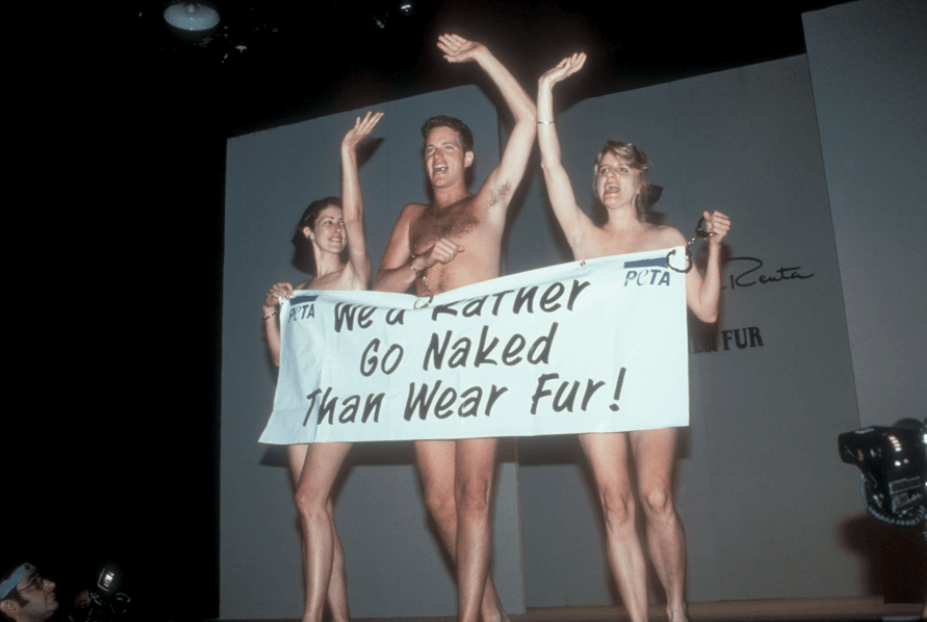
More than 30 years ago, we launched our first-ever naked protest during a 1991 Oscar de la Renta runway show. The eye-popping stunt landed PETA supporters—cuffed to a banner reading, “We’d Rather Go Naked Than Wear Fur”—on the cover of The New York Times style section.
Bold PETA activists would crash more Oscar de la Renta fashion shows in the years to come. Determined in our drive to end speciesism, we never passed up an opportunity to let models, celebrities, designers, fashion media, and the public know that animals suffer for fur. Finally, in 2021, Oscar de la Renta banned fur.
Gisele Bündchen
After Gisele Bündchen became the spokesmodel for the furrier Blackglama, PETA rushed the catwalk at the Victoria’s Secret Fashion Show in 2002 to encourage her to have a change of heart.
Years later, Bündchen told Vogue that the incident had changed her life: “Suddenly it dawned on me,” she said. “I was in the hamster wheel: I’m just going to go out there and be a good girl and do what my agent tells me to do. What do I know? It wasn’t until that shock—it stopped me in my tracks. They sent me all these videos. I wasn’t aware of what was happening, and I was devastated. So I said, ‘Listen, I’m not doing fur campaigns.’ It put me in the driver’s seat, finally.”
Valentino
“Fur Kills” and “Fur Is Dead!” were not the messages attendees of Valentino’s 2002 show might have expected to see, but they were absolutely the messages they needed to see. Finally, nearly 20 years later, Valentino stepped into the modern era, announcing that it would be fur-free by 2022.
Versace
A PETA supporter and a PETA U.K. supporter stirred things up at Versace’s 2002 show when they took over the runway to protest the violence and cruelty of the fur trade.
In 2018, Donatella Versace decided to drop fur from her family label’s collections: In an interview, the designer stated that she would no longer use real animal fur in any of her designs. “Fur? I’m out of that,” she said. “I don’t want to kill animals to make fashion. It doesn’t feel right.”
Jean Paul Gaultier
One of the activists who stormed the runway at the 2002 Versace show made her runway protests a double feature, stopping by Jean Paul Gaultier’s show earlier in the day as well. Before being removed by security, she flashed the crowd her anti-fur message:
In 2018, Gaultier announced live on French TV that he had banned fur from future collections, admitting that the ways animals are killed for their fur are “absolutely deplorable.” In response, PETA U.K. noted, “Fur today is as dead as the poor animals it was stolen from, and any designers not clued up enough to see that may as well hang up their sewing needles now.”
Julien Macdonald
A runway takeover during a Julien Macdonald show in 2003 left Macdonald with a lot to think about after activists wielding signs reading, “Fur Kills,” were led away from the runway.
Finally, in 2017, this designer to stars such as Gigi Hadid and Jennifer Lopez apologized for his use of fur, saying, “As a young designer I did use a lot of fur and do you know what, I think you should perhaps try not to. … It was my mistake. I was young. I am sorry. . . . You do not need to kill animals to wear nice clothes.”
Burberry
In 2006, three PETA activists took over the runway at the Burberry fashion show in Milan. As Otis Ferry, son of British rocker Bryan Ferry, walked the runway, the protesters leapt from the seated crowd onto the catwalk, chanting, “Fur is dead,” and wielding signs that read, “Burberry: Fur Shame.”
After a decade of our campaigns, the iconic British brand banned fur and angora in 2018.
Christian Lacroix
During a Christian Lacroix show at Paris Fashion Week in 2007, attendees saw just how truthful the catchy slogan “I’d Rather Go Naked Than Wear Fur” is when a PETA supporter removed all her clothes, evaded security, and rushed onto the catwalk with an anti-fur banner. Here’s what astonished onlookers saw at the event:
The brand later declared bankruptcy.
Kindness Is Always in Style
The designers’ choice to take fur off the runway has prevented many animals from being electrocuted, gassed, or otherwise killed for fur in the fashion industry. Now that the fur industry is so dead, our aim is to have all animal-derived materials, such as wool, leather, and exotic skins, exit the fashion circuit. The question “Who are you wearing?” should refer only to the designer and should never make you wonder whose skin you might be in.