Illegal Laboratory Monkey Transport Endangers Public, Prompts PETA Complaint to Feds

PETA has obtained and reviewed documents revealing that in the midst of a global pandemic, dozens of shipments, with nearly 2,000 monkeys, were crisscrossing U.S. highways in violation of federal law. The animals were destined for use in experiments and were transported in trucks across the country without the veterinary inspections required under the federal Animal Welfare Act.

In response to the alarming findings, PETA has filed a complaint with the U.S. Department of Agriculture (USDA), calling on the agency to investigate primate laboratories for flouting federal laws designed to protect animals and the public from dangerous diseases. The group also asked that the USDA suspend the primate facilities’ licenses and pursue civil and/or criminal penalties when appropriate.

Federal law requires that all monkeys transported between laboratories and/or breeding facilities be examined by a veterinarian within 10 days of shipment to ensure that they’re healthy and not showing signs of disease that could infect humans or other monkeys. But documents show that this law was violated at least 56 times in the past 17 months alone. At least 1,881 monkeys who had not been examined within the required dates were trucked to and from multiple states, including Florida, Maryland, Massachusetts, Michigan, Nevada, Ohio, Texas, Utah, Washington, and Wisconsin. The vehicles carrying them crossed multiple states in between.

Facilities that failed to examine the monkeys within the required time included Charles River Laboratories, Labcorp Drug Development, the National Institutes of Health, Orient BioResource Center, PreLabs, and Primera Science Center.

“U.S. laboratories haven’t been able to prevent deadly pathogens from infecting the monkeys they cage and experiment on, yet they still put these animals on transport trucks crisscrossing the country,” says PETA primate scientist Dr. Lisa Jones-Engel. “PETA is urging officials to investigate these brazen violations of federal laws immediately.”

PETA notes that monkeys who have tuberculosis, West Nile virus, malaria, Chagas disease, salmonellosis, herpes B, and other conditions that are transmissible to humans are in U.S. laboratories right now and have been transported via truck throughout the country. In 2019 and 2020, 227 shipments sent 60,546 monkeys to the U.S. from other countries, according to the Centers for Disease Control and Prevention (CDC).

The investigation request follows the January 21 crash of a truck carrying 100 monkeys in Pennsylvania. Three monkeys escaped and were shot on orders of the CDC, which had determined that they posed a public health risk. The long-tailed macaques, who came from Mauritius, had arrived at John F. Kennedy International Airport in New York that morning and had not yet been quarantined or tested for any pathogens that could endanger humans. Witnesses say that the crates holding the monkeys had no labels warning of potential danger or even indicating that they held monkeys.

For more information on PETA’s investigative newsgathering and reporting, please visit PETA.org or follow the group on Twitter, Facebook, or Instagram.

The post Illegal Laboratory Monkey Transport Endangers Public, Prompts PETA Complaint to Feds appeared first on PETA.

PETA Aims to End Injustice With a Surprise Auction Bid on RBG’s Old Fur Coat

PETA aims to transform a black mink coat—something that was once a symbol of success for a woman but now is a sign of an earlier time when most of us were unaware of the awful suffering involved for the animals killed for fur production—formerly owned by late Supreme Court Justice Ruth Bader Ginsburg into a powerful symbol of her progressive vision. That’s why we’re asking the Washington National Opera to pull RBG’s fur coat from the lineup of its upcoming benefit auction and instead donate it to PETA for use in a traveling educational exhibit—perhaps taking it to schools to show children how many animals go into such garments and pointing out how times have changed, as most designers and retailers are turning their backs on fur.

RBG fur coat for auction

RBG’s fur coat could also work as a gift to our fur donation program, which sends furs to humans in need as well as to wildlife rehabilitation facilities, which turn them into bedding for orphaned wildlife. In return, we’d donate $500 to the opera in RBG’s memory.

Either option would be a far more honorable fate for the coat than being claimed by the lowest kind of bidder: someone who still finds cruelly obtained fur “fashionable.”

We can’t bring back the animals killed for fur, but we can use this coat to advocate for equality and justice for all—principles that RBG cared deeply about.

If the Washington National Opera accepts our offer, the justice will posthumously join the long list of public figures who have donated unwanted fur coats to PETA, including Anjelica Huston, Mariah Carey, Kim Cattrall, Mary Tyler Moore, and Sharon Osbourne.

Killing methods for minks and other animals at fur factory farms are gruesome.

Although fur coats were common in previous generations, people now know that wearing fur is notoriously cruel.

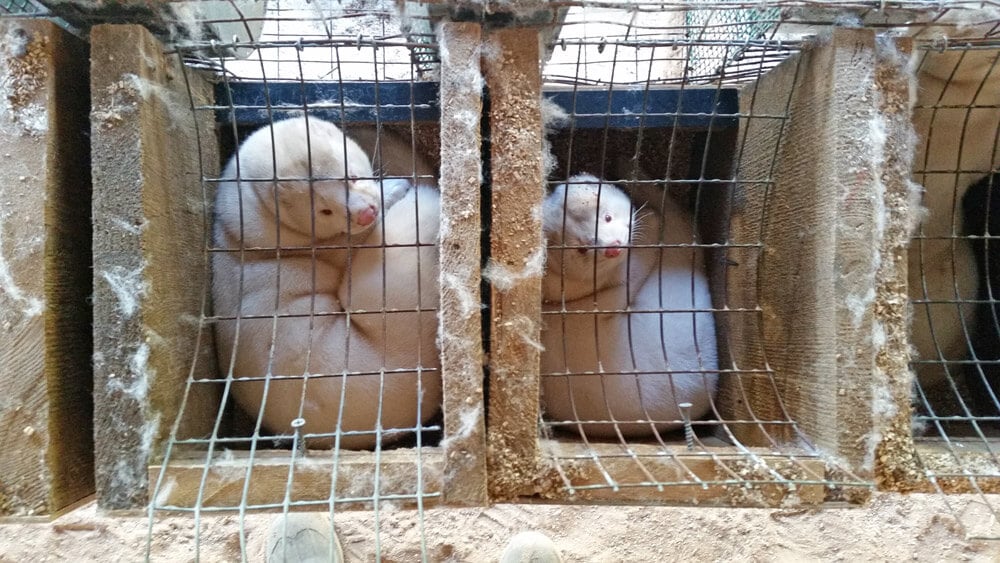
Minks on fur farms are packed into small cages, in which they pace frantically and mutilate themselves—biting their own feet and tails—to try to cope with the intense stress of confinement and out of their desperation to escape. Many are electrocuted, poisoned, gassed, or even skinned while they’re still alive.

minks in cage on fur farms could cause the next global pandemic

RBG’s mink coat is a relic of a bygone era.

Thanks to decades of PETA campaigns, designers, brands, and stores are dropping fur as quickly as consumers are shunning it. As faux fur and other innovative vegan materials take over, real animal fur can still be of important use.

RBG’s fur coat could be used to teach the next generation how speciesism—a human supremacist worldview responsible for massive global suffering—affects billions of animals every year.

We all have a part to play in ending injustice. PETA makes it easy to take action for animals suffering for fur.

The post PETA Aims to End Injustice With a Surprise Auction Bid on RBG’s Old Fur Coat appeared first on PETA.

VIDEO: Elephant Forced to Give Rides Endures Violent Beating at Thai Tourist Attraction

Appalling footage of a trainer violently beating an Asian elephant named Chan Chao with a bullhook at a tourist attraction in Thailand exposes the true cost of cruel elephant rides.

The video, which was taken by a tourist who said the horrific incident left them “in tears,” shows the trainer repeatedly lashing Chan Chao’s head with a spiked metal bar, reportedly piercing his skin and leaving deep cuts on his head.

The barbaric beating was so severe that, in an apparent attempt to placate distressed visitors, the facility’s manager made the trainer kneel at Chan Chao’s feet and apologize. Sorry, but an apology just doesn’t cut it—if the facility actually wants to make amends, it will stop forcing Chan Chao and other elephants to haul tourists on their backs under the threat of painful punishment and retire the animals to reputable sanctuaries.

The Truth About Cruel Elephant Rides

The abuse of Chan Chao is sickening indeed, but it’s just the tip of the iceberg—the tourism industry exploits countless other elephants whose suffering has not been caught on video.

The industry kidnaps baby elephants from their frantic mothers, breaks their spirits with agonizing beatings, and forces them to haul humans on their backs or perform meaningless tricks. All tourist attractions that offer elephant rides are profiting from the exploitation of these sensitive, intelligent animals, who don’t want to carry humans on their backs.

elephants in nature don't support elephant rides

Here’s How You Can Help Elephants

Elephants have close bonds with their family members and mourn when they lose a loved one. These gentle, complex animals don’t belong in miserable tourist attractions or any other facility that exploits them. By clicking the button below, you can take multiple quick and easy actions to help elephants right now: 

The post VIDEO: Elephant Forced to Give Rides Endures Violent Beating at Thai Tourist Attraction appeared first on PETA.

Showering on the Sidewalk? It’s PETA’s Earth Day Protest!

Making a bold statement with her nearly nude body covered only by a banner reading, “1 lb. of Beef Equals 180 Showers,” a PETA supporter will shower on a sidewalk on Tuesday in honor of Earth Day.

When:    Tuesday, April 19, 12 noon

Where:    At the intersection of 11th Avenue and 20th Street South, Birmingham

“This Earth Day, PETA will alert passersby that the meat and dairy industries are guzzling up our water supply and contributing to the climate catastrophe,” says PETA Executive Vice President Tracy Reiman. “Going vegan is the best way to reduce animal suffering, conserve water, and stop climate change.”

PETA—whose motto reads, in part, that “animals are not ours to eat”—opposes speciesism, which is a human-supremacist viewpoint. The group notes that growing water-intensive crops simply to feed animals raised for food consumes more than half the water used in the U.S. The U.N. has reported that a global shift to vegan eating is required to combat the worst effects of climate change, since animal agriculture is responsible for nearly one-fifth of all human-induced greenhouse-gas emissions.

PETA—whose motto reads, in part, that “animals are not ours to eat”—opposes speciesism, a human-supremacist worldview. For more information, please visit PETA.org or follow the group on Twitter, Facebook, or Instagram.

The post Showering on the Sidewalk? It’s PETA’s Earth Day Protest! appeared first on PETA.