
Celebrating Earth Day? See How PETA Has Taken Action Against the Climate Catastrophe

We’re all for hugging trees, but when it comes to actually helping our planet, the best thing anyone can do daily is to go vegan. Every day is Earth Day for PETA—and we celebrate it by encouraging everyone to save our fellow animals and fight the climate catastrophe by going vegan.

For Earth Day 2022 (April 22), take a look at how PETA has changed hearts and minds with eye-catching demonstrations by taking on the climate catastrophe’s leading culprit: animal agriculture.

PETA’s ‘Mother Earth’ Models Lead a Provocative Protest

In provocative demonstrations, PETA’s nearly naked “Mother Earth” models stepped out in neck-to-toe bodypaint to warn everyone that the industries responsible for killing billions of animals each year are also killing our planet.
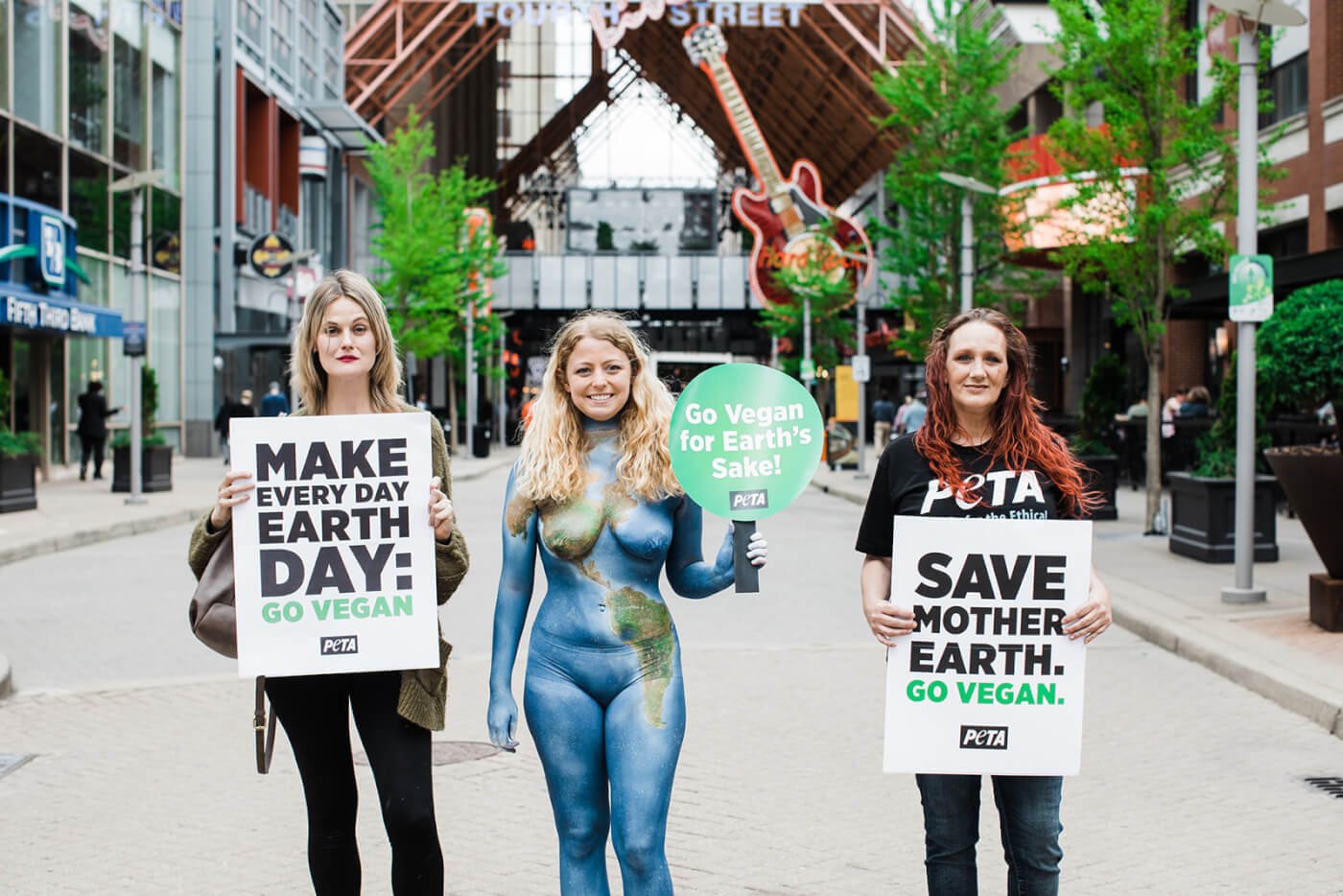
In an epidemic of animal suffering, the meat, egg, and dairy industries burn through vast amounts of land, food, water, and energy while generating waste that pollutes our air and waterways. According to the United Nations, raising animals for food is “one of the top two or three most significant contributors to the most serious environmental problems, at every scale from local to global.”

PETA Protesters Shut Meat-Eaters Up in a Bold Demonstration

PETA protesters defiantly paraded signs telling meat-eaters to “shut up” about the climate catastrophe. Raising animals to become food produces potent greenhouse gases—including carbon dioxide, methane, and nitrous oxide—which are major drivers of the climate catastrophe. One study concluded that a meat-eater’s diet accounts for more than seven times as many greenhouse-gas emissions as a vegan’s diet.

Tree-hugging and meat-eating don’t go hand in hand—especially when you consider that animal agriculture is a leading cause of deforestation. More than 80% of the Amazon rainforest that’s been cleared since 1970 is used for meat production.
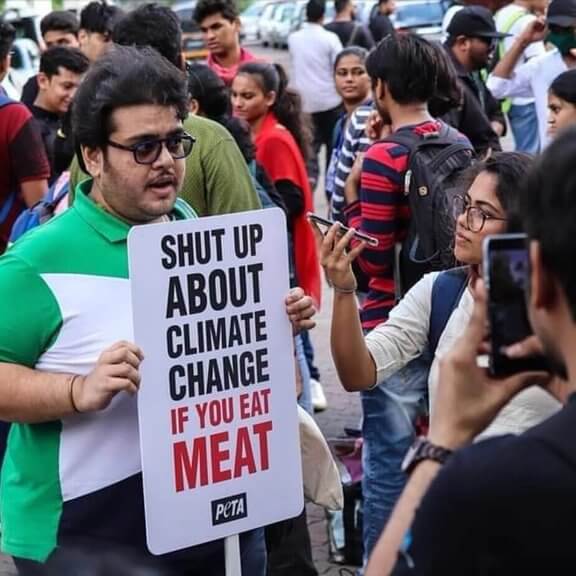
Shut about climate change if you eat meat protester

PETA Squares Up to Animal Agriculture’s War on Water

On World Water Day (March 22), a PETA model bathed on the streets to remind shocked passersby that taking shorter showers isn’t the solution to decreasing their water footprint.

The most significant part of our water footprint comes from what we eat—and eating other animals uses massive amounts of water (approximately 36 to 74 trillion gallons per year in the U.S. alone). To put it in perspective, it takes more than 2,400 gallons of water to produce a pound of beef—the equivalent of taking about 57 baths—but only 244 gallons to produce a pound of tofu.

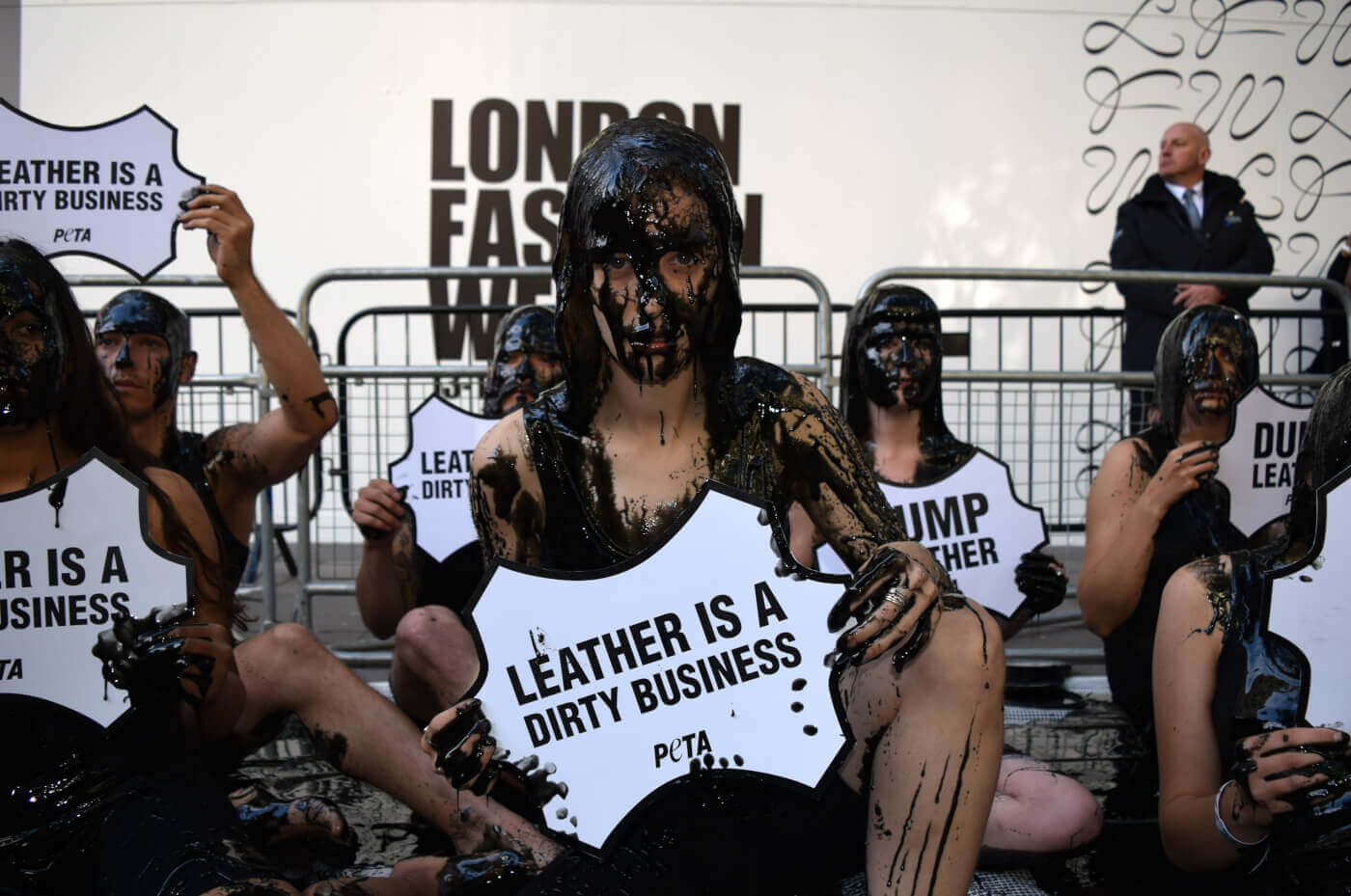
PETA Makes a Filthy Spectacle to Combat Leather

PETA supporters doused themselves in “toxic slime” to expose the environmentally detrimental effects of producing leather—a coproduct of the unsustainable meat industry.

On top of all the waste and pollutants generated by animal agriculture, turning animals’ skin into leather also requires massive amounts of energy and dangerous chemicals, including mineral salts, formaldehyde, coal-tar derivatives, and various oils, dyes, and finishes, some of them cyanide-based.
Go Vegan Before There Are No More Trees to Hug

Mother Nature needs our help—and you can do something about it. For Earth Day 2022, pledge to help save our planet by going vegan today!

The post Celebrating Earth Day? See How PETA Has Taken Action Against the Climate Catastrophe appeared first on PETA.

Reports of Cat Torture Video Prompt PETA Plea to Schools

Following reports that a video has circulated depicting possible Sharon Middle School students tormenting and killing a mother cat and her kittens, TeachKind—PETA’s humane education division—has just rushed a letter to Superintendent Justi Glaros offering to provide the district with a K–12 kindness-to-animals curriculum and “Empathy Now,” a guide to preventing youth violence against animals. The group is also offering to host free empathy-building virtual presentations to help prevent future violence.

The rumored incident—in which four juveniles were apparently captured on video shooting the cats with BB guns, hitting them with rocks and bricks, and dismembering them—would mark the second occurrence in just over two weeks to prompt outreach from TeachKind to Pennsylvania schools. In 2019, the group sent similar appeals to schools in the state three times.

“When children are taught that animals deserve respect, they learn to be kind to everyone,” says PETA Senior Director of Youth Programs Marta Holmberg. “TeachKind is on standby to help schools teach students that violence is wrong, whether the victim is a cat or a classmate.”

TeachKind notes that research shows that 43% of perpetrators of school massacres first committed acts of cruelty against animals, usually dogs or cats—so juvenile animal abusers potentially pose a serious threat to the community at large. TeachKind’s other resources include its free high school social justice curriculum, “Challenging Assumptions,” and its “Share the World” program kit for elementary school students.

TeachKind—whose motto reads, in part, that “animals are not ours to abuse in any way”—opposes speciesism, a human-supremacist worldview. For more information, please visit TeachKind.org or follow the group on Facebook or Instagram.

The post Reports of Cat Torture Video Prompt PETA Plea to Schools appeared first on PETA.

Nestlé Licensee AGV Products Corp. Joins Trend in Taiwan to Ban Animal Tests After Push From PETA

Following discussions with PETA and its partner organization Kindness to Animals (KiTA), AGV Products Corp.—a company licensed by Nestlé to produce, distribute, and market its Nestea products in Taiwan—has become the eighth major food company in 10 months there to ban all animal tests not explicitly required by law.

The company posted the new policy on its website, stating that it “will adapt to international scientific and animal welfare trends and will not conduct, sponsor, or entrust/outsource third-parties to conduct animal experiments that are not expressly required by laws” [English translation].

AGV Products Corp. had conducted or funded animal experiments that involved mutilating and killing almost 900 animals, purportedly to support human health claims for marketing oolong tea, tomato juice, oatmeal, and other products and ingredients to consumers. These included force-feeding mice, injecting them with allergens, and starving animals. All the animals were killed and dissected.

“Consumers increasingly avoid foods that involve force-feeding, sickening, and killing animals in cruel and unreliable tests,” says PETA Vice President Shalin Gala. “AGV’s kind decision to ban tests on animals continues a growing trend toward more effective, human-relevant research that Taiwan Sugar Corp. and other Taiwanese companies should embrace.”

PETA and KiTA have successfully persuaded major food companies in Taiwan—Asia’s largest food and beverage conglomerate, Uni-President Enterprises Corp.; Taiwan’s largest health food company, Standard Foods Group; a leading soft drink maker and bottling partner of The Coca-Cola Company, Swire Coca-Cola Taiwan; and others—to end animal experiments not required by law. Via PETA’s online action alert, more than 66,000 supporters have sent e-mails to other companies, including the Taiwanese government–owned Taiwan Sugar Corp., urging them to ban animal testing, too.

PETA—whose motto reads, in part, that “animals are not ours to experiment on”—opposes speciesism, a human-supremacist worldview. For more information on PETA’s newsgathering and reporting, please visit PETA.org or follow the group on Twitter, Facebook, or Instagram.

The post Nestlé Licensee AGV Products Corp. Joins Trend in Taiwan to Ban Animal Tests After Push From PETA appeared first on PETA.

More Horror at HyLife as 11 Pigs Die After Days in Crowded Pen—PETA Presses Prosecutor

PETA just received a report from the U.S. Department of Agriculture revealing that 11 pigs died at HyLife Foods’ Windom slaughterhouse after they were left for three days in a pen so crowded that they struggled to reach water—so today, PETA sent a letter to Cottonwood County Attorney Nicholas A. Anderson, calling on him to investigate and file applicable criminal charges against those responsible. According to the just-released December 2021 report, “[N]umerous hogs were laying on top of each other with no visible floor space left in the pen. Hogs were not able to reach the water without walking on top of each other.”

Just last month, PETA wrote to Anderson after uncovering federal reports that workers shot pigs near the eye and in the head in botched stunning attempts, leaving them conscious, crying out in pain, and trying to escape. Pigs were also denied food for more than 24 hours, had no access to water, and were repeatedly hit in the face with a paddle.

“It violates the cruelty statute to have caused these pigs to die in agony and terror after being crammed for days in a pen under the weight of other thirsty animals,” says PETA Vice President Dan Paden. “PETA urges the prosecutor to immediately launch a criminal investigation into HyLife and the persistent, egregious suffering of pigs there.”

PETA—whose motto reads, in part, that “animals are not ours to eat”—opposes speciesism, a human-supremacist worldview. For more information, please visit PETA.org or follow the group on Twitter, Facebook, or Instagram.

PETA’s letter to Anderson follows.

April 15, 2022

The Honorable Nicholas A. Anderson

Cottonwood County Attorney

Dear Mr. Anderson:

I’m writing to follow up on and renew my March 10 request that your office (and a law-enforcement agency, as you deem appropriate) investigate and file applicable criminal charges against HyLife Foods Windom LLC and the workers responsible for mistreating pigs at its slaughterhouse located at 2850 Hwy. 60 E. in Windom.

The U.S. Department of Agriculture’s Food Safety and Inspection Service (FSIS) has documented yet another such incident in a report that the agency recently made available to the public. (See the attached table.) According to the latest report, on December 13, 2021, an FSIS inspector found a pen at HyLife so severely crowded “that numerous hogs were laying on top of each other with no visible floor space left in the pen. Hogs were not able to reach the water without walking on top of each other.” The federal agent saw dead pigs in the pen and determined that all of these animals had arrived at HyLife three days earlier, on the morning of December 10, 2021. After HyLife personnel separated the pigs, the federal agent learned that 11 of them had died in the crowded pen.

This follows federal reports documenting the following:

  • On June 20, 2021, pigs were confined to pens without access to water.
  • On August 5, 2021, a worker struck a pig in the face twice with a paddle.
  • On August 10, 2021, a worker shot a pig near the left eye, leaving the conscious animal trying to walk away from the worker, before a second shot ended the pig’s suffering.
  • On September 20, 2021, a worker shot another pig in the head, after which the animal cried out, stood up, and tried to move away from the worker.
  • On September 29, 2021, pigs were denied feed for more than 24 hours.

All this may violate Minn. Stat. § 343.21. Please note that FSIS’ action—which is clearly insufficient—carries no criminal or civil penalties and doesn’t preempt criminal liability under state law for acts of cruelty to animals. Thank you for your time and consideration and for the important work that you do.

Sincerely,

Daniel Paden

Vice President of Evidence Analysis

The post More Horror at HyLife as 11 Pigs Die After Days in Crowded Pen—PETA Presses Prosecutor appeared first on PETA.

Winn-Dixie to Feel Pinch Over Live Dismemberment

A PETA supporter bodypainted as a stone crab will writhe atop a giant dinner plate in downtown Jacksonville, where Winn-Dixie’s headquarters is located, surrounded by protesters and a banner reading, “It’s a Rip-Off! I Feel Pain, and I Need My Claws!” The protest follows PETA’s release of new video footage that shows workers ripping the limbs off live crabs for a Winn-Dixie supplier and tossing the mutilated animals back into the ocean to suffer and die a prolonged death.

When:    The intersection of N. Laura and W. Monroe streets, Jacksonville

Where:    Friday, April 15, 12 noon

“Crabs need their claws to feed and defend themselves, yet they’re being torn apart limb by limb and tossed overboard to die,” says PETA Executive Vice President Tracy Reiman. “PETA is calling on anyone disturbed by this violence to leave animals in peace and off their plates.”

The Florida Fish and Wildlife Conservation Commission (FWC) requires that claws be torn off live stone crabs—which causes agonizing pain and would otherwise be illegal under the state’s cruelty-to-animals law—so PETA, the largest animal rights organization in the world, is now challenging the requirement with a formal rule-making petition to ban this conduct. PETA’s attorneys are making the case that the FWC allows Florida’s $30 million annual stone crab claw industry to operate in an illegal manner.

The group also filed a criminal complaint with the FWC regarding workers on the vessel that supplied Keys Fisheries, the largest seller of stone crab claws in the state. PETA’s video footage shows workers slamming a shark against the boat and appearing to carve out chunks of the animal’s flesh; ripping the mantles, which house the hearts and other organs, off live octopuses; and tearing live lobsters’ tails off before tossing the animals back, still living, into the water—all actions that experts concur cause pain.

Broadcast-quality video footage is available for download here, and photographs are available here. 

PETA—whose motto reads, in part, that “animals are not ours to eat” and which opposes speciesism, a human-supremacist worldview—notes that many faux-fish options are available today, such as Sophie’s Kitchen’s Plant-Based Crab Cakes, Gardein’s F’sh Filets, Plant-Based Tuna from Good Catch, and New Wave Foods’ new Plant-based Shrimp.

For more information, please visit PETA.org or follow the group on Twitter, Facebook, or Instagram.

The post Winn-Dixie to Feel Pinch Over Live Dismemberment appeared first on PETA.