PETA supporters, led by an “owl” mascot in a cage, will make some mayhem right outside the Johns Hopkins University (JHU) graduation ceremony this weekend. Urging administrators to shut down the school’s crude brain-mangling experiments on barn owls, the resolute group will rattle bars and crowd the protest area with stuffed owls in cages.
When: Sunday, May 22, 5:30 p.m.
Where: Homewood Field, 111 W. University Pkwy. (at the intersection with Canterbury Road), Baltimore
JHU experimenter Shreesh Mysore cuts open owls’ skulls, inserts electrodes into their brains, and bombards them with lights and noise for up to 12 hours at a time, purportedly to study attention-deficit/hyperactivity disorder in humans. When the owls’ brains become too damaged for additional experiments, he kills them. Mysore has publicly admitted that he may “misinterpret” what’s happening in the brains of the birds whose heads he bolts into place, and he received an official warning letter from the Maryland Department of Natural Resources for failing to obtain mandatory permits for his experiments on owls from 2015 to 2018.
“As Johns Hopkins University graduates plan for their futures, owls remain brain-damaged in Mysore’s laboratory,” says PETA Vice President Shalin Gala. “Nearly half a million concerned people have joined PETA in calling on Johns Hopkins to end these worthless experiments, and it’s time to free the owls.”
PETA—whose motto reads, in part, that “animals are not ours to experiment on”—opposes speciesism, a human-supremacist worldview.
Seeing animals suffering is one of the hardest things PETA investigators will ever have to do. So why do they persist? Because each one knows that documenting cruelty is critically important to stopping it. The impact of PETA’s investigators on our vital work for animals cannot be overstated—many of our victories wouldn’t have been possible without these intrepid staffers and their commitment to animal liberation.
Here are 7 quotes from PETA investigators that reveal what it’s really like to be on the front line and behind closed doors:
Sometimes, I will let out a good cry at home or in my car after a particularly disturbing day.
There are times when I have to hold back the tears. To see the workers torture these animals is infuriating.
[O]n every field observation assignment I’ve been on, I’ve seen animals suffering so badly that I probably wouldn’t have believed it myself if I hadn’t seen it with my own eyes.
This is from a PETA investigator who went undercover on a filthy Iowa farm supplying piglets for Hormel products:
I witnessed a bloodbath today. … I witnessed at least 30 piglets killed today. … Blood soaked the concrete floors.
While undercover at a Hormel supplier, a PETA investigator documented how a worker slammed piglets deemed “runts” headfirst into the concrete floor in an attempt to kill them.
Here, one PETA eyewitness recalls the promise they made to Loretta, a monkey trapped at Primate Products Inc. (PPI), a dealer that imports animals to sell to laboratories:
When I first met Loretta, I told her who I was, why I was there, and I assured her that I would not cause her any harm.
After PETA shared the documentation with the U.S. Department of Agriculture (USDA), a team of six agency inspectors conducted a three-day inspection of PPI and cited the facility for at least 25 violations of federal animal welfare laws, and PPI remains under federal investigation. Also thanks to this eyewitness, countless more folks now know that the process of getting monkeys into laboratories is traumatic and have joined PETA in persuading lawmakers to do better by primates.
Amid documenting the systemic neglect and violent handling of monkeys at Primate Products Inc., a PETA eyewitness takes a moment to comfort one of the victims exploited by the monkey dealer.
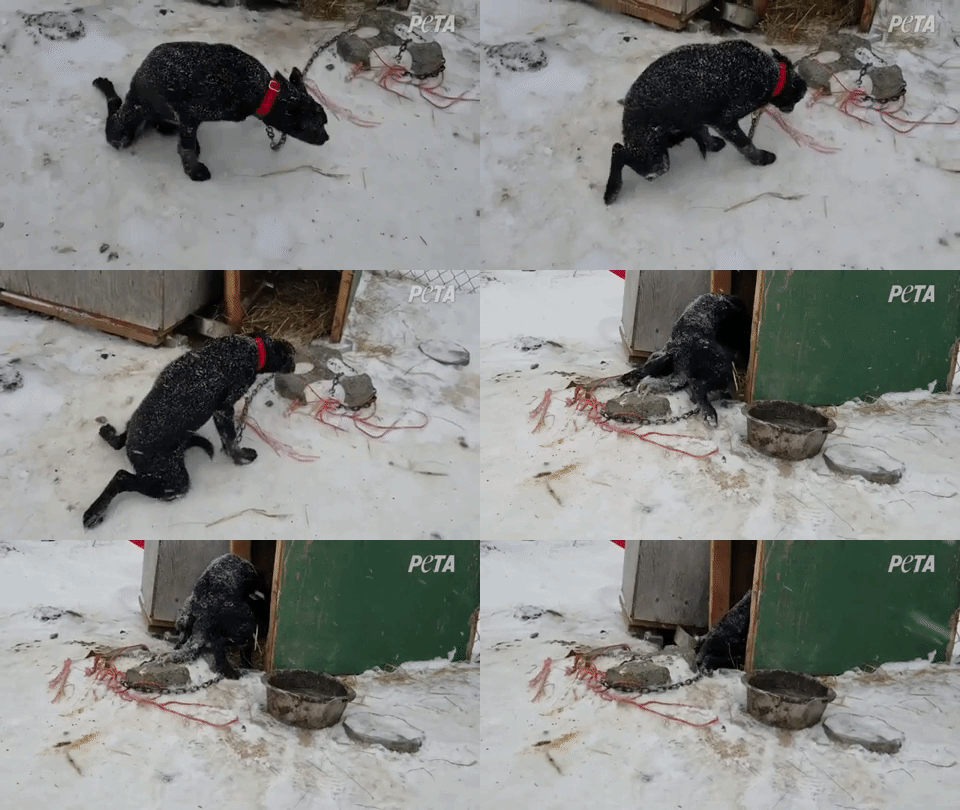
In a guest blog post, a PETA eyewitness who went to work at Team Baker Kennel—where past Iditarod “champion” John Baker and four-time Iditarod musher Katherine Keith kept their dogs—shared this:
This wasn’t exactly an easy decision for a person with a huge weakness for dogs. But these dogs were being used like heavy equipment. They were being raced to their deaths. And someone needed to shine a light on it.
Despite admitting that one dog, Birch, should be “put out of her misery” and that she was “not healthy,” Baker refused the investigator’s repeated offers to adopt her or provide her with veterinary care.
This is Birch. She endured horrific neglect at this kennel co-owned by former Iditarod “champion” John Baker. Despite sustaining a crippling, extremely painful spinal cord injury when she was just a puppy, she was denied veterinary care and chained in the freezing cold 24/7.
And this is from an investigator who went undercover at a massive chicken hatchery operated by a company supplying McDonald’s, KFC, Burger King, and other major fast-food chains:
Before taking this job, I knew some of the horrifying figures for chickens raised for meat and eggs—66 billion slaughtered worldwide each year, 9 billion in the U.S. alone. But as I found out, many victims of the chicken meat industry go uncounted, falling out of broken eggs and gasping on the cold concrete floor.
Thanks to this investigator, 25,790 people and counting have pledged to go vegan.
“I tried to grab loose eggs on the machine before they were crushed,” a PETA investigator recalls of their time spent undercover at a chicken hatchery supplying McDonald’s, KFC, and Burger King. “Sometimes, I wasn’t quick enough. I picked up one of these smashed eggs and the embryo came with it—but the head rolled out onto the table. My first thought was, ‘At least it was a quick death.’”
*****
PETA investigators are changing animals’ lives—and we need more folks who are interested in being heroes to animals.
In the last 13 years alone, our investigations have resulted in the following:
More than 1,200 criminal charges filed
More than 400 USDA citations issued
The closure of 20 facilities so far, sparing countless animals unimaginable suffering, terror, and agonizing deaths
If changing the world for animals sounds like something you want to be a part of, you’re in luck—PETA’s Cruelty Investigations Department is hiring.
You: Diligent, sensible, and ready to go above and beyond
Us: The largest and most effective animal rights organization on Earth
Together, let’s make a difference.
If you think you have the courage and wherewithal to be on the front line, we want to hear from you. Click on the buttons below to read more about position requirements.
Discover exactly what it takes to be a PETA investigator:
The U.S. Department of Justice (DOJ) and U.S. Department of Agriculture (USDA)’s Office of Inspector General have just removed at least 145 dogs found in “acute distress” from Envigo’s beagle-breeding facility in Cumberland County, Virginia, pursuant to a federal search warrant. The DOJ has also filed a 40-page complaint asking a federal court to permanently enjoin Envigo from violating the federal Animal Welfare Act (AWA). The moves follow USDA citations for more than 70 violations of the federal AWA since July 2021. Nearly 50 of the citations came in inspections prompted by a PETA exposé revealing hundreds of dead puppies and workers with no veterinary credentials injecting euthanasia drugs directly into puppies’ hearts without sedation—causing them immense pain—among other abuses.
Below, please find a statement from PETA Senior Vice President Daphna Nachminovitch:
Kudos to federal officials for finally taking the decisive action PETA has been calling for and getting dogs out of Envigo’s barren, cacophonous kennels, where workers sprayed them with high-pressure hoses and deprived them of food and veterinary care. PETA finds suffering like this every time we crack open an operation like Envigo, and this needs to be the beginning of the end for this hideous beagle-breeding mill.
For more information on PETA’s investigative newsgathering and reporting, please visit PETA.org or follow the group on Twitter, Facebook, or Instagram.
Anywhere groups of animals are closely confined—as they are in primate laboratories and on cargo planes filled with imported monkeys—monkeypox or other diseases can spill over to humans. Monkeypox, which likely originates in other species, has been found in U.S. primate laboratories in the past. Primate importation, breeding, and experimentation continue to pose infectious disease threats—PETA has documented the presence of Chagas, malaria, tuberculosis, West Nile Virus, and other diseases transmissible to humans in primate facilities across the country. In April, PETA released evidence that at least 2,000 monkeys were transported through multiple states recently without required veterinary inspections, putting humans at risk—prompting us to file a complaint with the U.S. Department of Agriculture, which the agency is now investigating. Ripping monkeys from their natural homes, shipping them around the globe, and confining them to cramped laboratory cages has already led to an Ebola scare and the deaths of humans from Herpes B. It’s time to end the dangerous practice of experimenting on primates now.
For more information on PETA’s investigative newsgathering and reporting, please visit PETA.org or follow the group on Twitter, Facebook, or Instagram.