
‘Giant Cow Head’ Landmark Meets Giant Anti-Dairy Message

Just in time for National Ice Cream Month, PETA has placed a new sky-high message right behind the Giant Cow Head landmark. In a twist on Edvard Munch’s “The Scream,” the new display alerts viewers to the fact that the dairy industry takes screaming calves away from their mothers shortly after birth so that their milk can be sold for human consumption instead.
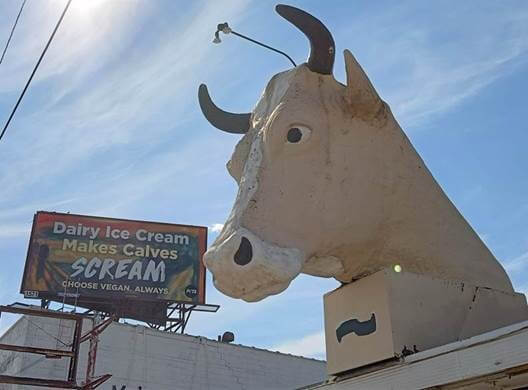
Photo courtesy of Karen Mouradjian

“Every scoop of dairy ice cream represents the misery and heartbreak of a mother cow and the calf who was stolen from her,” says PETA President Ingrid Newkirk. “PETA encourages everyone to put cruelty on ice and choose one of the many delicious vegan desserts on the market today.”

Nearly all of the 10 million cows who are abused for their milk each year in the U.S. are confined to cramped, filthy feedlots where they’re forced to stand on concrete flooring. PETA’s investigations into dairy facilities have found workers electroshocking cows in the face, hitting them with poles and a cane, and abusing them in other ways. It’s standard industry practice to artificially inseminate cows—workers insert an arm into the animals’ rectum and a metal rod to deliver semen into their vagina—and to send them to slaughter once their bodies wear out.

Cow’s milk is one of the leading food allergens among children, and millions of people—roughly 65% of the global population—are lactose intolerant. For all these reasons and more, vegan ice cream products—such as Oatly’s vegan ice creams in flavors like strawberry and hazelnut swirl, Ben & Jerry’s 20 vegan flavors, and Haagen-Dazs’ seven vegan offerings—are now flooding the market.

PETA’s billboard is located at 13031 Mack Ave. in Detroit, right behind the Giant Cow Head, viewable by traffic headed west on Mack Avenue.

PETA—whose motto reads, in part, that “animals are not ours to eat or abuse in any other way”—opposes speciesism, a human-supremacist worldview that fosters violence toward other animals. For more information, please visit PETA.org or follow the group on Twitter, Facebook, or Instagram.

The post ‘Giant Cow Head’ Landmark Meets Giant Anti-Dairy Message appeared first on PETA.
Judge Approves Plan to Transfer All 4,000 Surviving Beagles at Envigo to Shelters for Adoption

In the latest written order issued in the U.S. Department of Justice’s (DOJ) civil case against Envigo, Senior U.S. District Court Judge Norman K. Moon denied the company’s second attempt to gain permission to fulfill a sister entity’s contracts for approximately 2,100 beagles. Judge Moon wrote, “When the Court issued its Injunction …, it gave Envigo no more and no less than what it asked for. Which was to be permitted to fulfill ‘Envigo’s contractual obligations to its customers.’”

Accordingly, the DOJ and Envigo submitted a plan for the Humane Society of the United States to remove “all” approximately 4,000 surviving dogs from Envigo’s Cumberland, Virginia, facility so that they can be adopted. Today, in an oral order, Judge Moon approved the plan, which calls for the company to pay $100 per dog—and $150 per dog nursing a litter younger than 8 weeks—to help defray shelters’ costs in adopting out the animals. A hearing on whether this plan will be incorporated into Judge Moon’s preliminary injunction against Envigo—or a settlement between the DOJ and Envigo—is expected within 10 days.

“PETA’s groundbreaking undercover investigation helped spark a historic domino effect of state and federal legislative and law-enforcement action that paved the way for these dogs’ independence and this dog prison’s closure,” says PETA Senior Vice President of Cruelty Investigations Daphna Nachminovitch. “Envigo’s surviving victims will soon be given the opportunity to have what every dog deserves—the freedom to enjoy life, love, and respect for their individuality as members of a family home.”

In responding to Envigo’s latest efforts to sell 2,200 of the dogs in Cumberland for experimentation, the DOJ notes that the company “attempt[ed] to downplay the fact that it … wants to fulfill orders of another Inotiv subsidiary …. These contracts were entered into by a separate subsidiary, which is not a party to this case, is registered as a different entity with the Virginia Secretary of State, and appears to have its own Animal Welfare Act dealer license. For Envigo RMS to suggest that it does not matter which business entity is party to the contract is puzzling at best.”

PETA—whose motto reads, in part, that “animals are not ours to experiment on”—conducted a seven-month undercover investigation into Envigo. Broadcast-quality video footage from the group’s investigation is available here, and photographs from the investigation are available here.

For more information on PETA’s investigative newsgathering and reporting, please visit PETA.org or follow the group on Twitter, Facebook, or Instagram.

The post Judge Approves Plan to Transfer All 4,000 Surviving Beagles at Envigo to Shelters for Adoption appeared first on PETA.

Photos: Tormented ‘Monkey’ at Dulles Blasts EGYPTAIR for Primate Transport

A “mutilated monkey” led PETA supporters as they converged on Dulles International Airport this morning to unfurl a banner proclaiming, “Cruelty Doesn’t Fly: EGYPTAIR, Ban Monkey Shipments!” The action is part of a campaign by PETA entities calling on EGYPTAIR to stop shipping monkeys to laboratories, as other major airlines have done. Just days ago, after a longstanding PETA U.S. campaign, Air France announced that it will end all shipments of monkeys for the experimentation industry. More photos of the protest are available here.

“Monkeys are removed from their homes in nature or bred on squalid farms, stuffed into shipping crates, and loaded onto EGYPTAIR planes for terrifying 30-hour journeys to U.S. laboratories,” says PETA Senior Vice President Kathy Guillermo. “PETA is calling on EGYPTAIR to join nearly every other airline in refusing to ship monkeys slated to be used in failed experiments in this age of state-of-the-art, modern methodologies such as organs-on-chips and bioinformatics.”

In just the past three months, the airline has reportedly flown nearly 5,000 monkeys into the U.S., posing a grave public health risk and causing immense suffering to the animals, who are packed into small wooden crates and locked inside cargo holds. Those who survive the journey to laboratories may be mutilated, poisoned, deprived of food and water, forcibly immobilised, infected with painful and deadly diseases, psychologically tormented, and killed.

During the past two weeks, PETA entities have held protests to call on EGYPTAIR to stop shipping monkeys to laboratories, including at EGYPTAIR terminals in Frankfurt, London, and New York.

More information about the EGYPTAIR campaign is available here.

The post Photos: Tormented ‘Monkey’ at Dulles Blasts EGYPTAIR for Primate Transport appeared first on PETA.

Worried About Skin Cancer? Eating Fish Found to Be Associated With Melanoma

If you slather on sunscreen all summer to decrease the odds of developing skin cancer, there’s something else that could help tip the scales—stop eating fish.

Study Suggests That Consuming Fish Is Associated With Skin Cancer

A study from Brown University found that regularly eating nonfried fish seems to be associated with a greater risk of malignant melanoma, the fifth most common cancer in the U.S. Using a dataset from 1995, the researchers analyzed data from over 490,000 adults, who reported how often they ate fried fish, nonfried fish, and tuna over the course of a year. The research team then calculated the incidence of new melanomas, after adjusting for other factors. They found that higher intake of nonfried fish and tuna were associated with an increased risk of the cancer.

Based on the limits of the 1995 dataset, the researchers have not yet been able to confirm their suspicion that mercury and other toxins found in fish via bioaccumulation are to blame for the link with melanoma. However, if this is proved true, it’s worth noting that the U.S. National Science Foundation found the concentration of mercury in fish has only increased with time, likely due to increased fishing and the climate catastrophe.

Go Vegan for Your Health

Filling your plate with meat, eggs, and dairy products could be a recipe for heart disease, cancer, diabetes, and even impotence. Leading health experts agree that going vegan is the best thing we can do for ourselves and our families. Well-balanced vegan diets support a lifetime of good health and protect against numerous diseases, including some of our country’s biggest killers: heart disease, cancer, and strokes.

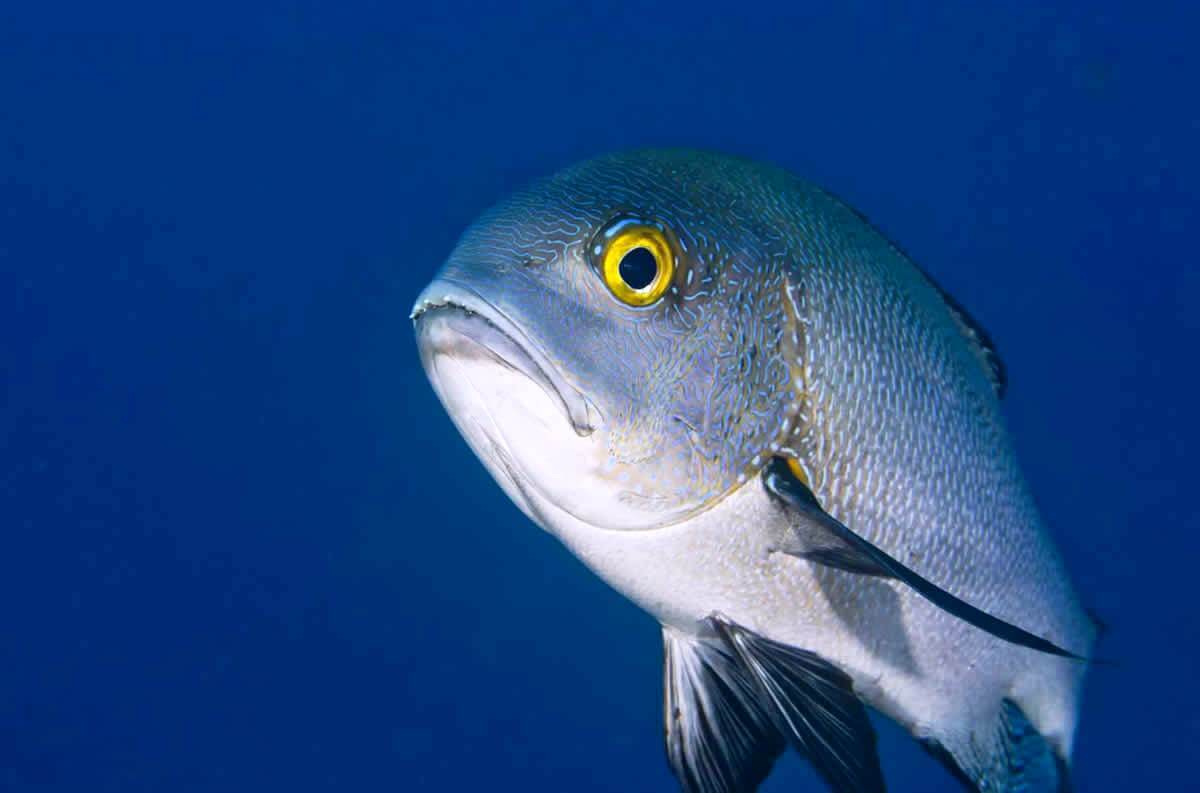
Midnight snapper fish© iStock.com/Liquid_Light

Getting to Know Fish

When you get to know who fish are, you’ll want to stop eating them. They’re smart, social animals with unique personalities, and just like dogs, cats, and humans, they feel pain and fear. Fish even have complex social relationships with each other and are “steeped in social intelligence,” according to the journal Fish and Fisheries. Imagine the trauma that you’d experience if someone wrecked your home and dragged your friends and family off to be eaten!


Ready to ditch animal products but don’t know how to start? We’re here to help. Take PETA’s 3-Week Vegan Challenge and we’ll support you every step of the way with recipes, resources, and meal plans to make eating vegan on a budget a breeze.

The post Worried About Skin Cancer? Eating Fish Found to Be Associated With Melanoma appeared first on PETA.

FDA Devising Clinical Trials for Pig-to-Human Transplants: PETA Statement

Please see the following statement from PETA Senior Vice President Kathy Guillermo on the U.S. Food and Drug Administration’s (FDA) reported plans for animal-to-human clinical trials:

FDA officials have lost their minds. Allowing clinical trials of xenotransplants to go forward after a man who received a pig’s heart lived just 45 days and contracted a virus known to affect pigs is inviting disaster. Contrary to the pig-abusing profiteers’ claims, there is no way to ensure that pigs are virus-free. Every animal-to-human transplant represents hundreds of pigs’ lives and the risk of a new pandemic. Cleaning up the organ procurement business, which wastes as many as 28,000 organs annually, and enacting presumed consent laws would save human lives, spare animals, and protect us from dangerous pathogens that can easily jump from one species to another.

For more information on PETA’s investigative newsgathering and reporting, please visit PETA.org or follow the group on Twitter, Facebook, or Instagram.

The post FDA Devising Clinical Trials for Pig-to-Human Transplants: PETA Statement appeared first on PETA.