Judge Denies Envigo’s Motion; All 4,000 Surviving Beagles May Soon Be Bound for Adoption

In the latest order issued in the U.S. Department of Justice’s (DOJ) civil case against Envigo, Senior U.S. District Court Judge Norman K. Moon denied the company’s second attempt to gain permission to fulfill a sister entity’s contracts for approximately 2,100 beagles. Judge Moon wrote, “When the Court issued its Injunction …, it gave Envigo no more and no less than what it asked for. Which was to be permitted to fulfill ‘Envigo’s contractual obligations to its customers.’”

Accordingly, the DOJ and Envigo have just submitted a plan for the Humane Society of the United States to remove “all” approximately 4,000 surviving dogs from Envigo’s Cumberland, Virginia, facility so that they can be adopted. The plan calls for the company to pay $100 per dog—and $150 per dog nursing a litter younger than 8 weeks—to help defray shelters’ costs in adopting out the animals. A hearing on whether this plan will be incorporated into Judge Moon’s preliminary injunction against Envigo—or a settlement between the DOJ and Envigo—is expected soon.

“Envigo’s surviving victims will soon be given the opportunity to have what every dog deserves—the freedom to enjoy life, love, and respect for their individuality as members of a family home,” says PETA Senior Vice President of Cruelty Investigations Daphna Nachminovitch. “PETA’s groundbreaking undercover investigation helped spark a historic domino effect of state and federal legislative and law-enforcement action that paved the way for these dogs’ independence and this dog prison’s closure.”

In responding to Envigo’s latest efforts to sell 2,200 of the dogs in Cumberland for experimentation, the DOJ notes that the company “attempt[ed] to downplay the fact that it … wants to fulfill orders of another Inotiv subsidiary …. These contracts were entered into by a separate subsidiary, which is not a party to this case, is registered as a different entity with the Virginia Secretary of State, and appears to have its own Animal Welfare Act dealer license. For Envigo RMS to suggest that it does not matter which business entity is party to the contract is puzzling at best.”

PETA—whose motto reads, in part, that “animals are not ours to experiment on”—conducted a seven-month undercover investigation into Envigo. Broadcast-quality video footage from the group’s investigation is available here, and photographs from the investigation are available here.

For more information on PETA’s investigative newsgathering and reporting, please visit PETA.org or follow the group on Twitter, Facebook, or Instagram.

The post Judge Denies Envigo’s Motion; All 4,000 Surviving Beagles May Soon Be Bound for Adoption appeared first on PETA.

Meet the Dog Who Helped Inspire a National News Story: Lady, Finally Unchained

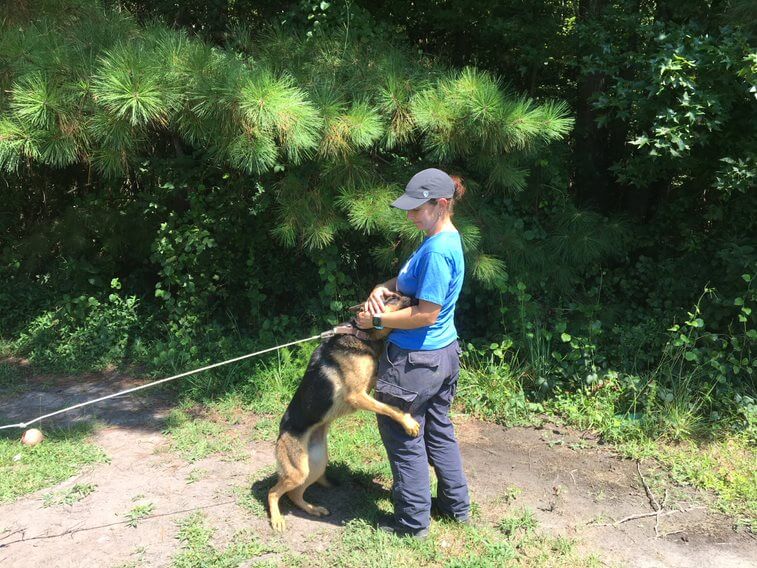
Chained and forgotten in “No-No Land,” Lady—a 6-year-old German shepherd whom PETA fieldworkers had been helping since 2017—garnered national attention, thanks to The Washington Post Magazine cover story “A Dog’s Life: Why Are So Many People Cruel to Their Dogs?” The piece by journalist Gene Weingarten and photojournalist Michael S. Williamson, both two-time Pulitzer Prize winners, shined a spotlight on the cruel treatment of dogs in rural North Carolina.

Since meeting Lady, PETA’s fieldworkers spayed her; provided her with a sturdy, custom-made doghouse and lightweight tether; and checked on her every chance they could—their visits were likely the only kindness or respect she received.

Lady was so desperate for comfort, love, and affection that she would wrap her arms around PETA staff in a tight hug whenever they came within range of her chain, as described in the article:

They are literally and figuratively at the end of their rope … most are filled with anxiety, and unnaturally needy: When you are there, they don’t want you to leave. They will hold on to you with their front legs in a bear hug that seems to defy the natural limitations of a dog’s skeleton and musculature. —Gene Weingarten, The Washington Post Magazine

For years, PETA begged Lady’s owner to relinquish her, but she stubbornly refused, as she cared more about “owning” Lady than actually caring for her. But all that changed this June, when her owner grew so tired of the fieldworkers’ persistence that she finally relented. With the help of friends at the Chesapeake Humane Society, Lady will spend her life indoors with a guardian who will care for her and treat her with kindness and respect—which she has received only from PETA’s team until now—and she will never be chained again.

Take Action for Chained Dogs

While Lady’s story ends with the chain coming off, many dogs are trapped in this hellish existence, tethered to one spot in scorching summers and freezing winters, often without adequate food or water, all day, every day. To better understand the plight of chained dogs, check out PETA’s documentary Breaking the Chain and learn what you can do to help them.

The post Meet the Dog Who Helped Inspire a National News Story: Lady, Finally Unchained appeared first on PETA.

PETA Statement re Bob Baffert Remaining in the Hall of Fame

Please see the following statement from PETA Senior Vice President Kathy Guillermo regarding the National Museum of Racing and Hall of Fame’s decision not to expel trainer Bob Baffert:

The National Museum of Racing and Hall of Fame has turned itself into a vanity project for the industry’s old guard. Bob Baffert is the poster boy for all that’s wrong in racing, from drugs and horse deaths to being disqualified from the Kentucky Derby and banned from Churchill Downs for two years. Yet his position in the Hall of Fame remains secure. The entire racing industry should come together and reject anyone whose success was built on a pile of dead horses and violations.

PETA—whose motto reads, in part, that “animals are not ours to use for entertainment or abuse in any other way”—opposes speciesism, a human-supremacist worldview. For more information, please visit PETA.org or follow the group on Twitter, Facebook, or Instagram.

The post PETA Statement re Bob Baffert Remaining in the Hall of Fame appeared first on PETA.

Don’t Give Refugee Pigeon Back to Racer, PETA Urges Shelter

Following reports that a pigeon named Bob, sent over the English Channel in a British pigeon race, was found 4,000 miles away in Alabama and is now in the care of the Monroe County Animal Shelter, PETA sent an urgent letter today to shelter Director Sue Evans urging her not to return Bob to the man who used him for pigeon racing, a hidden cruelty that badly exploits and kills birds. As PETA’s pigeon-racing exposés have revealed, the casualty rate of birds flying over the channel is so high that many racers refer to it as the “graveyard,” and the North of England Homing Union, with which Bob is reportedly registered, was compelled to apologize for the many birds lost in an “awful” race last year.

Bob is presumed to have landed on a U.S.-bound ship in the English Channel—and as PETA points out, there’s no doubt that others in the race drowned. In pigeon racing, domesticated birds (who are unable to fend for themselves in nature) are abandoned to the elements and struggle to find their way home and more than 60% of birds won’t return from a typical race.

“If birds used in British pigeon races don’t drown in the English Channel, they are often ‘culled’ as ‘losers’ by racers who snap their necks or gas them with car exhaust,” says PETA Senior Vice President of Cruelty Investigations Daphna Nachminovitch. “Bob the pigeon beat the odds to make it to safety, and PETA is calling on the Monroe County Animal Shelter to let him live out the rest of his days in peace.”

The group notes that an adoptive home is waiting for Bob with a PETA staffer who currently cares for two other rescued pigeons and has years of experience rehabilitating birds from the racing industry.

PETA—whose motto reads, in part, that “animals are not ours to use for entertainment or abuse in any other way”—opposes speciesism, a human-supremacist worldview. For more information, please visit PETA.org or follow the group on Twitter, Facebook, or Instagram.

PETA’s letter to Evans follows.

July 1, 2022

To:      Sue Evans, Director, Monroe County Animal Shelter

From:  Colin Henstock, Assistant Manager of Investigations, People for the Ethical Treatment of Animals

Re: Urgent Plea on Behalf of Bob the Pigeon

Dear Ms. Evans:

Your attention is urgently and respectfully requested. I’m writing with regard to Bob the pigeon, whom we understand your agency intends to return to the man who cruelly subjected him to the Guernsey race several weeks ago. We urge you to view the results of our investigation into similar U.K. pigeon races, which led to the deaths of thousands of birds.

Crossing the English Channel is one of the major dangers facing pigeons released outside the U.K. for races. The channel can be 150 to 200 miles wide at some crossings, and the birds cannot see land on the other side to use as a navigational reference. The casualty rate over the channel is so high that many racers refer to it as the “graveyard.”

But crossing the channel isn’t the only cause of the massive death rate for birds forced to race—they also succumb to storms, exhaustion, starvation, predation, and collisions with power lines. For the birds who do make it home, there is no guarantee of a happy ending, because of the widespread practice of culling. After the races are over, most of the pigeons who didn’t finish in the money or aren’t kept for breeding are deemed useless and then “culled” (killed) by cruel methods such as neck-breaking, drowning, or gassing with car exhaust. PETA investigators filmed such killings in England.

Bob is extremely fortunate to have found a ship to land on when he was exhausted. There is no doubt that many other birds in that race drowned in the channel. The North of England Homing Union held an especially poorly organized race last year, for which it was forced to apologize about the many birds lost due to poor planning.

If a dog or cat were abandoned in a similar manner in the state of Alabama, the person who did so would be prosecuted for cruelty to animals. Therefore, PETA respectfully asks you not to return Bob to the man who callously abandoned him. If you would be willing to transfer him, PETA has staff on hand with extensive experience in rehabilitating and caring for pigeons. 

Thank you in advance for your time and consideration and for the vital work that you do. I look forward to hearing from you.

Sincerely,

Colin Henstock

Assistant Manager of Investigations

The post Don’t Give Refugee Pigeon Back to Racer, PETA Urges Shelter appeared first on PETA.