Rescue of 4,000 Beagles Prompts PETA Push: Empty ALL Laboratory Cages!

Four thousand beagles bred for the experimentation industry are being released from the soon-to-be-shuttered animal supplier Envigo—but now PETA is pointing out that although these dogs are getting a new lease on life, tens of thousands of others remain imprisoned in barren laboratory cages across the country, subjected to painful, invasive, and ultimately fruitless experiments before being killed. That’s why PETA is calling on the National Institutes of Health (NIH) to take a cue from the Envigo facility’s pending closure, phase out all animal experiments, and adopt the group’s Research Modernization Deal, which offers a strategy for implementing modern, non-animal research methods—such as organs-on-chips and high-speed computers programmed with human data—that actually stand a chance of resulting in viable treatments and cures for humans.

“This isn’t only a feel-good story about rescued dogs—the beagles from Envigo represent the countless victims of the cruelty and pointlessness of all experiments on animals,” says PETA Senior Vice President Kathy Guillermo. “Every animal supplier and laboratory needs to be shut down, and NIH can start by dumping failed animal tests and funding scientifically superior, human-relevant studies.”

Prior to its imminent closure, the Envigo facility funneled dogs to laboratories, including the Medical University of South Carolina, Temple University and the University of Missouri-Columbia, where they endured horrific torment. In one test, experimenters cut incisions in beagles’ heads, drilled holes into their skulls, and injected a chemical solution into their brains. Some dogs were killed immediately, while others were kept alive for six weeks and then killed. In another study, beagle puppies were infected with staph bacteria, causing them to experience multi-organ failure, sepsis, severe shock, and death. In another study, experimenters damaged the bladders of puppies by using a pump to fill their bladders, inserted catheters into their rectums, cut into their abdomens to attach electrodes, and then severed their spinal cords. Envigo will soon be out of the beagle-breeding, laboratory-supplying picture, but other notorious operations, such as Marshall Farms in New York—which houses a staggering 21,000 dogs—and Ridglan Farms in Wisconsin, continue to do robust business supplying trusting, gentle beagles and other dogs for use in experiments such as these.

About 110 million animals—each an individual who feels pain and fear—suffer and are killed every year in U.S. laboratories, yet 95% of new drugs that test safe and effective in animal studies go on to fail or cause harm in human clinical trials.

PETA—whose motto reads, in part, that “animals are not ours to experiment on”—opposes speciesism, a human-supremacist worldview. For more information on PETA’s investigative newsgathering and reporting, please visit PETA.org or follow the group on Twitter, Facebook, or Instagram.

The post Rescue of 4,000 Beagles Prompts PETA Push: Empty ALL Laboratory Cages! appeared first on PETA.

Heat Hazard for Horses: Cancel Monmouth Park Races, Urges PETA

With temperatures expected to reach the mid-90s in New Jersey this weekend, PETA rushed a letter today to Monmouth Park Director of Racing and Racing Secretary John Heims, urging him to cancel the upcoming races if the heat stress index exceeds 160, noting that high temperatures can put horses at risk of incurring brain damage, heatstroke, and fatal cardiac trauma. The group also requested that, regardless of the heat stress index, officials allocate more time for thorough pre-race exams to identify any signs of distress, dehydration, or heatstroke in horses.

PETA is particularly concerned about the Baffert-trained horse Taiba, slated to run in the Haskell Stakes, given the number of horses from his barn—including Medina Spirit—who have mysteriously collapsed and died.

“Horses are pushed to the limit every time they race, and the added physical stress caused by skyrocketing temperatures can have deadly consequences,” says PETA Senior Vice President Kathy Guillermo. “PETA is calling on Monmouth Park to prevent another tragedy by canceling races in the face of extreme heat.

PETA—whose motto reads, in part, that “animals are not ours to use for entertainment”—opposes speciesism, a human-supremacist worldview. For more information, please visit PETA.org or follow the group on Twitter, Facebook, or Instagram.

PETA’s letter to Heims follows.

July 22, 2022

John Heims

Director of Racing and Racing Secretary

Monmouth Park

Dear Mr. Heims:

I’m writing on behalf of People for the Ethical Treatment of Animals U.S.—PETA entities have more than 9 million members and supporters globally—to urge you to protect horses by suspending racing at Monmouth Park if the heat stress index exceeds 160 and to take additional steps to guard against the effects of the high temperatures.

Temperatures are expected to reach close to 94 degrees in Oceanport on Saturday, when races are scheduled to be held. The temperature and the heat index are forecast to be even higher on Sunday. Horses are pushed to the limit every time they race, and the additional stress of skyrocketing temperatures can cause brain damage, collapse as a result of heatstroke, and fatal cardiac trauma.

If the heat stress index is below 160 and races are conducted, extra caution should be taken and additional protocols should be implemented, including allocating more time for thorough pre-race exams to identify any signs of distress, dehydration, or heatstroke.

Given Bob Baffert’s history of training horses who suddenly and mysteriously collapse and die, including Medina Spirit—who died suddenly and unexpectedly at Santa Anita Park—these precautions are especially important for the Baffert-trained Thoroughbred Taiba.

There are many examples of horses who have experienced breakdowns or collapse because of heat, including Merciless Cat, who endured a catastrophic breakdown when his aorta burst while the temperature at the track was over 100 degrees—video footage of this incident is available here.

To protect the health of horses and jockeys, tracks across the country have previously postponed races when high temperatures or heat indexes were expected, including Laurel Park in Maryland, which has canceled races this weekend, as dangerous temperatures are forecast there.

An average of three horses die in racing every day, and extreme heat can easily add to this death toll. By suspending racing until temperatures cool down, racetracks can help forestall further heat-related deaths. Please take immediate action to protect horses in New Jersey.

Thank you for your consideration. I look forward to hearing from you.

Sincerely,

Kathy Guillermo

Senior Vice President

Equine Matters Department

The post Heat Hazard for Horses: Cancel Monmouth Park Races, Urges PETA appeared first on PETA.

Highway and Newspaper Appeals Champion Whistleblowers Who Exposed Cruel Farm

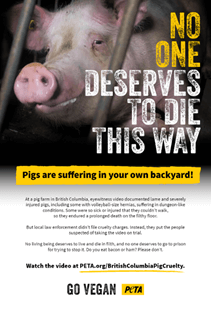
PETA believes factory farmers, not those who show the world what’s going on inside their wretched facilities, should be in court, yet that’s not the case when it comes to two activists who face sentencing after prosecution for live-streaming the volleyball-size hernias and illness afflicting pigs on Excelsior Hog Farm, so PETA is launching local, can’t-be-missed appeals urging everyone to vote with their food budget by leaving animals off their plates.

Featuring an image of a mother pig the activists found crammed inside a metal crate, an urgent message in tomorrow’s edition of the Vancouver Sun will slam law enforcement for prosecuting the whistleblowers rather than the animal abusers. And on Highway 91, PETA has just placed a sky-high vegan plea that includes an image of a piglet cradled in someone’s arms—not in a dirty pen or left to rot, as the local activists found was the case for animals on the farm.

“These wonderful people risked their own freedom to show consumers piles of dead pigs, blood and filth everywhere, and piglets unable to reach their mothers,” says PETA President Ingrid Newkirk. “PETA is calling on everyone to reject cruelty to animals by simply choosing healthy vegan meals.”

Sows at Excelsior Hog Farm—which is owned in part by Ray Binnendyk, a member of the board of directors of the BC Pork Producers Association—were forced to give birth in farrowing crates hardly bigger than their bodies, and they could nurse but not otherwise tend to their babies for the first weeks of their lives, causing many to die unattended. Sentencing for the activists who documented this abuse is scheduled for August 26.

On other farms, animals fare no better: Pigs’ tails are chopped off, their teeth are cut with pliers, and males are castrated—all often without pain relief. At the slaughterhouse, they’re hung upside down and bled to death. Each person who goes vegan saves the lives of nearly 200 animals every year.

PETA’s billboard is located along the Alex Fraser Bridge on Highway 91, just south of the interchange with Highway 17.

PETA—whose motto reads, in part, that “animals are not ours to eat”—opposes speciesism, a human-supremacist worldview. For more information on PETA’s investigative newsgathering and reporting, please visit PETA.org or follow the group on Twitter, Facebook, or Instagram.

The post Highway and Newspaper Appeals Champion Whistleblowers Who Exposed Cruel Farm appeared first on PETA.