Teen’s Arrest in Cat Killing Prompts PETA’s Push for Empathy Lessons to Prevent Future Violence

Amid reports of local residents discovering that their cats were dead or missing, 18-year-old Colin Lendewig was arrested on Tuesday and charged with both cruelty to animals and petty theft after home surveillance video captured him stealing cats and then appearing to kill one just off camera. In response, TeachKind, PETA’s humane education division, sent an urgent letter this morning to San Juan Unified School District Superintendent Kent Kern providing educators with kindness-to-animals curricula and “Empathy Now,” a guide to preventing all kinds of violence by young people. Research shows that 43% of school shooters, including the perpetrator at Robb Elementary School in Uvalde, Texas, first committed acts of cruelty against animals.

“If a teenager has been killing cats in the area, alarm bells signaling even greater danger ahead should be sounding and urgent intervention is needed to protect all sentient beings,” says PETA Senior Director of Youth Programs Marta Holmberg. “Compassion and empathy can be learned, and TeachKind is on standby to help teach young people that violence is wrong, whether the victim is a cat or a classmate.”

Juvenile animal abusers are a known potential serious threat to the community. That’s also one of the reasons why PETA urges people to keep their cats indoors. Dogs and cats should never be allowed to roam unattended outdoors, where they may be taken, attacked by other animals, or abused by cruel people.

TeachKind—whose motto reads, in part, that “animals are not ours to abuse in any way” and which opposes speciesism, a human-supremacist worldview—is also offering to send schools its free high school empathy-building curriculum, Challenging Assumptions, and its Share the World program kit for elementary school students in the area.

For more information, please visit TeachKind.org or follow the group on Facebook or Instagram.

The post Teen’s Arrest in Cat Killing Prompts PETA’s Push for Empathy Lessons to Prevent Future Violence appeared first on PETA.

Shut Down Seaquarium! ‘Crying Dolphin’ to Protest Over Starved and Stressed Animals, Bitten Visitors

On Saturday, a “crying dolphin” will lead a coalition of PETA supporters in urging Miami-Dade County to shut down the Miami Seaquarium after a new federal inspection report just obtained by PETA documented employees’ practice of starving dolphins into submission and forcing them to perform more often, causing them to attack trainers and bite visitors out of sheer stress.

When:      Saturday, October 29, 12 noon

Where:     The Miami Seaquarium, 4400 Rickenbacker Cswy., Key Biscayne

PETA points out that animals are still suffering, even after county officials committed to greater oversight of the facility following a damning report last year that revealed a slew of animal welfare violations, including feeding animals rotten fish, forcing lone orca Lolita to perform tricks that likely injured her jaw, and housing incompatible dolphins together, which resulted in deaths.

“Miami-Dade County officials assured the public that things would change at the Seaquarium, yet Lolita continues to languish in the world’s smallest orca tank and dolphins are being starved and deprived of any semblance of a meaningful life,” says PETA Executive Vice President Tracy Reiman. “PETA is calling on officials to shut down this seedy abusement park and compel it to send these long-suffering animals to seaside sanctuaries, where they would finally be able to start recovering from their lifetime of trauma. Time’s up!”

PETA—whose motto reads, in part, that “animals are not ours to use for entertainment”—opposes speciesism, a human-supremacist worldview. For more information, please visit PETA.org or follow the group on Twitter, Facebook, or Instagram.

The post Shut Down Seaquarium! ‘Crying Dolphin’ to Protest Over Starved and Stressed Animals, Bitten Visitors appeared first on PETA.

Harry Styles, ‘Chicken Champion,’ Inspires PETA’s New Halloween Costume!

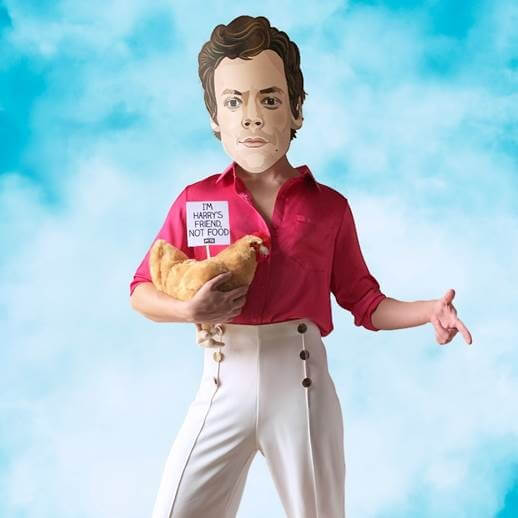
He may be a music and movie star, but Harry Styles won many hearts when he told fans, “I don’t eat chicken. … I don’t eat meat” after a chicken nugget was tossed onstage during a concert at Madison Square Garden—and now PETA has immortalized this “Champion for Chickens” with a limited-edition Halloween costume, available for purchase starting today. PETA hopes the costume—which includes a Harry Styles mask and a plush chicken sporting an “I’m Harry’s Friend, Not Food” sign—will inspire Stylers to give a cluck for chickens, just as he does. Each costume also comes with a vegan starter kit.

“Hearing Harry defend chickens onstage was music to our ears,” says PETA President Ingrid Newkirk. “This costume is PETA’s way of saying, ‘Harry, we adore you, and we urge everyone to do as you do and treat animals with kindness, as friends, not food.’”

Anyone who goes vegan spares nearly 200 animals a year daily suffering and terrifying deaths. Birds killed for their flesh are confined by the tens of thousands to severely crowded, filthy sheds and trucked through all weather extremes to slaughterhouses, where their throats are slit—often while they’re still conscious. Going vegan also shrinks our carbon footprint and our risk of suffering from heart disease, diabetes, strokes, cancer, and other life-threatening conditions.

PETA also released a Dr. Anthony Fauci costume this year, which is available here and selling well. It includes a mask, a white lab coat, a syringe, and a stuffed beagle (like the 4,000 dogs recently rescued from laboratory supplier Envigo following a PETA investigation) plus a “Good Riddance, Fauci” collar tag in celebration of his pending retirement.

PETA—whose motto reads, in part, that “animals are not ours to eat”—opposes speciesism, a human-supremacist worldview. For more information, please visit PETA.org or follow the group on Twitter, Facebook, or Instagram.

The post Harry Styles, ‘Chicken Champion,’ Inspires PETA’s New Halloween Costume! appeared first on PETA.

The World Is on Fire—Christine Lattin’s Plan? Scare Birds With Pink Puffs

The West Coast is burning, ice caps are melting, once-expansive rainforests are shrinking, and hurricanes are pummeling our coastal cities more violently than ever before. What’s Louisiana State University (LSU) experimenter Christine Lattin’s plan to confront the climate catastrophe? Plopping cocktail umbrellas and pink puffs in front of hungry, traumatized sparrows to see what happens.

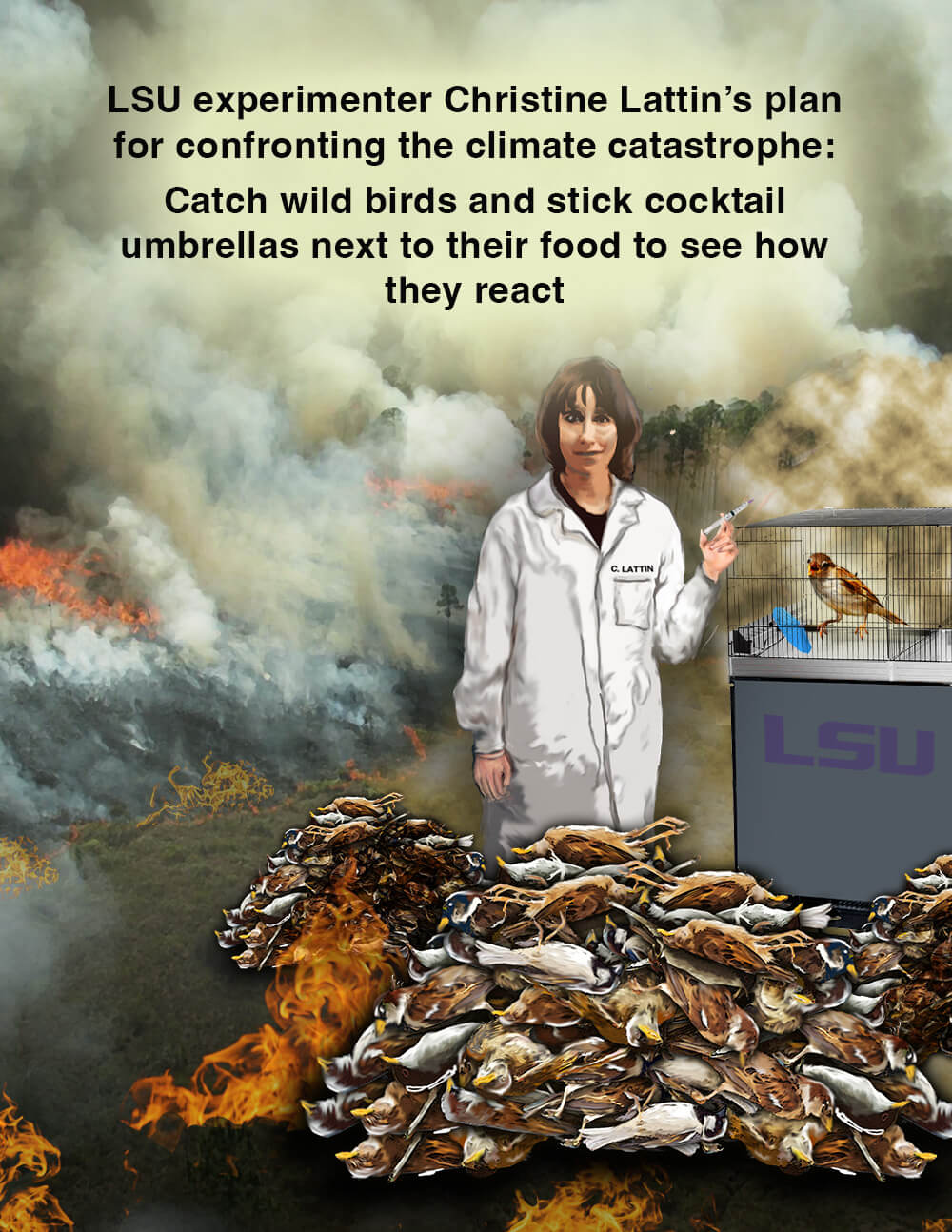
LSU experimenter Christine Lattin's plan for confronting the climate catastrophe: Catch wild birds and stick cocktail umbrellas next to their food to see how they react

While real scientists analyze samples of ice and soil, run complex computer simulations, and observe animals without interference in their natural habitat, Lattin dithers away in her laboratory, adding more small bodies to the ever-growing mountain of carcasses she has accumulated in more than a decade of grisly experimentation. She claims that her ongoing reign of terror will somehow yield information relevant to addressing the climate catastrophe and other human-caused environmental challenges. Although state and federal governments have produced book-length treatises on how to confront these critical issues, her strategy is simple:

  1. Lure unsuspecting sparrows and other birds into nets and imprison them in a laboratory. (Don’t be concerned if a few are so distressed that they die shortly after capture.)
  2. Prohibit the birds from eating for up to 15 hours so that they’re easier to manipulate in exchange for food.
  3. Give them their food back, but make sure they can’t get to it without going near a random object that you know will probably scare them—like a pink puff ball, a gold bell, or an opened blue cocktail umbrella. Watch how they react!
  4. Kill the birds—all of them—and dice up their brains.

Christine Lattin’s other strategies for tackling urgent ecological problems have included terrifying nesting pairs and their babies with recorded predator sounds, stuffing birds into bags, forcing them to eat crude oil, rolling them on a cart so they couldn’t perch, rattling their cages, blasting a radio in the animal room, cutting chunks out of their legs, and ripping out their feathers.

To the surprise of no one, the planet is still in deep trouble.

While Suffering Surrounds Her, Christine Lattin Causes More

Lattin’s spectacular fusion of absurdity, cruelty, and violence may be a foolproof strategy for generating more misery in the world, but it’s hardly a promising methodology for understanding how animals respond to stressors in their environment—many of which are brought on or exacerbated by the climate catastrophe—as she claims. Sparrows and starlings are physiologically distinct from other animals in ways that make the results of her experiments inapplicable to humans and other species.

If Lattin sincerely wants to address the climate catastrophe with her research, she need not try to simulate its effects in her laboratory by kidnapping and traumatizing unwilling victims. The climate catastrophe is here now—and the suffering it creates can already be studied in various ways in nature. There’s simply no excuse for causing more.

To Fight the Climate Catastrophe, Fight Speciesism

Throughout her career, Christine Lattin has captured, terrorized, and killed hundreds, perhaps thousands, of vulnerable birds for experiments with little or no relevance to humans or other species. The philosophy that undergirds her experiments—that it’s acceptable to harm other animals, deny them control over their own lives, and even kill them for the slightest possibility of a benefit to humans—is called speciesism. And it’s a big part of what got us into the climate catastrophe in the first place.

Speciesism fuels many of humans’ most environmentally ruinous practices. We destroy the rainforest for a hamburger, poison the water for a handbag, and decimate native species for worthless data. If animals have something humans want, we take it—their home (our home!) be damned.

Scaring sparrows with yellow pipe cleaners and blinking lights won’t help fix the total mess we’ve created. A change in our attitudes and behavior toward our fellow earthlings, however, will.

Take action now to urge LSU to strike at the root of the climate catastrophe by ending Lattin’s speciesist experiments.

The post The World Is on Fire—Christine Lattin’s Plan? Scare Birds With Pink Puffs appeared first on PETA.