
From Fearful Five to Fabulous Friends: Meet These Adoptable Kittens

PETA’s Bea Arthur Dog Park—with its scenic river views, space to run, and shaded picnic area—is a beloved destination for dogs and their guardians in Norfolk, Virginia. Because of its popularity with the canine contingent and because it’s so dangerous for cats to be outdoors alone, four abandoned kittens would be the last animals you’d expect to find there. But that’s just who PETA employees spotted one day, cowering in the bushes and trying desperately to dart through the fence.
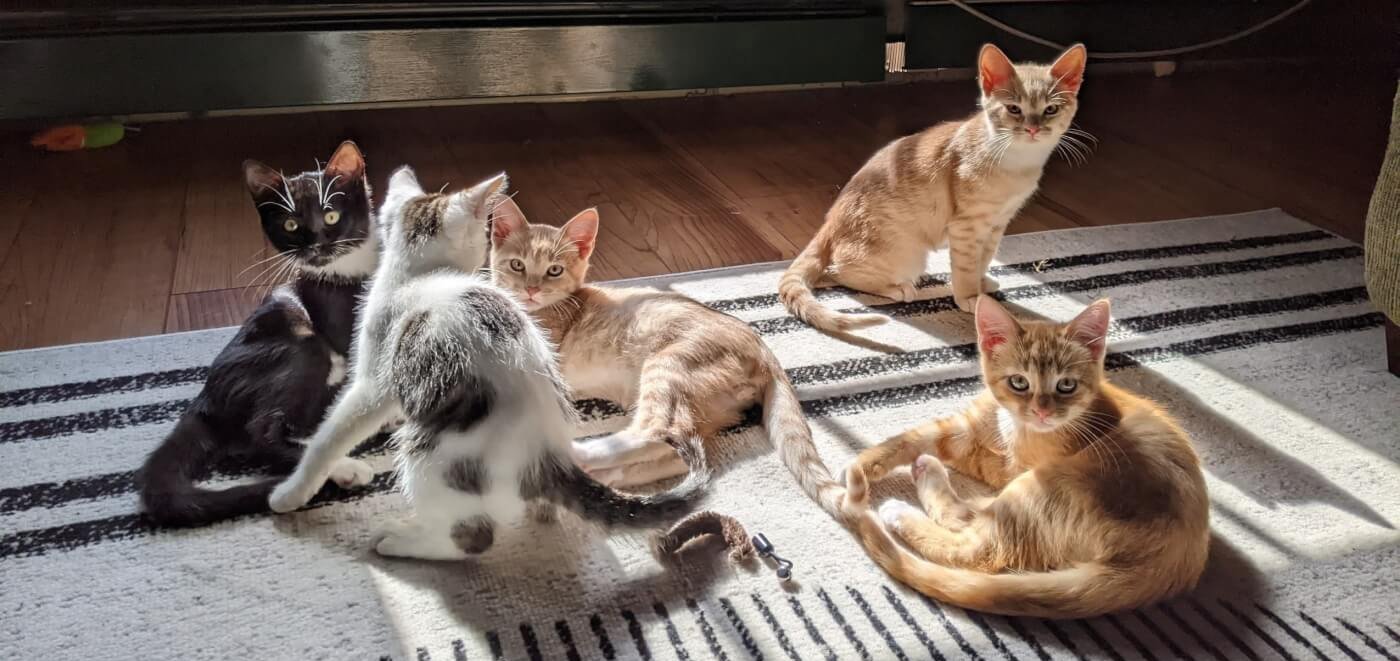
The workers whisked the kittens, who were understandably stressed and terrified, inside PETA’s Sam Simon Center headquarters. After a nourishing meal and a good night’s sleep, the four baby cats were placed in a compassionate foster home, where they joined a fifth kitten who had been surrendered around the same time so that PETA could find her a new family. And just like that, they became the cutest quintet on the East Coast!
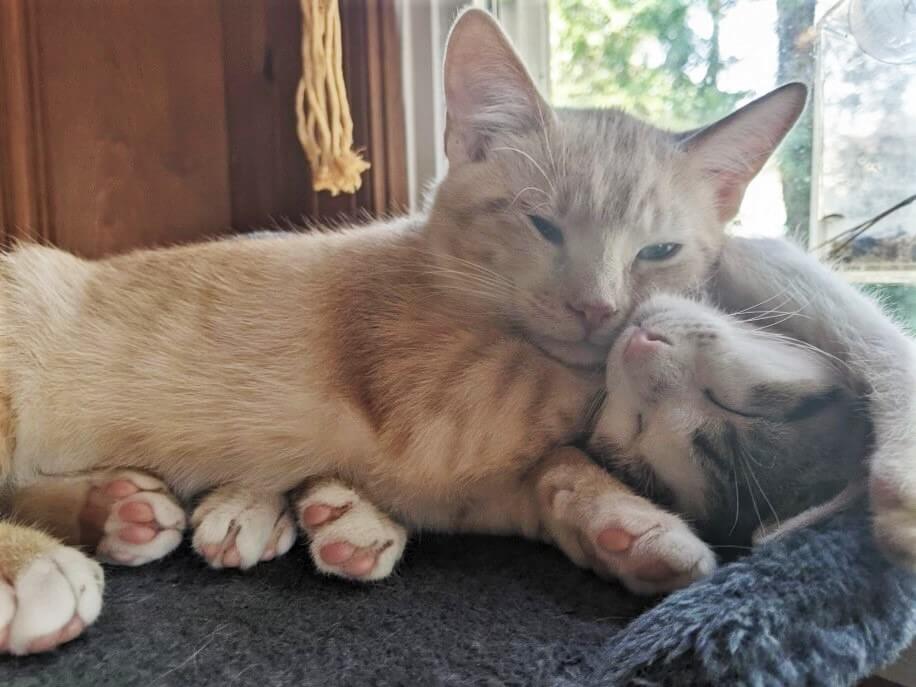
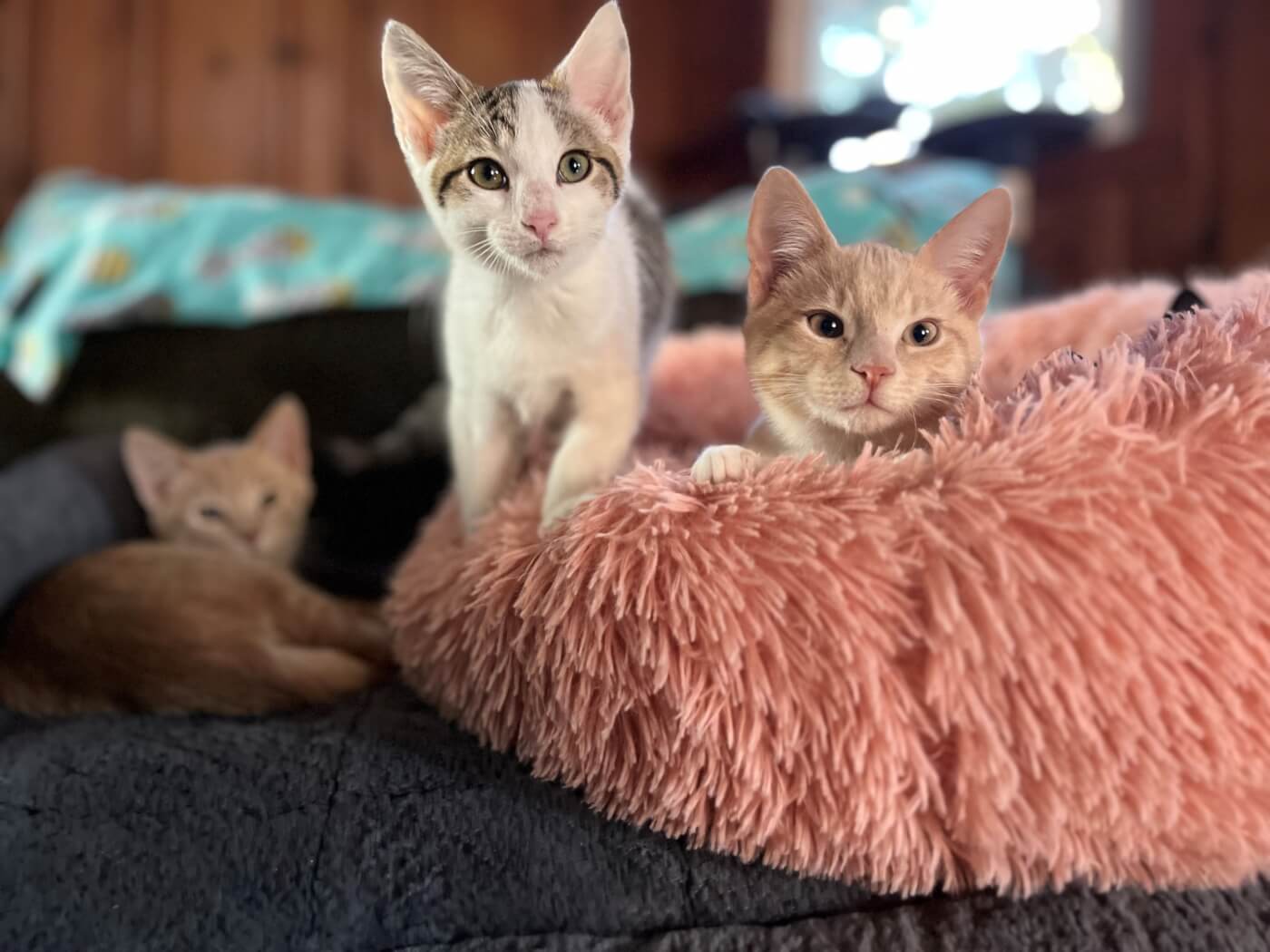
The kittens were initially shy and wary of humans, and for good reason: They’d been tossed to the dogs by a callous human who could have simply called PETA for help instead. But after several weeks of socialization with a foster guardian who carefully earned their trust, the fabulous five went from fearful and defensive to friendly and fun-loving.
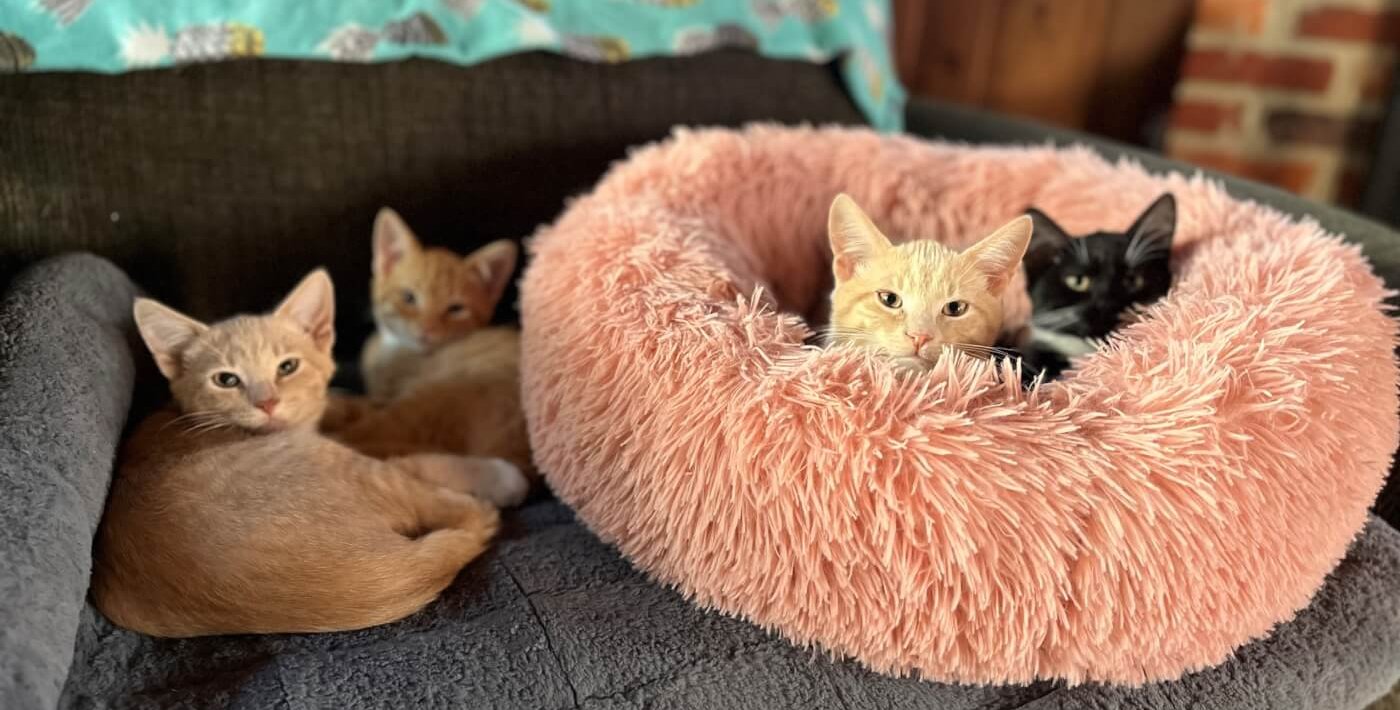
They love playing with toys and frolicking nonstop until it’s time to relax into a giant kitten pile for a nap. Their days of dodging the perilous outdoors are over, and now they like soaking up all the rays they can get indoors on a window perch or well-placed rug.
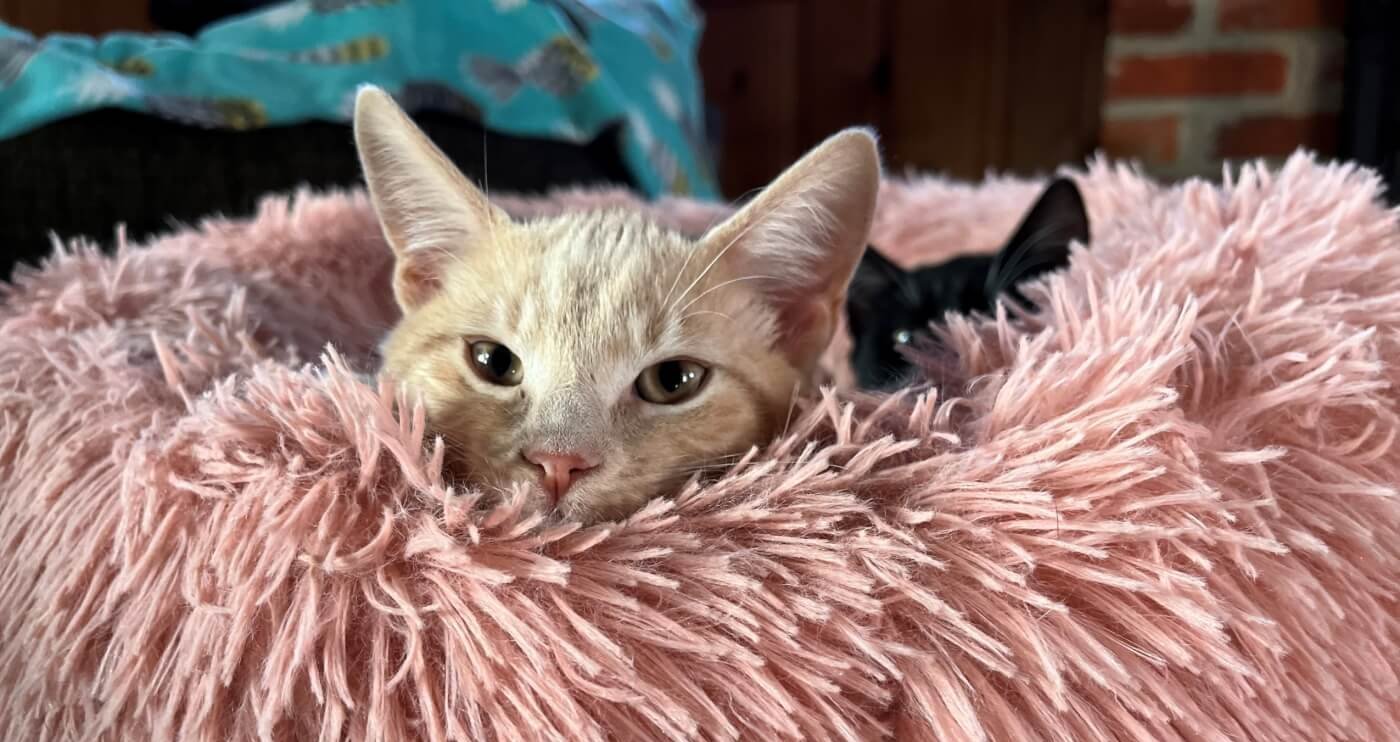
These kittens are ready for permanent homes. They are all around 14 weeks old and have been examined by a veterinarian and spayed or neutered. The crew counts one female among their ranks—a tiny tuxedo lady—while the rest are boisterous boys.
Looking to adopt a kitten or perhaps even a playful pair? E-mail Adopt@peta.org to learn more!

E-Mail Us to Learn More About These Kittens and Other Adoptable Animals

The post From Fearful Five to Fabulous Friends: Meet These Adoptable Kittens appeared first on PETA.
‘Ofrenda’ for Orcas in San Diego: PETA Latino to Honor SeaWorld’s Victims on ‘Día de los Muertos’

Amaya the orca and Duncan the bottlenose dolphin will be among those honored on Tuesday, Día de los Muertos, on PETA Latino’s ofrenda (memorial altar) for the hundreds of animals who have died at SeaWorld parks. PETA Latino supporters wearing traditional sugar skull makeup and orca skull masks will hold a vigil alongside the memorial with signs proclaiming, “Honor Their Memories. Close SeaWorld.”

When:      Tuesday, November 1, 12 noon

Where:    Plaza de Panama, near the intersection of El Prado and Pan American Road E., San Diego

“More than 40 orcas and over 500 other dolphins and whales have died in SeaWorld’s concrete tanks, many of them prematurely, and those who remain can do little but swim in circles and lash out at each other in frustration,” says PETA Latino Associate Director of Communications Alicia Aguayo. “PETA Latino is calling on SeaWorld to give these animals a chance at a real life instead of an early death by releasing them to reputable seaside sanctuaries.”

PETA Latino—whose motto reads, in part, that “animals are not ours to use for entertainment”—opposes speciesism, a human-supremacist worldview. For more information, please visit PETALatino.com or follow the group on Twitter, Facebook, or Instagram.

The post ‘Ofrenda’ for Orcas in San Diego: PETA Latino to Honor SeaWorld’s Victims on ‘Día de los Muertos’ appeared first on PETA.

PETA Demands Proof of Human ‘Benefits’ Claimed by Harvard’s Margaret Livingstone

Please see the following statement from PETA neuroscientist Dr. Katherine Roe refuting a recent statement by Margaret Livingstone at Harvard Medical School regarding her shocking monkey experiments that have caused outrage among scientists and animal welfare advocates alike. (At PETA, we have both.)

It seems Harvard experimenter Margaret Livingstone is trying the keep the public as she keeps the monkeys in her laboratory—in the dark. In a recent statement, Livingstone attempted to justify her horrific experiments by claiming that she had only sutured two monkeys’ eyes shut for only one year in 2016 and further asserting that her research has loosely benefited humans, but she offered no proof.

We call B.S.—and we have the receipts. PETA is publicizing Livingstone’s own papers, which not only expose that Livingstone has lied about how many times she has sewn baby monkeys’ eyes shut but also pull back the curtain on the torment and misery she has inflicted on animals—including forcing cats to stay awake in a rotating drum and drilling holes into monkeys, surgically implanting electrodes into their brains, and sewing coils onto the surface of their eyes.

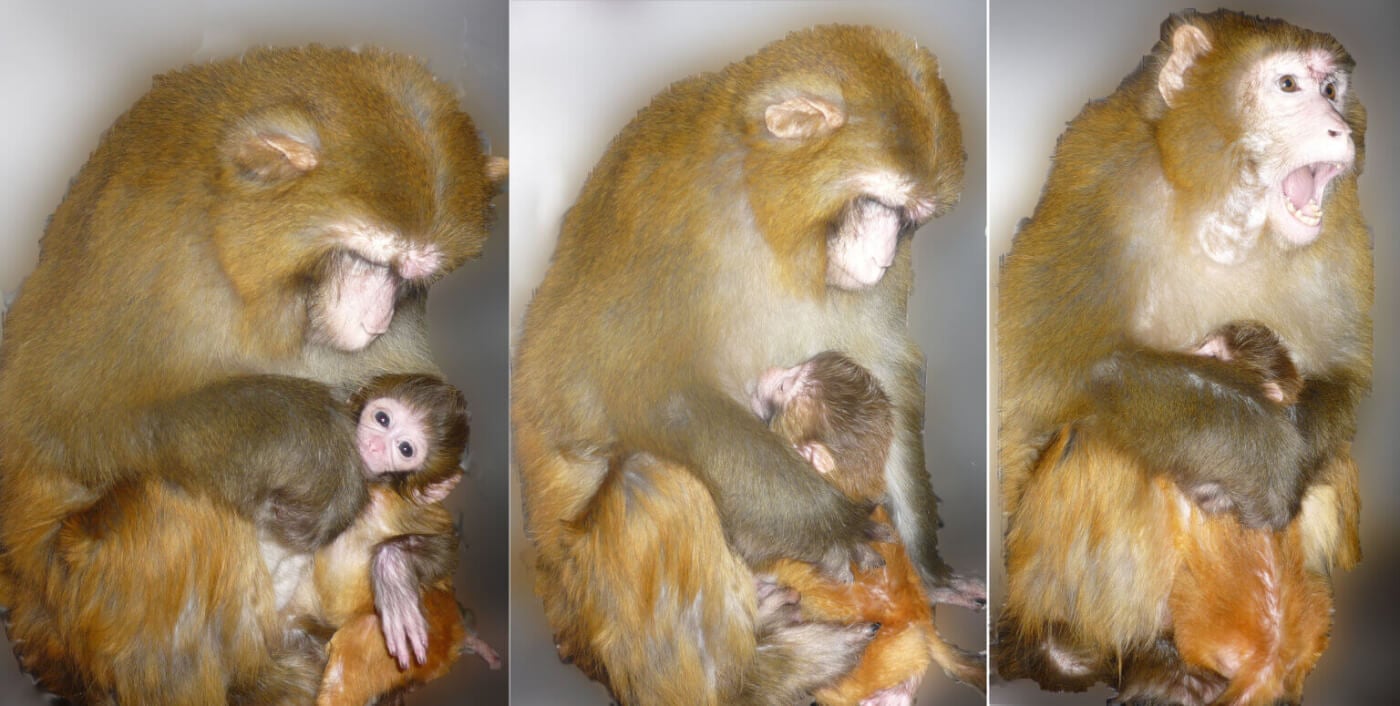
In her statement, Livingstone acknowledges that she permanently removes baby monkeys from their mothers and effectively blinds the infants using methods of varying invasiveness—including, in some instances, suturing their eyelids closed. She further admits that she implants posts into monkeys’ skulls to immobilize them, attaches steel coils to their eyes, and inserts electrodes into their brains. These procedures obviously inflict pain, distress, and discomfort on the vulnerable animals. Livingstone states: “Animals [who] experience distress, pain, or discomfort cannot be studied and our results would not be valid”—and in doing so, she effectively admits that her 40 years of tormenting and killing animals have only contributed invalid data. In other words, these experiments have been a shameful waste of monkeys’ lives and countless opportunities to help humans with relevant, non-animal methods.

If any of her depraved animal experiments have led to treatments for Alzheimer’s, glioblastoma, or tremor—as she claims in her statement—she hasn’t published any of that work, so we’re not taking Livingstone’s word for it. We need proof.

PETA—whose motto reads, in part, that “animals are not ours to experiment on”—opposes speciesism, a human-supremacist worldview. For more information on PETA’s investigative newsgathering and reporting, please visit PETA.org or follow the group on Twitter, Facebook, or Instagram.

The post PETA Demands Proof of Human ‘Benefits’ Claimed by Harvard’s Margaret Livingstone appeared first on PETA.

She’s Tormented Cats and Monkeys and Lied About It—Here’s the Truth

Written by Dr. Katherine Roe

Harvard experimenter Margaret Livingstone seems to be trying to keep the public in the dark, just as she does with the monkeys in her laboratory. In a recent statement, she attempted to justify her horrific experiments on monkeys by claiming that she has only sutured two monkeys’ eyes shut for only one year in 2016 and stating that her research has loosely benefited humans.

PETA is calling BS, and we have the receipts!

The following examples are only a small sample of the torment and misery that Livingstone has inflicted on animals over the past four decades.

  • In contradiction to her statement, she sewed shut the eyes of five rhesus monkeys, including infants, back in 2005. Then she killed them.

Receipt: “Loss of Neurofilament Labeling in the Primary Visual Cortex of Monocularly Deprived Monkeys”

  • She deprived cats of sleep by forcing them to stay awake in a rotating drum that she had constructed herself, intubated and paralyzed them, and implanted them with electrodes to study how their sleep-deprived brain cells would respond to visual input.

Receipt: “Effects of Sleep and Arousal on the Processing of Visual Information in the Cat”

  • She kept a baby owl monkey and the animal’s mother in complete darkness for up to 20 hours a day for the first 10 weeks of the baby’s life.

Receipt: “Ocular Dominance Columns in New World Monkeys”

  • She drilled holes into the skulls of at least dozens of squirrel monkeys, owl monkeys, long-tailed macaques, and rhesus macaques; surgically implanted electrodes into their brains; and attached head posts to their skulls. She also sewed coils onto the surface of their eyes. Then she either chemically paralyzed them or used head restraint devices to keep them still while she recorded their brain activity. For many of the experiments, the monkeys were killed within days of these procedures.

Receipts

  • She deliberately inflicted strabismus—or crossed eyes—on baby squirrel monkeys by cutting the eye muscles they needed to use in order to focus.

Receipt: “Ocular Dominance Columns in New World Monkeys”

  • In addition, she’s taken newborn infant rhesus macaque away from their mothers so that she can sew their eyelids shut or force them to be raised by staff members wearing welding masks.

Receipt: “Anatomical Correlates of Face Patches in Macaque Inferotemporal Cortex”

Maybe Marge has been torturing monkeys for so long that she has forgotten all the horrific things she has done. Or maybe she’s hoping no one knows how to do a literature search. Speaking of such searches, if any of her depraved animal experiments have led to treatments for Alzheimer’s disease, glioblastoma, or tremor, she hasn’t published any of that work. We want those receipts!

Please join PETA and almost 60,000 supporters in calling on Harvard’s administration to close Livingstone’s laboratory.

Take Action

The post She’s Tormented Cats and Monkeys and Lied About It—Here’s the Truth appeared first on PETA.

Ofrenda for Orcas in Orlando: PETA Latino to Honor SeaWorld’s Victims on Día de los Muertos

Tilikum the orca and Nanuq the beluga whale will be among those honored on Tuesday, Día de los Muertos, in PETA Latino’s ofrenda (memorial altar) for the hundreds of animals who have died at SeaWorld parks. PETA Latino supporters wearing traditional sugar skull makeup and orca skull masks will hold a vigil alongside the memorial with signs proclaiming, “Honor Their Memories. Close SeaWorld.”

When:      Tuesday, November 1, 12 noon

Where:    At the intersection of W. Church Street and S. Orange Avenue, Orlando

“More than 40 orcas and over 500 other dolphins and whales have died in SeaWorld’s concrete tanks, many of them prematurely, and those who remain can do little but swim in circles and lash out at each other in frustration,” says PETA Latino Associate Director of Communications Alicia Aguayo. “PETA Latino is calling on SeaWorld to give these animals a chance at a real life instead of an early death by releasing them to reputable seaside sanctuaries.”

PETA Latino—whose motto reads, in part, that “animals are not ours to use for entertainment”—opposes speciesism, a human-supremacist worldview. For more information, please visit PETALatino.com or follow the group on Twitter, Facebook, or Instagram.

The post Ofrenda for Orcas in Orlando: PETA Latino to Honor SeaWorld’s Victims on Día de los Muertos appeared first on PETA.