PETA Billboard Blasts Eli Lilly Over Near-Drowning Animal Test

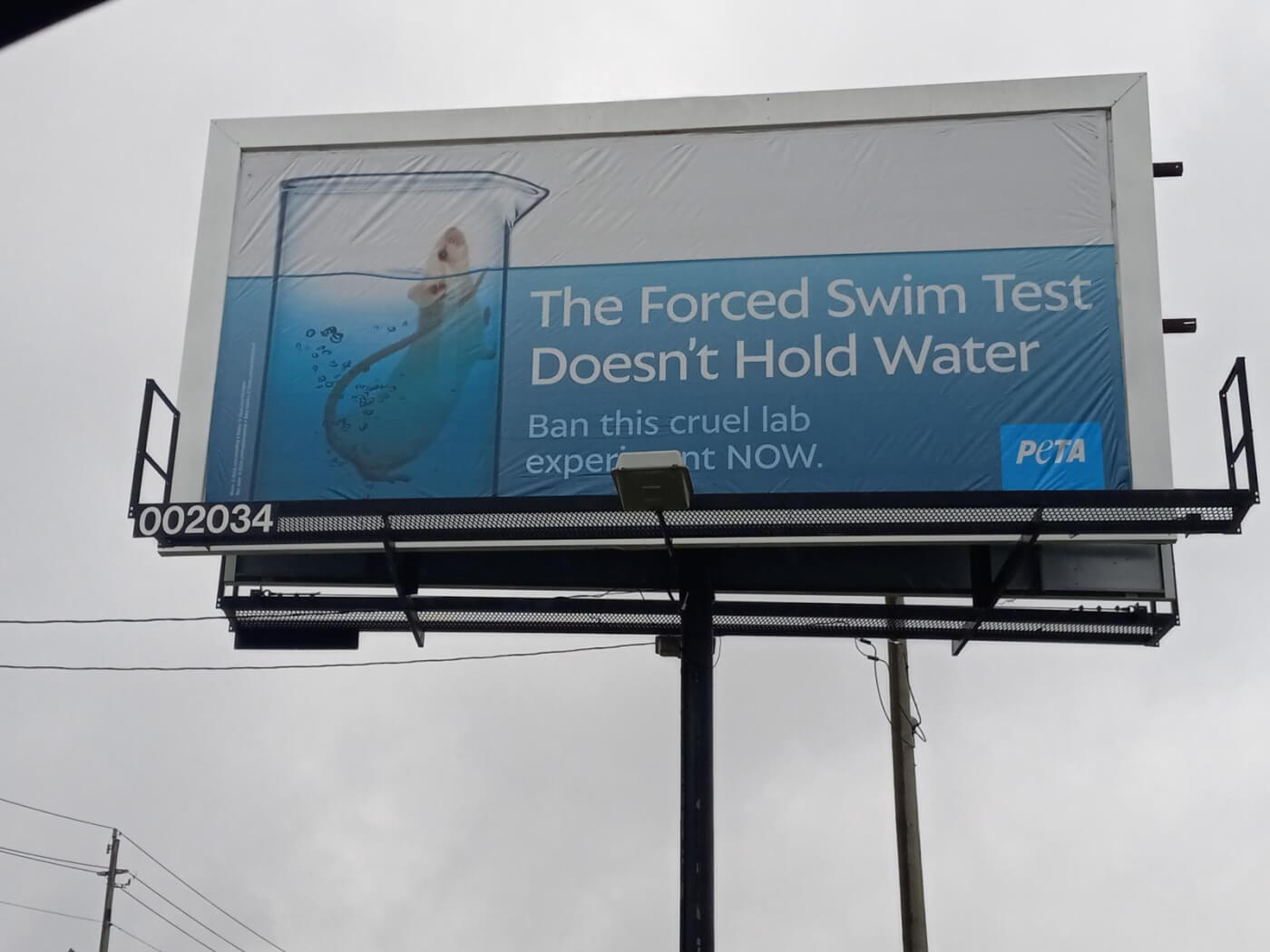
In a push for Eli Lilly to ban the forced swim test, in which mice and rats in water-filled beakers struggle to swim for their lives, PETA has placed a billboard near Eli Lilly’s headquarters, at 530 W. Morris St., with the message “The Forced Swim Test Doesn’t Hold Water. Ban This Cruel Lab Experiment NOW.”
“Eli Lilly refuses to ban scientifically debunked cruelty that makes tiny animals fear they’re drowning,” says PETA Senior Vice President Kathy Guillermo. “PETA is calling on the company to embrace modern, non-animal methods that are on the cutting edge of research, as most of its pharmaceutical competitors have already done.”

In the forced swim (or “behavioral despair”) test, mice, rats, or other small animals are often dosed with a test substance, placed in inescapable beakers filled with water, and made to swim to keep from drowning in misguided efforts to understand and treat human depression. The test has been heavily criticized by scientists who argue that floating isn’t a sign of depression or despair, as some claim, but rather a positive indicator of learning, saving energy, and adapting to a new environment.

Although more than 20,000 people who use Eli Lilly’s products have urged the company to ban the test, Eli Lilly CEO David Ricks claims that he “answers to the patients we serve”—and even though researchers are currently employing human cell–based systems, drug-repurposing programs, and other methods to develop antidepressant drugs, he also claims that there are no replacements for it. Eli Lilly has tormented a total of 3,400 mice and rats in this test since 1993, and none of the drugs it has attempted to develop by using it are on the market to treat depression.

Following talks with PETA, Johnson & Johnson, Bayer, GlaxoSmithKline, AbbVie, Roche, AstraZeneca, Novo Nordisk A/S, Boehringer Ingelheim, Pfizer, and Bristol Myers Squibb have all dropped the test.

PETA—whose motto reads, in part, that “animals are not ours to experiment on”—opposes speciesism, a human-supremacist worldview. For more information about PETA’s investigative newsgathering and reporting, please visit PETA.org or follow the group on Twitter, Facebook, or Instagram.

The post PETA Billboard Blasts Eli Lilly Over Near-Drowning Animal Test appeared first on PETA.
‘EMPTY THE TANKS’: Praxis Hits Miami With Seaquarium in Sight

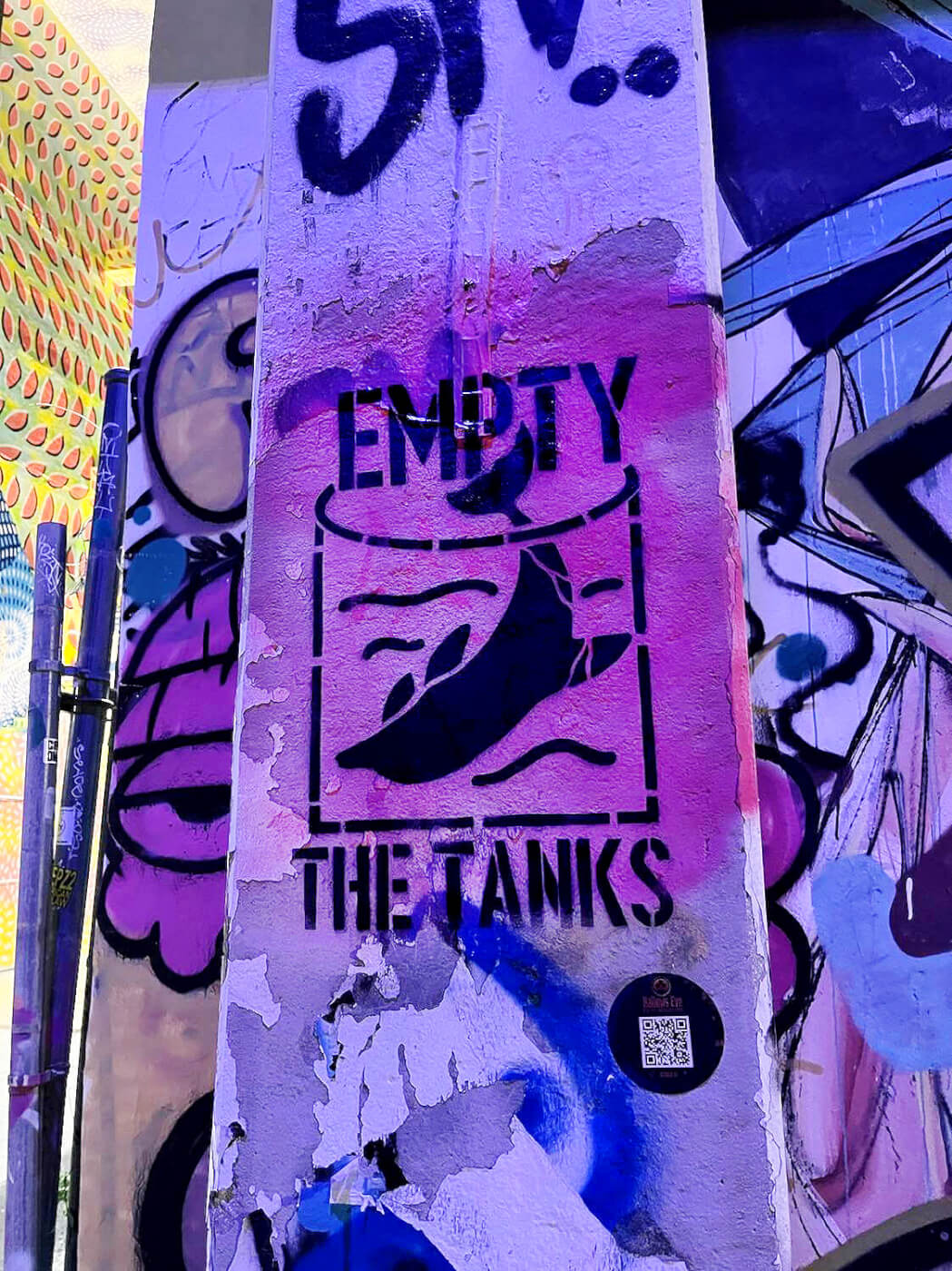
Animal liberation artist Praxis hit the streets of Miami this weekend with a clear message: Shut down the Miami Seaquarium, the abusement park that has starved dolphins to force them to perform degrading tricks. These sickening details and more came out in a U.S. Department of Agriculture inspection report, which PETA recently obtained. The inspection found that dolphins were biting humans out of stress from the underfeeding and that they’re at a breaking point from the abuse. This art demonstration is just the latest in Praxis x PETA’s history of stunning collaborations, which have called out the vile profiteers who use animals for experimentation, fashion, and entertainment.

Human Liberation, Animal Liberation

Praxis’ work has always been dedicated to standing in defense of all vulnerable animals by painting the streets, where he can reveal harm that goes on behind closed doors. Central themes of his art are grassroots resistance, awareness of exploitation, and community defense of subjects that oppressors try to render invisible. Praxis’ talent and passion shine across mediums, be it his trademark stencil bombing, wheatpasting, or designing of massive pieces for reclaimed commercial billboards.

stenciled spray paint art on a concrete pole reading "empty the tanks" with an illustration of a dolphin in a small tank.

The Seaquarium’s sordid history stretches over 50 years and includes the imprisonment of Lolita, an orca who has long lived without the companionship of another of her kind, left with little to do in a tiny, barren concrete tank. She is no longer forced to perform but is still left to a miserable, lonely existence, coping with symptoms of severe psychological trauma instead of being released into a seaside sanctuary. Praxis created a piece last year calling out her imprisonment at the Seaquarium:


View this post on Instagram


A post shared by PETA Latino (@officialpetalatino)

The Suffering Continues at the Miami Seaquarium

Miami-Dade County assured the public that things would improve and that there would be greater oversight of the animals when it approved a lease transfer to The Dolphin Company last fall. Clearly, though, these were empty words. Praxis and PETA have come together to call on Miami-Dade County Mayor Daniella Levine Cava to shut down the Miami Seaquarium. The dolphins there deserve to live in peace at a seaside sanctuary, not to be starved and otherwise harmed for the sake of fleeting human entertainment.

Praxis’ art inspires hope and brings the possibility of revolution within reach. Remember that your voice can make an enormous difference in a world of cruelty. Write to Mayor Cava today in support of the dolphins trapped at the Miami Seaquarium, and urge the county to shut down the park.

The post ‘EMPTY THE TANKS’: Praxis Hits Miami With Seaquarium in Sight appeared first on PETA.

New PETA Virtual Reality Experience Promises Close Encounters at Harvard and MIT

In a bid to encourage empathy for animals who are mutilated and killed in university laboratories, next week PETA will have its Harvard University and Massachusetts Institute of Technology (MIT) launch of Abduction—a unique virtual reality experience landing on college campuses across the country. In the eerie experience, visitors will enter a mysterious truck and put on a virtual reality headset. They’ll seemingly find themselves stranded in the desert with a couple of fellow humans, abducted by aliens, taken aboard a spaceship, and subjected to a terrifying experience similar to what animals endure in laboratories. They’ll watch as others are subjected to experiments—inspired by real tests done on animals—knowing that they’ll be next.

When:      Monday and Tuesday, October 31 and November 1, 11 a.m.–5 p.m.
Where:    Harvard Square, 48 John F. Kennedy St. (in front of Drayton Hall), Cambridge

When:      Wednesday, November 2, 11 a.m.–5 p.m.
Where:    At the intersection of Harvard and Quincy streets (outside Harvard Yard), parking meters 1239, 1237, and 1235, Cambridge

When:      Thursday and Friday, November 3 and 4, 11 a.m.–5 p.m.
Where:    Hockfield Court, near the intersection of Main and Ames streets, Cambridge

Watch the trailer here. Broadcast-quality footage of the Abduction virtual reality experience is available upon request. Images from the first day of the Harvard Abduction stop will be available Monday. Images from the first day of the MIT Abduction stop will be available Thursday.

At Harvard, experimenter Margaret Livingstone permanently takes newborn monkeys from their devoted mothers. She has condemned some to complete darkness for up to a year by sewing one or both of their eyelids shut—just to see how badly it affects their development. In current studies, staff handling the motherless baby monkeys wear welding masks so the traumatized infants never get to see a face, monkey or human. Today, PETA released this statement: PETA Demands Proof of Human ‘Benefits’ Claimed by Harvard’s Margaret Livingstone

At MIT, experimenters drilled holes into the skulls of rats, implanted electrodes into their brains, and surgically attached head posts to their skulls so that the animals could be held stock-still for tests. The rats were trained to poke their noses into a cone in order to receive positive stimulation via electric pulses delivered through the electrodes and were then given a drug to block their ability to experience pleasure. Other experimenters implanted electrodes into mice’s brains and injected a toxin into one eye of some of the mice, causing them to lose considerable vision in that eye.

“Many students don’t know that on their own college campuses, frightened and confused animals are being tormented, mutilated, and killed in cold, barren laboratories, with no way to escape or even understand what’s happening to them,” says PETA Senior Director Rachelle Owen. “PETA is on a mission to open young people’s eyes to this cruelty, help them understand what it feels like for the animals, and motivate them to join our call for a switch to superior, non-animal research.”

Studies show that 90% of all basic research, most of which involves animals, fails to lead to treatments for humans, which is why PETA is pushing universities to pivot to sophisticated, human-relevant research methods.

Abduction, which was filmed in VR180 with assistance from the virtual reality creation studio Prosper XR, will stop at several other college campuses from coast to coast, including Johns Hopkins University in Baltimore, Maryland, and Brown University in Providence, Rhode Island. Broadcast-quality footage of the Abduction virtual reality experience is available upon request.

PETA—whose motto reads, in part, that “animals are not ours to experiment on”—opposes speciesism, a human-supremacist worldview. For more information on PETA’s investigative newsgathering and reporting, please visit PETA.org or follow the group on Twitter, Facebook, or Instagram.

The post New PETA Virtual Reality Experience Promises Close Encounters at Harvard and MIT appeared first on PETA.