PETA’s dedicated team of scientists and other staff members works full-time all year long to shut down barbaric laboratories, advance non-animal tests, and expose the cruelty of experiments on animals in order to stop them.
We fund and design experiments to show how non-animal tests can replace those done on animals, collaborate with members of Congress to end the use of animals in laboratories, spearhead hard-hitting eyewitness exposés and public campaigns that have been pivotal in shifting public opinion against animal testing, and persuade major corporations, government agencies, and universities around the world to abandon cruel tests in favor of modern, non-animal methods.
In 2022 alone, we helped to secure the rescue of more than 4,000 dogs bred for use in experiments and prevented countless other animals from being used in studies we ended!
PETA’s 22 Biggest Victories in 2022 for Animals Used in Experiments
1. Envigo Beagle-Breeding Hellhole Shut Down After PETA Exposé; All 4,000 Surviving Dogs Transferred for Adoption
Our groundbreaking undercover investigation blew the lid off neglect, intense confinement, suffering, and death at Envigo’s massive beagle-breeding facility in Cumberland, Virginia, that sold dogs to laboratories.
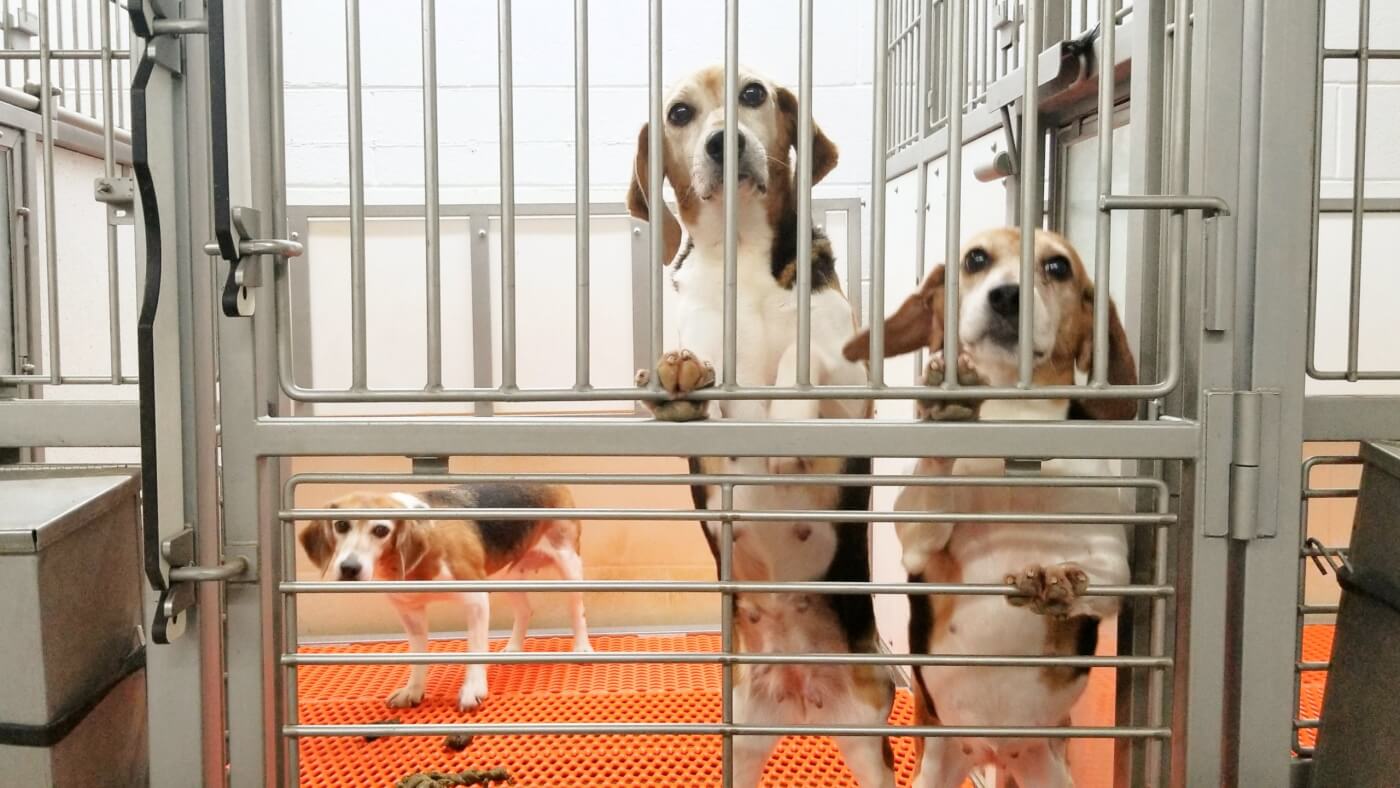
Envigo’s parent company, Inotiv, announced in June that it would close the Cumberland facility. Some 4,000 dogs were rescued. These fortunate animals were given the opportunity to have what every dog deserves—love, the freedom to enjoy life, and respect for their individuality as members of a family.
In July, a consent decree executed in the U.S. Department of Justice’s civil case against Envigo—prompted, in part, by citations issued on the heels of PETA’s investigation—permanently barred the company from “any activity requiring [a federal Animal Welfare Act] license” at its Cumberland facility, including breeding and raising dogs for sale and experimenting on animals. The consent decree left open the possibility that Envigo and/or its employees will be charged with crimes.
2. The Last 9 Dogs Transferred From Texas A&M Muscular Dystrophy Lab Are to Be Freed
Texas A&M University confirmed that it will release the nine healthy golden retrievers it had betrayed by transferring them from its notorious canine muscular dystrophy laboratory to its veterinary school.
This momentous news comes after PETA’s hard-fought campaign that began with our exposé of the school’s horrendous laboratory. Our relentless pressure ended its cruel breeding of dogs to develop this crippling disease, shut down the lab, and led to the adoption of more than 50 golden retrievers. These nine dogs will be in loving homes by the end of the year.
3. (and 4.) Air France and Kenya Airways Commit to Banning the Transport of Monkeys to Laboratories
Following more than a decade of campaigning by PETA entities and grassroots activists around the world, Air France announced that it would end its transport of monkeys to laboratories as soon as its current contracts end. Kenya Airways also committed to ending its transport of monkeys to U.S. laboratories after discussions with us.
The monkeys whose crates spilled out onto a Pennsylvania highway following a truck crash on January 21 had been flown on a Kenya Airways plane that had landed earlier that day. Air France and Kenya Airways join dozens of the other airlines that PETA has persuaded to end this despicable practice.
5. No Animals Killed in 2022 Cobra Gold Exercise
A top official confirmed to PETA that no animals would be killed in barbaric survival training drills during Cobra Gold 2022, a massive joint multinational military exercise held in Thailand and attended by the U.S. military.
During these cruel, dangerous, and likely illegal exercises, troops had been compelled to kill chickens with their bare hands, skin and eat live geckos, consume live scorpions and tarantulas, and decapitate cobras and drink their blood. These atrocities were initially halted in 2021 after PETA’s release of shocking video footage and our exposé, so this is the second year in a row in which no animals were used.
6. PETA Persuades Hospital to Ban Staff From Maiming Animals
After pressure from PETA and more than 75,000 of our supporters, Erlanger Health System announced a new policy banning its staff—including its emergency medevac provider, LIFE FORCE—from participating in medical training that uses animals.
Previously, LIFE FORCE personnel were forced to attend training sessions held by the University of Tennessee College of Medicine in which they had to practice invasive procedures on live pigs—including IV insertion, oral intubation, and chest tube insertion—or risk losing their jobs.
7. Companies in Taiwan Ban Tests on Animals Not Required by Law
Following discussions with PETA and our partner organization in Taiwan, Kindness to Animals, companies there banned animal tests not explicitly required by law. These companies include the following:
- Microbio Co. Ltd., a maker of health-food products
- AGV Products Corp., a major company licensed by Nestlé to produce, distribute, and market its Nestea products in Taiwan
- Grape King Bio, Taiwan’s largest biotech fermentation health-food company, known for a popular energy drink
8. Taiwan FDA Ends Blood Pressure Tests on Animals
Following a push from PETA, the Taiwan Food and Drug Administration (TFDA) finalized a regulation that removes animal testing recommendations and requirements for companies that want to make blood pressure health marketing claims about their food and beverage products. The TFDA will now require only safe and effective human tests for this purpose.
9. Congolese Aerospace Company Enacts Policy Against Animal Testing
KEKA Aerospace—a private space agency in the Democratic Republic of the Congo—publicly confirmed that it “will never use animals in [its] research again,” including for its planned Troposphere 6 rocket launch.
10. Judge Rules LSU Must Hand Over Bird Experiment Records to PETA
The 19th Judicial District Court for the Parish of East Baton Rouge ruled that Louisiana State University (LSU) must turn over to PETA all the records that we had requested related to LSU experimenter Christine Lattin’s taxpayer-funded experiments on sparrows. We first filed our lawsuit in December 2020 after LSU refused to release public documents, including veterinary-care records and videos recorded by Lattin, whose experiments involve trapping sparrows, pumping them with sex hormones, exposing them to terrifying calls from predators, and then killing them.
LSU was also ordered to pay PETA to cover our attorney’s fees and other costs we incurred.
11. Court Orders UW to Pay PETA $540,000 in Open Records Lawsuit
In Washington, a King County Superior Court judge ordered the University of Washington (UW) to pay PETA $539,902.45 in fees and penalties following our public records lawsuit. This came after the court found that UW had improperly withheld records detailing financial and leadership crises as well as the deaths of monkeys at its Washington National Primate Research Center.
12. Kikkoman Pulls Animal-Testing Funding From UW-Madison
After hearing from PETA, Kikkoman—the world’s largest Japanese-style soy sauce manufacturing company and a sponsor of the University of Wisconsin–Madison’s Food Research Institute—told the institute to stop using its funding for tests on animals and instead to allocate the company’s donations to educational programs, special meetings, and administrative expenses only.
Kikkoman, which has donated at least $1 million to the university, ended its own animal experiments in 2015 after talks with PETA.
13. Australian Universities End Forced Swim Test on Animals
After hearing from PETA, PETA Australia, and Humane Research Australia, the University of South Australia decided that the forced swim test won’t be approved for any future research projects.
Macquarie University in Sydney also prohibited the forced swim test. The school’s animal ethics committee reviewed the scientific literature on the test and reached the same conclusion as PETA scientists: The forced swim test is bad science.
14. Pakistan Bans Live-Animal Tests in Veterinary Training
The Pakistani government banned the use of live animals in testing and surgical veterinary training in the capital, Islamabad, and surrounding areas after PETA sent urgent letters to three colleges implicated in gory videos showing horrific scenes of reportedly abducted dogs subjected to invasive surgeries without receiving anesthetics.
We also contacted Pakistani ministries in charge of professional education and veterinary training, directly communicating our recommendations and broader animal testing concerns to the head of the prime minister’s Strategic Reforms Unit (SRU). We urged them to use humane simulation models and ban training methods on animals. The SRU agreed with us and initiated this landmark reform for animals.
PETA Scientists Make Progress for Animals Used in Regulatory Testing
Regulatory agencies, such as the U.S. Food and Drug Administration, the U.S. Environmental Protection Agency, and similar agencies around the world, require tests to assess the toxicity of products such as pharmaceutical drugs, pesticides, industrial chemicals, and medical devices before they’re put on the market. Although toxicity testing has historically been conducted on animals in crude tests developed decades ago, things are changing, thanks in part to the work of PETA scientists.
15. Department of Transportation Ends Animal Testing Requirement
After 30 years of work by PETA scientists and tens of thousands of our supporters’ responses to our action alerts, the U.S. Department of Transportation ended its requirement to use rabbits in painful skin-corrosion tests. The agency told us that its decision would encourage companies to use animal-free tests, and we’ll make sure every company knows about this updated rule.

16. PETA Science Consortium Donates Equipment to Replace Test on Live Rabbits
PETA Science Consortium International e.V. donated equipment worth $20,000 to an animal-free lab in order to help end a nearly 80-year old test in which chemicals are applied to the eyes of live rabbits.
17. Photos Obtained by PETA Reveal Multiple AWA Violations at Bethyl Laboratories
Photos obtained by PETA from the U.S. Department of Agriculture show sick and suffering animals at Bethyl Laboratories, an antibody-production facility in Texas. This is another example of cruelty at an antibody-production facility, and exposing it is helping to persuade scientists to use readily available non-animal antibodies. PETA is calling on the USDA to hold the facility accountable to the full extent under the federal Animal Welfare Act and urges the scientific community to use only animal-free antibodies.
18. PETA Scientists Show How to Improve Research Without Using Fetal Bovine Serum
A paper coauthored by PETA scientists shows how researchers can avoid the use of fetal bovine serum (FBS), which is used to grow cells in petri dishes. Every year, up to 1.8 million unborn calves are killed worldwide to produce FBS, which is obtained from the blood of fetal calves after their mothers are slaughtered for food. The paper shows how to improve research by replacing FBS with animal-free alternatives.

19. PETA Scientists Coauthor Groundbreaking Papers That Will Reduce the Use of Animals in Research
PETA scientists co-authored multiple papers that show how modern, non-animal approaches can replace archaic and crude experiments on animals. One paper showed a new approach to assess if chemicals cause cancer that is already being used to spare hundreds of mice and rats tests in which they’re fed pesticides every day to see if tumors develop. Another challenges the standard practice of measuring the accuracy of new non-animal methods by comparing them to flawed animal tests. And a third paper shows how a non-animal method can replace the use of hamsters to test veterinary vaccines.
20. PETA Scientists Give and Receive Awards at International Toxicology Meeting
Dr. Amy Clippinger, managing director of PETA’s Regulatory Toxicology Department and president of the Science Consortium, won the 2022 Society of Toxicology (SOT) Enhancement of Animal Welfare Award. The SOT, an international scientific organization with more than 8,000 members, chose Dr. Clippinger for her exceptional contributions to the advancement of non-animal approaches to toxicology testing.
At the SOT annual meeting, PETA scientists received Best Paper awards and presented a Student Award for Travel and Mentorship in Non-Animal Toxicology, which sent a student attending a historically Black university to the conference. The SOT annual meeting is the largest toxicology event in the world, drawing thousands of scientists, regulators, and academics each year.
21. European Chemicals Agency Commits to Ending Tests on Animals
The European Commission and European Chemicals Agency announced that they will be taking steps to end tests on animals for industrial chemicals. In its announcement about the decision, the European Commission acknowledged the ongoing pressure from a European Parliament resolution, which came after PETA UK shared its Research Modernization Deal with members of Parliament, and from the Save Cruelty Free Cosmetics European Citizens Initiative, which was launched by PETA entities alongside other animal protection organizations.
22. PETA Science Consortium International Turns 10
We celebrated the ten-year anniversary of the Science Consortium! From collaborations with experts on precedent-setting projects to awarding researchers free non-animal technology, the Science Consortium has made great strides replacing tests on animals with modern and humane testing approaches.

Together, we can achieve even more victories for animals used in experiments next year.
Please send a polite e-mail to your members of Congress urging them to mandate that the National Institutes of Health stop throwing away taxpayer money on cruel, useless experiments on animals and instead focus on modern, human-relevant research methods.
Note: PETA supports animal rights, opposes all forms of animal exploitation, and educates the public on those issues. PETA does not directly or indirectly participate or intervene in any political campaign on behalf of or in opposition to any candidate for public office or any political party.
The post 22 Major Victories That PETA Achieved for Animals in Labs in 2022 appeared first on PETA.