
Who’s the Most Influential Vegan in India? Watch PETA’s New Video to Find Out

PETA India recently named Acharya Prashant the “Most Influential Vegan” of 2022. As a teacher of Vedanta—the pinnacle of Indian “wisdom literature,” rooted in self-awareness and liberation—Prashant cares deeply about ending speciesism. His passion is on display in a new video in which he sits down for an interview with PETA India founder and PETA President Ingrid Newkirk, delving into his outreach efforts; the concept of ahimsa, a core tenet of many Eastern religions that means not causing harm to any sentient being; and his many accomplishments. The two animal rights icons also discuss effective ways to persuade others to go vegan.

Watch the Interview Below: Meet the ‘Most Influential Vegan’ of 2022

As the discussion progresses between these two luminaries, central vegan concepts emerge with further clarity: the gift of consciousness; the human responsibility to make kind choices; the respect and consideration all animals deserve; why every sentient being is an individual person; how being vegan also means being against all forms of supremacy, violence, and prejudice; why killing an animal is like killing a part of oneself; how problematic it is that many Indians want to adopt destructive consumption patterns from the West, often involving speciesism; why feeling compassion should outweigh the pull of popular culture; and why we must actively share what we know.

How Prashant Earned the Title ‘Most Influential Vegan’

Prashant—the founder and CEO of the PrashantAdvait Foundation—campaigns against superstition and strongly advocates for female empowerment, protection of the natural world, compassion for animals, Vedantic wisdom, living “rightly,” and living a life of compassion and honesty. He explains in person and on YouTube, Facebook, Twitter, and Instagram how being vegan is an essential part of true humanity.

Close-up on Acharya Prashant smiling at PETA India award ceremony where he was named 2022's Most Influential Vegan

Prashant’s compassion shines through his work to spare the lives of cows, pigs, chickens, turkeys, fish, and other animals exploited by the meat, egg, and dairy industries. His award from PETA India spotlights how he encourages everyone to live a conscious, nonviolent life and respect all sentient beings by going vegan.

PETA India's Most Influential Vegan Acharya Prashant sitting with two dogs by the water and holding the uplifted front right paw of one of them, with a quote by Prashant included: "You and the other being are essentially one. The Differences are countless but worthless. -Acharya Prashant"

He has consistently advocated against the mistreatment of animals used for food and made millions of humans aware of the perils of consuming them and “products” stolen from them, highlighting how vegan living linked to true spirituality is a solution to the global crises of poor health and environmental damage.

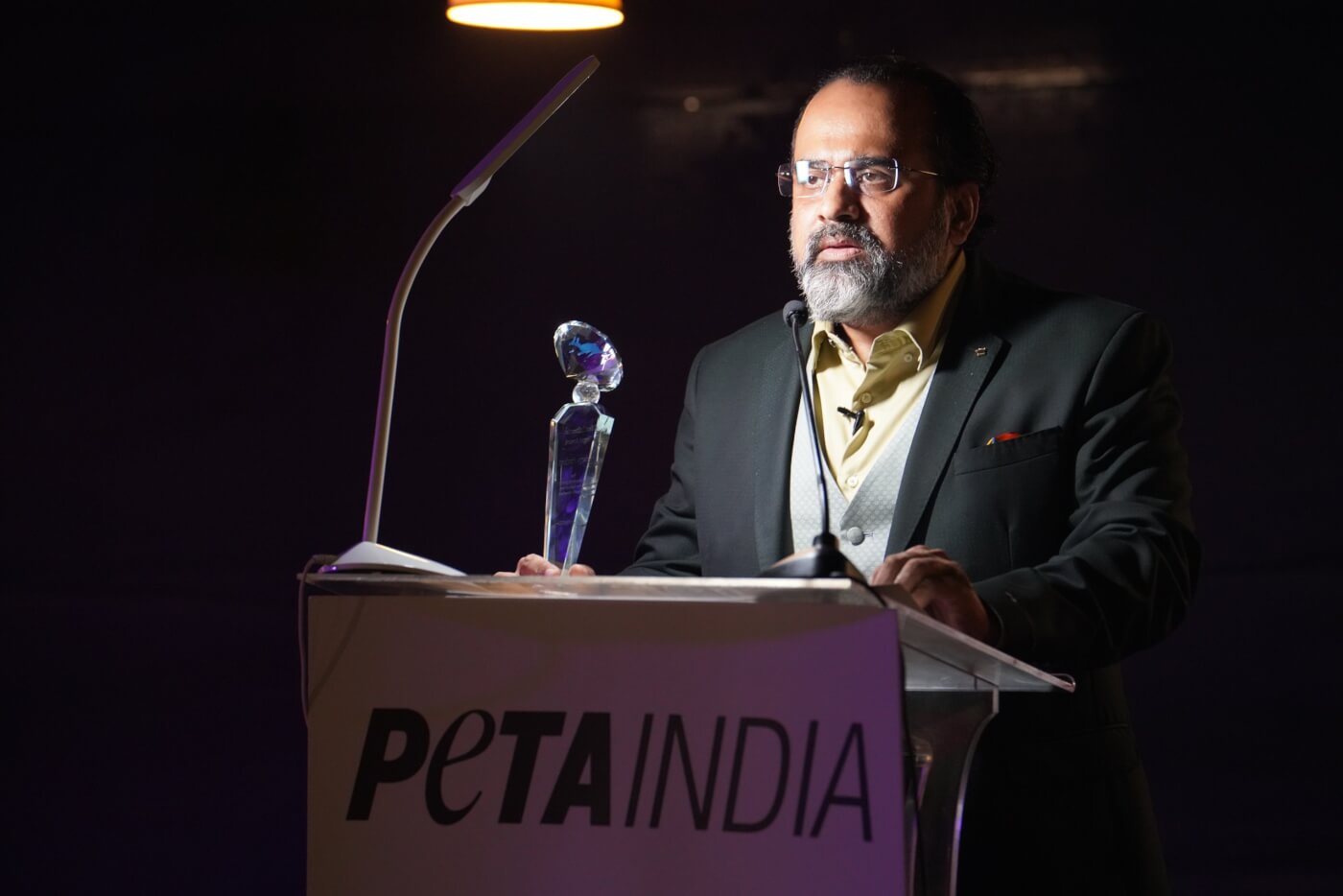
PETA India's Most Influential Vegan Acharya Prashant receives award

Teaching Vedanta pairs perfectly with raising awareness of animal liberation. Ahimsa is at the heart of this spiritual practice, so Prashant speaks often about it.

Ahimsa is deep understanding. Without that understanding, whatever one does is violence. Veganism is nothing but the logical culmination of vegetarianism. Where does vegetarianism come from? The feeling that I will not kill the animal—I don’t want to harm the animal. That same feeling finds its final expression in veganism.

—Acharya Prashant
How to Inhabit Your Inherent Ahimsa and Become an Influential Vegan Yourself

Going vegan shows compassion for animals; reduces your own risk of suffering from cancer, heart disease, diabetes, and obesity; helps fight the climate catastrophe by reducing greenhouse gas emissions; and can even help prevent future pandemics since COVID-19, SARS, swine flu, and bird flu have all been linked to confining and killing animals for food.

Ready to blossom? Cultivate ahimsa:

Order a Free Vegan Starter Kit

The post Who’s the Most Influential Vegan in India? Watch PETA’s New Video to Find Out appeared first on PETA.

Monkeys Seized From NIH-Funded Laboratory at Center of PETA Probe

Earlier today, authorities from the Colombian regional environmental agency Corporación Autónoma Regional del Valle del Cauca (CVC) raided the U.S. National Institutes of Health (NIH)–funded laboratory of two malaria experimenters and seized over 100 tiny owl monkeys held there following a damning 18-month PETA investigation.

The monkeys are now recovering at the CVC’s wildlife rescue and rehabilitation center.

The seizure comes after the CVC ordered the laboratory, Fundación Centro de Primates (FUCEP), to end all experiments on monkeys in the wake of its inspection report documenting such atrocities as 21 missing monkeys; a dead baby monkey; a monkey missing an eye; a lack of documentation, including veterinary records; and squalid, apparently illegal, conditions.

“Colombian officials acted quickly to seize these vulnerable monkeys and shut down this laboratory, but the same can’t be said for NIH, which still appears to be funding it,” says Dr. Magnolia Martínez, lead projects manager and congressional liaison with PETA’s Laboratory Investigations Department. “PETA is doubling down on its demand that the funding pipeline to sordid foreign laboratories like FUCEP cease now.”

PETA filed a complaint with NIH last month requesting that it stop funding FUCEP. PETA is also requesting that the National Institute of Allergy and Infectious Diseases investigate the experimenters, husband-wife duo Sócrates Herrera Valencia and Myriam Arévalo Ramírez, for apparent misuse of funds.

PETA’s exhaustive investigation into FUCEP revealed that monkeys had been deliberately infected with the malaria parasite and that their spleens had been surgically removed. Other monkeys were simply left to die from infected wounds. The investigation also found that the monkeys were held in rusty cages amid their own waste in a makeshift pen made of backyard fencing and plastic sheets and fed dog kibble soaked in sugary water.

NIH spent $279 million in 2022 to fund 742 research grants in Colombia and 63 other countries, including Bangladesh, Brazil, China, and Vietnam. The agency has no oversight mechanisms for foreign organizations that receive American taxpayer money.

For more information on PETA’s investigative newsgathering and reporting, please visit PETA.org, listen to The PETA Podcast, or follow the group on Twitter, Facebook, or Instagram.

The post Monkeys Seized From NIH-Funded Laboratory at Center of PETA Probe appeared first on PETA.

Animal Oversight Board Members Can’t Hide Names—Landmark 9th Circuit Court Victory for PETA

In a major win for PETA, the U.S. Court of Appeals for the Ninth Circuit ruled today that members of a public animal care committee of the University of Washington (UW) have no right under the U.S. Constitution to keep their identities secret—a historic decision with potentially wide-ranging implications for democracy.

In 2021, PETA submitted public records requests for the appointment letters of members of the UW Institutional Animal Care and Use Committee (IACUC). This was part of work done by PETA to investigate its suspicion that one reason the UW IACUC has been so ineffective in protecting animals in UW laboratories is that its members have illegal conflicts of interest.

Past and present UW IACUC members filed a lawsuit to block disclosure, arguing that they had a freedom of association right to operate in secrecy. Last year, the U.S. District Court for the Western District of Washington granted the UW IACUC members a preliminary injunction based on its view that by serving on an IACUC, members might be engaging in protected free expression.

PETA, which intervened in the lawsuit, appealed. The Ninth Circuit agreed with the group, explaining that IACUC members have no role other than ensuring that experimenters follow federal animal welfare law, including rules requiring IACUCs to reflect views other than those of the animal experimentation industry. The court noted specifically that the appointment letters exist “only because the Committee members were appointed by the University according to statutory and regulatory criteria to ensure diverse representation.”

PETA expects this decision will have far-reaching consequences and make it harder for all IACUCs to operate secretly or without accountability to the taxpayers who fund experiments.

“This is a landmark decision establishing that what these committees do as the last line of defense for animals in publicly funded laboratories is everyone’s business,” says PETA Foundation Director of Litigation Asher Smith. “All citizens have a right to judge for themselves whether these committees are enforcing the law or serving as a rubber stamp for UW experimenters, whose incompetence has caused animals to die needlessly from thirst, starvation, and human error.”

Adding their voices to PETA’s call for access to this information were the Reporters Committee for Freedom of the Press and 16 other media organizations, including The Seattle Times and the Student Press Law Center. The case is now back with the U.S. District Court for the Western District of Washington. The underlying lawsuit regarding whether PETA can access the public records it requested will remain ongoing. Another PETA lawsuit in Washington state court under Washington state open meetings law challenging IACUC members’ secrecy is also pending.

In October, a Washington state court ordered UW to pay PETA more than $540,000 in fees, penalties, and interest after it found UW liable under public records law based, in part, on its policy of routinely destroying photos and videos from experiments on monkeys.

PETA—whose motto reads, in part, that “animals are not ours to experiment on”—opposes speciesism, a human-supremacist worldview. For more information about PETA’s investigative newsgathering and reporting, please visit PETA.org, listen to The Peta Podcast, or follow the group on Twitter, Facebook, or Instagram.

The post Animal Oversight Board Members Can’t Hide Names—Landmark 9th Circuit Court Victory for PETA appeared first on PETA.

Monkey’s Death at Harvard Prompts PETA to Ask if Boston Has a New ‘Strangler’

Does Harvard Medical School employ the new Boston Strangler? PETA is raising the question with posters plastered all over town as well as an advertisement in the Boston Herald today, prompted by the strangulation death of a young monkey in the laboratory of notorious monkey experimenter Margaret Livingstone.

The infant was taken from her mother soon after birth and put alone in a cage with a cloth-covered object—the only “mother” the baby monkeys in Livingstone’s laboratory can cling to for comfort. No one in the lab noticed that the baby had ripped a hole in the cloth, got it caught around her neck, and strangled to death.

“This infant monkey was so poorly protected that Margaret Livingstone might as well have strangled her with her bare hands,” says PETA Senior Vice President Kathy Guillermo. “PETA demands that Harvard pull the plug on Livingstone’s twisted experiments immediately and retire these primates to reputable sanctuaries before the death toll rises.”

Although Livingstone is known for separating healthy newborn monkeys from their mothers and sewing their eyelids shut, it’s unclear whether the baby who strangled to death was one of the monkeys she had blinded or used in other visual deprivation procedures. But federal records obtained by PETA show a pattern of negligence in her laboratory: One monkey’s finger had to be amputated after they fought with an improperly caged, stressed macaque. Livingstone herself was turned in by her own veterinary staff for failing to wear personal protective equipment at the height of the pandemic while experimenting on a restrained monkey, a violation of federal guidelines.

PETA—whose motto reads, in part, that “animals are not ours to experiment on”—opposes speciesism, a human-supremacist worldview. For more information, please visit PETA.org, listen to The PETA Podcast, or follow the group on Twitter, Facebook, or Instagram.

The post Monkey’s Death at Harvard Prompts PETA to Ask if Boston Has a New ‘Strangler’ appeared first on PETA.

A Vegan White House Fish Fry? PETA’s Proposal to President Comes With a Catch: Go Vegan for Lent

PETA has presented President Joe Biden with a tasty opportunaty to set a positive example for America’s nearly 62 million Catholics by keeping all animals, including fish, off his plate during Lent this year: PETA is offering to help the country’s second Catholic president throw the first-ever White House vegan fish fry—and make sure it goes swimmingly by providing delicious fare from Washington-area restaurants. In a letter sent today, the group sweetens the deal for the president—who traditionally gives up his cherished ice cream and other sweets for the 40 days of Lent—with a promise to serve the city’s best dairy-free ice cream for dessert.

“It may be inconvenient to accept the fact that fish feel pain and fear, as all animals and humans do, but anything can be made deliciously vegan these days, so leaving fish off our plates during Lent and beyond isn’t hard at all,” says PETA President Ingrid Newkirk. “PETA is offering to treat the White House to a full vegan fish fry if President Biden goes vegan for Lent, inspiring others to show mercy to animals, too.”

PETA—whose motto reads, in part, that “animals are not ours to eat”—opposes speciesism, a human-supremacist worldview. For more information, please visit PETA.org, listen to The PETA Podcast, or follow the group on Twitter, Facebook, or Instagram.

PETA’s letter to Biden follows.

Dear Mr. President:

I’m writing on behalf of PETA, the world’s largest animal rights organization, with more than 5 million members and supporters in the U.S., with a respectful request: Will you please leave fish off your plate and go vegan for Lent? This act of mercy would encourage the nation’s  Catholics to consider that fish—and all other animals—never lent humans their flesh while showing you’re aware of the devastating impact that fishing has on the environment and the health risks associated with eating them. If you agree, we’ll cater a vegan fish fry at the White House with dairy-free ice cream for dessert from Washington restaurants such as NuVegan Café, Elife Vegan Restaurant, and Little Sesame.

Pope Francis has said, “Every act of cruelty towards any creature is contrary to human dignity.” Although old Lenten abstinence laws still treat fish differently, it’s no longer a seacret that fish are smart, sensitive beings, who have distinct personalities, learn from one another, recognize themselves in mirrors, and have better memories than most humans around our age. Scientific books like Jonathan Balcombe’s What a Fish Knows: The Inner Lives of Our Underwater Cousins should prevent us from pretending that fish are some kind of swimming vegetable, insensible to pain. Fish don’t willingly give up their lives to be eaten on Fridays—or any other day.

During this period of self-reflection, please show mercy and understanding by abstaining from eating all flesh, including that of fish. Thank you for your consideration.

Very truly yours,

Ingrid Newkirk

President

The post A Vegan White House Fish Fry? PETA’s Proposal to President Comes With a Catch: Go Vegan for Lent appeared first on PETA.