
Breaking: 18,000 Animals Killed in Explosion and Fire on Texas Dairy Farm

Shocking reports state that some 18,000 cows died following an explosion and a resulting fire that ripped through South Fork Dairy in Dimmitt, Texas.

Barn fires commonly kill massive numbers of animals. Farm buildings can have many fire hazards—such as dry materials and shoddy wiring—and they often lack safety measures, including fire escapes for the animals, sprinkler systems, and fire detectors.

Cows imprisoned on farms and raised for their milk are excluded from protection under the federal Animal Welfare Act, which means that there’s no federal law that prevents workers from removing their horns (or the tissue that would turn into horns) using guillotine dehorners, sharp wires, hot irons, or caustic chemicals—all without pain relief—let alone one to protect them from a fiery death in a barn explosion.

This Isn’t the First Deadly Barn Fire, and It Won’t Be the Last

A 2018 study found that from 2013 to 2017, 2.7 million animals imprisoned on farms in the U.S. died in preventable barn fires. The study concluded that 95% of them were chickens. According to the report, the single deadliest fire during this time frame occurred in 2017 in Indiana, when 1 million chickens died at Hi-Grade Egg Producers.

According to current estimates by the Animal Welfare Institute, nearly 6.5 million animals have died in barn fires since 2013.

These tragedies occur when living, feeling beings are treated as if they’re crops or nothing more than inanimate objects.

People would flood the streets in protest if millions of humans endured preventable deaths like this. Don’t fool yourself—these animals felt their skin boil and their lungs burn just like humans would. They most likely cried out for help that never came, and until their final seconds, they did everything they could to escape a painful death.

View this post on Instagram

A post shared by Belinda (@belinda_vegan)

On farms today, sensitive animals are crammed by the thousands into filthy, windowless sheds and stuffed into wire cages, metal crates, and other torturous devices. They’re never allowed to raise their families, root around in the soil, build nests, or do anything else that’s natural and important to them. Most won’t even feel the warmth of the sun on their backs or breathe fresh air until the day they’re loaded onto trucks headed for slaughterhouses.

Help Cows Exploited for Milk and Cheese

Cows produce milk for the same reason humans do: to nourish their babies. But in the dairy industry, they’re repeatedly and forcibly impregnated to keep the milk supply flowing. Calves are torn away from their mother just hours after birth, and the milk intended for them is instead shipped off for humans to drink. Even though a cow’s natural life expectancy is about 20 years, they’re typically killed after just five years on dairy farms, after their bodies have worn out.
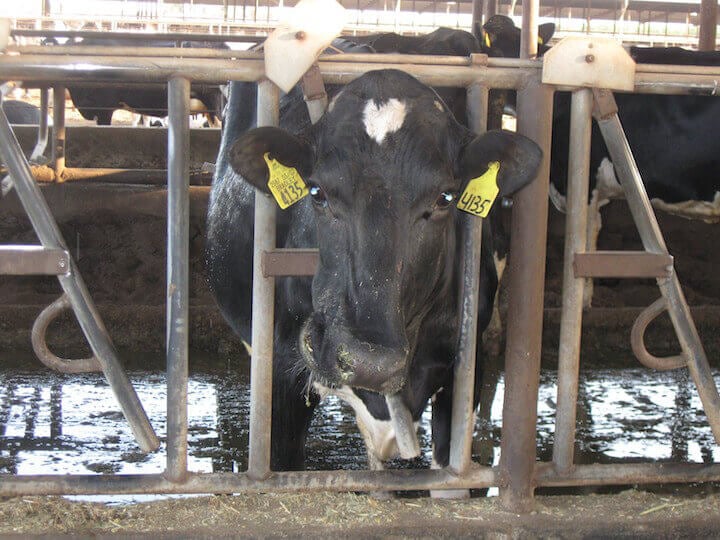
photo of cow on factory farm

Every year, 30 million cows are shipped to slaughterhouses and violently killed in the U.S. alone. You can help end this cruelty today, and we can help you get started.

The post Breaking: 18,000 Animals Killed in Explosion and Fire on Texas Dairy Farm appeared first on PETA.
Plunkett’s Hallmark Stops Selling Frogs Following an Appeal From PETA

After hearing from PETA, Plunkett’s Hallmark in Tucson, Arizona, was quick to pull cruel “EcoAquariums” containing frogs from its shelves and commit to not selling any live animals. PETA pointed out that animals sold in tiny, inhumane enclosures are routinely deprived of adequate care and often die prematurely. Plunkett’s Hallmark followed the lead of Hallmark corporate and other companies, including Albertsons, JCPenney, Rite Aid, and Walgreens, that refuse to sell live animals in small plastic prisons. PETA urges the public never to buy these cruel aquariums and to remember that children learn nothing about frogs’ natural behavior by watching them in a tiny enclosure where they have little to do except swim in endless circles. Confining them in such a way sends the harmful message that it’s acceptable to exploit animals for human entertainment. We also urge everyone to take action for other animals, including betta fish, who suffer in the pet trade.

The post Plunkett’s Hallmark Stops Selling Frogs Following an Appeal From PETA appeared first on PETA.

New PETA Virtual Reality Experience Promises Close Encounters at ASU

To encourage empathy for animals who are mutilated and killed in university laboratories, PETA will visit Arizona State University (ASU) on Thursday to launch Abduction, a unique virtual reality experience landing on college campuses across the country. In this eerie experience, visitors enter a mysterious truck and put on a virtual reality headset. They seemingly find themselves stranded in the desert with a couple of fellow humans, abducted by aliens, taken aboard a spaceship, and subjected to a terrifying experience similar to what animals endure in laboratories. They watch as others are subjected to experiments—inspired by real tests done on animals—knowing that they’ll be next.

When:    Thursday, April 13, 1 p.m.

Where:    Barrett Fountain at ASU, Tempe (See Google Maps link here.)

Watch the trailer here. Broadcast-quality footage of the Abduction virtual reality experience is available upon request.

At ASU, experimenters bound tiny marmoset monkeys into restraint chairs, leaving only their heads free; implanted metal posts into their skulls; and subjected them to behavioral testing for up to 46 days. Other experimenters inflicted injuries on monkeys’ spinal cords, deprived the animals of sustenance, forced them to walk on a treadmill in exchange for a bit of food or water, and then killed them. ASU experimenters also implanted catheters along rats’ necks, administered cocaine repeatedly to the animals through IVs, forced them to endure behavioral testing, and withheld food from them, providing only cocaine or sugar as a reward for pressing a lever.

“Many students don’t know that on their own college campuses, frightened and confused animals are being tormented, mutilated, and killed in cold, barren laboratories, with no way to escape or even understand what’s happening to them,” says PETA Senior Director Rachelle Owen. “PETA is on a mission to open young people’s eyes to this cruelty, help them understand what it feels like, and motivate them to join our call for a switch to superior, non-animal research.”

Studies show that 90% of all basic research—most of which involves animals—fails to lead to treatments for humans, which is why PETA is pushing universities to pivot to sophisticated, human-relevant research methods.

Abduction—which was filmed in VR180 with assistance from the virtual reality creation studio Prosper XR—has stopped at several other college campuses from coast to coast.

PETA—whose motto reads, in part, that “animals are not ours to experiment on”—opposes speciesism, a human-supremacist worldview. For more information on PETA’s investigative newsgathering and reporting, please visit PETA.org, listen to The PETA Podcast, or follow the group on Twitter, Facebook, or Instagram.

The post New PETA Virtual Reality Experience Promises Close Encounters at ASU appeared first on PETA.

‘Brew Change!’ Week of Action Targets Starbucks’ Vegan Milk Penalty

Today, supporters of PETA and Switch4Good are kicking off a weeklong push for Starbucks to drop its “penalty charge” for dairy-free milk, culminating in a sit-in with Animal Rights Initiative at a local Starbucks store on Monday. Accompanied by a social media uproar and protests in 23 cities across North America, the week of action follows PETA’s recent shareholder resolution challenging the surcharge, which won so many votes that PETA can and will submit it for a new vote in 2024.

When:    Monday, April 17, 11:30 a.m.

Where:    Starbucks, 2200 N.W. Market St., Seattle

The animal advocacy groups point out that the surcharge penalizes customers who want to help prevent abusive dairy industry practices and slash greenhouse gas emissions. Charging extra for vegan options is also an unfair practice that perpetuates dietary racism, given that 80% of Black and Indigenous Americans and more than 90% of Asian Americans are lactose intolerant.

“Starbucks should encourage customers to choose environmentally responsible and animal-friendly vegan milks, not pimp them for extra profits,” says PETA Executive Vice President Tracy Reiman. “New CEO Laxman Narasimhan must take each of Starbucks’ social commitments seriously, whether it’s fighting racism or slowing the climate catastrophe.”

“Starbucks is lagging behind all the coffee chains that don’t charge customers extra for caring about their health or the health of the planet,” says Dotsie Bausch, Founder and Executive Director, Switch4Good. “With our Justice Cup campaign and other actions, we’ve been pressuring Starbucks to drop the nondairy surcharge for a couple of years. Now we’re proud to join hands with PETA to keep up the pressure because justice and compassion shouldn’t come with a price tag.”

In today’s dairy industry, cows are artificially inseminated (raped via an inserted syringe) and calves are torn away from their loving mothers within a day of birth. Male calves are often slaughtered for veal, and females are eventually sentenced to the same miserable fate as their mothers.

The groups will hold events today in Boston; New York City; Pittsburgh; Portland, Oregon; Toronto; and other cities. PETA and Switch4Good will take to the streets of Las Vegas and Little Rock, Arkansas, this weekend, followed by Chicago next week.

PETA—whose motto reads, in part, that “animals are not ours to eat or abuse in any way”—opposes speciesism, a human-supremacist worldview. For more information, please visit PETA.org, listen to The PETA Podcast, or follow the group on Twitter, Facebook, or Instagram.

The post ‘Brew Change!’ Week of Action Targets Starbucks’ Vegan Milk Penalty appeared first on PETA.