Animal Neglect, Danger to Customers Reported at SeaQuest

A whistleblower has given PETA a damning glimpse into how animals, employees, and the public are being exposed to danger through SeaQuest’s negligent and inhumane practices. The allegations include animals at the facility being regularly deprived of veterinary care, despite obvious health problems, confined to cramped cages for months at a time, and put in direct contact with and injuring visitors. PETA submitted a complaint today to the U.S. Department of Agriculture (USDA) requesting that it investigate the operation for what appear to be numerous violations of the federal Animal Welfare Act (AWA).

“SeaQuest has repeatedly shown its inability to provide animals with even the most basic care, keep the public safe, and follow minimal government regulations,” says PETA Foundation Director of Captive Animal Law Enforcement Michelle Sinnott. “PETA urges everyone to stay away from roadside zoos like this, which put animals and humans in harm’s way for the sake of entertainment.”

The whistleblower reported that two Bengal cats received no treatment for infections for over a month, cockatiels were deprived of food in order to force them to interact with guests, parakeets frequently became “egg bound” (a potentially fatal condition in which eggs become stuck inside a bird) and received little to no veterinary care, and multiple people sustained scratches and bites from animals, including a wallaby, a parrot, and an otter. According to the whistleblower, the facility was also teeming with cockroaches and fruit flies.

The circumstances described in the complaint are just the latest in a years-long pattern of cruelty and neglect by SeaQuest Trumbull that has resulted in a string of USDA citations. Incidents include an employee hitting an otter with a metal bowl, rabbits left without food or water, an otter biting children on multiple occasions, and the accumulation of feces and debris in improperly maintained enclosures.

SeaQuest’s other facilities across the country are no better: Hundreds of animals have died, and the USDA has issued numerous citations for inadequate animal care, improper maintenance, and injuries to the public.

PETA—whose motto reads, in part, that “animals are not ours to use for entertainment”—opposes speciesism, a human-supremacist worldview. For more information about PETA’s investigative newsgathering and reporting, please visit PETA.org, listen to The PETA Podcast, or follow the group on Twitter, Facebook, or Instagram.

The post Animal Neglect, Danger to Customers Reported at SeaQuest appeared first on PETA.

NIH Pays Monkey Importer Charles River—Now Under Federal Investigation—Nearly $300 Million in Contracts

PETA reveals in a letter today that the National Institutes of Health (NIH) has awarded Charles River Laboratories—which faces ongoing civil and criminal investigations for its possible violations of monkey-importation laws—a staggering $280 million in taxpayer money since 2018 to run multiple laboratories, conduct experiments on animals, and more. In its letter to NIH, PETA urges the agency to reconsider these contracts and pay, along with Charles River, for the lifetime sanctuary care of the 1,000 monkeys the company reportedly brought into the U.S. illegally, whose fate remains uncertain.

“PETA is calling on NIH to reconsider all contracts with Charles River and send the 1,000 monkeys whose fate hangs in the balance to an accredited sanctuary so they can’t be returned to the monkey-smuggling pipeline,” says PETA Senior Vice President Kathy Guillermo.

Charles River is responsible for operating part of NIH’s Animal Center campus in Poolesville, Maryland, where hundreds of monkeys are housed and experimented on. The company also runs multiple National Institute of Allergy and Infectious Diseases laboratories in which experiments on ferrets, rabbits, primates, chickens, ducks, mice, and other rodents are conducted in Bethesda, Maryland, and Hamilton, Montana.

PETA’s letter cites serious issues with Charles River’s oversight, including the escape of a monkey infected with tuberculosis into the laboratory’s HVAC system, posing a threat to humans. The company further admits that imported monkeys may carry dangerous diseases that are transmissible to humans. NIH labs run by Charles River have had multiple animal welfare violations that resulted in the deaths of animals.

The U.S. Department of Justice has issued indictments against Cambodian officials and nationals for allegedly selling monkeys abducted from their forest homes. Like the monkeys caught up in the laundering scheme alleged in the indictments, the origin of the 1,000 monkeys in Charles River’s hands appears to be under investigation.

PETA—whose motto reads, in part, that “animals are not ours to experiment on”—opposes speciesism, a human-supremacist worldview. For more information, please visit PETA.org, listen to The PETA Podcast, or follow the group on Twitter, Facebook, or Instagram.

The post NIH Pays Monkey Importer Charles River—Now Under Federal Investigation—Nearly $300 Million in Contracts appeared first on PETA.

Banner Over Fisher Freeway Bridge to Blast Human Supremacy

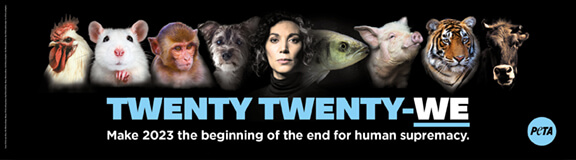
On Friday, PETA supporters and members of Peoria Area Voices for Animals will unfurl a giant “Twenty Twenty-We” banner on the W. Closen Road bridge over I-474 urging everyone to make 2023 the beginning of the end for human supremacy. The unmissable plea features an image of a woman alongside faces of other animals in an effort to tackle speciesism, the archaic belief that other species exist solely for humans to eat and exploit.

When:    Friday, April 28, 4 p.m.

Where:    W. Closen Road bridge between S. Clarence Place and S. Byron Court, Bellevue

“All animals feel pain and fear, desire freedom, love their offspring, have unique personalities, and value their own lives,” says PETA Executive Vice President Tracy Reiman. “PETA’s campaign is a reminder that animals are someone, not something, and ending speciesism means making kind choices for animals at the market and beyond.”

Despite animals’ extraordinary talents, abilities, and intelligence, people use them as experimentation tools, food, clothing, or playthings because of speciesism. Not only does this mentality contribute to the deaths of billions of animals each year, it also accelerates the climate catastrophe and the spread of zoonotic diseases. To combat speciesism, PETA encourages everyone to buy only cosmetics and household products never tested on animals, eat and wear vegan, and avoid aquariums, roadside zoos, and circuses that have live-animal acts.

PETA’s motto reads, “Animals are not ours to experiment on, eat, wear, use for entertainment, or abuse in any other way.”

For more information, please visit PETA.org, listen to The PETA Podcast, or follow the group on Twitter, Facebook, or Instagram.

The post Banner Over Fisher Freeway Bridge to Blast Human Supremacy appeared first on PETA.

What Happened to Starving Monkeys After 40 Years?

In the 1980s, two separate groups of experimenters set out to answer a not-so-burning question: Will a sentient being live a longer, healthier life when kept in a state of perpetual hunger for, say, 40 years?

At the University of Wisconsin–Madison and at a National Institutes of Health (NIH) laboratory in Bethesda, Maryland, experimenters kept rhesus macaques on a starvation-like diet that fell 30% below their minimum standard daily calorie requirement.

Photo of two rhesus monkeys sitting side by side, separated by a cage wall©️ University of Wisconsin | Jeff Miller
The monkeys in this Wisconsin NPRC photo were subjected to years of cruel treatment. Experimenters put the one on the left on an extremely low-calorie diet, leaving the monkey hungry most of the time, while the one on the right was fed sugary processed food, which monkeys never eat in nature.

And they kept them hungry like this for four decades.

What was their final, earth-shattering conclusion? Dunno, says the journal Nature.

The UW-Madison experimenters said the lives of their hungry monkeys were improved by food deprivation, but those at NIH said the opposite about theirs.

These conflicting outcomes, according to one experimenter, “cast a shadow of doubt on the translatability of the caloric-restriction paradigm as a means to understand aging and what creates age-related disease vulnerability.”

Starving monkeys isn’t science, you say? Who could possibly have predicted that?

We could have.

It’s apparently not enough to deprive monkeys of everything that makes life worth living and slowly drive them insane by keeping them caged in solitary confinement, interrupted only by periods of pain from needles and blood draws and myriad other daily horrors, but to also intentionally keep them hungry—for 40 years—is simply demented.

This is yet another horror story in an unfortunately endless litany of wasted lives, wasted money, and wasted time amassed on the taxpayers’ dole by experimenters who are doing nothing to help anyone and leaving misery in their wake.

PETA has a simple message for how to end these wrongs: Put modern science into all laboratories. Adopt PETA scientists’ Research Modernization Deal, a clear-cut roadmap to ending animal experiments and shifting to cutting-edge research models that will put U.S. laboratories on the vanguard of scientific innovation, leaving this garbage behind.

The post What Happened to Starving Monkeys After 40 Years? appeared first on PETA.

Maryland Horse Racing Deaths: Here’s the Track That Will Save Lives

Please see the following statement from PETA Senior Vice President Kathy Guillermo regarding recent horse deaths at Laurel Park racetrack and the Maryland Racing Commission meeting this morning to discuss an assessment of the safety of the track:

The horsemen and state officials clamoring for an independent review of the dirt track at Laurel Park are pretending that they don’t know which surface is the safest, but everyone in racing knows: It’s not dirt—it’s synthetic. Statistics consistently show, year after year, that the death rate on synthetic tracks is significantly lower than on any other surface. Every track in the U.S., including Laurel, should convert to synthetic immediately. If they don’t, they’re willfully allowing horses to die, and die badly.

PETA—whose motto reads, in part, that “animals are not ours to use for entertainment or abuse in any other way”—opposes speciesism, a human-supremacist worldview. For more information, please visit PETA.org or follow the group on Twitter, Facebook, or Instagram.

The post Maryland Horse Racing Deaths: Here’s the Track That Will Save Lives appeared first on PETA.