
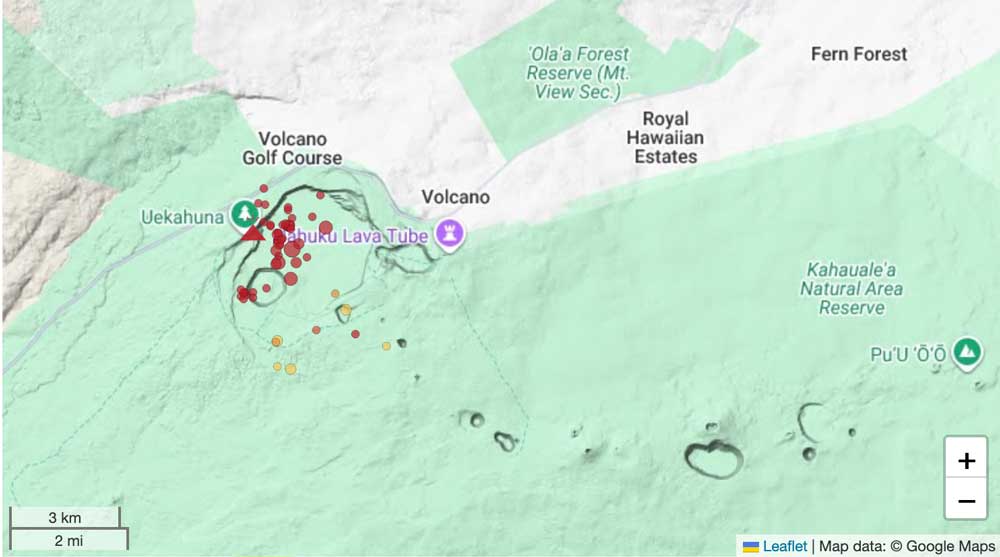
A shallow intrusion of magma is occurring within the summit region near the existing eruption location in Hawai’i Volcanoes National Park, the Hawaiian Volcano Observatory reported a short time ago:
„Earthquake activity has increased in the summit region of Kīlauea beneath Halemaʻumaʻu crater and the south caldera region. Ground deformation patterns recorded by summit tiltmeters suggest that magma is intruding beneath the ground in this area, in an east-west orientation, near the western or southern part of Halemaʻumaʻu crater.
Increased earthquake activity began this afternoon, September 30, 2026, at approximately 2 p.m. HST, underneath Halemaʻumaʻu. Since then, about 40 earthquakes have been detected and activity is still on-going. The largest event so far, a magnitude 3.4 earthquake, occurred at 9:52 p.m. HST, 1.4 km (0.9 miles) beneath the surface in the northeast part of Halemaʻumaʻu. Starting around 8 p.m. HST, summit tiltmeters began to show extremely rapid changes consistent with crack growth in an east-west orientation, possibly near the current vent area, suggesting that magma is intruding in this region.
Historically, east-west-trending fissures have erupted in the southeastern part of Halemaʻumaʻu and extended through the Keanakākoʻi crater area all the way to Chain of Craters Road near Lua Manu. The last east-west fissure in this area erupted in September 2023 and extended from the middle of Halemaʻumaʻu to the eastern wall just beneath the Keanakākoʻi overlook. An event of this type is also possible under current conditions.
Currently, there are no signs of a change at the surface as the existing eruptive vent complex in Halemaʻumaʻu, including the north and south vents, continues to intermittently spatter with strong glow and flames; however, conditions could change quickly. It is possible that this event ends without reaching the surface or it produces a fissure eruption in a new location within the summit caldera region.
Current activity is restricted to the summit region of Kīlauea. No anomalous activity has been detected in the East Rift Zone or Southwest Rift Zone.
The USGS Hawaiian Volcano Observatory is monitoring the situation closely and will issue additional messages as needed.“