Kilauea volcano (Hawai’i): new vents in Halema’uma’u crater indicate possible change in eruption

Small lava flows from multiple vents inside the Halema'uma'u crater of Kilauea volcano (image: USGS / HVO webcam)

Small lava flows from multiple vents inside the Halema'uma'u crater of Kilauea volcano (image: USGS / HVO webcam)

The awaited 55th lava-fountaining episode has still not manifested itself, even though monitoring data indicate that it is more than ready as the system is pressurized beyond the normal point when lava fountains start. Instead of starting a lava fountaining episode, spattering and minor lava effusion has now continued for the longest precursory activity of any episode observed so far.

Interesting changes, in particular, the opening of new effusive vents in the northwestern crater area as well as different seismic patterns in recent days suggest that the volcano’s activity is about to enter an new stage and that the next eruptive activity could be quite different from the 54 lava fountaining episodes that the volcano has been producing since Dec 2024.

The volcano observatory (HVO/USGS) sent out a detailed report:

„Kīlauea summit region is pressurized above the level required to start a fountaining episode. Additional changes to the type of activity/eruption location could potentially occur.

Data from summit tiltmeters and Global Positioning Satellite (GPS) instruments indicate that the summit region is highly pressurized. This pressurization may be due to the increased height, about 500 feet (150 meters), of the north-south-west vent complex since the start of the eruption on December 23, 2024. The opening of new vents last night and this morning north of the established vent complex in Halemaʻumaʻu appears to be a response to this pressurization.
The new vents are about 150 feet (45 meters) below the level of the north vent. The new vents opened without significant seismicity, although they are in the region where a short-lived swarm of shallow earthquakes took place from about 9:15 to 9:25 p.m. HST on the night of September 13.

Current summit reinflation leading up to this change in activity has been very irregular since lava fountaining episode 54 on August 25 and difficult to model due to repeated deflations and periods of no inflation. On September 7, summit tiltmeters indicated that the Halemaʻumaʻu magma chamber surpassed the amount of pressurization typically observed to start a fountaining episode. Since September 7, the number of small magnitude earthquakes began to increase in the Kīlauea summit region, likely related to the general increase in pressure in the Halemaʻumaʻu magma chamber.

Nearly 100 earthquakes have been located since September 7, in three general areas: about 1.5 km (0.9 miles) below Halemaʻumaʻu including the northwest side where the new vents occurred, about 3 km (1.8 miles) deep just south of Halemaʻumaʻu, and 1.5 km (0.9 miles) deep beneath Keanakākoʻi crater on the southeast side of the caldera. Most earthquakes have been smaller than magnitude-2, though the largest event was M2.6 on September 11. 

Lava has not yet erupted as high fountains, but smaller, precursory lava flows have erupted from the north vent over 104 times between September 7–12. Since then, intermittent spatter bursts on September 13–15 have built a small spatter cone around the north vent that was measured as 36-39 feet (11-12 meters) tall September 14 afternoon. Last night, September 14, cracks on and near the base of the northwest wall of Halemaʻumaʻu crater erupted lava just north of the vent complex beginning just before 9:00 p.m. HST. No fountaining was associated with the new vents, which continue to feed a small flow today in the northwest corner of the crater floor. Precursory flows have been ongoing for 8 days now, the longest period recorded during this eruption.

No unusual activity has been detected in the Southwest or East Rift Zones of Kīlauea. All activity has been confined to the summit region of Kīlauea in Hawaiʻi Volcanoes National Park.

Interpretation:

The magma plumbing system connecting the eruptive vents in Halemaʻumaʻu to the shallow magma chamber below has been remarkably stable throughout most of this eruption. During the start of episode 30 lava fountaining on August 6, 2025, earthquakes and ground deformation in an area on the south rim of Halemaʻumaʻu crater were associated with the opening of a new fissure on the south side of the crater, which erupted briefly only during episode 30. Earthquakes occurred minutes to hours before the new fissure began erupting in this area. That vent opened about 10 minutes prior to the onset of fountaining and stopped erupting about 2 hours into the fountaining episode. Kīlauea summit rapidly deflated during lava fountaining episode 30, and the fissure on the south side Halemaʻumaʻu did not erupt again. 

Overnight glow and spatter visible in the north/south/west vents indicate that the conduits remain intact and connected to the underlying chamber despite the opening of new vents nearby last night. Volcanic tremor, which has been the major seismic signal during this eruption, has also continued. While many lava fountaining episodes are preceded by lava flows or visible spatter, this period of precursory activity is now the longest since high fountains began after episode 4 from January 15–18, 2025. The rate of earthquakes has decreased slightly in the past day but the summit region of Kīlauea summit remains at a high level of pressurization despite the opening of new vents last night. The new vents are at a lower elevation than the main eruptive vent complex in Halemaʻumaʻu, which could sustain prolonged continuous eruption of lava. However, the continued high level of pressurization could also potentially result in additional changes outlined below. 

Possible Outcomes

The impact of Kīlauea summit increased pressurization and earthquakes on the next episode of lava fountaining, if any, is unknown at this time. It is not possible to forecast an exact outcome of this activity. However, some potential scenarios are described below based on past episodic eruptions of Kīlauea (1983 Puʻuʻōʻō and the 1969 Maunaulu eruptions). These past eruptions both continued after lava fountaining episodes ended, with fissures opening nearby that erupted more continuous lava flows.  

Scenario 1: Eruption becomes continuous at the new vents: Lava could continue to erupt from the vents in Halemaʻumaʻu, as lava flows or spatter bursts, for an unforeseeable amount of time. The prolonged nature of low-level activity since September 7 and opening of new vents could be signs of a transition to lava erupting more continuously within Halemaʻumaʻu from existing vents. The only similar scenario is the onset of episode 48 during the Puʻuʻōʻō eruption where pressure built up to a new fountaining episode, but instead of fountaining a new fissure opened up down rift of Puʻuʻōʻō and began erupting continuously.

Scenario 2: Eruption returns to fountaining: Alternatively, a fountaining episode from an existing vent in Halemaʻumaʻu could begin at any point during this period of increased pressurization.  Prior to episode 35 of the Puʻuʻōʻō eruption, a fissure erupted uprift of the vent before fountaining began and continued for 2 weeks after the end of the fountain episode. Normal fountain episodes resumed after the end of this extended excursion.

Scenario 3: Formation of new vent(s) in summit region: Magma could form a new shallow pathway toward the surface, potentially resulting in other new vents erupting lava within the summit caldera. In this scenario, we would expect earthquakes, potentially with tightly clustered locations, along with changes in the patterns of ground deformation indicative of shallow crack formation, similar to what occurred in the new vent formation during episode 30 on August 6, 2025, when a crack in the southwest wall of Halemaʻumaʻu briefly erupted.  

Scenario 4: Intrusion into the upper parts of the Southwest Rift Zone or East Rift Zone: Magma could migrate into the upper portion of the Southwest Rift Zone or the East Rift Zone in Hawaiʻi Volcanoes National Park. In this scenario, we would expect an extended period of increased rates of earthquakes migrating from the summit towards a rift zone, along with ground deformation indicative of summit magma chamber deflation. 

Eruption History:

There have been 54 episodes of lava fountaining since the Halemaʻumaʻu eruption began in late December 2024 at the summit of Kīlauea. Each episode was preceded by a period of summit inflation as magma accumulated in the shallow chamber beneath Halemaʻumaʻu followed by rapid summit deflation during lava fountaining. New fountaining episodes usually occur when inflation recovers the amount lost in the previous fountaining episode indicating the system has repressurized.  This repeating pattern coupled with uniform inflation as measured on summit tiltmeters has allowed the USGS Hawaiian Volcano Observatory to track the pressurization required to initiate fountaining episodes and issue forecast windows of several days for the onset of fountaining for about 50 of the episodes.“

Source: USGS Hawaiian Volcano Observatory

Summit inflation pattern over the past months corresponding to the recent lava fountain episodes and the current situation reflecting over-ressurization of the system (image: USGS / HVO)

Dukono Volcanic Ash Advisory: ash plume to 7,000 ft (2,100 m) as of Sep 16, 01:50 UTC

Satellite image of Dukono volcano on 16 Sep 2026

Explosive activity continues. The Volcanic Ash Advisory Center (VAAC) Darwin warned of a volcanic ash plume rising to an estimated 7000 ft (2100 m), or flight level 070, and moving at 10 kts in NE direction.
Original VAAC bulletin:

FVAU01 at 02:18 UTC, 16/09/26 from ADRM
VA ADVISORY
DTG: 20260916/0210Z
VAAC: DARWIN
VOLCANO: DUKONO 268010
PSN: N0142 E12754
AREA: INDONESIA
SOURCE ELEV: 1229M AMSL
ADVISORY NR: 2026/758
INFO SOURCE: HIMAWARI-9
ERUPTION DETAILS: VA TO FL070 OBS AT 16/0150 EXT NE
OBS VA DTG: 16/0150Z
OBS VA CLD: SFC/FL070 N0138 E12755 - N0142 E12749 - N0235
E12800 - N0215 E12838 MOV NE 10KT
FCST VA CLD +6 HR: 16/0750Z SFC/FL070 N0139 E12755 - N0143
E12749 - N0234 E12809 - N0206 E12841
FCST VA CLD +12 HR: 16/1350Z SFC/FL070 N0138 E12755 - N0143
E12749 - N0233 E12809 - N0206 E12841
FCST VA CLD +18 HR: 16/1950Z SFC/FL070 N0138 E12755 - N0143
E12749 - N0234 E12809 - N0206 E12841
RMK: VA HEIGHT AND MOVEMENT BASED ON SATELLITE IMAGERY AND
MODEL GUIDANCE.
NXT ADVISORY: NO LATER THAN 20260916/0810Z=

Sakurajima Volcanic Ash Advisory: no ash plume observed as of 15 Sep 2026, 21:30 UTC

An eruption was reported at Sakurajima at 21:31 UTC on 15 September 2026, but no volcanic ash cloud was identifiable in satellite data as of 21:30 UTC. No further advisories are planned unless ash is detected.
Original VAAC bulletin:

FVFE01 at 21:46 UTC, 15/09/26 from RJTD
VA ADVISORY
DTG: 20260915/2146Z
VAAC: TOKYO
VOLCANO: SAKURAJIMA [AIRA CALDERA] 282080
PSN: N3136 E13039
AREA: JAPAN
SOURCE ELEV: 1117M AMSL
ADVISORY NR: 2026/200
INFO SOURCE: JMA HIMAWARI-9
ERUPTION DETAILS: ERUPTED AT 20260915/2131Z FL110 EXTD NE
OBS VA DTG: 15/2130Z
OBS VA CLD: VA NOT IDENTIFIABLE FM SATELLITE DATA WIND FL110 220/12KT

FCST VA CLD +6 HR: NOT AVBL
FCST VA CLD +12 HR: NOT AVBL
FCST VA CLD +18 HR: NOT AVBL
RMK: WE WILL ISSUE FURTHER ADVISORY IF VA IS DETECTED IN SATELLITE
IMAGERY.
NXT ADVISORY: NO FURTHER ADVISORIES=

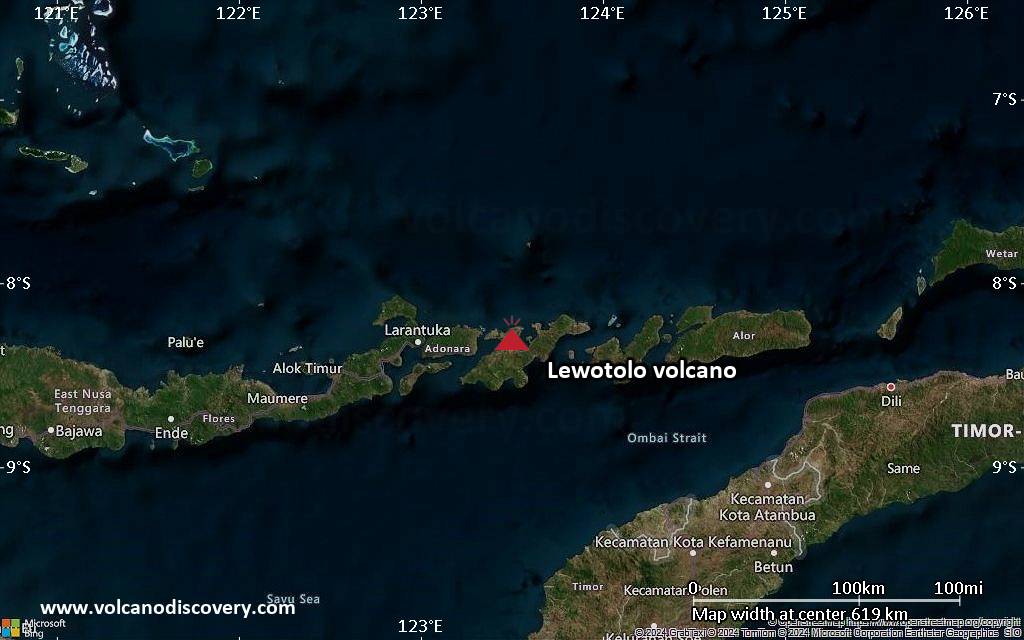
Lewotolo Volcanic Ash Advisory: ash plume to 6,000 ft (1,800 m) as of Sep 15, 17:49 UTC

Explosive activity continues. The Volcanic Ash Advisory Center (VAAC) Darwin warned of a volcanic ash plume rising to an estimated 6000 ft (1800 m), or flight level 060.
Original VAAC bulletin:

FVAU04 at 17:49 UTC, 15/09/26 from ADRM
VA ADVISORY
DTG: 20260915/1800Z
VAAC: DARWIN
VOLCANO: LEWOTOLOK 264230
PSN: S0816 E12330
AREA: INDONESIA
SOURCE ELEV: 1423M AMSL
ADVISORY NR: 2026/238
INFO SOURCE: HIMAWARI-9, CVGHM
ERUPTION DETAILS: VA TO FL060 MOV W REP FM GND AT 15/1059Z
EST VA DTG: 15/1730Z
EST VA CLD: SFC/FL060 S0814 E12333 - S0819 E12331 - S0817
E12241 - S0758 E12239 - S0745 E12253 MOV NW 20KT
FCST VA CLD +6 HR: 15/2330Z SFC/FL060 S0819 E12332 - S0816
E12242 - S0753 E12242 - S0741 E12300 - S0814 E12334
FCST VA CLD +12 HR: 16/0530Z SFC/FL060 S0818 E12333 - S0829
E12247 - S0808 E12239 - S0748 E12254 - S0814 E12333
FCST VA CLD +18 HR: 16/1130Z SFC/FL060 S0819 E12332 - S0821
E12242 - S0757 E12241 - S0743 E12259 - S0814 E12334
RMK: VA NOT IDENTIFIABLE ON CURRENT SATELLITE IMAGERY.
HOWEVER, GROUND REPORT INDICATES ONGOING EMISSIONS. HEIGHT
AND MOVEMENT BASED ON GROUND REPORTS AND MODEL GUIDANCE.
NXT ADVISORY: NO LATER THAN 20260916/0000Z=

Santiaguito Volcano Volcanic Ash Advisory: VA SEEN ON WEBCAM

The Volcanic Ash Advisory Center (VAAC) Washington issued the following bulletin.
Original VAAC bulletin:

FVXX22 at 14:29 UTC, 15/09/26 from KNES
VA ADVISORY
DTG: 20260915/1427Z

VAAC: WASHINGTON

VOLCANO: SANTA MARIA 342030
PSN: N1445 W09133

AREA: GUATEMALA

SOURCE ELEV: 12287 FT AMSL

ADVISORY NR: 2026/540

INFO SOURCE: GOES-19. WEBCAM. NWP MODELS.

ERUPTION DETAILS: VA SEEN ON WEBCAM

EST VA DTG: 15/1410Z

EST VA CLD: SFC/FL140 N1447 W09148 - N1445 W09132
- N1444 W09132 - N1442 W09149 - N1447 W09148 MOV
W 15KT

FCST VA CLD +6HR: 15/2000Z SFC/FL140 N1445 W09132
- N1444 W09131 - N1438 W09147 - N1444 W09148 -
N1445 W09132

FCST VA CLD +12HR: 16/0200Z SFC/FL140 N1446
W09149 - N1446 W09132 - N1445 W09132 - N1440
W09149 - N1446 W09149

FCST VA CLD +18HR: 16/0800Z SFC/FL140 N1446
W09149 - N1445 W09131 - N1444 W09131 - N1438
W09149 - N1446 W09149

RMK: VA EMS SEEN ON WEBCAM. WX CLDS OBSC STLT
IMG. NWP MDLS FCST LTLCG IN FL WINDS THRU T+18.
...BUTLER

NXT ADVISORY: WILL BE ISSUED BY 20260915/2030Z