
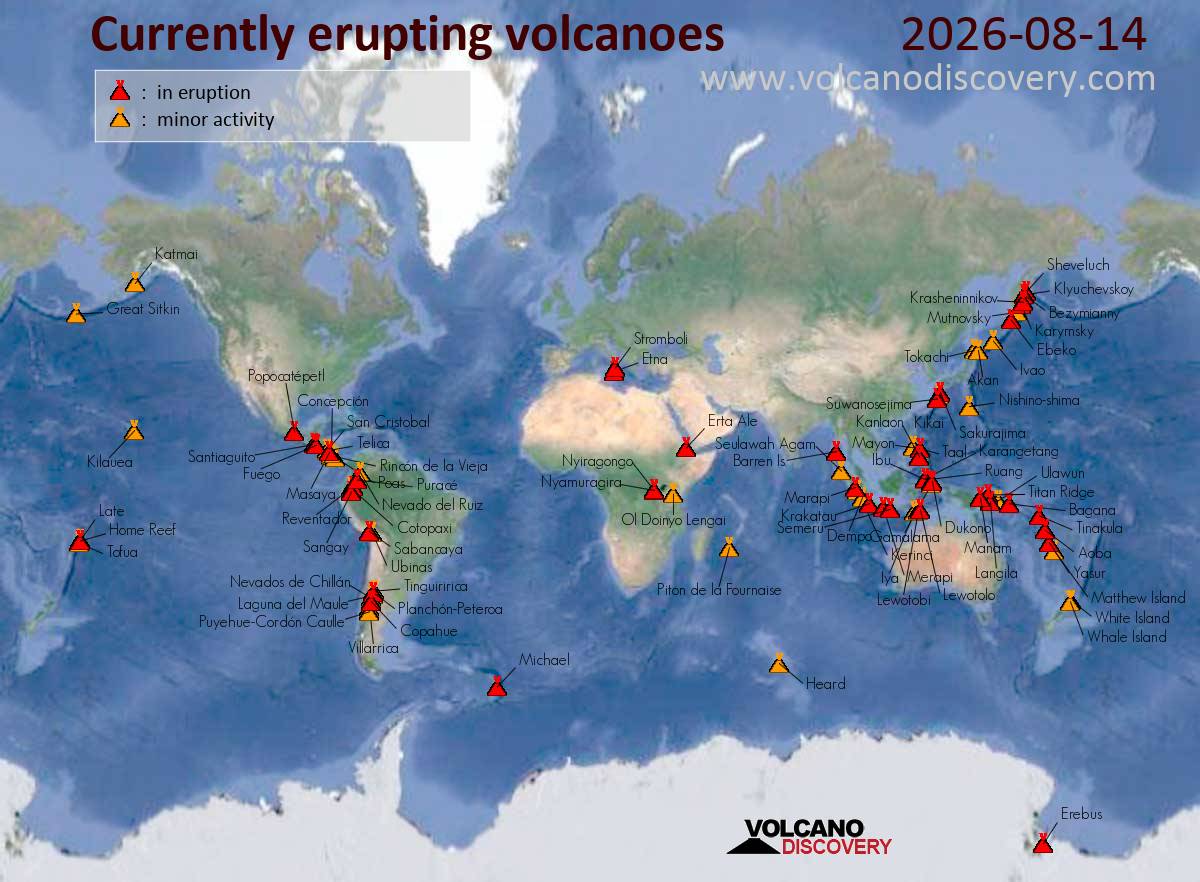
Etna (Sicily, Italy): Explosive activity continues. The Volcanic Ash Advisory Center (VAAC) Toulouse warned of a volcanic ash plume rising to an estimated 15000 ft (4600 m), or flight level 150, and moving at 15 kts in S direction.
Original VAAC bulletin: ash plume to 15,000 ft (4,600 m) as of Aug 14, 13:00 UTC
…13 Aug:
The Sezione di Catania – Osservatorio Etneo (INGV) reported that a renewed stronger phase of activity occurred at Etna’s Voragine Crater (VOR) during 6-12 August, continuing the eruptive sequence described in previous reports. An explosion at the summit craters at 0250 on 6 August marked the onset of Strombolian activity at VOR, producing weak ash emissions and plumes that drifted ESE. Explosions of variable frequency ejected coarse material that fell mainly within the crater, weak ash emissions drifting SSW, and a lava flow spilling into the adjacent Northeast Crater (NEC).
Beginning at 2230, the Strombolian activity intensified and evolved into lava fountaining, and the eruptive cloud drifted SE. The Aviation Color Code (ACC) was raised first to Orange and then to Red.
… [read more]
Krasheninnikov (Kamchatka, Russia): (13 Aug) The Kamchatkan Volcanic Eruption Response Team (KVERT) reported that the effusive activity at Krasheninnikov continued during 6-10 August. Lava flows advanced along the E flanks of the Northern Cone, and emissions of gas-and-steam, sometimes containing ash, were observed. Satellite data analyzed by KVERT showed a large bright thermal anomaly.
The Aviation Color Code remained at Yellow (the second lowest level on a four-color scale). Dates and times are provided in Coordinated Universal Time (UTC); events are in local time only where specified.
… [read more]
Sheveluch (Kamchatka): (14 Aug) An eruption was reported at Sheveluch at 01: no ash plume observed as of 14 Aug 2026, 02:00 UTC
…13 Aug:
The Kamchatkan Volcanic Eruption Response Team (KVERT) reported continuing lava effusion and explosive activity at the lava domes along the N crater floor of Young Sheveluch (on the SW flank of Old Sheveluch) during 6-10 August. Growth continued along the N part of the main lava dome. A thermal anomaly was identified in satellite images on most days; weather clouds occasionally obscured views.
The Aviation Color Code remained at Orange (the second highest level on a four-color scale). Dates are based on UTC; specific events are in local time where noted.
… [read more]
Bezymianny (Kamchatka): (13 Aug) The Kamchatkan Volcanic Eruption Response Team (KVERT) reported that effusive activity of the volcano continued during 6-10 August. Lava flows were accompanied by powerful gas-steam emissions. A daily thermal anomaly was identified in satellite images.
Dates and times are provided in Coordinated Universal Time (UTC); events are in local time only where specified.
… [read more]
Tokachi (Hokkaido): (13 Aug) The Japan Meteorological Agency (JMA) reported that volcanic activity at Tokachidake remains elevated, with active plumes emanating from Crater 62-2 and the Furikozawa fumarole group. Recent eruptions included a grayish-white plume rising 300 m above the crater rim. Thermal activity, volcanic gas emissions, and seismicity have increased since the spring of 2026, and further eruptions may affect areas within 1.5 km of Crater 62-2.
The public is advised to remain vigilant for large volcanic rocks and ashfall, follow local authority instructions, and avoid dangerous areas. The volcano remains at Alert Level 2 (on a scale of 1-5).
… [read more]
E-san (Hokkaido): (13 Aug) The Japan Meteorological Agency (JMA) reported that volcanic earthquakes with hypocenters near the crater floor at Esan increased during 5 August through the next morning. The event count was 53 on 5 August, with an additional 6 through 1200 on 6 August. This was the first time since 31 March 2012 that the 24-hour maximum earthquake count exceeded 50 events at Esan.
No volcanic tremor was recorded, and ground deformation and fumarolic conditions at the craters showed no changes. JMA stated that no signs of increasing volcanic activity were recognized. The Alert Level remained at 1 (on a 5-level scale).
… [read more]
Sakurajima (Kyushu, Japan): Explosive activity continues. The Volcanic Ash Advisory Center (VAAC) Tokyo warned of a volcanic ash plume rising to an estimated 6000 ft (1800 m), or flight level 060, and moving at 10 kts in NW direction.
Original VAAC bulletin: ash plume to 6,000 ft (1,800 m) as of Aug 14, 19:30 UTC
…13 Aug:
The Japan Meteorological Agency (JMA) reported ongoing eruptive activity at Minamidake Crater (Aira Caldera’s Sakurajima volcano) during 3-10 August. Sakurajima exhibited ongoing eruptive activity that began in early August 2026, with eruptions producing ash plumes up to 2.2 km above the crater, ejections of large ballistic rocks up to 600 m from the crater, and pyroclastic flows. Monitoring data indicated continuing ground deformation beneath the Aira Caldera as well as high sulfur dioxide emissions.
The Alert Level remained at 3 (on a 5-level scale), and the public was warned to be cautious within 2 km of both the Minimadake and Showa craters.
… [read more]
Suwanosejima (Ryukyu Islands): (13 Aug) The Japan Meteorological Agency (JMA) reported that eruptive activity at Suwanosejima’s Otake Crater continued during 31 July-7 August. White plumes rose as high as 400 m above the crater rim, and crater incandescence was observed at night with a high-sensitivity camera. The Alert Level remained at 2 (the second level on a five-level scale) and the public was warned to be cautious within 1.5 km of the crater.
Sources: Source: Japan Meteorological Agency (JMA)
… [read more]
Kanlaon (Central Philippines): (13 Aug) Philippine Institute of Volcanology and Seismology (PHIVOLCS) reported that Kanlaon remained at Alert Level 2 during 6-11 August. Moderate volcanic unrest during this time was characterized by 1-5 daily volcanic earthquakes, sulfur dioxide emissions fluctuating between 651 and 1,568 tons per day, plumes obscured due to cloud cover, and ground deformation showing inflation with short-term deflation. Authorities prohibited entry within a 4-kilometer radius (Permanent Danger Zone) and advised against flying near the summit due to risks of sudden steam-driven or phreatic eruptions and possible magmatic activity.
Sources: Source: Philippine Institute of Volcanology and Seismology (PHIVOLCS)
… [read more]
Karangetang (Siau Island, Sangihe Islands, Indonesia): (13 Aug) The Pusat Vulkanologi dan Mitigasi Bencana Geologi (PVMBG) reported that eruptive activity at Karangetang continued during 6-12 August. Dense white plumes rose 10-20 m above the summit daily. The seismic network recorded up to 21 avalanche events and 15-131 gas emission events per day, along with 1-47 harmonic tremor events and 3-33 non-harmonic tremor events.
PVMBG noted increases in gas emission events and harmonic tremor on 7 August.
… [read more]
Ibu (Halmahera, Indonesia): The Volcanic Ash Advisory Center (VAAC) Darwin issued the following bulletin.
Original VAAC bulletin: ERUPTION REP AT 14/1446Z EST VA DTG:14/1530Z
…13 Aug:
The Pusat Vulkanologi dan Mitigasi Bencana Geologi (PVMBG) reported that activity at Ibu continued during 6-12 August, with daily eruptive events recorded by the seismic network. Daily gray ash plumes rose 400-500 m above the summit. The Alert Level remained at 2 (the second lowest level on a four-level scale) and the public was advised to stay 2 km away from the active crater and 3.5 km away from the N crater wall opening.
Sources: Source: Pusat Vulkanologi dan Mitigasi Bencana Geologi (PVMBG, also known as CVGHM)
… [read more]
Lewotobi (Flores): Explosive activity continues. The Volcanic Ash Advisory Center (VAAC) Darwin warned of a volcanic ash plume rising to an estimated 8000 ft (2400 m), or flight level 080.
Original VAAC bulletin: ash plume to 8,000 ft (2,400 m) as of Aug 14, 19:11 UTC
…13 Aug:
The Pusat Vulkanologi dan Mitigasi Bencana Geologi (PVMBG) reported that eruptive activity continued at Lewotobi Laki-laki during 6-12 August. Ash plumes ranged from 200-800 m above the summit, drifting mostly toward the N, SW, W, and NW. The Alert Level remained at 3 (on a scale of 1-4), and the public was warned to stay 5 km away from the center of Laki-Laki.
Sources: Source: Pusat Vulkanologi dan Mitigasi Bencana Geologi (PVMBG, also known as CVGHM)
… [read more]
Lewotolo (Lesser Sunda Islands): (13 Aug) The Pusat Vulkanologi dan Mitigasi Bencana Geologi (PVMBG) reported ongoing eruptive activity at Lewotolok during 6-12 August. Daily white plumes rose as high as 200 m above the summit and drifted in multiple directions. Ash plumes rose 200-600 m above the summit and drifted SE, SW, and W during 7-11 August.
Incandescent material was periodically ejected above the summit, notably on 8-11 August. The Alert Level remained at 2 (on a scale of 1-4) and the public was warned to stay 2 km away from the summit.
… [read more]
Krakatau (Sunda Strait, Indonesia): (14 Aug) Explosive activity continues. The Volcanic Ash Advisory Center (VAAC) Darwin warned of a volcanic ash plume rising to an estimated 4000 ft (1200 m), or flight level 040.
Original VAAC bulletin: ash plume to 4,000 ft (1,200 m) as of Aug 14, 05:40 UTC
…13 Aug:
The Pusat Vulkanologi dan Mitigasi Bencana Geologi (PVMBG) reported that eruptive activity continued at Anak Krakatau during 6-12 August. White to gray plumes of variable density rose to approximately 10-150 m above the summit. Fog and cloudy weather obscured continuous observations.
The Alert Level remained at 3 (on a scale of 1-4) and the public was advised to stay 3 km away from summit.
… [read more]
Merapi (Central Java, Indonesia): (13 Aug) The Pusat Vulkanologi dan Mitigasi Bencana Geologi (PVMBG) reported that the eruption at Merapi (on Java) continued during 6-12 August with lava avalanches produced by the active lava dome on the upper SW flank. The seismic network recorded 4-19 lava avalanches per day that traveled as far as 2 km down the SW flank. Two pyroclastic flows were detected on 10 August, one of which was also observed descending the SW flank, and single flows were detected on 11 and 12 August.
The Alert Level remained at 3 (on a scale of 1-4), and the public was warned to stay 3-7 km away from the summit, based on location.
… [read more]
Semeru (East Java, Indonesia): The Volcanic Ash Advisory Center (VAAC) Darwin issued the following bulletin.
Original VAAC bulletin: ERUPTION REP AT 14/0947Z EST VA DTG:14/1030Z
…13 Aug:
The Pusat Vulkanologi dan Mitigasi Bencana Geologi (PVMBG) reported that activity continued at Semeru during 6-12 August, with daily eruptive events recorded by the seismic network. Daily white-to-gray or gray ash plumes rose 300-1,100 m above the summit and drifted multiple directions. The Alert Level remained at 3 (the second lowest level on a scale of 1-4) and the public was advised to stay at least 5 km from the summit crater, where incandescent ballistic material could fall, to avoid all activity within 13 km of the summit along the Besuk Kobokan drainage in the SE sector, and beyond that distance to stay 500 m from the riverbanks, where pyroclastic flows and lahars could extend as far as 17 km from the summit.
Sources: Source: Pusat Vulkanologi dan Mitigasi Bencana Geologi (PVMBG, also known as CVGHM)
… [read more]
Dukono (Halmahera): (14 Aug) Explosive activity continues. The Volcanic Ash Advisory Center (VAAC) Darwin warned of a volcanic ash plume rising to an estimated 7000 ft (2100 m), or flight level 070, and moving at 10 kts in N direction.
Original VAAC bulletin: ash plume to 7,000 ft (2,100 m) as of Aug 14, 04:00 UTC
Aoba (Vanuatu): The Volcanic Ash Advisory Center (VAAC) Darwin issued the following bulletin.
Original VAAC bulletin: UNKNOWN OBS VA DTG:14/1537Z
…13 Aug:
The Vanuatu Meteorology and Geohazards Department (VMGD) reported that minor eruptive activity continued at Ambae during July 2026. Persistent volcanic tremor and continuous volcano-seismic events were detected, and satellite imagery in July 2026 showed ongoing plume emissions from active vents, containing volcanic gases, steam, and ash. Lava effusion and flows within Lake Voui have significantly altered the crater’s geomorphology, resulting in the growth of the volcanic cone and the disappearance of the lake.
Satellite data indicated continuous thermal anomalies, and high sulfur dioxide emissions confirmed ongoing degassing. The Alert Level remained at 3 (on a scale of 0-5), and the public was advised to stay outside Danger Zone B, defined as a 3-km radius around the active vents in Lake Voui, and to avoid streams during heavy rains due to lahar hazards from the remobilization of residual ash.
… [read more]
Kilauea (Hawai’i): (13 Aug) The Hawaiian Volcano Observatory (HVO) reported that the eruption within Kīlauea’s Kaluapele summit caldera, characterized by episodic fountaining, incandescence, and intermittent spatter from craters along the SW margin of Halemaʻumaʻu Crater, continued at variable levels during 6-12 August. Weak glow and intermittent incandescence were observed from the north vent, while the south vent appeared dark for most of the reporting period after 7 August. Incandescence persisted at the N end of a feature that had opened upslope of the south vent on 30 July.
Overflight photographs on 11 August identified it as a collapse feature, which was 10 x 20 m based on measurements using satellite imagery. Flames and intensified glow from the vents and the collapse feature accompanied gas pistoning, which alternated with periods of continuous tremor throughout the week. Very minor spattering activity occurred within the north vent at about 2000 on 6 August and between 0430 and 0500 on 7 August.
… [read more]
Great Sitkin (United States, Aleutian Islands): (13 Aug) The Alaska Volcano Observatory (AVO) reported that lava continued to slowly erupt within the summit crater of Great Sitkin during the week of 6-12 August. A GNSS sensor on the NW shore of the island continued to record deflation, consistent with pressure reduction at depth because of the lava effusion. Satellite data showed gradual expansion of the lava dome toward the ESE and slightly elevated surface temperatures when cloud cover did not obscure the volcano.
Seismic activity remained low, with only occasional small volcanic earthquakes and seismic signals associated with minor rockfalls detected. The Volcano Alert Level remained at Watch (the third level on a four-level scale) and the Aviation Color Code remained at Orange (the third color on a four-color scale).
… [read more]
Popocatépetl (Central Mexico): (13 Aug) The Centro Nacional de Prevención de Desastres (CENAPRED) reported that daily exhalations at Popocatépetl continued during 6-12 August, accompanied by water vapor, volcanic gases, and ash; daily counts ranged from 35 to 74. Six minutes of tremor were recorded during 5-6 August. Emissions of water vapor and volcanic gases were visible from the crater each morning and drifted generally W to NW.
Cloud cover restricted visibility of the crater on 9-10 August. From 11 August the ash content of the exhalations was described as occasionally light rather than continuous.
… [read more]
Santiaguito (Guatemala): Explosive activity continues. The Volcanic Ash Advisory Center (VAAC) Washington warned of a volcanic ash plume rising to an estimated 14000 ft (4300 m), or flight level 140.
Original VAAC bulletin: ash plume to 14,000 ft (4,300 m) as of Aug 14, 12:00 UTC
Fuego (Guatemala): Explosive activity continues. The Volcanic Ash Advisory Center (VAAC) Washington warned of a volcanic ash plume rising to an estimated 18000 ft (5500 m), or flight level 180.
Original VAAC bulletin: ash plume to 18,000 ft (5,500 m) as of Aug 14, 15:00 UTC
…13 Aug:
The Instituto Nacional de Sismología, Vulcanología, Meteorología e Hidrología (INSIVUMEH) reported that a period of stronger activity at Fuego that had begun at 0830 on 3 August ended on 5 August, after 50 hours of activity. Pyroclastic density currents, causing erosion that altered the crater morphology; rockfalls and accumulations of erupted material were reported in the Seca (W flank) and Ceniza (SW flank) ravines. Ashfall primarily affected communities on the W and SW flanks within the municipality of San Pedro Yepocapa (Chimaltenango).
Lower-level eruptive activity continued through 12 August. Explosions recorded by the seismic network at rates of 4-11 per hour generated gas-and-ash plumes that rose as high as about 1 km above the summit and drifted as far as 25 km. Ashfall was reported in downwind areas, including San Pedro Yepocapa, Sangre de Cristo, and Finca Palo Verde.
… [read more]
Telica (Nicaragua): (13 Aug) The Washington Volcanic Ash Advisory Center (VAAC) reported that ash plumes at Telica were identified in webcam and satellite images on 11 August rising to 1.7-2 km (5,500-6,500 ft) a.s.l. and drifting SW and WSW as far as 140 km from the summit.
Sources: Source: Washington Volcanic Ash Advisory Center (VAAC)
… [read more]
Rincón de la Vieja (Costa Rica): (13 Aug) The Observatorio Vulcanológico y Sismológico de Costa Rica-Universidad Nacional (OVSICORI-UNA) reported that two energetic phreatic eruptions at Rincón de la Vieja were recorded by the seismic and infrasound networks at 1717 and 1725 on 11 August. The events had acoustic magnitudes of 4.1 and 4.5, respectively, and produced a lahar. Cloud cover obscured the crater, but webcam video showed two white plumes rich in water vapor and gases rising about 1 km above the summit and drifting W.
No ashfall was reported. A possible eruption was recorded at 0318 on 12 August but was not confirmed. The Alert Level remained at 3 (Caution) and the Aviation Color Code remained Orange.
… [read more]
Poas (Costa Rica): (13 Aug) The Observatorio Vulcanológico y Sismológico de Costa Rica-Universidad Nacional (OVSICORI-UNA) reported that Poás remained active during 8-12 August, with occasional eruptive events that were restricted to the crater area. The Volcanic Alert Level remained at 2 (the second lowest level on a four-level scale).
Sources: Source: Observatorio Vulcanologico y Sismologico de Costa Rica-Universidad Nacional (OVSICORI-UNA)
… [read more]
Puracé (Colombia): The Volcanic Ash Advisory Center (VAAC) Washington issued the following bulletin.
Original VAAC bulletin: VA EMS ONGOING
…13 Aug:
The Servicio Geológico Colombiano (SGC) reported that eruptive activity at Puracé continued during 6-12 August, with episodes of continuous tremor and long-period (LP) events located beneath the crater at depths of less than 1 km. Seismicity related to rock-fracturing remained very low in both number and magnitude and occurred 1-2 km beneath the crater. Sulfur dioxide flux stayed above the average baseline level, measuring 2,100 tonnes per day on 6 August, 1,900 tonnes per day on 7 August, and 2,100 tonnes per day on 8 August.
Plumes dispersed NW except for on 8 August when they dispersed W. Soil carbon dioxide concentrations continued to rise throughout the reporting period.
… [read more]
Reventador (Ecuador): Explosive activity continues. The Volcanic Ash Advisory Center (VAAC) Washington warned of a volcanic ash plume rising to an estimated 15000 ft (4600 m), or flight level 150.
Original VAAC bulletin: ash plume to 15,000 ft (4,600 m) as of Aug 14, 16:10 UTC
Sabancaya (Peru): (13 Aug) The Instituto Geofísico del Perú’s (IGP) Centro Vulcanológico Nacional (CENVUL) reported continuing eruptive activity at Sabancaya during 3-9 August. Forty-three earthquakes associated with the movement of magmatic fluids were recorded, along with events related to internal rock fracturing; no volcanic explosions occurred during the period. Emissions of water vapor, gas, and ash rose as high as 1.7 km above the summit, dispersing predominantly N and NW, affecting areas within 10 km of the vent.
No significant deformation of the edifice was detected. Moderate sulfur dioxide (SO₂) emissions averaged 766 tonnes per day, and 13 thermal anomalies (each less than 2 MW) associated with the lava dome were identified. The Alert Level remained at Orange (the third level on a four-color scale) and the public was warned to stay outside of a 12 km radius from the summit.
… [read more]