
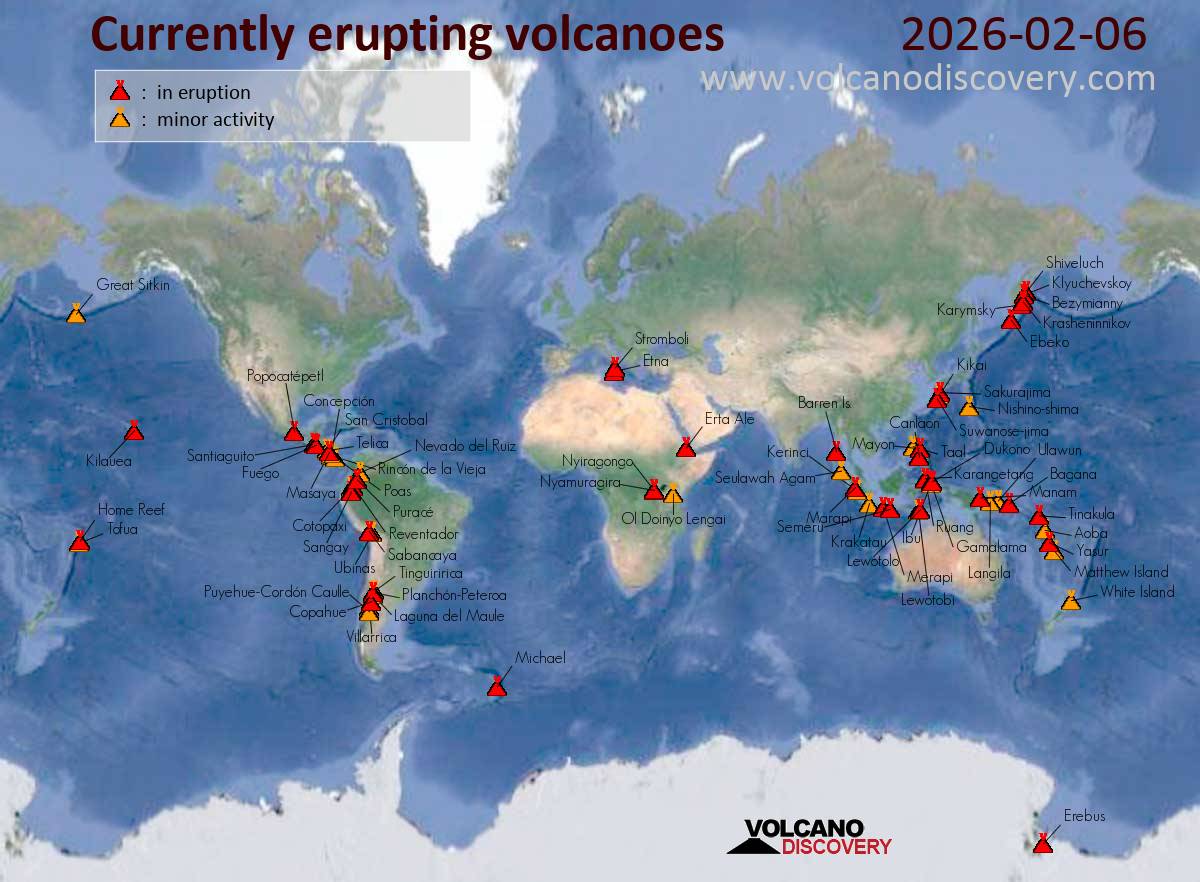
Shiveluch (Kamchatka): Explosive activity continues. Volcanic Ash Advisory Center (VAAC) Tokyo warned about a volcanic ash plume that rose up to estimated 28000 ft (8500 m) altitude or flight level 280 and is moving at 15 kts in SW direction.
The full report is as follows: VA CONTINUOUSLY OBS IN SATELLITE IMAGERY OBS VA DTG:06/1120Z to 28000 ft (8500 m)
Canlaon (Central Philippines): The Philippine Institute of Volcanology and Seismology (PHIVOLCS) reported that the eruption continued at Kanlaon on 5 February 2026 (local). Plume(s) rose to a maximum of 150 m (492 ft) above the vent. The alert level remained at „2 – Moderate Level of Volcanic Unrest“ (on a 0–5 level scale).
Source: Philippine Institute of Volcanology and Seismology (PHIVOLCS)
… [read more]
Taal (Luzon, Philippines): The Philippine Institute of Volcanology and Seismology (PHIVOLCS) reported that the eruption continued at Taal on 5 February 2026 (local). Plume(s) were reported. The alert level remained at „1 – Low-Level Unrest“ (on a 0–5 level scale).
Source: Philippine Institute of Volcanology and Seismology (PHIVOLCS)
… [read more]
Mayon (Luzon Island, Philippines): Volcanic Ash Advisory Center Tokyo (VAAC) issued the following report: ERUPTION AT 20260206/1643Z VA CLD UNKNOWN REPORTED OBS VA DTG:06/1650Z
…6 Feb:
The Philippine Institute of Volcanology and Seismology (PHIVOLCS) reported that the eruption continued at Mayon on 5 February 2026 (local). Eruptive activity was primarily characterized by the collapse of new material associated with dome growth. Lava effusion continued. Seismicity related to pyroclastic density currents was recorded 33 times. There were 348 seismically detected rockfalls. Crater glow was visible to the naked eye. Plume(s) were reported. Sulfur dioxide (SO₂) emissions averaged 1,799 tonnes per day on 5 February. Volcanic seismicity was recorded 2 times. The alert level remained at „3 – Increased Tendency Towards Hazardous Eruption“ (on a 0–5 level scale). Activity also included: seismically detected pyroclastic density current(s) (PDCs), volcanic seismicity.
Source: Philippine Institute of Volcanology and Seismology (PHIVOLCS)
… [read more]
Manam (Papua New Guinea): Explosive activity continues. Volcanic Ash Advisory Center (VAAC) Darwin warned about a volcanic ash plume that rose up to estimated 7000 ft (2100 m) altitude or flight level 070 .
The full report is as follows: VA TO FL070 OBS AT 06/0830Z MOV WNW OBS VA DTG:06/0830Z to 7000 ft (2100 m)
Telong (northern Sumatra, Indonesia): The Center for Volcanology and Geological Hazard/Pusat Vulkanologi dan Mitigasi Bencana Geologi (CVGHM/PVMBG) reported that unrest continued at Telong, Bur ni on 5 February 2026 (local). The alert level remained at „Level 2 – Alert“ (on a 4-level scale).
Source: Center for Volcanology and Geological Hazard/Pusat Vulkanologi dan Mitigasi Bencana Geologi (CVGHM/PVMBG)
… [read more]
Karangetang (Siau Island, Sangihe Islands, Indonesia): The Center for Volcanology and Geological Hazard/Pusat Vulkanologi dan Mitigasi Bencana Geologi (CVGHM/PVMBG) reported that unrest continued at Karangetang on 5 February 2026 (local). The alert level remained at „Level 2 – Alert“ (on a 4-level scale).
Source: Center for Volcanology and Geological Hazard/Pusat Vulkanologi dan Mitigasi Bencana Geologi (CVGHM/PVMBG)
… [read more]
Raung (East Java): The Center for Volcanology and Geological Hazard/Pusat Vulkanologi dan Mitigasi Bencana Geologi (CVGHM/PVMBG) reported that unrest continued at Raung on 5 February 2026 (local). Gas and vapor plume(s) rose to a maximum of 300 m (984 ft) above the vent. The alert level remained at „Level 2 – Alert“ (on a 4-level scale).
Source: Center for Volcanology and Geological Hazard/Pusat Vulkanologi dan Mitigasi Bencana Geologi (CVGHM/PVMBG)
… [read more]
Ibu (Halmahera, Indonesia): Explosive activity continues. Volcanic Ash Advisory Center (VAAC) Darwin warned about a volcanic ash plume that rose up to estimated 6000 ft (1800 m) altitude or flight level 060 and is moving at 10 kts in NE direction.
The full report is as follows: VA TO FL060 LAST REPORTED AT 06/1419Z MOV NE to 6000 ft (1800 m)
…6 Feb:
The Center for Volcanology and Geological Hazard/Pusat Vulkanologi dan Mitigasi Bencana Geologi (CVGHM/PVMBG) reported that the eruption continued at Ibu on 5 February 2026 (local). There were 126 seismically detected explosions reported. Ash and gas plume(s) rose to a maximum of 600 m (1,969 ft) above the vent. The alert level remained at „Level 2 – Alert“ (on a 4-level scale).
Source: Center for Volcanology and Geological Hazard/Pusat Vulkanologi dan Mitigasi Bencana Geologi (CVGHM/PVMBG)
… [read more]
Tangkubanparahu (West Java): The Center for Volcanology and Geological Hazard/Pusat Vulkanologi dan Mitigasi Bencana Geologi (CVGHM/PVMBG) issued a report for Tangkuban Parahu on 5 February 2026 (local). The alert level remained at „Level 1 – Normal“ (on a 4-level scale).
Source: Center for Volcanology and Geological Hazard/Pusat Vulkanologi dan Mitigasi Bencana Geologi (CVGHM/PVMBG)
… [read more]
Sangeang Api (Flores Sea, Indonesia): The Center for Volcanology and Geological Hazard/Pusat Vulkanologi dan Mitigasi Bencana Geologi (CVGHM/PVMBG) reported that unrest continued at Sangeang Api on 5 February 2026 (local). The alert level remained at „Level 2 – Alert“ (on a 4-level scale).
Source: Center for Volcanology and Geological Hazard/Pusat Vulkanologi dan Mitigasi Bencana Geologi (CVGHM/PVMBG)
… [read more]
Lewotobi (Flores): The Center for Volcanology and Geological Hazard/Pusat Vulkanologi dan Mitigasi Bencana Geologi (CVGHM/PVMBG) reported that unrest continued at Lewotobi (Laki-Laki) on 5 February 2026 (local). Gas and vapor plume(s) rose to a maximum of 100 m (328 ft) above the vent. Seismically detected flowage events were recorded 1 times. There was 1 seismically detected rockfall. The alert level remained at „Level 3 – Standby“ (on a 4-level scale). Activity also included: seismically detected flowage event(s).
Source: Center for Volcanology and Geological Hazard/Pusat Vulkanologi dan Mitigasi Bencana Geologi (CVGHM/PVMBG)
… [read more]
Soputan (North Sulawesi, Indonesia): The Center for Volcanology and Geological Hazard/Pusat Vulkanologi dan Mitigasi Bencana Geologi (CVGHM/PVMBG) reported that unrest continued at Soputan on 5 February 2026 (local). The alert level remained at „Level 2 – Alert“ (on a 4-level scale).
Source: Center for Volcanology and Geological Hazard/Pusat Vulkanologi dan Mitigasi Bencana Geologi (CVGHM/PVMBG)
… [read more]
Lewotolo (Lesser Sunda Islands): The Center for Volcanology and Geological Hazard/Pusat Vulkanologi dan Mitigasi Bencana Geologi (CVGHM/PVMBG) reported that the eruption continued at Lewotolok on 5 February 2026 (local). There were 106 seismically detected explosions reported. The alert level remained at „Level 3 – Standby“ (on a 4-level scale).
Source: Center for Volcanology and Geological Hazard/Pusat Vulkanologi dan Mitigasi Bencana Geologi (CVGHM/PVMBG)
… [read more]
Merapi (Central Java, Indonesia): The Center for Volcanology and Geological Hazard/Pusat Vulkanologi dan Mitigasi Bencana Geologi (CVGHM/PVMBG) reported that the eruption continued at Merapi on 5 February 2026 (local). There were 77 seismically detected rockfalls. The alert level remained at „Level 3 – Standby“ (on a 4-level scale).
Source: Center for Volcanology and Geological Hazard/Pusat Vulkanologi dan Mitigasi Bencana Geologi (CVGHM/PVMBG)
… [read more]
Semeru (East Java, Indonesia): The Center for Volcanology and Geological Hazard/Pusat Vulkanologi dan Mitigasi Bencana Geologi (CVGHM/PVMBG) reported that the eruption continued at Semeru on 5 February 2026 (local). There were 83 seismically detected explosions reported. Ash and gas plume(s) rose to a maximum of 1,000 m (3,281 ft) above the vent. There were 6 seismically detected rockfalls. Seismically detected flowage events were recorded 1 times. The alert level remained at „Level 3 – Standby“ (on a 4-level scale). Activity also included: seismically detected flowage event(s).
Source: Center for Volcanology and Geological Hazard/Pusat Vulkanologi dan Mitigasi Bencana Geologi (CVGHM/PVMBG)
… [read more]
Marapi (Western Sumatra, Indonesia): The Center for Volcanology and Geological Hazard/Pusat Vulkanologi dan Mitigasi Bencana Geologi (CVGHM/PVMBG) reported that eruptive activity increased at Marapi on 5 February 2026 (local). There were 3 explosions reported, with plumes rising to a maximum of 3,000 m (9,843 ft) above the vent. The alert level remained at „Level 2 – Alert“ (on a 4-level scale).
Source: Center for Volcanology and Geological Hazard/Pusat Vulkanologi dan Mitigasi Bencana Geologi (CVGHM/PVMBG)
… [read more]
Dukono (Halmahera): The Center for Volcanology and Geological Hazard/Pusat Vulkanologi dan Mitigasi Bencana Geologi (CVGHM/PVMBG) reported that the eruption continued at Dukono on 5 February 2026 (local). There was 1 seismically detected explosion reported. Ash and gas plume(s) rose to a maximum of 300 m (984 ft) above the vent. The alert level remained at „Level 2 – Alert“ (on a 4-level scale).
Source: Center for Volcanology and Geological Hazard/Pusat Vulkanologi dan Mitigasi Bencana Geologi (CVGHM/PVMBG)
… [read more]
Awu (Sulawesi & Sangihe Islands): The Center for Volcanology and Geological Hazard/Pusat Vulkanologi dan Mitigasi Bencana Geologi (CVGHM/PVMBG) reported that unrest continued at Awu on 5 February 2026 (local). The alert level remained at „Level 2 – Alert“ (on a 4-level scale).
Source: Center for Volcanology and Geological Hazard/Pusat Vulkanologi dan Mitigasi Bencana Geologi (CVGHM/PVMBG)
… [read more]
Kerinci (Sumatra): The Center for Volcanology and Geological Hazard/Pusat Vulkanologi dan Mitigasi Bencana Geologi (CVGHM/PVMBG) reported that unrest continued at Kerinci on 5 February 2026 (local). Gas and vapor plume(s) rose to a maximum of 200 m (656 ft) above the vent. Seismically detected flowage events were recorded 1 times. The alert level remained at „Level 2 – Alert“ (on a 4-level scale). Activity also included: seismically detected flowage event(s).
Source: Center for Volcanology and Geological Hazard/Pusat Vulkanologi dan Mitigasi Bencana Geologi (CVGHM/PVMBG)
… [read more]
Iliwerung (Lesser Sunda Islands): The Center for Volcanology and Geological Hazard/Pusat Vulkanologi dan Mitigasi Bencana Geologi (CVGHM/PVMBG) reported that unrest continued at Iliwerung on 5 February 2026 (local). Felt seismicity was reported 2 times. The alert level remained at „Level 2 – Alert“ (on a 4-level scale). Activity also included: felt seismicity.
Source: Center for Volcanology and Geological Hazard/Pusat Vulkanologi dan Mitigasi Bencana Geologi (CVGHM/PVMBG)
… [read more]
Lokon-Empung (North Sulawesi, Indonesia): The Center for Volcanology and Geological Hazard/Pusat Vulkanologi dan Mitigasi Bencana Geologi (CVGHM/PVMBG) reported that unrest continued at Lokon-Empung on 5 February 2026 (local). Gas and vapor plume(s) rose to a maximum of 25 m (82 ft) above the vent. The alert level remained at „Level 2 – Alert“ (on a 4-level scale).
Source: Center for Volcanology and Geological Hazard/Pusat Vulkanologi dan Mitigasi Bencana Geologi (CVGHM/PVMBG)
… [read more]
Kilauea (Hawai’i): The United States Geological Survey – Hawaiian Volcano Observatory (USGS-HVO) reported that there was a pause in eruptive activity at Kilauea between 4 February 2026 (local) and 5 February 2026 (local). Gas plume(s) were reported. A small incandescent spot was observed at the north vent. The alert level remained at „Watch“ (level 3 on a 4-level scale). The aviation alert level remained at „Orange“ (level 3 on a 4-level scale).
Source: United States Geological Survey – Hawaiian Volcano Observatory (USGS-HVO)
… [read more]
Home Reef (Tonga Islands): (6 Feb) Since early 2026, the volcano entered another effusive phase.
It seems multiple lava flows are emitting in various directions, from the thermal detection mostly on the northern part of the island.
Shishaldin (Aleutian Islands, Alaska): The United States Geological Survey – Alaska Volcano Observatory (USGS-AVO) reported that unrest continued at Shishaldin between 4 February 2026 (local) and 5 February 2026 (local). Vapor plume(s) were reported. Seismicity was slightly elevated over the past day. The alert level remained at „Advisory“ (level 2 on a 4-level scale). The aviation alert level remained at „Yellow“ (level 2 on a 4-level scale). Activity also included: tremor.
Source: United States Geological Survey – Alaska Volcano Observatory (USGS-AVO)
… [read more]
Great Sitkin (United States, Aleutian Islands): The United States Geological Survey – Alaska Volcano Observatory (USGS-AVO) reported that the eruption continued at Great Sitkin between 4 February 2026 (local) and 5 February 2026 (local). Lava continued to slowly erupt in the summit crater. The alert level remained at „Watch“ (level 3 on a 4-level scale). The aviation alert level remained at „Orange“ (level 3 on a 4-level scale).
Source: United States Geological Survey – Alaska Volcano Observatory (USGS-AVO)
… [read more]
Popocatépetl (Central Mexico): The Centro Nacional de Prevención de Desastres (CENAPRED) reported that the eruption continued at Popocatépetl between 4 February 2026 (local) and 5 February 2026 (local). Gas and vapor plume(s) were reported. The alert level remained at „Yellow Alert – Phase 2“ (level 4 on a 7-level scale).
Source: Centro Nacional de Prevención de Desastres (CENAPRED)
… [read more]
Santiaguito (Guatemala): Explosive activity continues. Volcanic Ash Advisory Center (VAAC) Washington warned about a volcanic ash plume that rose up to estimated 14000 ft (4300 m) altitude or flight level 140 .
The full report is as follows: LGT VA OBS to 14000 ft (4300 m)
…6 Feb:
The Instituto Nacional de Sismología, Vulcanología, Meteorología e Hidrología (INSIVUMEH) reported that the eruption continued at Santa María between 4 February 2026 (local) and 5 February 2026 (local). Gas and vapor plume(s) rose to a maximum of 300 m (984 ft) above the vent. Glow was observed from the crater of El Caliente Dome during the early morning and nighttime hours. There were explosions reported, occurring at a rate of up to 2 per hour, with plumes rising to a maximum of 800 m (2,625 ft) above the vent. There were incandescent rockfalls.
Source: Instituto Nacional de Sismología, Vulcanología, Meteorología e Hidrología (INSIVUMEH)
… [read more]
Fuego (Guatemala): Explosive activity continues. Volcanic Ash Advisory Center (VAAC) Washington warned about a volcanic ash plume that rose up to estimated 15000 ft (4600 m) altitude or flight level 150 .
The full report is as follows: FREQUENT VA EMS to 15000 ft (4600 m)
…6 Feb:
The Instituto Nacional de Sismología, Vulcanología, Meteorología e Hidrología (INSIVUMEH) reported that the eruption continued at Fuego between 4 February 2026 (local) and 5 February 2026 (local). There were explosions reported, occurring at a rate of up to 14 per hour, with plumes rising to a maximum of 1,037 m (3,402 ft) above the vent. Pulses of incandescent material wee ejected up to 300 m above the crater. There were incandescent rockfalls. Gas and vapor plume(s) rose to a maximum of 500 m (1,640 ft) above the vent. Activity also included: audible sounds (e.g., booms, rumbling), shockwave.
Source: Instituto Nacional de Sismología, Vulcanología, Meteorología e Hidrología (INSIVUMEH)
… [read more]
Turrialba (Costa Rica): The Observatorio Vulcanológico y Sismológico de Costa Rica – Universidad Nacional (OVSICORI-UNA) reported that unrest continued at Turrialba between 4 February 2026 (local) and 5 February 2026 (local). The alert level remained at „Level 2 – Warning“ (on a 0–4 level scale).
Source: Observatorio Vulcanológico y Sismológico de Costa Rica – Universidad Nacional (OVSICORI-UNA)
… [read more]
Rincón de la Vieja (Costa Rica): The Observatorio Vulcanológico y Sismológico de Costa Rica – Universidad Nacional (OVSICORI-UNA) reported that unrest continued at Rincón de la Vieja between 4 February 2026 (local) and 5 February 2026 (local). The alert level remained at „Level 2 – Warning“ (on a 0–4 level scale). The aviation alert level remained at „Yellow“ (level 2 on a 4-level scale).
Source: Observatorio Vulcanológico y Sismológico de Costa Rica – Universidad Nacional (OVSICORI-UNA)
… [read more]
Poas (Costa Rica): The Observatorio Vulcanológico y Sismológico de Costa Rica – Universidad Nacional (OVSICORI-UNA) reported that the eruption continued at Poás between 4 February 2026 (local) and 5 February 2026 (local). The alert level remained at „Level 2 – Warning“ (on a 0–4 level scale). The aviation alert level remained at „Yellow“ (level 2 on a 4-level scale).
Source: Observatorio Vulcanológico y Sismológico de Costa Rica – Universidad Nacional (OVSICORI-UNA)
… [read more]
Sangay (Ecuador): Mild explosive activity continues from the volcano. The Volcanic Ash Advisory Center (VAAC) Washington reported intermittent emissions of volcanic ash plumes.
The full report is as follows: sporadic emissions of volcanic ash
…6 Feb:
The Instituto Geofísico-Escuela Politécnica Nacional (IG-EPN) reported that the eruption continued at Sangay between 4 February 2026 (local) and 5 February 2026 (local). There were 251 seismically detected explosions reported. Ash and gas plume(s) rose to a maximum of 850 m (2,789 ft) above the vent. The alert level remained at „2 – Yellow“ (on a 4-level scale). Activity also included: SO2 degassing, thermal anomaly(ies).
Source: Instituto Geofísico-Escuela Politécnica Nacional (IG-EPN)
… [read more]
Reventador (Ecuador): Volcanic Ash Advisory Center Washington (VAAC) issued the following report: OCNL VA EMS
…6 Feb:
The Instituto Geofísico-Escuela Politécnica Nacional (IG-EPN) reported that the eruption continued at Reventador between 4 February 2026 (local) and 5 February 2026 (local). There were 79 seismically detected explosions reported. Ash and gas plume(s) rose to a maximum of 1,000 m (3,281 ft) above the vent. The alert level remained at „3 – Orange“ (on a 4-level scale). Activity also included: SO2 degassing, thermal anomaly(ies).
Source: Instituto Geofísico-Escuela Politécnica Nacional (IG-EPN)
… [read more]
Sabancaya (Peru): The Centro Vulcanológico Nacional del Instituto Geofísico del Perú (CENVUL-IGP) reported that the eruption continued at Sabancaya between 4 February 2026 (local) and 5 February 2026 (local). At 0812 on 5 February, a moderate-sized explosion was recorded, with plumes rising to a maximum of 2,300 m above the crater rim. A total of 37 earthquakes related to the movement of magma and gases were recorded. The alert level remained at „Orange“ (level 3 on a 4-level scale).
Source: Centro Vulcanológico Nacional del Instituto Geofísico del Perú (CENVUL-IGP)
… [read more]