RSF commander Al-Fatih Abdallah Idris, also known by his alias “Abu Lulu”, was reportedly arrested by the RSF leadership in October 2025 after multiple videos shared online showed him executing captives in civilian clothing.
“The RSF commander known as Abu Lulu has previously been accused of war crimes committed during the attacks that resulted in the fall of El Fasher last year,” said Tigere Chagutah, Amnesty International’s Regional Director for East and Southern Africa Regional Office.
“It is alarming to learn he has returned to combat without any investigation into the allegations. The RSF leadership must remove Abu Lulu from the battlefield and from their ranks immediately, and he must be investigated for the war crime of wilful killings.
“The RSF leadership must ensure that Abu Lulu is held accountable for his actions by competent and credible judicial mechanisms guaranteeing the highest standards of fair trial without resort to death penalty. It is essential that Abu Lulu, and all RSF soldiers who have committed crimes, are subject to an independent investigation for crimes under international law.”
The ongoing conflict in Sudan began in April 2023. It has killed tens of thousands of people and displaced more than 12 million, making it the world’s largest humanitarian crisis.
Amnesty International has previously documented war crimes by the RSF and allied Arab militias where they jointly carried out ethnically targeted attacks against the Masalit and other non-Arab communities in West Darfur.
Military-connected social media accounts target activists with disinformation
Online slurs precede intimidation and violent attacks against dissidents
Meta, TikTok, X and YouTube allow harmful content to spread rapidly
Coordinated disinformation campaigns portraying government critics as “foreign agents” are silencing dissent and fueling intimidation and violence under Indonesian President Prabowo Subianto, Amnesty International said in a new report published today.
‘Building up Imaginary Enemies’ reveals a growing pattern in which Indonesian authorities – including the military – deploy online disinformation to target journalists, activists, academics and protesters in retaliation for their legitimate activism and expression. Meanwhile, tech giants Meta, TikTok, X and YouTube have allowed harmful disinformation to remain online.
This disinformation is a political weapon, deployed to consolidate the government’s power when public criticism intensifies, while demonizing and weakening those who dare to speak out.
Agnès Callamard, Secretary General at Amnesty International
“Authoritarian practices have accelerated in Indonesia under President Prabowo Subianto’s government. Amnesty’s research shows that in the 18 months since Prabowo took power, online disinformation has emerged as a key tactic to systematically discredit government critics, shut down public debate and justify repression – all while social media companies sit back and let it happen,” Amnesty International’s Secretary General Agnès Callamard said.
“This disinformation is a political weapon, deployed to consolidate the government’s power when public criticism intensifies, while demonizing and weakening those who dare to speak out. By branding protesters, journalists and human rights defenders as ‘foreign agents’, Indonesia’s authorities and their supporters are deliberately shifting attention away from people’s legitimate grievances.”
Intent to deceive
Since President Prabowo took office in October 2024, there have been multiple waves of demonstrations in Indonesia, including against corruption, budget cuts, environmental degradation and expanded powers handed to the military. Prabowo and senior officials have responded by repeatedly and publicly accusing critics of being paid, manipulated and controlled by foreign interests, and framing dissent as orchestrated rather than legitimate.
This has been followed by a proliferation of “foreign agent” slurs against civil society actors online, often based on unsubstantiated claims that they want to “undermine” or “divide” Indonesia due to the fact they receive foreign funding or other support from overseas actors.
Under international law, civil society organizations and media outlets have the right to access international funding, which is often essential for exercising the right to freedom of association.
Amnesty International’s research found that campaigns disseminating false “foreign agent” allegations against civil society have in most instances involved hundreds of accounts acting in sync to post identical videos, graphics or messages in quick succession. This false information is then amplified across Instagram, Facebook, X, TikTok and YouTube. Amnesty was able to infer from the coordinated nature of the campaigns that these accounts were spreading falsehoods with the intention to deceive, a key element of disinformation.
The implications for those branded as “foreign agents” are severe, with victims telling Amnesty it undermined their work and credibility, increased their risk of criminalization and exposed them to physical harm.
‘Your head will fall to the ground’
Digital disinformation campaigns have frequently spilled over into physical violence. In March 2026, Andrie Yunus, deputy coordinator of the Commission for the Disappeared and Victims of Violence (KontraS), was the victim of an acid attack in Jakarta, suffering severe chemical burns.
He had been targeted for months by coordinated online campaigns portraying him as a “foreign agent” after he helped lead peaceful protests against revisions to Indonesia’s Military Law. Dozens of accounts presenting themselves as part of the Indonesian military, together with hundreds of anonymous accounts, took part in these campaigns across different social media platforms.
State investigations later led to the arrest of four military officers. Yet even after the acid attack and arrests, disinformation continued. Coordinated videos accused Yunus of staging the assault to attract foreign funding.
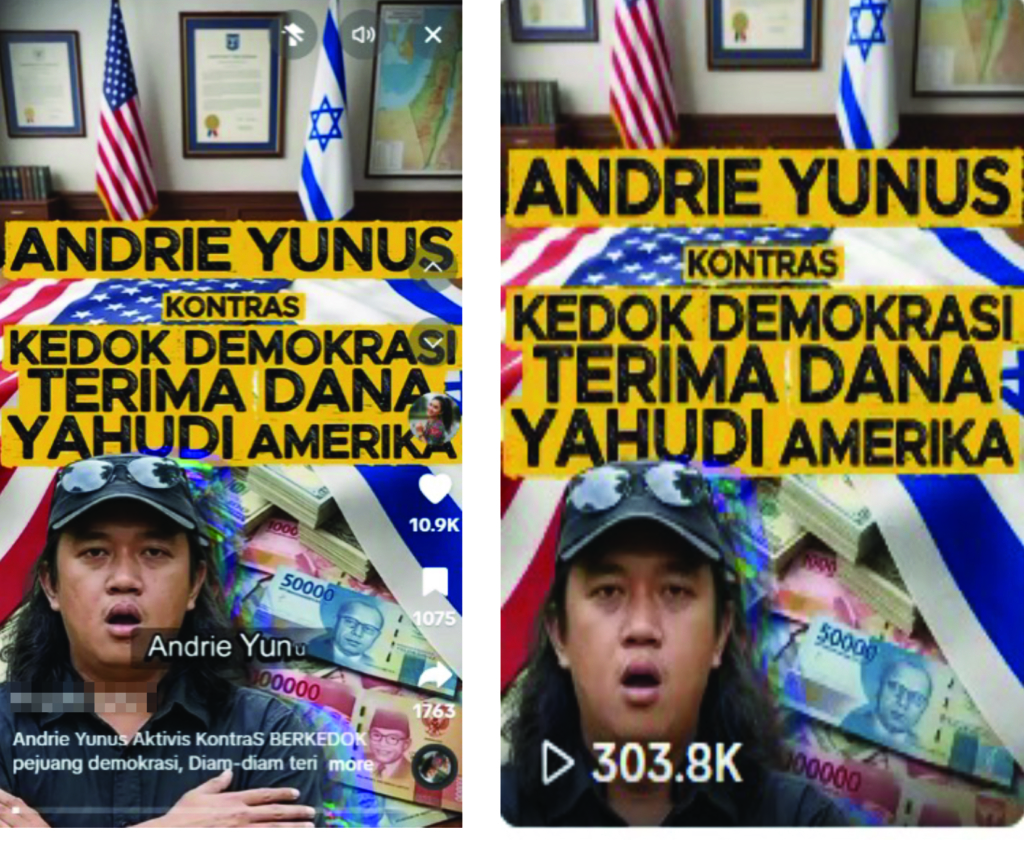
Original TikTok post that attacked and labeled Andrie Yunus as a foreign agent. The post was published on 5 April 2026. The caption reads: “Andrie Yunus, a KontraS activist, DISGUISED as a democracy fighter, secretly receives funds from American Jews. Curious?? Watch this video until the end. #andrieyunus #kontras #foreignstooge #osf #soros”
Independent media outlets have also been heavily targeted. Tempo, one of Indonesia’s most respected news organizations, faced sustained disinformation campaigns, including by Instagram accounts presenting themselves as military units, accusing it of being controlled by foreign donors after it reported critically on government policy.
Online smear campaigns were accompanied by chilling acts of intimidation, including a severed pig’s head delivered to Tempo’s newsroom and follow-up packages containing decapitated rats. Online disinformation then sought to portray the threats as staged stunts to garner foreign support.
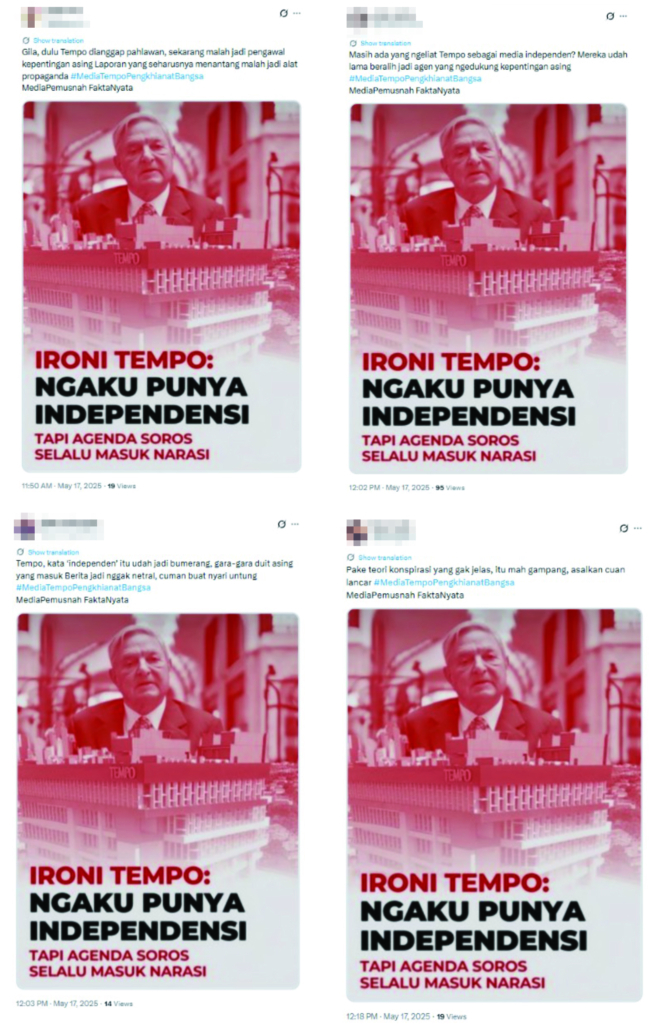
A set of tweets from different anonymous X accounts published within the same one-hour window on 17 May 2025, featuring an identical graphic depicting a large portrait of George Soros looming over the Tempo office building. The headline reads, “The irony of Tempo: Claims to have independence,” followed by the subtext, “But Soros’s agenda always enters the narrative.” Although the accompanying captions vary slightly, they reproduce the same ‘foreign agent’ rhetoric.
Greenpeace Indonesia activist Iqbal Damanik was targeted after he led a peaceful protest against the government’s mining activities in Raja Ampat, West Papua.
He told Amnesty: “I received so many direct messages from anonymous users. I assume they are the ones who believe the disinformation out there about me. Some threatened to kill me. One of them said, ‘Your head will fall to the ground.”
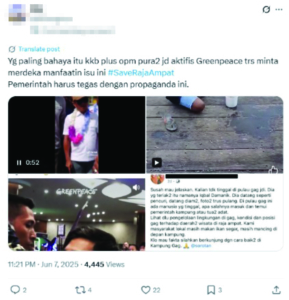
Tweet accusing Greenpeace campaigner Iqbal Damanik of being affiliated with armed groups in Papua published on 7 June 2025. The tweet shares several videos and images, including the photo of Iqbal leading a protest movement against nickel mining in Raja Ampat. The tweet reads: “The most dangerous thing is that armed criminal groups (KKB) and the OPM pretend to be Greenpeace activists and then call for independence, exploiting this issue. #SaveRajaAmpat. The government must take firm action against this propaganda.
Climate of intimidation
The pervasive use of disinformation has created a climate of fear far beyond those directly targeted, discouraging people from participating in protests, collaborating with civil society organizations or expressing critical views online.
As one journalist told Amnesty: “This is dangerous for all of us. If we all become afraid of being labelled ‘foreign agents’ and stop reporting news or any stories critical of the government, then we are back to the authoritarian atmosphere of the past.”
Amnesty’s report found that Indonesia’s domestic laws fail to protect those targeted with disinformation and are more likely to be used to prosecute and criminalize critics. A new proposed law on ‘Countering Disinformation and Foreign Propaganda’ risks deepening Indonesia’s authoritarian trajectory by being used to further restrict the right to freedom of expression.
“Instead of upholding fundamental rights to freedom of expression, association and peaceful assembly, Indonesian authorities have failed at every level: state actors participate in the attacks, victims are denied protection and a climate of intimidation is allowed to take hold,” Agnès Callamard said.
“The Indonesian government must protect journalists, activists and protesters rather than enabling and disseminating toxic disinformation against them.”
Social media companies’ responsibilities
The report also finds that Meta, TikTok, X and YouTube’s inadequate content moderation, engagement-driven algorithms and failure to address Indonesia’s heightened human rights risks allowed disinformation to spread rapidly. Most of the posts documented remained online for months – some for more than a year – and many went viral.
“Big Tech’s failures have contributed to the human rights harms documented in this report, with falsehoods spreading faster than facts. Their platforms have played a significant role in enabling an environment in which disinformation, censorship and violence can thrive,” Agnès Callamard said.
Amnesty International wrote to Meta, TikTok, X and YouTube twice: first to seek information during the research phase, and later to share its findings before publication. Only TikTok responded to Amnesty International’s letters detailing our findings, pledging to “set up additional monitoring for this specific issue”.
“Despite the increasingly hostile climate for human rights work and failures of the government and social media companies to counter disinformation, many of the activists we interviewed remain resilient. They continue to adapt, support one another and resist. However, the burden must not rest on them alone,” Agnès Callamard said.
“Amid the heightened risks under President Prabowo’s administration, Meta, TikTok, X and YouTube must stop disinformation, strengthen content moderation, conduct Indonesia-specific human rights due diligence and provide remedy to those harmed due to their failures.”
End disinformation attacks on Indonesian activists
Responding to the Dominican Republic assuming the presidency of the 79th World Health Assembly, Ana Piquer, Americas Director at Amnesty International, said:
“As it assumes the presidency of the world’s leading global health forum, President Luis Abinader’s government in the Dominican Republic has the responsibility to demonstrate that its international leadership translates into real guarantees of access to healthcare for everyone within its territory, without racial discrimination.”
As it assumes the presidency of the world’s leading global health forum, President Luis Abinader’s government in the Dominican Republic has the responsibility to demonstrate that its international leadership translates into real guarantees of access to healthcare for everyone within its territory, without racial discrimination.”
Ana Piquer, Americas Director at Amnesty International
“It is deeply contradictory for the country to preside over the World Health Assembly while putting the health of Haitian people and Dominicans of Haitian descent at risk by perpetuating practices that may deter them from seeking hospital care out of fear of being deported to Haiti. The Dominican government must immediately separate access to healthcare from migration control and ensure that no one is subjected to racial discrimination, detention or expulsion after receiving medical care.”
It is deeply contradictory for the country to preside over the World Health Assembly while putting the health of Haitian people and Dominicans of Haitian descent at risk by perpetuating practices that may deter them from seeking hospital care out of fear of being deported to Haiti.”
Ana Piquer, Americas Director at Amnesty International
In November 2025, Amnesty International analysed the implementation of the migration protocol in public hospitals across the country, concluding that it lacks any public health justification and, on the contrary, reinforces racial discrimination against Haitian people while negatively affecting the entire population of the Dominican Republic.
For more information or to arrange an interview, please contact press@amnesty.org
Here, we provide the details on the main findings from the report, at a global and regional level.
Global figures
Global executions
Amnesty International recorded at least 2,707executions in 2025 in 17 countries, an increase of 78% from the 1,518 known executions in 2024. It is the highest figure recorded by Amnesty International since 1981 when it recorded 3,191 executions (excluding China).
China remained the world’s leading executioner, but the true extent of its use of the death penalty remains unknown as this data remains classified as a state secret. The global figure of executions recorded by Amnesty International excludes the thousands of executions believed to have been carried out in China, as well as those carried out in Viet Nam and North Korea where Amnesty International believes the death penalty was used extensively.
The countries with the highest number of executions were China (1000s), Iran (2,159+), Saudi Arabia (356+), Yemen (51+), USA (47) – in that order.
Women were known to have been executed in five countries: China (+), Egypt (1), Iran (61), Kuwait (1) and Saudi Arabia (5).
Executions were recorded in 17 countries, an increase by two on the record-low figures recorded for 2024 (15). This is in line with historical low trends recorded since 2018 that have seen executions confined to 20 or fewer countries.
Violating international law
1,257 executions were known to have been carried out unlawfully for drug-related offences across five countries: China (+),Iran (998, 46% of the total), Kuwait (2, 12%), Saudi Arabia (240, 67%) and Singapore (15, 88%). Information on Viet Nam, which is also likely to have carried out such executions, was unavailable. The total number of 1,257 known executions for drug-related offences constitutes 46% of total executions recorded globally, nearly doubling the 2024 figure (637).
At least 17 public executions were known to have been carried out, in Afghanistan (6) and Iran (11).
At least 3 people – in Iran (1) and Saudi Arabia (2) – were executed for alleged crimes that occurred when they were below 18 years of age.
The methods of execution used in 2025 were: beheading; hanging, lethal injection, shooting and nitrogen gas asphyxiation.
Global death sentences
At least 2,334 new death sentences across 48 countries were recorded in 2025, compared to at least 2,087 death sentences recorded across 46 countries in 2024.
Six countries − Bahrain, Comoros, Gambia, the Maldives, Qatar, and Taiwan − were known to have imposed death sentences after a hiatus.
Amnesty International recorded commutations or pardons of death sentences in 24 countries.
Amnesty International recorded 1 exoneration of individuals under sentence of death in the USA.
Globally, at least 25,508 people were under sentence of death at the end of 2025.
Abolishing the death penalty
At the end of 2025, 113 countries were fully abolitionist and 145 in total had abolished the death penalty in law or practice.
Regional analysis
Americas
For the 17th consecutive year, the USA was the only country in the region to execute people.Eleven US states carried out executions in 2025, an increase by two compared to 2024 (nine).US executions reached the highest figure (47) since 2009, with Florida driving the spike with 19 executions.
Trinidad and Tobago and the USA were the only two countries in the Americas known to have imposed new death sentences.
Asia-Pacific
Asia-Pacific continued to be the region with the highest number of executions in the world.
In Asia -Pacific, seven countries (Afghanistan, China, Japan, North Korea, Singapore, Taiwan and Viet Nam) were known to have carried out executions in 2025, an increase from five in 2024.
Executions resumed in Japan and Taiwan after a hiatus; the government of Singapore almost doubled its yearly execution total compared to 2024.
At least 796 new death sentences were known to have been imposed in the region.
The authorities of Viet Nam abolished the death penalty for eight offences.
Europe and Central Asia
No death sentences or executions were recorded in Europe and Central Asia.
2025 was the first year since President Alexander Lukashenko assumed office in 1994 that Amnesty International recorded no new death sentences nor executions in Belarus.
The Kyrgyz Constitutional Court declared efforts to reintroduce the death penalty in the country unconstitutional.
Russia and Tajikistan continued to observe moratoriums on executions.
Middle East and North Africa
The number of executions in the region grew alarmingly from at least 1,442 in 2024 to at least 2,611 in 2025.
The Iranian authorities were known to have carried out at least 2,159 executions, the highest figure recorded in Iran by Amnesty International since 1981.
Executions in Saudi Arabia reached the highest figure on record in any given year, from at least 345 in 2024 to at least 356 in 2025.The authorities of United Arab Emirates (UAE) resumed executions for the first time since 2021.In total, seven countries across the region were known to have carried executions in 2025: Egypt, Iran, Iraq, Kuwait, Saudi Arabia, United Arab Emirates, and Yemen.The number of recorded death sentences reached 743 a slight decrease from 773 in 2024.
The Council of Ministers of Lebanon supported a bill to abolish the death penalty.
Sub-Saharan Africa
Recorded executions in the region fell by 47%, from 34 in 2024 to 18 in 2025.
Executions were recorded in Somalia and South Sudan, two of the only five countries known to have implemented death sentences in the last decade.
Recorded death sentences in the region increased by 74%, from at least 443 in 2024 to 771 in 2025.
The number of countries that issued death sentences decreased from 14 in 2024 to 13 in 2025
Legislative initiatives to abolish the death penalty were registered in Gambia, Liberia and Nigeria.
Responding to the resumption of the trial of activists who organized Tiananmen vigils in Hong Kong, Amnesty International Hong Kong’s spokesperson Fernando Cheung said:
“As closing arguments begin in this trial, the Hong Kong authorities must confront the basic injustice at its heart: commemorating victims of human rights abuses is compassionate, not criminal. Holding people criminally responsible for peaceful commemoration compounds the injustice suffered by the victims of the Tiananmen crackdown.
“Throughout these trial proceedings, Chow Hang-tung and Lee Cheuk-yan have shown remarkable courage and dignity in the face of prosecution. They did nothing but legitimately exercise their human rights in their Tiananmen commemorations.”
Amnesty International’s Deputy Regional Director Sarah Brooks added:
“The prosecution’s case relies on vague, overly broad and arbitrary definitions of ‘subversion’. The charges against Chow and Lee should be dropped, and the authorities must ensure that people in Hong Kong can freely remember the events of 4 June 1989 without fear of retaliation.
“Chow and Lee are prisoners of conscience, incarcerated simply for exercising their human rights, and they must be immediately and unconditionally released.”
Background
The prosecution and defence are scheduled to deliver their closing statements in the trial of Hong Kong’s Tiananmen activists from 18 May 2026.
Chow Hang-tung and Lee Cheuk-yan were among the members of the Hong Kong Alliance in Support of Patriotic Democratic Movements of China (Hong Kong Alliance) charged with “inciting subversion of state power” under the Beijing-imposed National Security Law in September 2021.
They have been held in pre-trial detention ever since, having been repeatedly denied bail, and face up to 10 years’ imprisonment if convicted. Both have been designated prisoners of conscience by Amnesty International.
Authorities said the annual Tiananmen vigil the Hong Kong Alliance had organized since 1990 was evidence of the group “endangering national security”.
Amnesty International has repeatedly raised concerns that Hong Kong’s National Security Law, enacted in June 2020, is being used to target civil society groups, journalists, political activists and academics for actions that are fully protected under international human rights law.
The Tiananmen vigils commemorated the events of 4 June 1989, when Chinese troops opened fire on students and workers who had been peacefully protesting for political reforms in and around Beijing’s Tiananmen Square. Hundreds – possibly thousands – of people were killed. Tens of thousands more were arrested across China in the suppression that followed.
In the 37 years since the crackdown, all discussion of the incident has been heavily censored in China, and authorities have effectively erased it from their version of history.
While commemorating the Tiananmen crackdown was forbidden in mainland China, in Hong Kong crowds reaching hundreds of thousands of people would gather annually in centrally located Victoria Park to peacefully remember those killed. The vigil participants called on the Chinese authorities to reveal the truth about what happened and accept accountability for the atrocity; local government as a practice did not interfere or object.
The last major vigil organized by the Hong Kong Alliance was held in 2019. The Hong Kong vigil was banned in 2020 and 2021, ostensibly on Covid-19 grounds. Since then, the National Security Law has effectively criminalized peaceful protest in the city – including Tiananmen commemorations.