Poland: Constitutional opt out puts country on collision course with the EU

Poland’s Constitutional Tribunal has today ruled that Polish law takes primacy over EU law, and breaches of EU law in Poland can no longer be referred to the EU Court of Justice, by Polish courts. Eve Geddie, Director of Amnesty International’s European Institutions Office said:

“This is another dark day for justice in Poland. With this ruling the court has effectively ruled that Polish law supersedes EU law, and challenged the EU’s ability to protect human rights and the rule of law within member states. The ruling is part of a wider struggle over independence of the judiciary in Poland.”

Eve Geddie Director of Amnesty International’s European Institutions Office

The EU Court has played an important role in safeguarding Polish judges against a mounting attack on judicial independence.

“With the move to brazenly sidestep the EU Court and the protection it offers, Poland has steered itself on a collision course with the European Union. The EU and member states must take urgent legal, political and financial action and make clear that these fundamental principles are not open to negotiation or gamesmanship,” said Eve Geddie.

For more information contact

Alison Abrahams on alison.abrahams@amnesty.org or +32 483 680 812

Out of hours contact details

+44 20 7413 5566 email: press@amnesty.org  twitter: @amnestypress 

BACKGROUND

The ruling was issued in response to the query of the Prime Minister of Poland, who asked the Constitutional Tribunal to examine the compliance of provisions of the Treaty on EU, in particular the principle of primacy of EU law, with the Polish Constitution.

However, the independence of the Constitutional Tribunal itself has been questioned by the European institutions as well as the European Court of Human Rights. Today’s ruling was delivered by a full bench of the Constitutional Tribunal, including irregularly appointed judges. As such, it did not meet the requirements of an independent court.

On 15 July, the EU Court held that the disciplinary regime for judges in Poland is not compatible with EU law and asked Poland to take the measures necessary to rectify the situation.

The post Poland: Constitutional opt out puts country on collision course with the EU appeared first on Amnesty International.

Togo: Prominent activist targeted with Indian-made spyware linked to notorious hacker group

  • Togolese activist targeted with spyware by the Donot Team hacker group.
  • Amnesty International exposes links between the Donot Team attacks and Innefu Labs, a cybersecurity company based in India.
  • First time Donot Team publicly linked to cyberattacks targeting activists outside of South Asia.
  • Spyware-loaded emails and fake Android applications could access device’s camera and microphone, steal photos and files, and read WhatsApp messages.

Activists in Togo risk being targeted by shadowy cyber-mercenaries who use covert digital attacks to try and steal victims’ private information to sell to private clients, a new Amnesty International investigation has uncovered.

In a new report released today, Amnesty International reveals how fake Android applications and spyware-loaded emails tied to the notorious Donot Team hacker group were used to target a prominent Togolese human rights defender in an attempt to put them under unlawful surveillance. The discovery is the first time Donot Team spyware was found in attacks outside of South Asia. The investigation also discovered links between the spyware and infrastructure used in these attacks, and Innefu Labs, a cybersecurity company based in India.

Across the world, cyber-mercenaries are unscrupulously cashing in on the unlawful surveillance of human rights defenders

Danna Ingleton, Deputy Director of Amnesty Tech

The Togolese activist, who wishes to remain anonymous for security reasons, has a history of working with civil society organizations and is an essential voice for human rights in the country. Their devices were targeted between December 2019 and January 2020, during a tense political climate ahead of the 2020 Togolese presidential election.

“Across the world, cyber-mercenaries are unscrupulously cashing in on the unlawful surveillance of human rights defenders,” said Danna Ingleton, Deputy Director of Amnesty Tech.

“Anyone can be a target – attackers living hundreds of miles away can hack your phone or computer, watch where you go and who you talk to, and sell your private information to repressive governments and criminals.”

The persistent attacks over WhatsApp and email tried to trick the victim into installing a malicious application that masqueraded as a secure chat application. The application was in fact a piece of custom Android spyware designed to extract some of the most sensitive and personal information stored on the activist’s phone.

The spyware would have enabled attackers to access the camera and microphone, collect photos and files stored on the device, and even read encrypted WhatsApp messages as they are being sent and received. The covert nature of such attacks makes it extremely difficult for activists to detect whether their devices have been compromised.

“Having realized that this was an attempt at digital espionage, I felt in danger. I can’t believe that my work could be so disturbing to some people that they would try to spy on me. I am not the only one working for human rights in Togo. Why me?”, the Togo-based human rights defender told Amnesty International.

Amnesty International’s investigation uncovered a trail of technical evidence left by the attackers which identified links between the attack infrastructure and an Indian-based, Innefu Labs. The company which advertises digital security, data analytics, and predictive policing services to law enforcement and armed forces and claims to work with the Indian government.  Innefu Labs does not have a human rights policy and does not appear to carry out human rights due diligence – despite the enormous risks their products pose to civil society.  Amnesty International has observed additional evidence of Donot Team attacks against organizations and individuals across Asia, mostly concentrated in the north of India, Pakistan and Kashmir.

Activists under attack

The space for human rights work in Togo has been shrinking – in 2019, the year preceding the presidential election, Amnesty International documented the adoption of laws curtailing the rights to freedom of expression and peaceful assembly and cases of human rights violations committed by authorities, particularly against pro-democracy activists.    

Several religious and opposition political figures in Togo have reportedly been targeted with digital surveillance tools. In August 2020, The Guardian and Citizen Lab revealed that two Catholic clergy members, Bishop Benoît Alowonou and Father Pierre Chanel Affognon had been targeted using a NSO Group-linked WhatsApp vulnerability.

The Pegasus Project, coordinated by Forbidden Stories with the technical support of Amnesty International’s Security Lab, earlier this year revealed that hundreds of Togolese numbers were listed as potential targets of NSO Group’s Pegasus spyware. Those on the list included independent journalists and members of political opposition groups.

The threat of targeted surveillance, whether real or not, can inflict a huge psychological toll on activists and cause a devastating chilling effect on their human rights work. Little is known about the wild-west cyber surveillance industry, despite Amnesty International’s and other civil society’s repeated requests for more transparency, and even less is known about the flourishing hacker-for-hire industry.

“The surveillance industry is out of control with companies and cyber-mercenaries alike operating entirely in the shadows.”

“Surveillance companies must stop putting profit over people and ensure repressive regimes are not using their technology to put a stranglehold on civil society,” said Danna Ingleton.

Amnesty International is calling on:

  • Innefu Labs to publish in full the findings of an external audit the company commissioned into links between its spyware tools and infrastructure used in the attack against the Togo activist. The company must also implement a human rights policy.
  • The Indian government to investigate cyberattacks linked to Innefu Labs and take urgent action to ensure India-based surveillance companies are not involved in the targeting of activists – which is unambiguously illegal under international human rights law.
  • The Togolese government to ensure that everyone, including activists, is protected from human rights abuses, and to investigate and redress any harm caused by cyberattacks carried out by private sector actors.

In a written response to Amnesty International, Innefu Labs denied “the existence of any link whatsoever between Innefu Labs and the spyware tools associated with the ‘Donot Team’” and the attack against the human rights activist in Togo. Innefu Labs also stated that they are not aware of any use of their IP address for the alleged activities.

There is no evidence to suggest Innefu Labs had a direct involvement or knowledge of the targeting of the human rights defender in Togo using the Donot Team spyware tools. The activity linked to the Donot Team may involve multiple distinct actors or organisations with access to the same custom spyware toolset and shared infrastructure.

The post Togo: Prominent activist targeted with Indian-made spyware linked to notorious hacker group appeared first on Amnesty International.
Turkey: Activists in more than 40 countries demand acquittal of students facing three years in jail for celebrating Pride

Ahead of a court ruling expected on Friday in the case of 18 Turkish students and one academic who are being prosecuted for taking part in a Pride parade in May 2019, Nils Muižnieks, Amnesty International’s Europe Director said:

“Activists around the world have joined Amnesty International in calling for the acquittal of 18 students and an academic at the Middle East Technical University (METU) in Ankara. They are facing up to three years in prison simply for organising and participating in an entirely peaceful Pride march on campus in May 2019 that the University management had unlawfully banned.

“Shockingly, this celebration of love and solidarity by these young people was met with police using pepper spray, plastic bullets and tear gas. Not only were their fundamental rights violated that day, but they have been dragged through the courts for more than two years with the threat of jail dangling over their heads.

“The ban on the Pride march lacked legal grounds and these students who defied it had their rights to freedom of expression and peaceful assembly violated. On Friday, there can only be one just outcome: their wholesale acquittal.”

BACKGROUND

The 19 individuals are charged with “participating in an unlawful assembly” and “failing to disperse despite being warned”. This is despite the fact that in February 2019, the Ankara Administrative Appeals Court had lifted the blanket ban prohibiting all LGBTI+ activities in Ankara which had been introduced under the state of emergency. Nevertheless University management relied on this historic ban as the legal basis to stop the annual campus-based Pride march from going ahead.

In June 2020, another administrative court in Ankara overturned the university’s unlawful ban, confirming that it had no legal basis.

The case of the METU students was part of Amnesty International’s flagship Write for Rights campaign in 2020. More than 445,000 people have demanded their acquittal.

See here for more information about the case

For more information contact Stefan Simanowitz on press@amnesty.org

On 8 October, the hearing will be monitored by @aforgutu. The newly established LGBTI+ rights organisation @unikuir will also share updates

The post Turkey: Activists in more than 40 countries demand acquittal of students facing three years in jail for celebrating Pride appeared first on Amnesty International.

Singapore: Foreign interference law is a tool for crushing dissent

Responding to Singapore lawmakers passing legislation that seeks to prevent foreign interference in domestic affairs, Emerlynne Gil, Amnesty International’s Deputy Regional Director for Research, said:

“The passing of Singapore’s foreign interference law constitutes a brutal attack on the rights to freedom of expression and association, creating yet another tool that can be used arbitrarily by the authorities to stifle government critics and crush dissent in the country.”

“When Singapore’s leaders speak of hostile foreign information campaigns that they perceive as stoking the fires of subversion, they use this fear-cloaked rhetoric merely to justify their own attempts to stamp out and silence dissenting voices.”

“The foreign interference law is so vague and broadly worded that it could be used to silence almost any government critic. It arrives just weeks after independent media site The Online Citizen – a popular site for alternative political views – was forced to shut down over alleged failures to identify its funding sources, raising alarm bells that the Singapore authorities are intensifying their efforts to enforce total subservience to the state.”

“The fact that this legislation was rushed through parliament, lacks sufficient independent oversight, and introduces severe and disproportionate penalties only adds to evidence of Singapore’s authoritarian leanings.”

“Amnesty International calls on the government to rescind this law and uphold the right to freedom of expression in Singapore.”

Background

After a late-night parliamentary session, Singapore’s lawmakers passed the Foreign Interference (Counter-measures) Act (FICA) on 4 October. The legislation allows the authorities to force social media platforms and internet service providers to hand over user data, block content and remove applications that share information considered by the authorities to be anti-state.

Moreover, any individuals or groups deemed politically significant in Singapore would be required to declare sources of foreign funding and face potential “countermeasures” in order to remove any foreign interference deemed hostile.

Those caught breaking the law, which still needs to be formally ratified by president Halimah Yacob in order to officially pass, could face lengthy prison terms or fines.

On 16 September 2021, The Online Citizen, a popular online website for alternative political views, went offline hours before a government-imposed deadline to suspend the site for failing to declare its sources of funding. The site ceased operating just days after Prime Minister Lee Hsieng Loon first tabled the Foreign Interference (Counter-measures) Act (FICA) on 13 September 2021.

According to the government, FICA aims to strengthen the “ability to prevent, detect and disrupt foreign interference in [Singapore’s] domestic politics conducted through (i) hostile information campaigns (HICs) and (ii) the use of local proxies.”

The post Singapore: Foreign interference law is a tool for crushing dissent appeared first on Amnesty International.

Afghanistan: 13 Hazara killed by Taliban fighters in Daykundi province – new investigation

  • Nine former members of government security forces extrajudicially executed after surrendering
  • Victims included a 17-year-old girl who was caught in crossfire

Taliban forces unlawfully killed 13 ethnic Hazaras, including a 17-year-old girl, in Afghanistan’s Daykundi province after members of the security forces of the former government surrendered, a new investigation by Amnesty International has revealed.

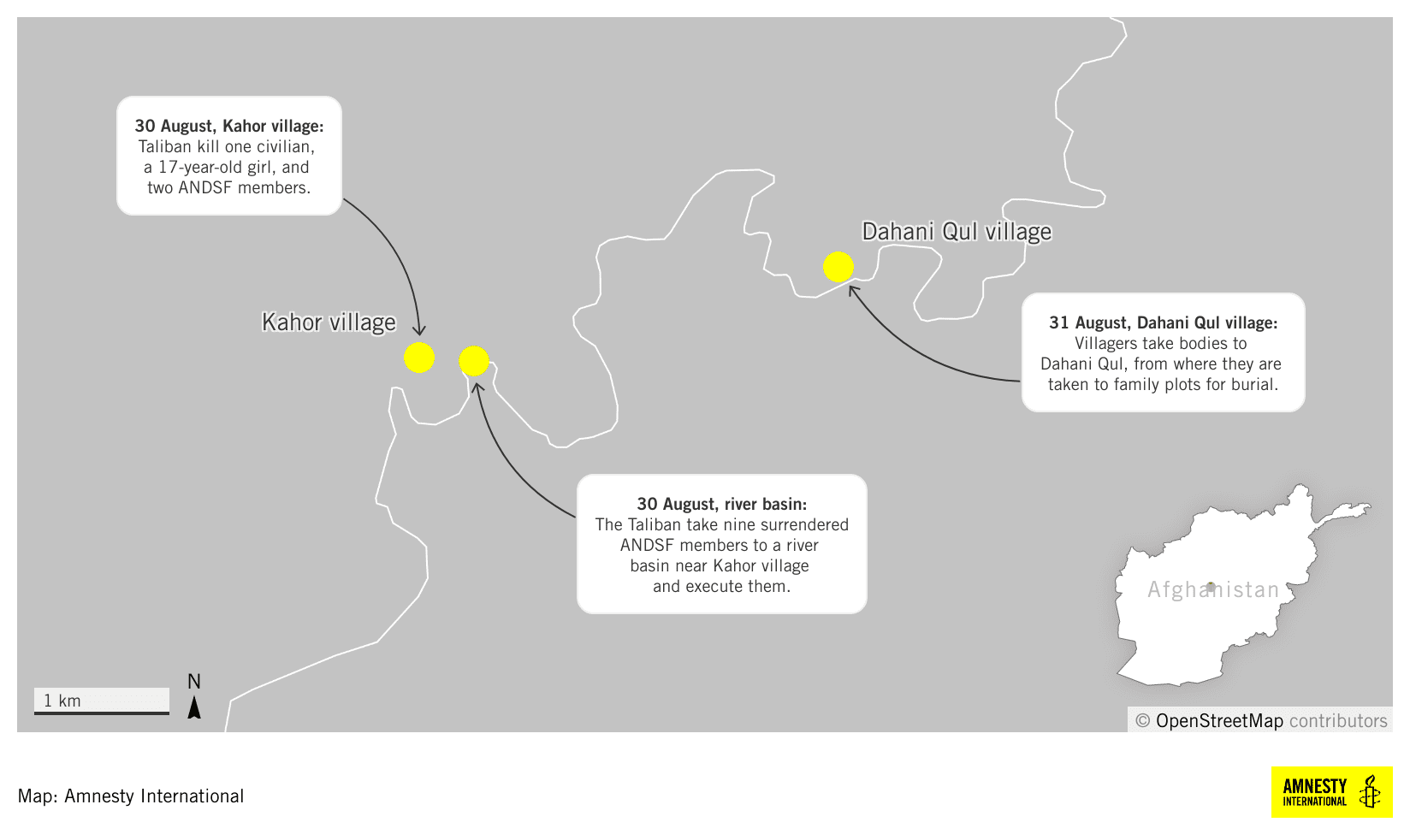
The killings happened in Kahor village of Khidir district on 30 August. Eleven of the victims were former members of the Afghan National Defence Security Forces (ANDSF), and two were civilians.

According to eyewitness testimony gathered by Amnesty International, the Taliban extrajudicially executed nine of the ANDSF members after they had surrendered, killings that appear to be war crimes. Two civilians were killed as they attempted to flee, including a 17-year-old girl shot when the Taliban opened fire on a crowd of people.

These cold-blooded executions are further proof that the Taliban are committing the same horrific abuses they were notorious for during their previous rule of Afghanistan”

Agnès Callamard

Amnesty International verified photographs and video evidence taken in the aftermath of the killings, and identified the location of Kahor village, where they happened.

“These cold-blooded executions are further proof that the Taliban are committing the same horrific abuses they were notorious for during their previous rule of Afghanistan,” said Agnès Callamard, Amnesty International’s Secretary General.

“They repeatedly violate the rights of those they perceive as their adversaries, even killing those who have already surrendered. The Taliban say they are not targeting former employees of the previous government, but these killings contradict such claims.

“The Taliban must immediately cease these cruel acts of revenge, and ensure employees of the former government and their families can live safely in Afghanistan. The new government must make clear that such grave violations will not be tolerated, and that those responsible will be prosecuted.”

Verifying human rights abuses committed by the Taliban since they took control of Afghanistan in August 2021 has proven difficult, as the group have cut mobile phone service in many regions. Shortly after the fall of Kabul, Amnesty International documented how Taliban fighters massacred nine ethnic Hazara men after taking control of Ghazni province.

Killings in Kahor village

The Taliban took control of Daykundi province on 14 August. An estimated 34 former ANDSF members initially sought safety in Khidir district, and had government military equipment and weaponry with them. They then agreed to surrender to the Taliban as the group established its authority over vast swathes of the region.

Mohammad Azim Sedaqat, who was leading the surrender, arranged to decommission the group’s weapons in the presence of the Taliban. On 29 August, the men negotiated to surrender fully to the Taliban.

On 30 August, an estimated 300 Taliban fighters arrived in convoy close to Dahani Qul village, where the ANDSF members were staying, some with family members. As the ANDSF members attempted to leave the area with their families, one vehicle remained stuck close to Kahor village.

When the Taliban fighters caught up with them, they opened fire on the crowd and killed the 17-year-old girl, called Masuma. One of the ANDSF members then fired back, killing one Taliban fighter and wounding another.

The Taliban continued to shoot as the families fled, killing two ANDSF members caught in crossfire as they were fleeing the scene. After nine more ANDSF members surrendered, the Taliban promptly took them to a nearby river basin and executed them.

Videos and photographs reviewed by Amnesty International show the corpses of 11 men lined up, with many showing bullet wounds to their heads. One video shows a body being carried up an incline, believed to be at the river basin near Kahor. Amnesty International has been unable to independently geolocate this video, but its content is consistent with eyewitness testimony describing the location as close to Kahor.

The names and estimated ages of the 11 ANDSF members are: Musa Amiri, 46; Khudad Jawahiri, 33; Esmatullah Zarigh, 34; Noor Ali Ibrahimi, 34; Habibullah, 33; Amanullah, 32; Reza Karimi, 31: Dawran, 26; Dur Mohammad, 41; Abdul Hamid Fahimi, 28: and Reza Joya, 33.

Aftermath of the killings

On 31 August, the day after the killings, villagers took the bodies to Dahani Qul, where they were then brought to family plots for burial. Amnesty International reviewed and verified information confirming the locations of two of the graves, and the identities of the people buried there.

The Taliban then told remaining family members that anyone who had fled should return, and surrender within three days. Interviewees told Amnesty International that one senior Taliban official warned: “I have killed people for the past 20 years. Killing is easy for me. I can kill again.”

On 1 September, Sadiqullah Abed, the Taliban-appointed chief of police for Daykundi province, denied any killings had happened and instead only confirmed that a member of the Taliban had been wounded in an attack in Daykundi.

Background

The Taliban seized power in Afghanistan following the collapse of the government in mid-August 2021. Amnesty International has called for the protection of thousands of Afghans at serious risk of Taliban reprisals, from academics and journalists to civil society activists and women human rights defenders.

In a recent briefing, Afghanistan’s fall into the hands of the Taliban, Amnesty International detailed a litany of human rights abuses committed by the Taliban, including targeted killings of civilians and surrendered soldiers, and the blockading of humanitarian supplies, which constitute crimes under international law.

The post Afghanistan: 13 Hazara killed by Taliban fighters in Daykundi province – new investigation appeared first on Amnesty International.