Following the repression of a protest planned on 9 October 2021 by opposition and pro-democracy activists in Chad, Abdoulaye Diarra, Amnesty International Central Africa researcher said:
“The crackdown on this weekend’s protest is the latest in a series of blatant restrictions on the rights to freedom of expression and freedom of peaceful association we have documented for years in Chad.
When authorities’ attempts to ban the protest did not deter demonstrators, security forces took over the main streets in the capital N’Djamena and fired tear gas, injuring several people, and arresting dozens of demonstrators who have been released on the same day.
Abdoulaye Diarra, Amnesty International Central Africa researcher
“On the morning of the protest, text messages and Internet networks were reportedly slowed down for hours in some areas of N’Djamena, confirming the link between disruptions in Internet access and moments of political contestation we have been observing over the past five years in the country.
“Since the beginning of the political transition, several demonstrations were banned and suppressed by the authorities. Between 27 April and 19 May 2021, at least 16 people were killed during protests in N’Djamena and the southern town of Moundou. The investigations’ outcomes are still awaited.
“Authorities in Chad must end this campaign of intimidation against critical voices, respect and protect the rights to freedom of expression, association and peaceful assembly. The apparent restrictions on Internet connectivity which took place around the protest must be investigated, and people in Chad must be allowed to freely access and exchange information online.”
Background
Since the death of former President Idriss Deby Itno in April 2021, Chad has been ruled by the Transitional Military Council (Conseil militaire de transition in French) led by his son, Mahamat Idriss Deby.
On Saturday 9 October 2021, ‘Wakit Tama’, a coalition of civil society organizations and opposition parties in Chad, called for a protest to denounce the transitional authorities’ governance.
The authorities, evoking “risks of disturbing public order”, banned the protest, but people gathered in the capital N’Djamena. According to ‘Wakit Tama’s’ spokespersons, at least 10 people were injured by tear gas and 45 others were arrested during the protest repression.
On 2 October, police fired tear gas at hundreds of demonstrators starting to gather around the headquarters of the opposition political party ‘Les Transformateurs’ . The police also dispersed demonstrators in other areas of Ndjamena. According to the authorities, the agreed itinerary for the protest has not been respected. .
On 10 October, Wakit Tama said in a statement that five of its main leaders were to be heard by the judicial police today, after police reportedly raided the headquarters of ‘Les Transformateurs’.
The Iranian authorities must immediately halt the planned execution of a young man who was sentenced to death for a crime that took place when he was a child, following a grossly unfair trial marred by torture-tainted “confessions”, Amnesty International said today.
Arman Abdolali was moved to solitary confinement in Raja’i Shahr prison in Karaj in preparation for his execution on Wednesday 13 October. His execution was scheduled twice before – in July 2021 and in January 2020 – but was halted both times after an international outcry.
“Time is rapidly running out, the Iranian authorities must immediately halt all plans to execute Arman Abdolali on 13 October. Use of the death penalty against people who were under 18 at the time the crime was committed is prohibited under international law and constitutes an abhorrent assault on child rights,” said Diana Eltahawy, Deputy Director for the Middle East and North Africa at Amnesty International.
“The Iranian authorities are demonstrating their ruthless intent to resort to the death penalty in complete disregard for their obligations under international law by scheduling Arman Abdolali’s execution for a third time. Global action helped to stop Arman Abdolali’s previously scheduled executions, we now urge the international community, including the UN and EU, to urgently intervene to save his life.”
Use of the death penalty against people who were under 18 at the time the crime was committed is prohibited under international law and constitutes an abhorrent assault on child rights
Diana Eltahawy, Amnesty International
Arman Abdolali was first sentenced to death in December 2015 after being convicted of murder in a grossly unfair trial, in which the court relied on torture-tainted “confessions”, in connection with the disappearance of his girlfriend in 2014. Her body was never found; the court stated that the murder had been committed without leaving any trace indicating that Arman Abdolali had attained “mental maturity” and understood the nature and consequences of the crime. The international legal prohibition on sentencing people who were children when they allegedly committed the crime to death is absolute, therefore is not subject to claims of “maturity” or “understanding the crime”.
In reaching this decision, the court also relied on the opinion of a Children and Adolescent Court Advisor who stated that Arman Abdolali understood the “abhorrent” nature of the crime. The sentence was upheld by the Supreme Court in July 2016. The trial and appeal verdicts both noted Arman Abdolali’s allegations that he was held in prolonged solitary confinement for 76 days and repeatedly beaten to “confess”, but no investigation was ordered and the “confessions” were described by the court as “unequivocal”.
In February 2020, the Supreme Court granted him a retrial after the Children and Adolescent Court Advisor withdrew her initial opinion, saying it had been issued without meeting him in person or studying his casefile. His retrial, at Branch 5 of Criminal Court One of Tehran Province, largely focused on whether there were doubts about his “maturity” at the time of the crime.
In September 2020, the court ruled that it was not possible to determine Arman Abdolali’s “maturity” so many years after the crime had taken place and ruled that in the absence of any evidence to the contrary, his criminal responsibility stands.
Given these deeply flawed proceedings, Amnesty International is also calling on the Iranian authorities to quash Arman Abdolali’s conviction and grant him a retrial in line with fair trial standards generally and those pertaining to children in particular, without resorting to coerced “confessions” or use of the death penalty.
Under Iranian law, in cases of murder and certain other capital crimes, boys aged above 15 lunar years and girls aged above nine lunar years are treated as adults and can be sentenced to death. However, Article 91 of Iran’s Islamic Penal Code grants judges the discretion to replace the death penalty with an alternative sentence if they believe there are doubts about the individual’s “maturity” at the time of the crime. In practice, there is no clarity over the evidence and the standards of proof needed to demonstrate “full maturity”.
“This case highlights the deeply flawed nature of Iran’s child justice system. We again urge the Iranian authorities to put an end to the violations of the right to life and children’s rights by amending the Penal Code to ban the use of the death penalty against anyone who was under 18 at the time of the crime without exception, pending the full abolition of the death penalty,” said Diana Eltahawy.
Iran continues to use the death penalty for crimes committed by people under the age of 18, in violation of its obligations under the International Covenant on Civil and Political Rights and the Convention on the Rights of the Child.
The authorities executed at least three people who were under the age of 18 at the time of the offence in 2020. Earlier this year, they executed in secret Sajad Sanjari, a young man who was 15 at the time of the offence. Scores of people similarly convicted of crimes committed when they were children remain on death row in Iran. In 2020, Iran carried out at least 246 executions securing the shameful place of second top executioner worldwide.
Responding to the conviction of Prey Lang Community Network (PLCN) activist Chan Thoeun for “intentional violence with aggravating circumstances”, Ming Yu Hah, Amnesty International’s Deputy Regional Director for Campaigns, said:
“Chan Thoeun and the PLCN have been standing up against powerful illegal logging interests for years. They have defended the Prey Lang forest while the Cambodian authorities have turned a blind eye to the rampant destruction of this vital ecosystem, which is an essential part of the culture of Indigenous Kuy communities.”
“While Chan Thouen will not face a prison term, this remains an unjust conviction. He never should have been charged or tried in the first place. This conviction fits the pattern of previous attempts to silence and intimidate environmental activists in Prey Lang and across Cambodia, where bogus charges and suspended sentences are frequently used to suppress peaceful activism.”
“Time and time again, the Cambodian courts fail to deliver genuine justice in cases involving human rights defenders and environmental activists. Meanwhile, the Cambodian government continues to trample on Indigenous Peoples’ rights and allows logging companies to pursue their illegal activities with impunity.”
“Cambodia cannot be a responsible climate actor while marginalizing, harassing and convicting Indigenous and environmental activists in unfair trials. Amnesty International calls on the Cambodian authorities to overturn this verdict and to allow independent environmental groups to undertake unrestricted monitoring of illegal deforestation.”
Background
Today, Cambodian environmental activist Chan Thoeun, an activist with the Prey Lang Community Network (PLCN) was convicted of “intentional violence with aggravating circumstances” under Articles 217 and 218 of the Criminal Code and given a two-year suspended sentence. He was initially tried in absentia for “attempted murder” by the Kampong Thom Provincial Court of First Instance on 16 September, and the charges against him changed today during the verdict announcement.
The alleged incident occurred in July 2020 in Kampong Thom’s Sandan district after Chan Thoeun had taken photos of trucks illegally transporting timber from the Prey Lang Wildlife Sanctuary. According to Chan Thoeun’s lawyer, after the confrontation, the alleged victim filed a complaint with district military police accusing Chan Thoeun of attempted murder.
Chan Thoeun has vehemently denied the allegations against him. PLCN have stated that the complainant is a timber trader who was engaged in illegal logging at the time of the confrontation with Chan Thoeun.
Prey Lang is mainland Southeast Asia’s largest lowland evergreen forest, covering approximately 500,000 hectares across four provinces. In 2016, much of the forest was designated as a wildlife sanctuary. More than 250,000 people live in and around Prey Lang, most of whom identify as Indigenous Kuy. Prey Lang is a crucial part of the Kuy people’s livelihood, culture and spirituality.
Widespread illegal logging and the repression of environmental activism are among the grave threats to Cambodia’s Prey Lang rainforest. In February 2020, the Cambodian authorities banned environmental defenders from entering the Prey Lang wildlife sanctuary and PLCN have been barred from conducting their forest patrols ever since.
Throughout 2021, Cambodian authorities have unleashed a relentless assault on environmental activists, while the government claims to be a responsible actor on climate and promotes the country as a suitable market for carbon credits ahead of the 2021 United Nations Climate Change Conference, also known as COP26.
In early February 2021, Ministry of Environment officers arrested and arbitrarily detained five environmental defenders while they were investigating illegal logging in Prey Lang. They were only released three days later, after signing a document committing them to refrain from entering Prey Lang without permission from the Ministry of Environment.
Several grassroots environmental groups, including PLCN, have been threatened based on accusations they are operating illegally because they are not registered under Cambodia’s widely-criticized Law on Associations and Non-Governmental Organizations.
In June 2021, four environmental activists affiliated with Mother Nature Cambodia, a prominent campaign group that has won several major environmental victories, were charged variously with “plotting” and “insulting the King” (lèse majesté) after investigating river pollution in the Tonle Sap River in Phnom Penh. In May 2021, the Phnom Penh Municipal Court convicted and sentenced five Mother Nature Cambodia activists to between 18 and 20 months in prison for seeking to protest government plans to fill and privatize a major lake in the capital.
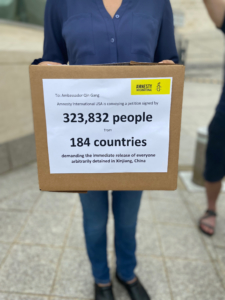
More than 323,000 people worldwide sign Amnesty International’s ‘Free Xinjiang Detainees’ petition
Open letter urges UN to investigate human rights violations against Uyghurs, Kazakhs and other Muslim minorities
New testimonies reveal impact on detainees’ family members
The international community must strongly condemn the ongoing serious human rights violations in China’s Xinjiang Uyghur Autonomous Region (Xinjiang) and pave the way for justice and accountability, Amnesty International said today in an open letter to UN member states.
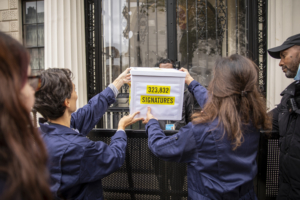
The call comes after 323,832 people from 184 countries and territories signed the organization’s petition calling on the Chinese authorities to release the hundreds of thousands of Muslim minority men and women arbitrarily detained and subjected to mass internment, torture and persecution in Xinjiang.
Around the world, hundreds of thousands of people have signed our petition to express their outrage at evidence of crimes against humanity and other serious human rights violations being inflicted on Muslims in Xinjiang
“Around the world, hundreds of thousands of people have signed our petition to express their outrage at evidence of crimes against humanity and other serious human rights violations being inflicted on Muslims in Xinjiang,” said Agnès Callamard, Amnesty International’s Secretary General.
“It’s a clear sign that people around the world see through China’s efforts to silence critics and lash out in response to credible reporting on its atrocities in Xinjiang. Every signature is a direct call on China to immediately stop this systematic persecution.
“The Chinese government must immediately release all people arbitrarily detained in the camps and in prisons, dismantle the internment camp system, and end the systematic attacks against predominantly Muslim ethnic groups in Xinjiang.”
Petitions delivered at Chinese embassies
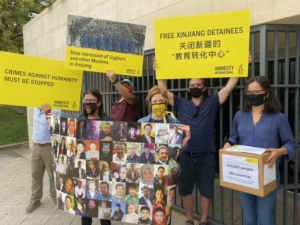
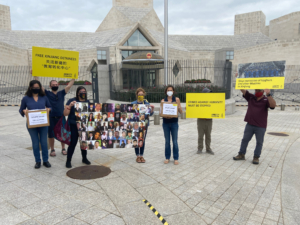
In recent days, Amnesty International supporters in 10 cities around the world have held public events to hand over their Free Xinjiang detainees petitions.
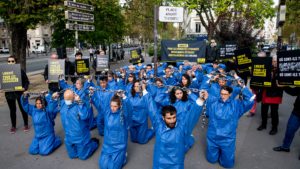
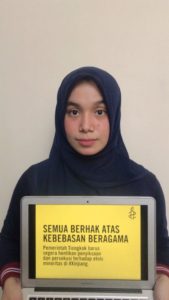
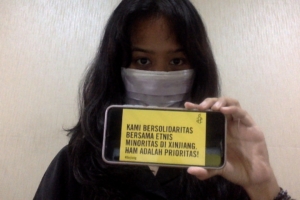
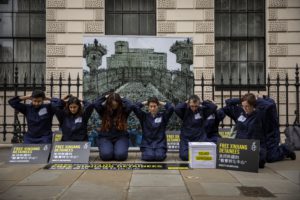
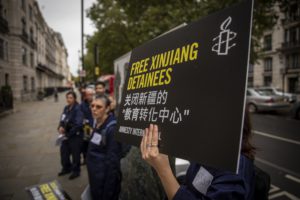
On 7 October, activists gathered at the Chinese embassy in London, UK, to hand over their petition while dressed in the distinctive blue uniforms that camp detainees are forced to wear. Amnesty International activists planned similar events at Chinese embassies in: Dakar, Senegal; Helsinki, Finland; Lima, Peru; Lisbon, Portugal; Madrid, Spain; Paris, France; The Hague, the Netherlands; and Washington DC, USA. Amnesty International Indonesia hosted an online seminar and led a digital action encouraging activists to dress in blue uniforms and post selfies.
The global petition is part of an ongoing Amnesty International campaign, launched in June 2021, to demand an end to the arbitrary detention and other serious human rights violations suffered by predominantly Muslim ethnic groups in Xinjiang.
The campaign highlights more than 60 cases of individuals arbitrarily detained in “transformation-through-education” centres – actually, internment camps – or sentenced to prison for years. These represent only a small fraction of the hundreds of thousands of men and women – possibly up to one million or more – whom the Chinese authorities have detained under the guise of fighting “terrorism”.
New family testimonies
Amnesty International interviewed dozens of family members of those arbitrarily detained in Xinjiang and recently released new videos sharing some of their experiences.
Memeteli’s sister, Hayrigul Niyaz, was detained after she returned from studying abroad, and he has no information about her whereabouts in Xinjiang. Memeteli told Amnesty International: “If I met her again, I will say: ‘Sorry, my sister, that I couldn’t save you from the camps.’”
Adila’s father, Sadir Ali, was arrested in 2018 and sentenced to 20 years in prison, allegedly because he was fasting during Ramadan. Adila said: “Deep [in my] heart I will never be happy because my father is in the jail or in the camp. Why is the Chinese government doing this to us?” She said she had been unable to visit her hometown for 11 years and has lost contact with her relatives in Xinjiang.
Abduweli Ayup, a well-known Uyghur activist now living in Norway, told Amnesty International about his sister, Sajidugul Ayup and brother Erkin Ayup, who are serving 12 and 14 year prison sentences, respectively, in Xinjiang for “inciting terrorism”: “I feel every time I do something, it will be dangerous for my family. No one can protect my family members from the punishment. I know that maybe my words will make the Chinese government very angry, but at least I will make the Chinese government know that I will not just watch them torture my sister. I’m not afraid to speak out anymore.”
Accountability for Xinjiang violations
In June 2021 Amnesty International launched a report documenting how Uyghurs, Kazakhs and other predominantly Muslim ethnic minorities in Xinjiang face systematic state-organized mass imprisonment, torture and persecution amounting to crimes against humanity.
The Chinese government has shown a total unwillingness to acknowledge the reality of the situation in Xinjiang, to halt the human rights violations, or to conduct impartial and thorough investigations and prosecute those suspected to be responsible in fair trials without recourse to the death penalty.
Meanwhile, UN bodies and member states have been slow to respond to the violations. Indeed, another UN Human Rights Council session ended last week without any formal action being taken to address abuses in Xinjiang.
Amnesty International is urging UN member states to stand together to strongly condemn China’s serious human rights violations in Xinjiang and to launch a robust, independent, international investigative mechanism to ensure accountability.
“Despite mounting evidence of serious human rights violations and crimes under international law over the past four years, the United Nations and its member states have failed to live up to their responsibility to hold China to account for its actions,” said Agnès Callamard.
The international community must stop pretending that the dystopian reality for Muslims in Xinjiang will somehow remedy itself. Too much time has already been wasted. Now more than ever, UN member states have a duty to protect the human rights of all people in Xinjiang, launch an investigation into the suspected crimes under international law, and ensure accountability.
Agnès Callamard
“The international community must stop pretending that the dystopian reality for Muslims in Xinjiang will somehow remedy itself. Too much time has already been wasted. Now more than ever, UN member states have a duty to protect the human rights of all people in Xinjiang, launch an investigation into the suspected crimes under international law, and ensure accountability.”
Gallery – images from Amnesty International petition handover events.
Petition handover at the Chinese Embassy in London, demanding the release of all people detained in internment camps and in prisons in Xinjiang, 7 October 2021.
Amnesty International France petition handover event in Paris, 7 October 2021
Amnesty International France petition handover event in Paris, 7 October 2021
Amnesty International France petition handover event in Paris, 7 October 2021.
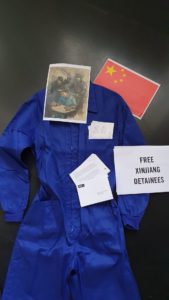
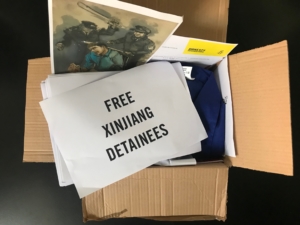
Amnesty International Portugal’s kit sent to the Chinese Embassy in Lisbon included a blue uniform and messages calling for detainees to be freed.
Amnesty International Portugal’s kit sent to the Chinese Embassy in Lisbon included a blue uniform and messages calling for detainees to be freed.
Amnesty International Indonesia activists take part in a selfie action in solidarity with detainees in Xinjiang.
Amnesty International Indonesia activists take part in a selfie action in solidarity with detainees in Xinjiang.
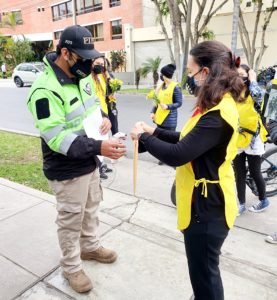
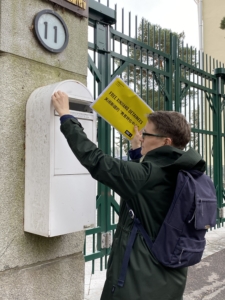
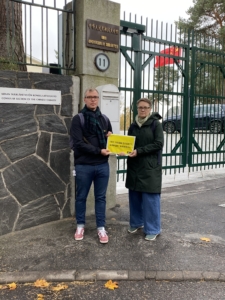
The police were called to respond to a “nuisance” when Amnesty International Netherlands attempted to hand over the petition in The Hague, 7 October 2021.
Amnesty International Netherlands staff attempt to hand over the petition in The Hague, 7 October 2021.
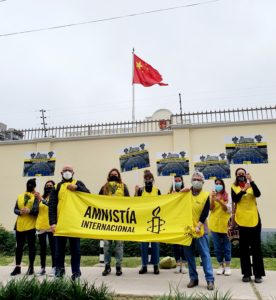
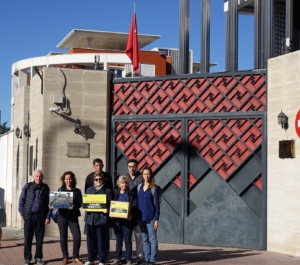
Amnesty International Peru staff protest outside the Chinese Embassy in Lima, 7 October 2021.
Amnesty International Peru staff protest outside the Chinese Embassy in Lima, 7 October 2021.
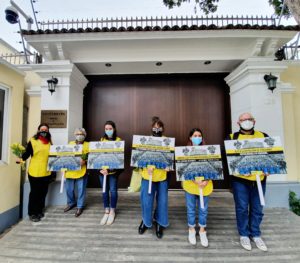
Amnesty International Peru staff hand over the petition outside the Chinese Embassy in Lima, 7 October 2021.
AIUSA staff protest outside the Chinese Embassy in Washington, DC, 8 October 2021.
AIUSA petition handover event outside the Chinese Embassy in Washington, DC, 8 October 2021.
AIUSA petition handover event outside the Chinese Embassy in Washington, DC, 8 October 2021.
Amnesty International Finland activists hand over a petition at the Chinese Embassy in Helsinki, 7 October 2021.
Amnesty International Finland activists hand over a petition at the Chinese Embassy in Helsinki, 7 October 2021.
Amnesty International Spain staff protest outside the Chinese Embassy in Madrid, 7 October 2021.
Petition handover at the Chinese Embassy in London, demanding the release of all people detained in internment camps and in prisons in Xinjiang, 7 October 2021.
Petition handover at the Chinese Embassy in London, demanding the release of all people detained in internment camps and in prisons in Xinjiang, 7 October 2021.
Petition handover at the Chinese Embassy in London, demanding the release of all people detained in internment camps and in prisons in Xinjiang, 7 October 2021.
Amnesty International Sections in multiple cities delivered petitions to Chinese embassies calling for the release of those arbitrarily detained in Xinjiang.
The Curaçaoan and Dutch authorities have violated the rights of Venezuelans seeking international protection in Curaçao, Amnesty International said today in the new report, Still no Safety: Venezuelans denied protection in Curaçao. The organization documented 22 cases of Venezuelans, including children, who have been subjected to human rights violations such as automatic detention under inhumane conditions, ill-treatment, family separations and the denial of their right to seek asylum.
Almost 5.7 million Venezuelans have fled the human rights crisis in their country, making it one of the largest forced displacement crises in the world. Curaçao, a nearby Caribbean island that is part of the Kingdom of the Netherlands, is one of the destination countries. It is estimated that 17,000 Venezuelans live with irregular migratory status on the island.
“It’s unacceptable that the Kingdom of the Netherlands has supported the Curaçaoan authorities in rounding up, detaining and deporting people who fled Venezuela in search of safety. Instead of turning a blind eye while people’s human rights are being violated, the Dutch authorities should ensure that they receive the international protection they need,” said Erika Guevara-Rosas, Americas director at Amnesty International.
Still no protection
Amnesty International has found that the situation of Venezuelans seeking protection in Curaçao has not improved since it published the report Detained and Deported in 2018. Although Curaçao introduced a new international protection procedure, it still does not meet international human rights law and standards. For example, Venezuelans fleeing the crisis are still automatically detained for undefined periods of time, in which they are pressured to sign forms consenting to deportation and have very limited access to legal assistance. The protection assessment interviews are carried out by government officials who are also in charge of arresting foreigners with irregular migratory status. So far, the new procedure has only led to rejection of applications for protected status. The organization is deeply concerned that Curaçao consequently sends people back to Venezuela where they are at great risk of serious human rights violations, in breach of the international principle of non-refoulement.
The conditions in the “Foreigners Barracks”, the detention center in the Sentro di Detenshon i Korekshon Korsou (SDKK) prison, remain inhumane, with detainees subjected to sensory deprivation, overcrowding, being locked up among convicted prisoners, and a lack of privacy. Venezuelans told Amnesty International that prison guards subjected them to degrading and inhuman treatment, such as physical and verbal abuse and being forced to leap like frogs while naked. In 2019, police shot a group of Venezuelans who were in the Foreigners Barracks with rubber bullets. The intentional and disproportionate force the police used against them, and the severity of the injuries, may amount to ill-treatment or torture.
Miguel, who was among those shot with rubber bullets, recalls how the guards punished him and his group for seeking protection: “Then the craziness started: the guards didn’t let us sleep. They made noise at every moment with hammers. I was sleeping on the ground and poorly fed. I lost thirty-five kilos in five months. They damaged us psychologically to make sure we left the island.”
Detention of children and family separation
Curaçao has violated the rights of Venezuelan children by detaining them and separating them from their parent(s) who live on the island. Amnesty International has found eight cases of children who were or had been detained amongst adults in the Foreigners Barracks or in juvenile institutions. They were not reunited with their parent(s), neither were the parent(s) allowed to visit them. Instead, the Curaçaoan authorities deported them or were planning to deport them without their parents’ knowledge or authorization. The intentional and severe mental suffering that government officials have inflicted by deporting children and separating them from their parent(s) may in some cases amount to torture.
“It’s unacceptable that the Kingdom of the Netherlands has supported the Curaçaoan authorities in detaining and deporting people who fled Venezuela in search of safety
Erika Guevara-Rosas, Americas director at Amnesty International
In the case of Yusmari, her two sons, aged 15 and 16 at the time, were automatically detained in the Foreigners Barracks after the Coastguard had intercepted them and handed them over to the Curaçaoan immigration police. Yusmari, who already lived with an irregular migratory status on the island, recalls when they were put in the Foreigners Barracks: “Every time we called, we would cry.” Her youngest son, who is now back in Venezuela, told Amnesty International: “I felt bad. I was not used to being locked up.” After two days, Yusmari’s sons were detained in a youth institution where she was not allowed to contact or visit them. When she finally got permission and arrived at the youth institution, she learnt that the Curaçaoan authorities had already deported her children.
The Netherlands’ contribution to human rights violations
Despite various alarming signals about serious refugee and migrant rights violations committed in recent years, the Dutch authorities have intensified their active cooperation and support to Curaçao, principally in the field of detection, detention and deportation of irregular migrants and people seeking protection.
In November 2019 the Dutch military assisted in the guarding of a group of unlawfully detained Venezuelans, who appear to have been collectively deported in breach of international law. The Netherlands has also provided the Dutch Caribbean Coastguard with equipment and personnel to intercept people arriving by boat in an irregular manner, regardless of the high risk they run of being subjected to human rights violations on land.
The Dutch authorities have not created any binding human rights safeguards, independent monitoring mechanisms, or investigated alleged violations while supporting the Curaçaoan authorities. The responsible State Secretary has repeatedly stated that the Dutch authorities have no obligations to do so, because the Dutch government regards migration policy and possible violations as Curaçao’s responsibility.
However, Amnesty International takes the position that international obligations to respect and protect human rights also apply to the Netherlands when it supports the Curaçaoan authorities. The Dutch authorities have obviously failed to do so and have therefore contributed to a system of violations.
Amnesty International calls on the Curaçaoan authorities to guarantee the rights of Venezuelans seeking protection by creating an asylum procedure that meets international standards. They should stop the detention of children, and the separation of families; and only use detention of adults as a last resort. They must conduct prompt, thorough, independent and impartial investigations into all allegations of human rights violations committed during arrests or in custody.
The government of the Netherlands should assess human rights risks and create binding human rights safeguards applicable to the support it provides the Curaçaoan authorities. Moreover, the Netherlands should establish an independent inquiry to investigate its responsibilities in the assistance and other forms of cooperation between the Netherlands and Curaçao in the field of migration and international protection, in particular the guarding of Venezuelans in the sports hall in 2019 and the actions of the Coastguard.
For more information or to request an interview, contact: