Cambodia: Casinos get state approval despite links to human rights abuse at scamming compounds

  • Regulators rubber-stamped casinos this year despite evidence of slavery and torture
  • Survivors describe being trafficked to casino complexes and forced to scam
  • Casinos linked to scamming compounds owned by major Cambodian companies

A new investigation by Amnesty International shows that a dozen casinos in Cambodia are directly linked to scamming compounds where torture, forced labour, child labour and human trafficking have taken place.

Analysis of official licensing documents issued by Cambodia’s Commercial Gambling Management Commission (CGMC) shows that casino owners are in direct control of buildings and sites where human rights abuses have been documented in at least 12 separate locations. The findings corroborate testimony from compound survivors who described being on casino property while they were confined and abused.

The casinos’ plans were recognized by the CGMC in December and January – during the country’s supposed nationwide crackdown on scamming compounds. The approved businesses include three Crown casinos owned by Anco Brothers Co. Ltd., one of the most powerful companies in Cambodia.

“This research establishes a clear link between Cambodia’s licensed casinos and its scamming compounds. At a time when the government says it is dismantling the scamming industry, the evidence shows it is simultaneously recognizing the plans for casino properties where abusive scamming compounds are run,” Amnesty International’s Co-Regional Director Montse Ferrer said.  

“This contradiction raises urgent questions about whether Cambodian regulators are legitimizing companies linked to grave abuses. The authorities must explain why casinos with documented links to trafficking and torture continue to receive official approval. Every day that these casinos remain licensed is another day in which people on casino property are at risk of human rights abuse.”

In December 2025 and January 2026, the CGMC reviewed and recognized plans submitted by companies operating casinos. These included Crown casinos in the cities of Poipet, Bavet and Chrey Thum, and the Majestic Two and Majestic Hotel & Casino in Sihanoukville, whose former chairman was charged in January 2026 with illegal recruitment for exploitation, aggravated fraud, organized crime and money laundering.

The CGMC published detailed maps of the casino complexes, which show casino buildings, rental buildings, guest accommodation, hotels and general facilities.  

By comparing the official CGMC maps with satellite imagery, analyzed alongside Amnesty International’s own visits to compounds and testimony from scores of survivors gathered for its June 2025 report on scamming compounds, Amnesty identified 11 instances where the compounds profiled in the 2025 report were within the casino complexes recognized by the CGMC.
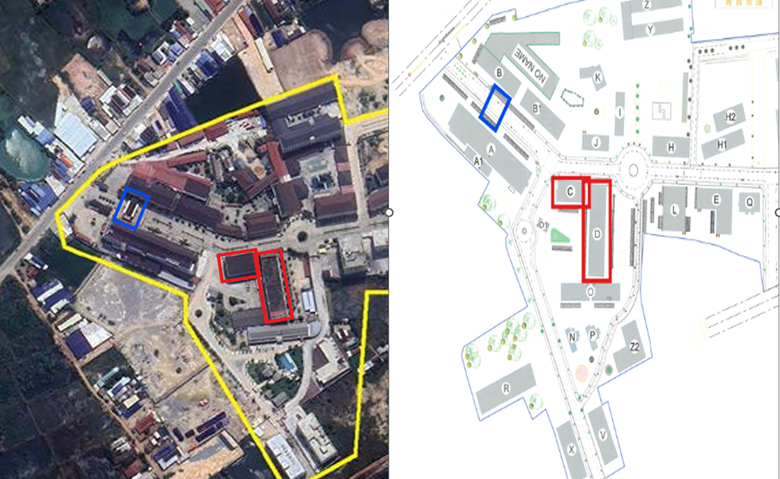
Amnesty International’s KA02 (left) and Casino Kyom (Wo Casino)’s CGMC-approved map (right) with red boxes indicating where a victim was confined and tortured and a blue box indicating the gate he identified from images.

Amnesty International’s KA02 (left) and Casino Kyom (My casino)’s CGMC-approved map (right) with red boxes indicating where a victim was confined and tortured and a blue box indicating the gate he identified from images. © Amnesty International/CGMC

In all cases, the same companies had been operating the casinos since at least 2022. All of the testimony obtained by Amnesty International – in which survivors reported being confined, tortured and/or enslaved in scamming compounds – took place from 2022 onwards.

Amnesty International was able to link an additional complex not featured in its June 2025 report, the Crown Bavet Casino, to very recent evidence of human rights abuse. In January 2026, Amnesty interviewed two individuals from Kenya who had been subject to forced labour and deprived of their liberty at the casino complex, in one case until December 2025. The victims identified the buildings, including through photographs they had taken while confined, and the Crown logo. One of them identified building 15 in the CGMC map as the location where she was confined. The map marks this building as “residential and office building”.

“The children in the room were crying”

Between 2024 and 2026, Amnesty International interviewed survivors who were able to identify exact buildings within casino complexes where they were held.

Two survivors told Amnesty International they were at the Crown Resorts complex in Poipet where they were confined for months, threatened with electric shock batons and forced to open bank accounts that were likely used to launder money. The victims identified an image from Google Streetview which features a door and a sign for “Crown Casino”, saying they were taken through that door and forcibly confined inside.

One was in tears as she recounted: “The guards would enter the room and trigger the shock batons … it made a terrible sound. The children in the room were crying.” The building where she was tortured is marked in the Crown Resorts map in Poipet as “Restaurant and Office Buildings”.
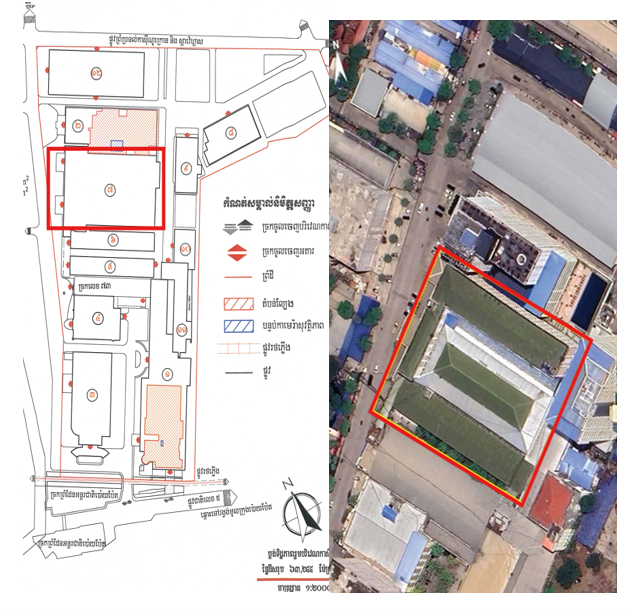
Crown Resorts (Poipet) CGMC-approved map (left) and the PO18 scamming compound profiled by Amnesty International’s (right) with a red box on both maps showing the location where two victims were deprived of their liberty and threatened with violence.

The Crown Resorts (Poipet) CGMC-approved map (left) and the PO18 scamming compound profiled by Amnesty International (right) with a red box on both maps showing the location where two victims were deprived of their liberty and threatened with violence. © Amnesty International/CGMC

Another victim, who was a child when he was trafficked into Cambodia, was deprived of his liberty in two separate casino complexes recently recognized by the CGMC. Sawat (not his real name) said he was confined in building 9, identified in the Crown Chrey Thom map plans as a “Hotel and office”, and was later taken to a location now confirmed as the New Venetian Casino in Bavet, operated by the New Venetian Resort Co., Ltd.

At The New Venetian site, Sawat said he was tortured in a dark room on the eighth floor of  “building E” before being told to eat his “last meal” in 2024. He jumped out of a window to escape, later losing consciousness before receiving medical assistance away from the compound.

Building E is identified as a “Hotel” in the CGMC approved map of the casino complex. During a site visit, Amnesty International observed a marker on the gate to Buildings C, D and E reading “The New Venetian Casino and Resort” with the corresponding logo.
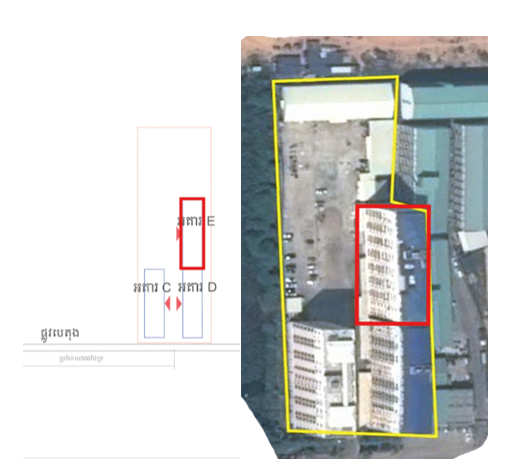
The New Venetian casino is shown in the CGMC-approved map (left) and the BA03 scamming compound profiled by Amnesty International (right), with a red box on both maps showing the location where the victim was deprived of their liberty.

The New Venetian casino’s CGMC-approved map (left) and the BA03 scamming compound profiled by Amnesty International (right), with a red box on both maps showing the location where a victim was deprived of their liberty. © Amnesty International/CGMC

A systemic pattern that demands accountability

In addition to the Crown casinos and The New Venetian casino, Amnesty International also confirmed the following CGMC-recognized casino buildings located within the same complex as scamming compounds documented in its June 2025 report. Deprivation of liberty was documented in all locations, among other abuses:

  • Casino Kyom (My casino), operated by Zhou Cheng K.P. Hotel Co. Ltd., a Cambodian company with links to China through one of its two directors; the same location Amnesty International identified as scamming compound KA02;
  • Marinan International, operated by Marinan International Co., Ltd., a Cambodian company with links to China through one of its two directors; the same location Amnesty International identified as scamming compound PO07 where evidence of human trafficking and forced labour was documented;
  • Peak Casino, operated by Conglomerate Development Group Co., Ltd., a Cambodian company; the same location Amnesty International identified as scamming compound SI12;
  • Majestic Hotel & Casino and Majestic Two, both operated by Big House Commercial Corporation, a Cambodian company with links to China through one of its two directors; the same locations Amnesty International identified as scamming compounds SI15 and SI16, respectively, where evidence of human trafficking, forced labour, child labour and enslavement were documented;
  • Long Feng Xuan Casino, operated by Long Feng Xuan Co., Ltd., a Cambodian company whose sole director is listed as being based in China; the same location Amnesty International identified as scamming compound SI20;
  • Huang (or Wang) Chao International, operated by Bao Shi International Entertainment Co., Ltd., a Cambodian company; the same location Amnesty International identified as scamming compound SI32;
  • Golden Sea Casino; operated by King Golden Sea Corp Ltd., a Cambodian company; the same location Amnesty International identified as scamming compound SI50 where evidence of human trafficking, forced labour and torture and other ill-treatment was documented.

In all cases Amnesty International has evidence that the human rights abuse documented took place within the buildings marked as part of the casino complexes recognized by the CGMC. Amnesty has also verified further accounts of human rights abuse connected to at least three of these casino complexes since the publication of its June 2025 report.

“The scale and industrialized nature of abuse documented in these Cambodian casinos makes clear that this is a high-risk sector that demands investigation and accountability at every level of the corporate chain,” Montse Ferrer said.

“The Cambodian government must immediately suspend the gambling licenses of these casinos and conduct a full, independent and transparent investigation into the violations documented at these sites. It should also investigate all those suspected of individual responsibility for crimes under international law or other gross human rights violations, including the owners, financiers and operators of these casinos.”

Background

In June 2025, an Amnesty International report found that more than 50 scamming compounds across Cambodia were sites of widespread slavery, human trafficking, forced labour, torture and other human rights abuses, operating as prison-like facilities controlled by organized criminal groups. The report concluded that Cambodian authorities had failed to prevent or address these violations, with evidence pointing towards state complicity or deliberate inaction that had allowed the industry to flourish. Nearly half of the 53 scamming compounds Amnesty International identified in June 2025 were linked to a casino.

In July 2025, the Cambodian government announced a nationwide crackdown on scamming compounds in the country. The CGMC has taken some enforcement actions since the start of this crackdown, such as the suspension and sealing of four casinos in Preah Sihanouk province in November 2025.

As reflected in the UN Guiding Principles on Business and Human Rights, all businesses — including casino operators — bear a responsibility to respect human rights, which is independent of the state duty to protect against human rights abuses by private actors. Where casino premises are used to facilitate the detention, coercion and exploitation of trafficked workers, casino operators and property owners may face exposure under Cambodian, transnational, and international criminal law where there is evidence that they knowingly assisted in the trafficking, enslavement or torture of persons.

Amnesty International wrote to the CGMC and all the companies named above to give them an opportunity to respond to the allegations raised. At the time of publication, none have responded.

The post Cambodia: Casinos get state approval despite links to human rights abuse at scamming compounds appeared first on Amnesty International.

Haiti: New massacre highlights widespread failure to protect the population   

In response to the massacre that took place on 29 March 2026 in Petite-Rivière de l’Artibonite, in the Artibonite department, Astrid Valencia, Deputy Director for Research for the Americas at Amnesty International, said: 

“The massacre, reportedly carried out by ‘Gran Grif’, one of Haiti’s most violent gangs, is yet another tragedy in a long chain of crimes that the Haitian authorities and the international community have failed to stop. 

This crime once again highlights the human cost of the authorities’ inability to protect the population, with human rights at the centre. There is an urgent need to establish conditions for sustainable security, including ensuring that all those suspected of criminal responsibility are brought to justice in fair trials.” 

This crime once again highlights the human cost of the authorities’ inability to protect the population.” 

Astrid Valencia, Deputy Director for Research for the Americas at Amnesty International

Although figures remain preliminary, authorities have confirmed at least 16 people killed and 10 injured, while the Special Representative of the UN Secretary-General in Haiti has reported that at least 70 people may have been killed. During the attack, at least 50 homes were burned and looted, and thousands of people were forced to flee their homes.

The post Haiti: New massacre highlights widespread failure to protect the population    appeared first on Amnesty International.

Iran: Seven protesters and dissidents at risk of imminent execution after four men arbitrarily executed in secret within 24 hours

Responding to the arbitrary and secret executions of four dissidents in Iran since yesterday as at least seven other protesters and dissidents face the imminent risk of execution, Amnesty International’s Deputy Regional Director for the Middle East and North Africa Diana Eltahawy said:

“Iranian authorities must immediately halt any plans to execute dissidents Vahid Bani Amerian and Abolhassan Montazer and protesters Mohammad Amin Biglari, Ali Fahim, Abolfazl Salehi Siavashani, Amirhossein Hatami, and Shahin Vahedparast Kolo, held in Ghezel Hesar prison, Alborz province.

“It is unconscionable that even as the population is reeling from conflict and mass bereavement amid the ongoing aerial bombardment by Israel and the USA, the authorities of the Islamic Republic of Iran continue to weaponize the death penalty to eradicate dissenting voices and further terrify people. 

“Earlier this morning, the authorities executed in secret Babak Alipour and Pouya Ghobadi. This followed yesterday’s execution in secret of Akbar (Shahrokh) Daneshvarkar and Mohammad Taghavi Sangdehi. According to information available to Amnesty International, authorities carried out the arbitrary executions of the four without providing them or their families and lawyers advance notice or allowing them to say their final goodbyes. An informed source said the authorities have not returned the bodies of at least three – Babak

Alipour and Pouya Ghobadi and Akbar (Shahrokh) Daneshvarkar – to their families, deepening families’ anguish and suffering. 

“Fears have now intensified over the fate of Vahid Bani Amerian and Abolhassan Montazer, convicted in the same case following a grossly unfair torture-tainted trial. The authorities have refused to provide any information regarding their fate and whereabouts to their families or lawyers since their transfer to an unidentified location on 30 March.

“In another distressing development, authorities transferred five young protesters – Mohammad Amin Biglari, Ali Fahim, Abolfazl Salehi Siavashani, Amirhossein Hatami, Shahin Vahedparast Kolo – from Ghezel Hesar to an unidentified location this morning, also sparking fears of their imminent execution. They were sentenced to death in a separate case related to alleged offences committed in the context of the January 2026 protests.

“All 11 men have said they were subjected to torture and other ill-treatment in detention, including beatings, floggings, prolonged solitary confinement, and death threats at gunpoint before being convicted in grossly unfair trials that relied on forced ‘confessions’ extracted under torture and lasted only a few hours.

“The death penalty violates the right to life and is the ultimate cruel, inhuman and degrading punishment. Carrying out death sentences imposed after serious fair trial violations render the execution arbitrary. All states must urgently call on Iranian authorities to immediately halt all executions and establish a moratorium on all executions with a view to abolishing the death penalty.”

 Background:

Vahid Bani Amerian, Abolhassan Montazer, Babak Alipour, Pouya Ghobadi, Akbar (Shahrokh) Daneshvarkar and Mohammad Taghavi Sangdehi – were sentenced to death following grossly unfair proceedings before a Revolutionary Court in Tehran in October 2024,

which convicted them of “armed rebellion against the state” (baghi) on allegations of affiliation with banned opposition group, the People’s Mojahedin Organization of Iran (PMOI). They repeatedly denied all accusations of taking up arms against the state.

According to information obtained from informed sources, in the evening of 29 March 2026, Akbar (Shahrokh) Daneshvarkar and Mohammad Taghavi Sangdehi were suddenly transferred from Section 4 of Ghezel Hesar prison to an unidentified location. The next morning, 30 March, authorities announced their executions. They then took four other men, Babak Alipour, Pouya Ghobadi, Vahid Bani Amerian and Abolhassan Montazer, along with 14 other dissidents, also held in Section 4, to an unidentified location.

In the morning of 30 March, the authorities cut off all phone lines for political dissidents imprisoned Section 4 of Ghezel Hesar prison, who have since been held incommunicado. 

On 31 March, the authorities announced the executions of Babak Alipour and Pouya Ghobadi.

The executions of 30 and 31 March follow the executions of four other men; Saleh Mohammadi, Mehdi Ghasemi and Saeed Davoudi- on 19 March 2026, who had been arrested in connection with the January 2026 protests, and the reported execution of Kouroush Keyvani on espionage-related charges on 18 March 2026.

Saleh Mohammadi was sentenced to death by Criminal Court One in Qom on 4 February, less than three weeks after his arrest on 15 January 2026 in connection with the death of a security agent during protests in Qom on 8 January 2026, an accusation he denies. The verdict, reviewed by Amnesty International, shows that he retracted his “confessions” in court saying they were extracted under torture, but the court dismissed this without any investigation. An informed source said he sustained hand fractures as a result of beatings.

Seven men, namely Mohammad Amin Biglari, Ali Fahim, Abolfazl Salehi Siavashani, Amirhossein Hatami, Shahin Vahedparast Kolor, Shahab Zohdi and Yaser Rajaifar were sentenced to death for “enmity against God” (moharebeh) by Branch 15 of the Revolutionary Court of Tehran for allegedly setting a Basij base on fire in Tehran. Their sentences were issued on 9 February 2026, less than a month after their arrests in January 2026.

An informed source said Mohammad Amin Biglari was forcibly disappeared for several weeks before being moved to Ghezel Hesar prison.  Authorities denied him access to a lawyer during investigations and then assigned him a state-appointed lawyer, who failed to represent his interests during a fast-tracked trial in which the court relied on forced “confessions” to convict him. They subsequently denied an independent lawyer, appointed by his family, access to his casefile, hindering his ability to file an appeal before the Supreme Court.

Since the 2022 Woman Life Freedom uprising, Iranian authorities have embarked on an execution spree putting to death thousands following grossly unfair trials, with the pace of accelerating following the 12-day war in 2025 and reaching a scale not seen in over four decades.

The post Iran: Seven protesters and dissidents at risk of imminent execution after four men arbitrarily executed in secret within 24 hours appeared first on Amnesty International.

Israel: Iran’s missile strike that killed nine civilians ‘must be investigated as a war crime’ – new investigation

  • Strike on Ramat Lehi neighbourhood destroyed Tiferet Israel synagogue
  • New investigation shows no military objective in vicinity of strike
  • The weapon used in the strike is wildly inaccurate” – Erika Guevara-Rosas

A missile strike by the Islamic Republic of Iran’s authorities on the Israeli city of Beit Shemesh that killed nine civilians – including four teenagers – must be investigated as a war crime, Amnesty International said in a new investigation.

The strike, just before 2pm local time on 1 March on the Ramat Lehi neighbourhood, destroyed the Tiferet Israel synagogue and caused extensive damage to the bomb shelter beneath it. An estimated 46 people were also injured.

Amnesty International analyzed verified digital evidence posted on social media, along with photos and videos the organization collected from the site of the strike, and found that an Iranian ballistic missile was used in the attack.

“The weapon used in Iran’s strike on the Ramat Lehi neighborhood in Israel is wildly inaccurate and carries a massive warhead, making it completely inappropriate for use in densely populated civilian areas,” said Erika Guevara-Rosas, Amnesty International’s Senior Director of Research, Advocacy, Policy and Campaigns.

This attack destroyed a synagogue and a bomb shelter – two places that should have been areas of refuge and safety for civilians

Erika Guevara-Rosas, Amnesty International’s Senior Director of Research, Advocacy, Policy and Campaigns

Amnesty International’s research found no evidence of the presence of legitimate military objectives in the immediate vicinity of the attack. The nearest military objective to the site of the strike appears to be an Israeli military base near the town of Sdot Micha, which is located approximately 3.5km to the west of the impact site.

“This attack destroyed a synagogue and a bomb shelter – two places that should have been areas of refuge and safety for civilians. Nine civilians were killed, including four children. The strike must be investigated as a war crime,” said Erika Guevara-Rosas.

“The Iranian authorities’ use of a ballistic missile in this attack renders it indiscriminate and therefore a violation of international humanitarian law. Launching an indiscriminate attack that causes civilian deaths, injuries or damage to civilian objects constitutes a war crime. There must be an independent and impartial investigation, and anyone for whom there is sufficient evidence of responsibility must be prosecuted in a fair trial.”

Amnesty International verified social media footage showing the munition falling in the city of Beit Shemesh. The trajectory of the munition and the extent of the damage at the scene of the strike are consistent with the use of a ballistic missile carrying a large warhead, rather than a cruise missile or smaller drone-delivered munition. Images from the aftermath show the razed synagogue, along with widespread damage across an approximate 500-metre radius.

© Private / Amnesty International

Israeli media outlets reported that the warhead used was approximately 500kg. Amnesty International has not been able to confirm the payload of the weapon. A 2024 analysis of the accuracy of Iranian ballistic missiles found they routinely missed their target by at least half-a-kilometre.

Between 16 March and 19 March, Amnesty International interviewed four survivors of the attack, and a rescue worker who arrived soon after the strike. The organization also analyzed satellite imagery of the site before and after the attack to corroborate the scale of destruction.

“We are all in despair. We are broken”

Nine civilians were killed as a result of the strike: siblings Sara Biton, aged 13, Avigail Biton, 15, and Yaakov Biton, 17; Gabriel Revah, 16; Oren Katz, 46; Sara Elimelech, 67, and her daughter, Ronit Elimelech, 45; and Bruria Cohen, 76, and her son, Yossi Cohen, 41.

Rabbi Yitzak Biton lost three of his children in the attack. On the morning of the attack, he gave a lesson to Torah students. His two daughters, Sara and Avigail, convinced his son Yaakov to go to the nearby bomb shelter with them, while he, his wife Tamar, and his four-year-old daughter Rachel stayed at their house, located one block from the synagogue.

Rabbi Yitzak Biton and Yaakov Biton © Private / Amnesty International

He told Amnesty International: “The ceiling and the roof [of their house] collapsed… I looked through the window, and I saw the area where the synagogue was. It was on fire, and there was very black smoke in the sky. I was afraid to go… After I worked up the courage to go, I saw the synagogue was completely destroyed, and the [bomb] shelter was split open. The shelter wasn’t safe. It did not provide protection.

Avigail (l) and Sara Biton © Private / Amnesty International

“I lost not one, not two, but three children… One day, out of the blue, half of the family is gone.”

Sarah Fanny Amar, 53, was in the bomb shelter when the strike hit the synagogue. She told Amnesty International: “There was a big boom… I was hanging from metal, and metal was on top of me. Before the boom I was sitting, so the shockwave had thrown me. Around me everything was black and dust… The ceiling collapsed on top of me… I started walking, but I could barely see anything, and I was feeling my way with my hands. I was walking on top of ruins and people… Outside, there was fire… Cars were burning… I got to the grass, and that’s where I collapsed. I opened my eyes in an ambulance.

Sarah Fanny Amar © Private / Amnesty International

“With these bombs, you’re left with no desire to live, to sleep, to eat… I can’t live like this… Even in the shelter you are not safe… I knew everyone who was killed.”

Nissim Edery, 71, was sitting with his neighbour about 100m from the site of the attack. He told Amnesty International: “At the moment of the explosion, I was thrown 4-5m from the shockwave… I realized it was a missile that hit our area… I walked toward the explosion, and there was a huge fire and smoke… It was unbelievable to see what destruction this missile made.

“I know three of the victims, a brother and his two sisters. It tore my heart… We are all in despair. We are broken.”

Reuven Harow, 56, is a senior medic for the emergency medical service Magen David Adom. He arrived at the site around 10 minutes after the attack. He told Amnesty International: “People were coming out all bloodied and bruised… No one knew where the missile strike was – there was damage everywhere…

Reuven Harow © Private / Amnesty International

“Bodies were blown apart… There were body parts lying around for hours after. The focus was on saving anyone who was alive… The people who were giving treatment at the scene – they were treating family and family friends they had known for years. Everyone knows everyone here… What I kept saying over and over is ‘This isn’t real’… It looked like I was watching a movie.”

Background

On 28 February, the US and Israel launched joint attacks on Iran, with thousands of strikes across the country since. The Iranian authorities have launched retaliatory attacks across the region. The armed conflict rapidly expanded into regional hostilities across the Middle East and has resulted in significant loss of civilian life and destruction of civilian infrastructure. Israel has also escalated its attacks on Lebanon in response to Hezbollah’s attacks.

According to various media sources, Iranian forces have used cluster munitions in multiple attacks in Israel since 28 February, including on 18 March, in an attack near Tel Aviv that killed two civilians. Cluster munitions are inherently indiscriminate weapons, and their use is prohibited by international humanitarian law. Last year, Amnesty International documented how Iranian forces’ use of cluster munitions in the ‘12 Day War’ with Israel violated international humanitarian law.

As of 27 March, according to reports, as a result of Israeli and US attacks, at least 1,900 people, including at least 100 Minab schoolchildren, have been killed in Iran; more than 1,116 in Lebanon. Iranian attacks have thus far killed at least 16 civilians in Israel and four in the occupied West Bank; and at least 23 killed across other Gulf Cooperation Council countries in the region.

The post Israel: Iran’s missile strike that killed nine civilians ‘must be investigated as a war crime’ – new investigation appeared first on Amnesty International.

Zimbabwe: Authorities must guarantee free expression and safety ahead of public hearings.

Speaking ahead of the public hearings on the Constitution of Zimbabwe Amendment (No 3) Bill, 2026, Amnesty International’s Deputy Regional Director, for East and Southern Africa, Vongai Chikwanda, said:

“Amnesty International urges the Zimbabwean authorities to guarantee, without discrimination, the rights to freedom of expression and peaceful assembly during the upcoming public hearings.

“Restriction of public debate before, during, or after public hearings shuts down genuine participation, accountability, and the rule of law. Given past incidents of violence and suppression of dissenting voices, authorities must take concrete measures to ensure all participants can freely express their views and assemble without fear of intimidation, harassment, assault, or arrest.

Amnesty International urges the Zimbabwean authorities to guarantee, without discrimination, the rights to freedom of expression and peaceful assembly during the upcoming public hearings. Restriction of public debate before, during, or after public hearings shuts down genuine participation, accountability, and the rule of law

Vongai Chikwanda, Deputy Regional Director, Amnesty ESARO

“Article 61 of Zimbabwe’s constitution guarantees freedom of expression, rights to peaceful assembly and association, which are key pillars of democratic participation. We urge the authorities to uphold these rights during the upcoming hearings, ensuring any restrictions are lawful, achieve a legitimate aim, and are necessary and proportionate. Overly restrictive or intimidatory measures risk creating a climate of fear and undermining the credibility of the consultative process.”

Background

The Constitution of Zimbabwe Amendment (No. 3) Bill, 2026, was gazetted on February 16, 2026. The bill, among many proposals, has clauses that seek to extend presidential and parliamentary terms from five to seven years, thereby prolonging President Mnangagwa’s tenure until 2030, replacing direct presidential elections with parliamentary selection of the president, and consolidating executive control over key state institutions. Key opponents to the bill, such as National Constitutional Assembly’s Lovemore Madhuku and Constitutional Defenders Forum’s Tendai Biti, have been arrested, detained, and assaulted. Public hearings on the bill will run from 30 March 2026 to 2 April 2026.

The post Zimbabwe: Authorities must guarantee free expression and safety ahead of public hearings. appeared first on Amnesty International.