Afghanistan: Shameful failure of UNHRC special session to address escalating human rights crisis

The UN Human Rights Council today failed the people of Afghanistan after neglecting to establish an independent mechanism to monitor ongoing crimes under international law and human rights violations and abuses, Amnesty International said today. 

At the opening of today’s UNHRC special session, the Afghanistan Independent Human Rights Commission, the UN High Commissioner for Human Rights, the UN Special Procedures and a host of other civil society speakers – including Amnesty International – unequivocally called for the creation of a robust investigative mechanism. Such a mechanism would allow for monitoring and reporting on human rights violations and abuses, including grave crimes under international law, and to assist in holding those suspected of criminal responsibility to justice in fair trials.

However, the calls were ignored by UNHRC member states, who adopted by consensus a weak resolution which merely requests further reports and an update by the UN High Commissioner for Human Rights in March 2022, which adds little to the oversight process already in place.

“The UN Human Rights Council special session has failed to deliver a credible response to the escalating human rights crisis in Afghanistan. Member states have ignored clear and consistent calls by civil society and UN actors for a robust monitoring mechanism,” said Agnès Callamard, Amnesty International’s Secretary General.

“Many people in Afghanistan are already at grave risk of reprisal attacks. The international community must not betray them, and must urgently increase efforts to ensure the safe evacuation of those wishing to leave. States must now move beyond handwringing, and take meaningful action to protect them.

“Amnesty International’s recent on-the-ground investigation into the massacre of Hazara men in Ghazni province is proof that the Taliban’s capacity for murder and torture has not diminished.

“UN member states must correct today’s failure when the Human Rights Council meets again in a few weeks. A robust investigative mechanism – with a mandate to document, collect and preserve evidence of ongoing crimes and human rights violations across Afghanistan – is urgently needed.”

Background

The Taliban have seized power in Afghanistan following the collapse of the former government in recent weeks. Amnesty International has called for the protection of thousands of people at serious risk of Taliban reprisals, from academics and journalists to civil society activists and women human rights defenders.

Last week Amnesty International revealed how the Taliban were responsible for a massacre of nine ethnic Hazara men after taking control of Ghazni province in July 2021. The brutal killings likely represent a tiny fraction of the total death toll inflicted by the Taliban following recent territorial gains to date, as the group have cut mobile phone service in many of the areas they have captured, preventing information from emerging.

The post Afghanistan: Shameful failure of UNHRC special session to address escalating human rights crisis appeared first on Amnesty International.

Five years and hundreds of young activists trained, Amnesty International ends It’s My Body! with achievements and successes in Argentina, Chile and Peru.

Doesn’t a woman have the right to decide about her own body? Can’t women defend themselves alone?
So, you need to have a man by your side? The (school) teacher answered me with a resounding yes

Jeshu, 17, Amnesty International activist in Chile

“It takes a village to raise a child”, says the African proverb. But what happens when the village does not want to teach the child? As we grow up, we learn things from our parents, from school and generally from various others; but what if the fundamental things we need to learn are not properly addressed?

For example, sexual and reproductive rights and the freedom to make decisions about one’s own body should not be a matter of discussion because they should be a right guaranteed and promoted by all societies.

However, in Latin America the subject is still taboo, and many young people do not receive information about their rights, or do not find answers to questions that would help them to live their sexuality and relationships to the full. A traditional cultural environment, the lack of open and unbiased information and the lack of comprehensive sexuality education integrated into formal education are, among others, some of the causes of this situation.

This is why in 2016 Amnesty International launched the It’s My Body! programme, involving young people in Argentina, Chile and Peru and made it possible for them to increase awareness and obtain information about sexuality, reproductive and sexual rights, and health services.

Why do I take part? Because I want to see a change in my region. Because I don’t want to be the problem but part of the solution to the problem. Because they talk about me without asking me. They take decisions to improve my well-being, but they don’t do anything. It is important to me that this should not be a taboo but a subject that is given the importance it deserves

Tomy, 16, project activist in Peru

The programme has helped to create opportunities for young people to learn more about their rights, to undertake their first experiences in activism, to feel free to shape their learning and interact with like-minded people. It’s My Body! has put young people at the centre of all its activities, so they are involved in decision-making processes and are represented in all aspects of the programme, as well as gaining the tools to initiate and take part in discussions on issues that matter to them.

Although cultural context, history and traditions differ in the three countries, they share the same lack of guarantees for sexual and reproductive rights socially, culturally and politically. The programme succeeded in bringing together young activists in one common action, with different results depending on the country and context.

The approaches used throughout the programme have created a network of young leaders, peer educators and workshop leaders to reach out to other young people to inspire them and increase their awareness. The programme also helped to create a new generation of activists who are raising their voices to demand access to their sexual and reproductive rights.

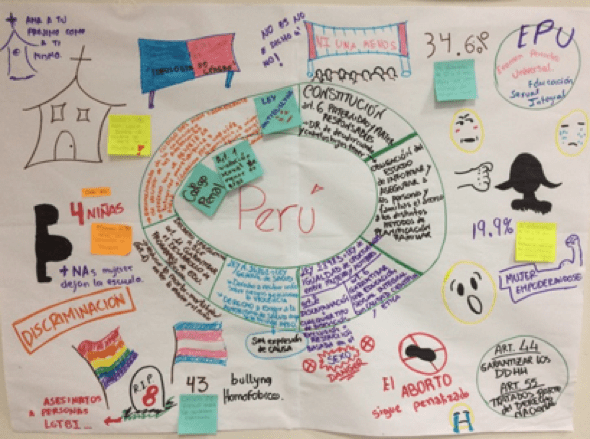
A paperboard designed by young activists in Peru at a workshop organized as part of the project.
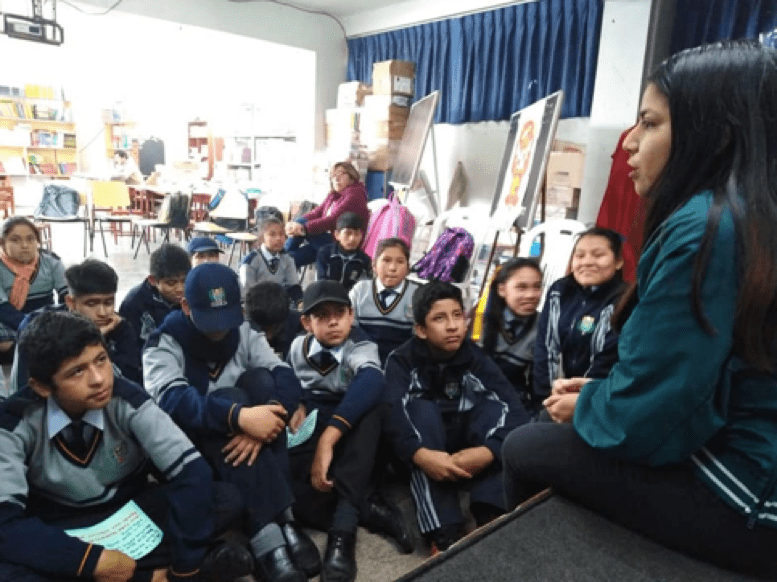
Peer education in a Peruvian school

One of the most important aspects for the young people who took part in the programme was the horizontal and non-hierarchical nature of the human rights education tools they worked with. This enabled them to take ownership of the knowledge and the techniques to reach out to more young people and to address issues that are usually difficult to deal with because they are intimate and personal, and because of the nature of their societies.

Personally, I don’t see It’s My Body! as merely an advocacy project for sexual and reproductive rights in Latin America. Rather, it is a new form of activism that makes the young people in the country important through empowering them over an issue that is not exclusively for adults, and in this way generates a circle of learning that is much better.

PI, Amnesty International activist in Argentina

Peer education was also a key focus throughout the programme, and gave rise to circles of learning centred on young people; where creativity, sharing and learning from emotion lay at the heart of education. Peer learning also developed into resistance to adultcentrism that encouraged a new form of activism. Thanks to this approach, young people have felt empowered and able to carry advocacy processes through and thus influence decision making on issues that matter to them.

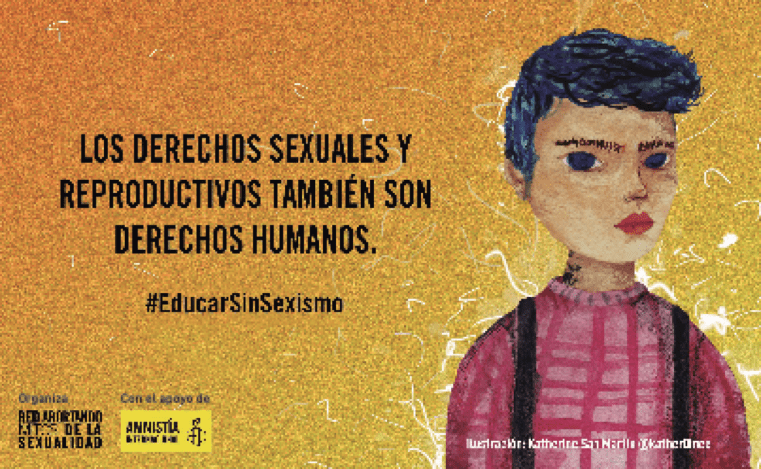
A social media post produced by young activists in Chile to educate and work with other young people on the issue of sexual and reproductive rights.
Illustration: Katherine San Martin.

In addition to increased knowledge about sexual and reproductive rights, strengthened advocacy skills, and generally strengthening young people’s personalities, It’s My Body! achieved real, practical results. For example, in Argentina, one young person successfully reformed a school curriculum to include comprehensive sexuality education. In Peru, young people who took part in the project trained parents and teachers across the country. In Chile, a young man obtained a favourable judgement when defending his case of discrimination at school and appealed to the Office for the Protection of Rights (OPD) and the courts for violation of his sexual and reproductive rights using his human rights knowledge and skills acquired in the project.

My life did not change when I called myself a feminist, or an activist, let alone when I took on the position of coordinator or workshop leader as part of this – wonderful – project, but my life changed when I realized that I was able to change someone else’s life.

(BA) Sofia, 17, project activist in Chile

Political advocacy by young people is one of the main legacies of the programme. The achievement of legalizing abortion in Argentina and the challenge of implementing the law, monitoring of the constituent process in Chile and the struggle to include comprehensive sexuality education in the education curriculum in Peru are strategic lines of Amnesty International’s work that will be able to count on the active participation and involvement of young people beyond the It’s My Body programme!

The It’s My Body! programme has been funded by Operation Day’s Work Norway.

The post Five years and hundreds of young activists trained, Amnesty International ends It’s My Body! with achievements and successes in Argentina, Chile and Peru. appeared first on Amnesty International.
It’s My Body! on camera

Five years ago Amnesty International launched It’s My Body!, a programme to support young activists in Argentina, Chile and Peru to improve their knowledge of sexual and reproductive rights, and to train a new generation of activists with the skills and tools to take part in the debates leading to decisions about them.

Creativity, peer education and youth centrism have been the approaches that have marked this programme.

As a final part of the programme, Amnesty International has asked activist groups in each country to consider the impact the programme has had on their lives. Reflecting the key approach of the programme, in which young people are the leaders of all activities, this evaluation stage was conducted in a participatory and creative manner. The plan was to empower young people to create an audiovisual piece in which they could express what they had learned in order to tell a story from their perspectives and experiences, in their preferred creative language. To do this, Amnesty worked with La Combi – Arte Rodeante, a video production house specialising in the creation of participatory audiovisual materials. “The production of participatory audiovisual pieces allows creators to document their ideas from their own point of view. The audiovisual process becomes a very powerful tool for collective expression and generates learning and reflection. The focus on non-hierarchical working has also permitted closer links between the young filmmakers”, says Carolina Martín de Ramón, Co-director of La Combi – Arte Rodeante. The workshop facilitation team guided activists through the process of defining and writing a script, with the aim of giving them the tools to put their ideas in front of the camera without influencing the choice of

story or subject matter. Young activists from the three countries were also given the technical skills necessary to record their own video and edit the final output, allowing them to tell a story of their choice in their own words.

Young people in Argentina, Chile and Peru face similar barriers and issues in all three countries where people are still not allowed to talk openly about young people’s sexual and reproductive rights, neutral comprehensive sexuality education in schools is limited and finally the lack of adequate policies on the issue further accentuates this problem. However, the three countries have different histories, traditions and political contexts, which are reflected in the videos produced. “When we opened up the video production process to make it fully participatory, we didn’t know what we were going to get from the activists. It has been very interesting to see how they have developed intimate stories and stories about their personal journeys and growth in such an artistic way, according to the differences between them, but true to themselves, their profiles and the impact of It’s My Body”, Imke van der Velde, Regional Education Coordinator for Amnesty International, says about the video production process.

Argentina

The video by the activist group from Argentina focuses on the personal journey that the project has inspired in them. The young people have questions that often remain unanswered, but they are aware of the stark contrast with their situation. While one possibility is to adopt a passive stance, the video ends by demonstrating that there is another way, through personal involvement and the role of activist.“In the video we created, we decided to show the internal process of getting involved in human rights activism, bringing together the stages in a process that all three young women who worked on this creative project went through.” Noe, activist from Argentina.

Chile

The young Chileans behind the video focused on a more personal and intimate journey of self-discovery. The video talks about the raw discomfort that young people go through when growing up: Who hasn’t felt out of place at some point in their lives? How to give young people the right answers? But discomfort forces them to make a choice, and the choice is to transform fear into power and to claim what they need to be conscious and committed citizens: information, freedom and decision-making power.

Peru

This video, produced by a group of a variety of young people from different parts of the country, has a different tone and talks about the direct implications of not having information about sexual and reproductive rights. The cause? A culture that is not yet prepared to answer basic questions in the face of the reality of a young woman who is discovering herself and who wants to live her emotional and sexual relationships to the full. “In our microvideo we want to illustrate the reality of what is happening. In Peru there is a very high rate of teenage pregnancy, and this happens because of a lack of information. Many people I know, friends and classmates, have become pregnant. At school they don’t talk to us about this issue, which is a very important one.” Katherina, activist from Peru.

The three videos are very different in their character, language and style. They are the products of young people and their different cultural contexts – and sometimes their rebelliousness towards them – and reflect their worries and concerns, as well as the ideas for change that young people have and that will continue to influence and guide them beyond the programme.

From gender culture, through youth pregnancy, to climate change and sexual and gender-based violence, these videos reflect current issues that are vital to young people, and shed light on activists who are ready, willing and able to take an active role in discussions to motivate and bring about social and cultural change in their countries.

The It’s My Body! programme has been funded by Operation Day’s Work Norway.

The post It’s My Body! on camera appeared first on Amnesty International.
Zambia: President-elect Hakainde Hichilema must turn the tide on repression

The inauguration of former opposition leader Hakainde Hichilema as Zambia’s new president is an opportunity to turn the tide on the country’s worsening human rights situation, Amnesty International said today. The organization urged the president-elect to prioritize protecting freedom of expression and association, take decisive action to end abuses by police and place socio-economic rights on his agenda, including tackling inequality, poverty, unemployment, collapsing healthcare system and poor education funding. Hakainde Hichilema will be inaugurated on 24 August in Lusaka.

Under the outgoing president, Edgar Lungu, Zambia’s human rights record has deteriorated sharply. Opposition leaders and activists have been arrested and detained, prominent media houses have been shut down, and police crackdowns on peaceful protests have led to several deaths.

The inauguration of Hakainde Hichilema must spell the end of a dark era of repression in Zambia

Deprose Muchena, Amnesty International's Director for East and Southern Africa

“The inauguration of Hakainde Hichilema must spell the end of a dark era of repression in Zambia,” said Deprose Muchena, Amnesty International’s Director for East and Southern Africa.

“We are calling on the new administration to place human rights at the centre of their agenda, including by removing restrictions on the peaceful exercise of human rights, and ensuring accountability for past violations in order to end the culture of impunity. Years of intensifying repression have pushed Zambia to the brink of a human rights crisis- now is the time for a decisive break with the past.”

Systematic crackdown on human rights

The rights to freedom of expression and peaceful assembly had come under increasing attack in Zambia, particularly over the past five years, with opposition leaders and activists jailed and at least five people killed by police since 2016.

The new administration must place human rights at the centre of their agenda, including by removing restrictions on the peaceful exercise of human rights, and ensuring accountability for past violations in order to end the culture of impunity

Deprose Muchena

Under President’s Lungu’s administration, authorities weaponized the law to criminalize peaceful dissent, charging critics with a wide range of offences including criminal defamation, incitement of public disorder and sedition.

For example, on 9 March 2020, police arrested a 15-year-old boy in Kapiri Mposhi, and charged him with three counts of criminal libel after he allegedly criticized President Lungu on Facebook.

Media outlets came under attack during Lungu’s presidency. In June 2016, one of Zambia’s leading daily newspapers, The Post, was shut down and liquidated over a disputed tax debt. The closure of the newspaper, which was known for its critical investigative work against government, was preceded by state-sanctioned violence against staff, including the beating the owner of The Post newspaper, Fred M’membe, his wife Mutinta M’membe and the newspaper’s Deputy Managing Editor, Joseph Mwenda.

Police abuses

The crackdown also saw an escalation in excessive use of force by the police, which has been fatal in some cases. On 22 December 2020, police shot dead two unarmed people at a gathering of opposition supporters.

Several people had gathered to show their solidarity with Haikainde Hichilema, who is the leader of the United Party for National Development (UPND), when he was summoned for questioning at police headquarters in Lusaka.

State prosecutor Nsama Nsama, who was not part of the gathering, was shot dead while buying a meal at a nearby restaurant, while Joseph Kaunda, a UNPD supporter, was shot by police as they dispersed the crowd. A day earlier, the government had publicly urged police to use ‘any means necessary to maintain law and order’ when dealing with opposition supporters.

An investigation by Zambia’s Human Rights Commission established that the order to shoot came from Lusaka Police Commissioner Nelson Phiri, who was removed from service but not charged with any offence.

Hakainde Hichilema has an opportunity to pull Zambia back from the brink. Tackling the injustices of the past is a crucial step towards building a better future for the country

Deprose Muchena

In 2018, student Vesper Shimuzhila died when police threw a tear gas canister into her room, during their violent dispersal of a student protest. Her family were given $25,000USD in compensation but no officer has been charged.

“President-elect Hichilema must adopt a bold and decisive human rights strategy to ensure respect for the human rights of all Zambians, including by tackling impunity and bringing perpetrators of past violations to justice,” said Deprose Muchena.

“Hakainde Hichilema has an opportunity to pull Zambia back from the brink. Tackling the injustices of the past is a crucial step towards building a better future for the country.”

The post Zambia: President-elect Hakainde Hichilema must turn the tide on repression appeared first on Amnesty International.
Sahel: Amnesty identifies Serbian weapons in stockpiles of brutal armed groups

Amnesty International’s arms experts have identified Serbian-manufactured weapons in videos posted by armed groups operating in the Sahel, including an Islamic State affiliate which has claimed responsibility for hundreds of civilian deaths. The new rifles, some the latest available models, match trade records of Serbia’s sales to Burkina Faso, suggesting the weapons were recently sold to the government before falling into the hands of armed groups.

Amnesty International’s analysis of commercial trade data also shows that the Czech Republic, France and Slovakia have exported large quantities of small arms and light weapons to Sahel governments since widespread conflict broke out.  

By 2020, when Serbia made its latest reported arms transfer to Burkina Faso, violence between armed groups was already well underway.

Patrick Wilcken, Head of Business, Security and Human Rights

Since 2011, Mali has been facing an insurgency led by various armed groups including Islamic State of Greater Sahara (ISGS), and the al-Qaeda-affiliated Jama’at Nusrat al Islam wal Muslimeen (JNIM), and the conflict has spilled over into Burkina Faso and Niger. Armed groups have carried out multiple attacks on civilians and a humanitarian crisis is fast engulfing the region. Serbia, the Czech Republic, France and Slovakia have all ratified the Arms Trade Treaty (ATT), which prohibits the transfer of arms if there is a risk they will be used to commit or facilitate human rights violations.    

“The conflict in the Sahel has been characterized by serious human rights violations by all parties, including massacres of civilians by unaccountable armed groups. More than a million people have been displaced in the region, and the humanitarian crisis is fast becoming one of the worst in the world,” said Patrick Wilcken, Head of Business, Security and Human Rights at Amnesty International. 

“In this increasingly dire context, states must act with extreme caution when considering arms transfers to the Sahel. Not only is there an unacceptably high risk of diversion to armed groups, national armies and police forces in the region have appalling human rights records. Ahead of the annual Arms Trade Treaty conference next week, we urge all states to live up to their obligations and refrain from any arms transfers that could fuel human rights violations.” 

On 30 August, delegates from 110 countries will meet in Geneva for the Seventh Conference of States Parties to the Arms Trade Treaty. The ATT prohibits exports of arms where there is an overriding risk they will be used to commit or facilitate genocide, crimes against humanity, war crimes and serious human rights violations. This includes the risk that weapons sold to governments will be illicitly diverted to human rights violators. 

Worsening conflict

The situation across the central Sahel region is growing increasingly unstable, and armed groups have proliferated in the context of a multi-faceted and brutal conflict. More than 6,000 civilian deaths were reported between 2017 and 2021 in Burkina Faso, Mali and Niger, according to data from the Armed Conflict Location Event Database. More than 1,200,000 Burkinabè have been displaced since 2016, according to UNHCR.  

In June 2021, unidentified armed men killed 130 civilians in the village of Solhan in Burkina Faso, the worst attack on civilians seen so far in the conflict. ISGS has claimed responsibility for multiple attacks on civilians in 2021, including one on 21 March which left 137 people dead across several locations in Niger.

So-called ‘self-defence’ groups, established in opposition to JNIM and ISGS, have also carried out massacres of civilians, leading to a bloody cycle of reprisals. In March 2020, one such ‘self-defence’ group, the Koglweogo, launched a series of appalling attacks on villages in Burkina Faso which left at least 43 people dead. A month earlier, Dan na Ambassagou, an ethnic armed militia, killed 32 villagers in Ogossagou, Mali.  

Serbian weapons in hands of fighters

Amnesty International collected and analysed more than 400 pieces of digital content from Burkina Faso and Mali, including verified photos and videos posted on social media by members of armed groups between January 2018 and May 2021. The imagery shows weapons stockpiles, as well as guns in the hands of fighters from various armed groups including ISGS, JNIM, Dozos, Volunteers for the Defense of the Fatherland (VDP), Koglweogo, and Dan au Ambassagou, in both Mali and Burkina Faso.  

While most of the weapons visible were legacy Kalashnikovs of Soviet origin, many decades old, Amnesty identified 12 cases where fighters carried newer weapons made by Serbian company Zastava. These include M02 Coyote heavy machine guns, and M92 and M05 series rifles, including the most up to date M05E3 models which were not available before fighting began in northern Mali in 2011.  

While tracing precise chain of custody was not possible, it is likely that these weapons were diverted to the armed groups either through illicit channels or battlefield capture. 

Between 2015-20, Serbia reported total transfers of 20,811 rifles and carbines; 4,000 assault rifles; 600 revolvers and self-loading pistols; and 290 machine guns to Burkina Faso, in its annual reports to the ATT. 

The ATT requires States Parties to assess the risk of diversion of the arms covered by the Treaty – particularly small arms and light weapons which are easy to conceal and transport. If there is a substantial risk that arms will be diverted to end users who will use them to commit or facilitate human rights violations,  exports should not be authorized. 

“By 2020, when Serbia made its latest reported arms transfer to Burkina Faso, violence between armed groups was already well underway. Any adequate risk assessment by Serbia would have concluded that arms sales to Burkina Faso were likely to contribute to human rights violations,” said Patrick Wilcken.  

Any arms sold to governments in the Sahel region risk falling into the hands of armed groups and fuelling the conflict.

Patrick Wilcken

Other European Arms

According to official EU annual report data, since 2013, EU states have issued 506 licences, worth 205 million euros, of military equipment to Mali and Burkina Faso. 

Slovakia has reported transfers of 1,000 assault weapons, 2,460 rifles and carbines, 550 machine guns; 680 pistols and revolvers and 750 sub-machine guns to Mali; the Czech Republic has reported transfers of 3,500 assault rifles and 10 sub-machine guns to Burkina Faso; and France has reported a further 1,164 pistols and self-loading revolvers, 4 rifles and carbines, along with 13 armoured combat vehicles to Mali. 

“The Serbian weapons we identified are the latest evidence that any arms sold to governments in the Sahel region risk falling into the hands of brutal armed groups, and fuelling the worsening conflict,” said Patrick Wilcken.  

“As the situation deteriorates across the Sahel, all exporting states must adopt strict safeguards in order to prevent weapons being diverted to armed groups, or used to commit human rights violations by armed forces. If such safeguards cannot be guaranteed, arms should not be transferred. Importing states must also clamp down on illicit arms sales, and ensure that stocks are secure.” 

The post Sahel: Amnesty identifies Serbian weapons in stockpiles of brutal armed groups appeared first on Amnesty International.