Syria/Jordan: UN-led return operation will put refugees at risk of abuses in Syria

The UN and the Syrian Arab Red Crescent (SARC) must halt plans to transfer refugees from Rukban camp back to Syria, Amnesty International said today. The operation would put returnees at risk of arbitrary detention, enforced disappearance, and torture and other ill-treatment, including sexual violence, as Amnesty International documented in a report this week. Rukban is an informal settlement, located in an isolated and inhospitable area between the Syrian and Jordanian borders known as “the berm”. Living conditions in the camp are dire, and residents lack access to medical care, sanitation and clean water.

Our research shows that the Syrian authorities have specifically targeted returnees from Rukban, accusing them of ‘terrorism’ before subjecting them to serious human rights violations.

Marie Forestier, Researcher on Refugee and Migrants Rights

Amnesty International received information that beginning in September, the UN plans to facilitate the transfer of people from Rukban to “shelters” in Homs, where they will be quarantined for 14 days. Amnesty has documented how these so-called shelters have been used by Syrian authorities to detain and interrogate returnees. Some of these returnees were then transferred to intelligence centres where they were arbitrarily detained and in some cases, tortured and forcibly disappeared. It is not clear how many people will be moved from Rukban if the UN-led return operation goes ahead.

“We are urging the UN and SARC not to proceed with these returns, which will undoubtedly put the women, men and children who have been living in Rukban in danger. Our research shows that the Syrian authorities have specifically targeted returnees from Rukban, accusing them of ‘terrorism’ before subjecting them to serious human rights violations,” said Marie Forestier, Researcher on Refugee and Migrants Rights at Amnesty International.

“Quarantine requirements in government-controlled facilities will essentially give the Syrian authorities 14 days to interrogate returnees. These returns must not go ahead; instead, the Syrian and Jordanian governments, as well as all parties to the conflict, must urgently ensure unfettered access of humanitarian aid to Rukban.”

Not safe

Amnesty International’s report “You’re going to your death” found that Syrian authorities have targeted returnees precisely because they sought asylum abroad. Out of the 66 cases documented in the report, Syrian security officials detained all 10 individuals who returned from Rukban camp. Three were subjected to torture or other ill-treatment, and two were forcibly disappeared.

Samer, who lived in Rukban for six years before returning to Homs in 2019, said: “[The Syrian authorities] hate people from Rukban. They think that they all have links with terrorism and should be mistreated.” Samer said that intelligence members arbitrarily detained and forcibly disappeared him for nine months, during which time they tortured him.

The evidence that Syria is not safe for returns is overwhelming – this return operation must not proceed.

Marie Forestier

Under the plan seen by Amnesty International, leaving the quarantine site in Homs would be subject to approval by the Syrian government, giving authorities the power to detain returnees for even longer periods without judicial oversight.

The last humanitarian convoy allowed into the berm by the Syrian government was in September 2019. In March 2020, Jordan announced it would not allow aid to pass through its territory, citing COVID-19 concerns. The head of the Rukban local council told Amnesty International that camp residents have expressed anger that the only convoys coming to Rukban are transferring people to Syrian government-controlled areas, rather than bringing aid.

“The evidence that Syria is not safe for returns is overwhelming – this return operation must not proceed,” said Marie Forestier.

Background

In early 2015, tens of thousands of people seeking safety from the conflict in Syria ended up stranded in the border area known as “the berm”, after Jordanian authorities sealed off border crossings. Around 10,000 people currently live in the camp there.  An estimated 75% of the berm’s population have returned to Syria since mid-2015, largely due to dire living conditions.

The post Syria/Jordan: UN-led return operation will put refugees at risk of abuses in Syria appeared first on Amnesty International.
New investigation exposes global misuse of police batons

Amnesty International and the Omega Research Foundation today called on governments to support a UN-led process to regulate the trade in law enforcement equipment, highlighting how ubiquitous weapons like police batons are routinely misused in ways which can constitute torture and other ill-treatment. 

In a new investigation, Blunt Force, the organizations catalogued 188 incidents where law enforcement officials have misused striking weapons such as batons, which are currently traded with little to no regulation. The investigation draws on open-source photo and video evidence from 35 countries, and includes examples from violent crackdowns on protests in Belarus, Colombia, France, India and Myanmar. Videos show law enforcement officials using batons and similar weapons like lathis and sjamboks to inflict punishment, beat people who are already restrained, deliver unjustified dangerous blows to the head, or choke people in neck holds.  

Batons can cause serious injury and even death when used improperly, yet they are traded with little to no regulation.  

Verity Coyle, Advisor on Military, Security and Policing at Amnesty International

As a UN process to create an international regulatory framework moves ahead, Amnesty and Omega are calling for tighter controls on the trade in “less lethal” law enforcement weapons, as well as an outright ban on certain types of inherently abusive equipment used for torture or the death penalty. 

“Batons can cause serious injury and even death when used improperly. Yet the trade in law enforcement equipment like this continues to benefit from a shocking absence of regulation. Governments should be obliged to conduct rigorous risk assessments before allowing this equipment to be exported,” said Verity Coyle, Advisor on Military, Security and Policing at Amnesty International.  

“States should also ensure that law enforcement agencies are trained and instructed in human rights compliant policing, including in the context of public assemblies, where many of the violations we documented took place. There are international standards governing how police can use force, but our investigation shows these being flouted all over the world – with profoundly dangerous consequences.” 

Stop the unlawful use of police batons

Commonly used – and abused

Striking devices are the most common type of less-lethal weapon, carried by police and security forces worldwide. These include batons, lathis (long sticks) and sjamboks (rigid whips). The widespread deployment of this equipment means it is also among the most frequently abused, especially in the context of crackdowns on protests.  

Some less lethal weapons and equipment can have a legitimate use in law enforcement, if employed correctly and in line with international standards. Law enforcement officials face a wide variety of situations which require instantaneous decisions, often in highly stressful and even dangerous circumstances. But the use of force must only be resorted to with the utmost respect for the law, and with due consideration for the serious impact it can have on a range of human rights.


A growing number of states have recognised the need to address the trade in law enforcement weapons and equipment, as part of the global fight against torture and other ill-treatment.

Dr Michael Crowley, Omega Research Foundation

Under the UN Basic Principles on the Use of Force and Firearms by Law Enforcement Officials (BPUFF), police may only use force for a legitimate law enforcement purpose, and may not use more force than needed to achieve this objective. Any potential harm caused by police using force must not outweigh the harm they want to prevent.  Furthermore, as with other means of force, batons must never be used for the purpose of punishment. These rules also apply in the context of policing public assemblies.  

Blunt Force shows how law enforcement officials routinely act against international human rights law and standards by attacking protesters who present no threat of violence.  

Amnesty International’s Crisis Evidence Lab and Digital Verification Corps analysed more than 500 videos of protests between 2011 and 2021, identifying and verifying 188 incidents of baton misuse. Videos of five illustrative cases are available here, with Amnesty and Omega’s analysis of how international standards have been breached in each case.  

For example, a video from Hong Kong shows a young male protester being repeatedly hit with batons by several officers. One of the officers strikes the protester on the head, causing bleeding. Strikes to the head are particularly dangerous and can even be fatal, and putting another life at risk is prohibited under international law and standards, if it is not unavoidable and in response to a similarly serious threat. Crucially, the video shows that officers clearly had other, less harmful options at their disposal to achieve their aim of arresting the protester.  

Footage from Belarus shows riot police leading a protester down some stairs. An officer strikes the protester on the back of the legs even though he is not resisting arrest; while being held by one officer, the protester is then struck on the back of the head with a baton and punched in the face and stomach. Baton strikes while a subject is under control are unnecessary and disproportionate, and amount to using batons punitively – which amounts to torture or other cruel, inhuman and degrading treatment or punishment, a violation of international law. 

UN Process

The UN Secretary General has tasked a group of experts to develop proposals with the aim of creating an international framework to regulate the trade in equipment that can be used for torture or in the death penalty. This includes less-lethal equipment like batons and tear gas. They must report back to the UN General Assembly in 2022. 

Given the clear risk of common law enforcement weapons being misused, any global framework to regulate the trade must cover the broadest possible scope of equipment. 

Dr Michael Crowley, Research Associate at the Omega Research Foundation, said: 

“A growing number of states have recognised the need to address the trade in law enforcement weapons and equipment, as part of the global fight against torture and other ill-treatment. The ongoing UN process to develop common international standards is a once-in-a-generation opportunity to regulate a trade which has been out of control for decades. 

“We call on all states to support the creation of a global, legally binding instrument which bans inherently abusive equipment and weapons and places strict controls on the trade in standard law enforcement equipment, to ensure it is never sent to those who will use it for torture or other ill-treatment. To make a real difference, such regulation must cover the types of weapons, such as batons, that are most regularly misused by law enforcement officials around the world.” 

The post New investigation exposes global misuse of police batons appeared first on Amnesty International.
Blunt Force: Investigating the misuse of police batons and related equipment

Introduction

Time and again, law enforcement officials are too quick to resort to the use of force, often against peaceful protesters exercising their rights to freedom of peaceful assembly. 

In recent years and throughout the Covid-19 pandemic, states have restricted the rights to freedom of peaceful assembly and freedom of expression, often violently. Civic space is shrinking. Among the most frequently used and misused weapons in this context are police batons in different forms and sizes. 

Amnesty International has investigated the misuse of batons and other striking weapons, analysing illustrative incidents spanning the past decade from around the world. Examining hundreds of photos and videos, researchers have verified 188 incidents of the misuse of striking weapons including police batons, lathis (long sticks), sjamboks (rigid whips) and improvised weapons in 35 countries, covering all regions of the globe. These include examples from violent crackdowns of mass protests in countries as diverse as Belarus, Colombia, France, India and Myanmar. 

Why Amnesty is campaigning to regulate the torture trade

Agnès Callamard – Secretary General, Amnesty International

Batons have been used to inflict beatings as a means of punishment, beat people who are already restrained, deliver unjustified dangerous head and neck strikes, and choke people in neck holds. Single baton blows have been delivered with such force that the victims have collapsed to the ground. Incidents documented also include batons being used to commit sexual violence.

Amnesty International’s Crisis Evidence Lab and Digital Verification Corps, based at six global universities, analysed more than 500 photographs and videos, identifying and verifying the final 188 illustrative incidents showing instances of security forces using striking weapons and other less lethal weapons and equipment in a manner that amounts to torture or other ill-treatment.  

Less lethal weapons and equipment are intended to allow law enforcement officials to use the minimum level of force according to circumstances and avoid using lethal force. Some less lethal weapons and equipment can have a legitimate use in law enforcement if employed correctly and in line with international standards for law enforcement. Yet such equipment can have unintended dangerous and even lethal effects if not used in compliance with human rights standards and is also open to abuse. 

Amnesty International has documented its misuse in all regions of the world – in many instances against protesters exercising their right to freedom of peaceful assembly.

Health implications of baton strikes

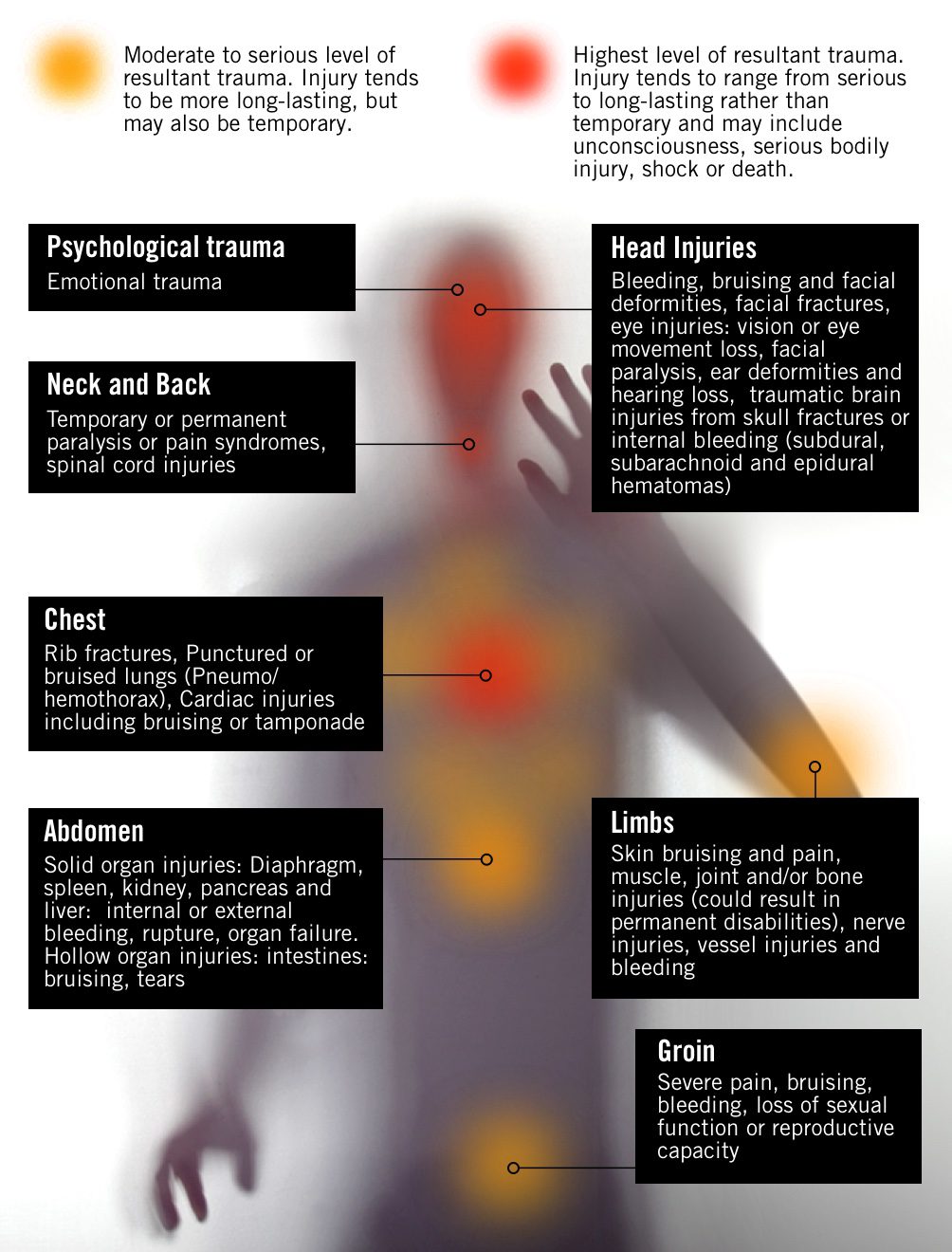
Baton injuries can range from characteristic abrasions, bleeding and bruising to more severe injuries including bone fractures, nerve/muscle damage and internal injuries that may result in permanent disability or death. Injury patterns and severity are dependent on the location of the strike, the amount force used, and the type of baton. 

Police forces across the world are equipped with a range of less lethal equipment – such as tear gas and pepper spray, batons, plastic and rubber bullets, and water cannon – which is regularly deployed in the policing of public protest.   

For decades, Amnesty International has been documenting how these weapons are used to abuse human rights. In June 2020, Amnesty launched a major investigation into the misuse of tear gas, documenting abuse in 22 countries and territories. Blunt Force focuses on striking weapons, such as police batons, which are widely misused across the world. 

This equipment is the simplest – and commonest – type of less lethal weapon. Striking weapons come in many shapes and sizes and different materials. They include not just police batons and sticks, but also whips, which are inherently abusive. Striking weapons are routinely used in intimidatory, aggressive acts of force leading to physical and psychological trauma.  

Batons are currently traded with no regulation. There is an emerging opportunity to create a global, legally binding instrument at the UN that prohibits the trade in inherently abusive equipment and places strict human rights-based trade controls on other equipment, like batons – which can serve a legitimate function, but that as our research shows, can also be used for acts of cruel, inhuman and degrading treatment, and even torture.

Use of force standards

To fulfil their responsibilities of maintaining law, safety and public order and preventing and detecting crime, law enforcement officials are granted a number of powers, including the power to use force and firearms. 

These powers come with obligations and responsibilities, particularly regarding a range of human rights that may be affected by these powers and which the state and its agents are obliged to respect and protect. 

Law enforcement officials face a wide variety of situations, sometimes requiring instantaneous decisions, often in highly stressful and even dangerous circumstances. The use of force must only be resorted to with the utmost respect for the law and with due consideration for the serious impact it can have on a range of human rights: the right to life, to physical and mental integrity, to human dignity, to peaceful assembly, and to freedom of movement – to name just the ones most frequently affected. Four guiding principles (legality, necessity, proportionality, and accountability) must govern any state action that impacts on the human rights of a person. Any use of police powers by law enforcement officials must comply with these principles; for example, when carrying out an arrest or a stop-and-search activity or when using force against an individual, or group of individuals. 

Although punishment is never a legitimate objective for a law enforcement action, such practices are regularly reported in the policing of public assemblies, and batons are one of the weapons most frequently used for this purpose. Over the last two years, Amnesty International has reported on many instances in which law enforcement officials have used batons to punish people for violating COVID-19 restrictions. This is clearly unlawful, as punishment is never a legitimate objective for a law enforcement action.  

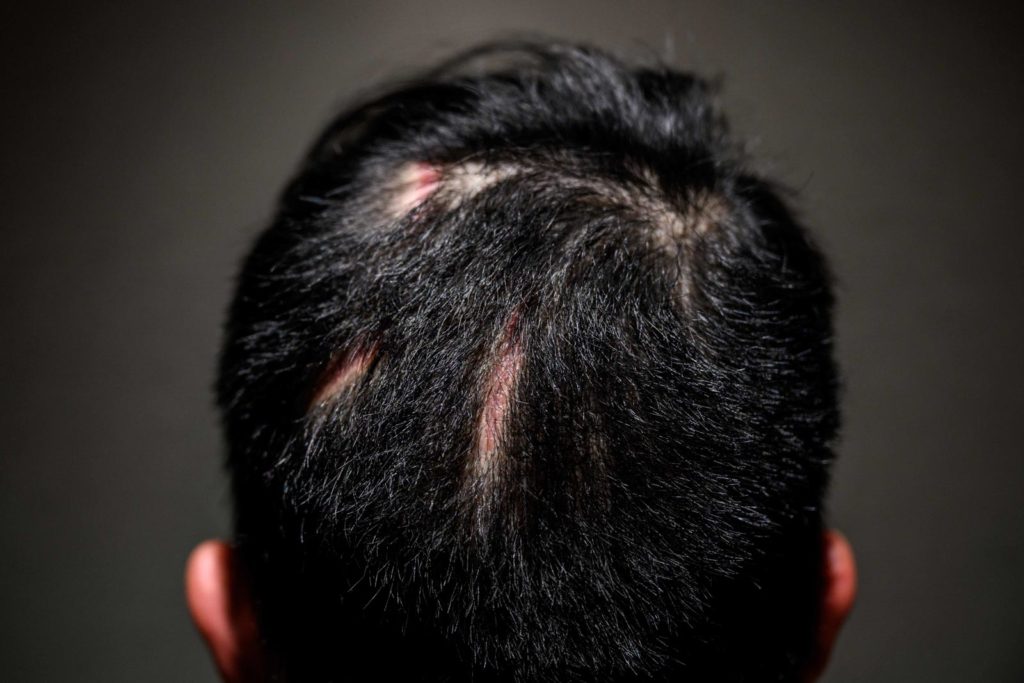
Then-17-year old high-school student Joseph poses in Hong Kong to show scarring from injuries on his head which he received on the night of August 31, 2019, when he and others were allegedly clubbed repeatedly with batons inside a waiting train after a team of riot police stormed into the Prince Edward subway station

Necessity means using only the force actually needed to achieve an objective, and attempting first to use non-violent means first, whenever this is feasible. Verbal commands, negotiation, peaceful settlement of conflict, warnings, or simply keeping a safe distance – all these are ways to achieve an objective without resorting to the use of force. It is crucial that law enforcement officials are well trained in all these options in order to enable them to minimize any harm they might cause.  

Police are often observed resorting to the easiest, rather than the least harmful means. When they have a weapon at hand, such as a baton, it is often this weapon they will use. When dispersing protesters, police frequently carry out so-called baton charges. Here, lines of police run at crowds with raised batons, chasing after protestors and beating them in order to make them disperse – even though police have other options beyond potentially inflicting considerable injury by means of a baton. Verbal commands, simple pushes or carrying people away are actions that will cause much less harm than hitting someone with a baton.   

Law enforcement objectives are not supposed to be achieved at all costs. Any harm police might cause must not outweigh the harm they want to prevent. When a person is only passively resisting but not acting violently, using force that is likely to cause any more than negligeable injury would be disproportionate. Even when police are facing violent individuals, putting the life of such individuals at risk is only permissible if the life of another person is at stake. Baton use can result in considerable injuries, including life threatening ones. There are many very harmful ways of using a baton. Hitting the head or the neck, jabbing someone with the baton, using it as a neck hold – all these are life threatening baton uses.  

Even when accompanied by adequate instructions and training, law enforcement equipment is often misused, sometimes in an abusive, unlawful way. This can amount to excessive use of force, in some instances violating the prohibition on torture and other cruel, inhuman, or degrading treatment. 

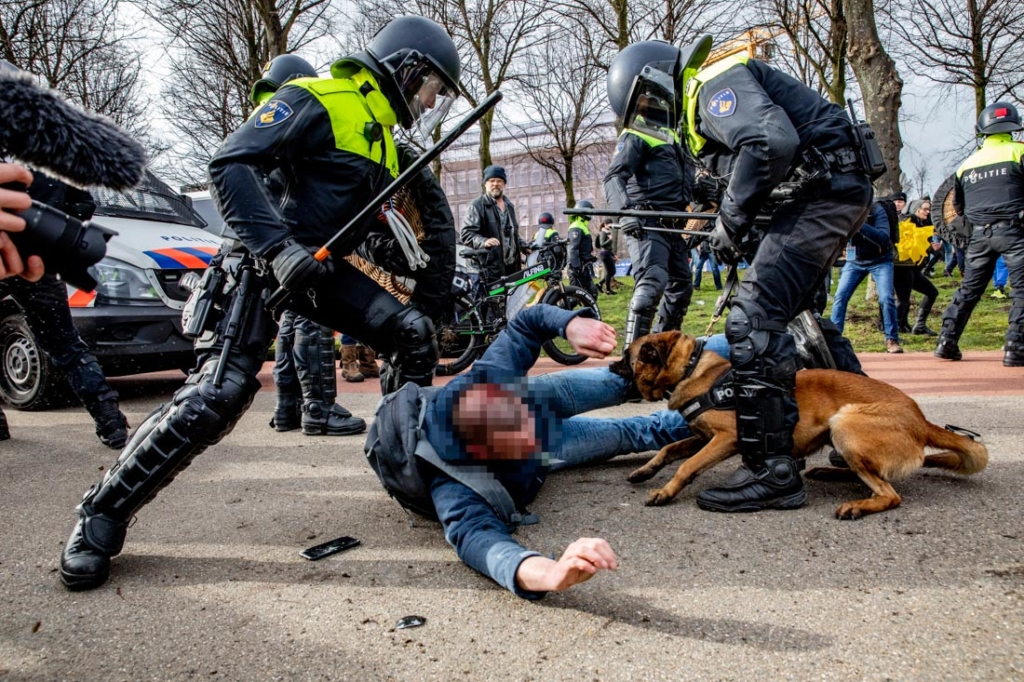
Police officers detain a protester during a protest on the Malieveld against the coronavirus policies and the government
Police officers detain a protester during a protest on the Malieveld against the coronavirus policies and the government on March 14, 2021 in The Hague, Netherlands.

Nobody is above the law, especially those who have a duty to uphold it

Dr Anja Bienert, Amnesty International Netherlands

Right to protest

The rights to freedom of peaceful assembly, expression and association are enshrined in international law. States are under an obligation to facilitate the right to freedom of peaceful assembly, actively encouraging people to engage in assemblies.  

States must respect, protect, and fulfil the right to peaceful assembly without discrimination of any kind. Peaceful assemblies should be protected, and they do not lose their peaceful character if there are isolated acts of violence or unlawful behaviour by some individuals.  

The exercise of this right should not be dependent on the authorisation of the state; states may request notice (although not for spontaneous assemblies) – but not authorisation.

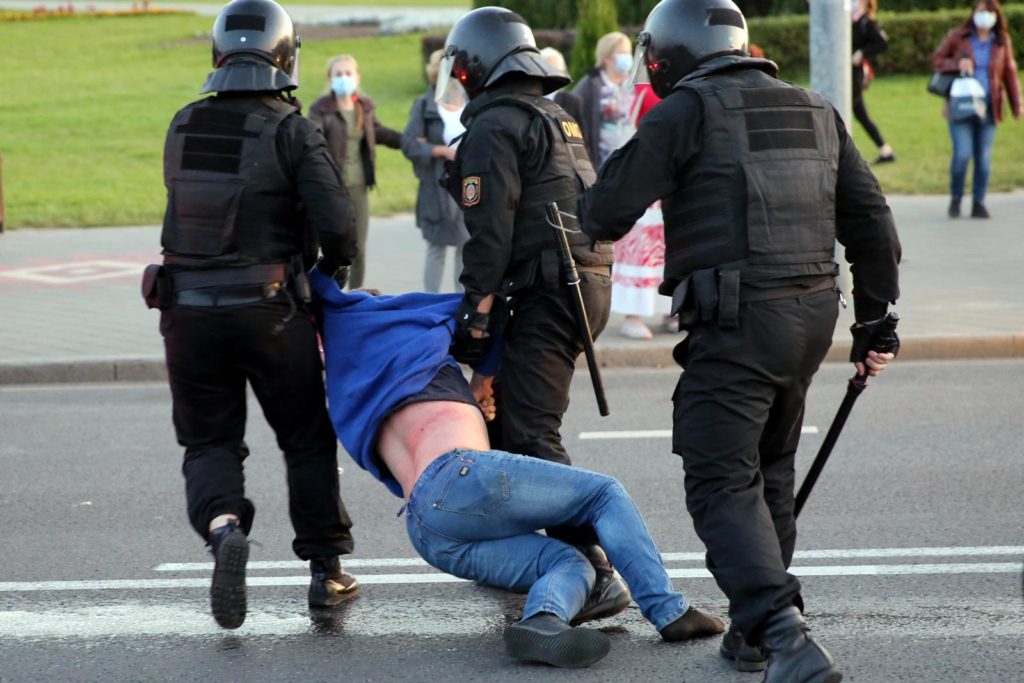
Riot police officers detain a man during an opposition rally to protest
Riot police officers detain a man during an opposition rally to protest against the presidential inauguration in Minsk on September 23, 2020. – Belarus leader Alexander Lukashenko held his presidential inauguration in secret on September 23, 2020, after claiming victory in disputed polls that his opposition rivals have described as massively rigged.

Policing of assemblies

In the handling of public assemblies, it is the primary responsibility of the police to facilitate and protect the exercise of the right to freedom of peaceful assembly. When fulfilling this duty, police are supposed to take all reasonable and appropriate measures to enable people to exercise this right without undue interference and without intimidating those who wish to participate in the assembly. In doing so, they should always act in an impartial manner. When having to balance different interests at stake, police should give due consideration to the importance of the right to freedom of peaceful assembly. A policing approach that displays a heavy handed, zero-tolerance attitude with excessively robust interventions from the outset may contribute to increased tension and provoke hostility or aggressive reactions, leading to the overall escalation of a situation. 

Amnesty International believes it is the duty of law enforcement agencies to facilitate the holding of peaceful assemblies and avoid approaches that might be perceived as measures to intimidate or harass people wishing to enjoy their right to freedom of peaceful assembly. Zero-tolerance approaches are generally counterproductive, risk worsening a potentially tense situation, and have a chilling effect on those who wish to assemble peacefully. The approach of law enforcement agencies in the policing of assemblies should be driven by communication, negotiation and mediation, seeking a peaceful settlement to conflicts with the overall aim of ensuring that an assembly is held smoothly.

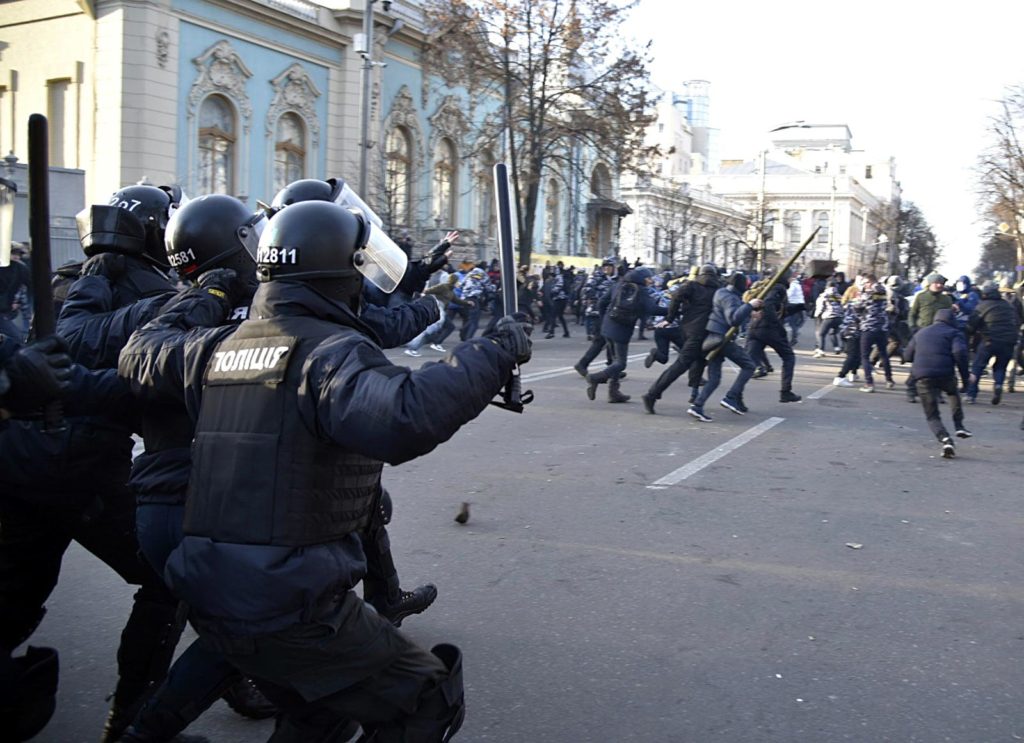
Clashes between police and protesters at the parliament building in Kyiv, Ukraine

What are batons?

Description

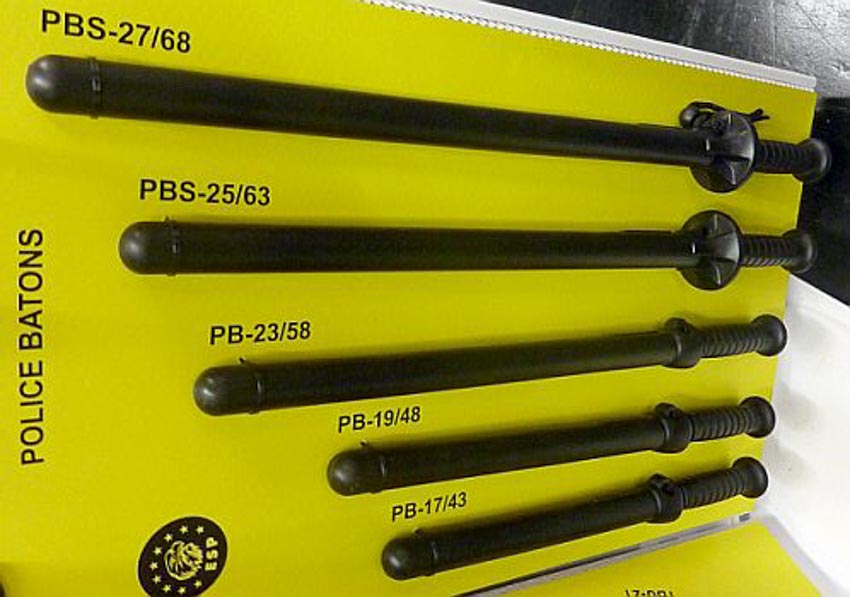
Batons are a type of hand-held kinetic impact weapon (also known as ‘striking weapons’). They are usually made of rubber, plastic, wood, or metal, and can range in size from approximately 20 centimetres to two metres in length. There are three main types of batons:  

  • straight baton,
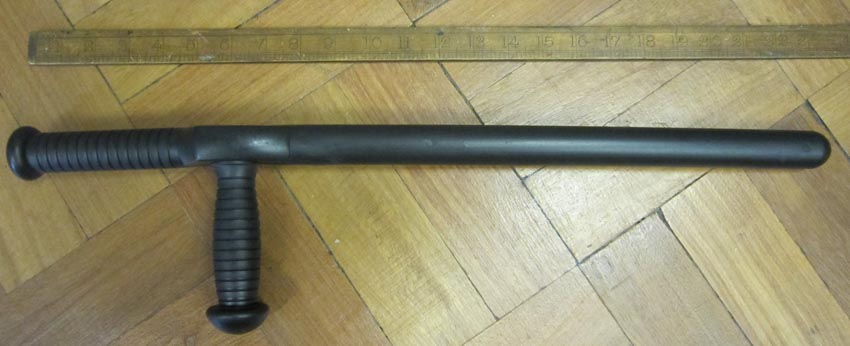
  • side-handle baton (or ‘tonfa’), a straight baton with an added handle on one side, 
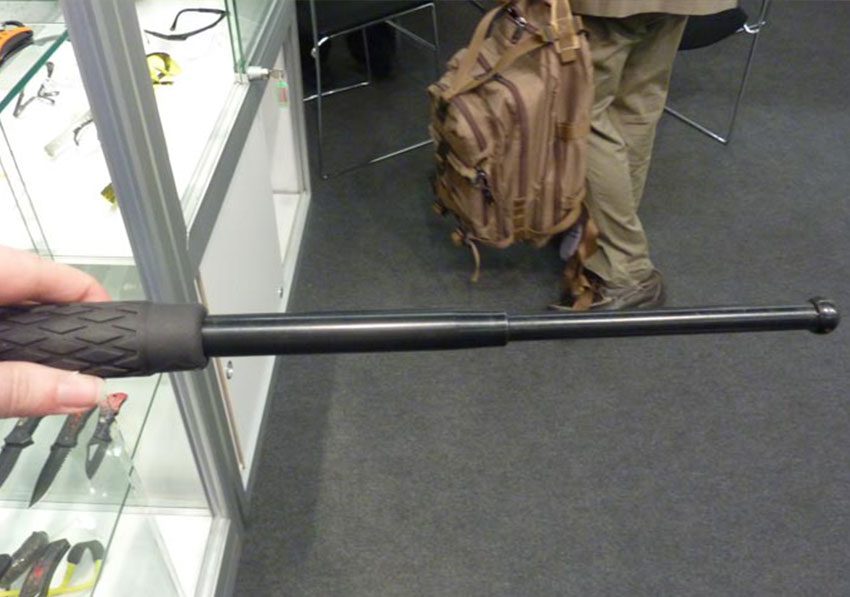
  • extendable or telescopic baton, a baton that can extend up to two or three times its retracted length.
Side-handle baton
Side-handle baton
Straight baton
Straight baton
Extendable baton
Extendable baton

Intended purpose

Batons are most commonly used to threaten or strike a person, causing physical pain to force the person to either comply or be deterred from an action. They can also be used defensively by law enforcement officials, including, for example, to protect officials from blows from violent individuals. 

Possible health/human rights implications of use in policing

Batons are often misused by law enforcement officials to inflict unnecessary or excessive force through, for example, beating, pushing, or jabbing, which may cause internal injuries or bleeding. Overarm strikes and strikes to the head or other sensitive areas of the body increase the risk of serious injury or death. Batons can be used to lever, apply force to, or crush body parts. Batons are also known to have been misused as a tool of rape or to apply dangerous restraint techniques, particularly neck-holds that may restrict breathing. 

As a rule, batons should be used in a way that does not cause considerable injury, and therefore should be aimed at larger muscles parts such the thighs. Anything more than a single baton strike may amount to excessive use of force. Law enforcement officials must assess (and be able to justify) the need for each single baton strike, something that can only be ensured through continuous training and rigorous certification processes. Repeated baton strikes are likely to be punitive and amount to excessive use of force or even torture or other ill-treatment. Law enforcement officials must be held accountable for any misuse of batons and other forms of force and this requires close supervision and accountability structures. The use of batons in a way that is likely to cause considerable injury and excessive pain, such as strikes to the knees, elbows, wrists and groin areas must be avoided, unless the threat the person presents is at least equally serious and cannot be countered by less harmful use of the baton (or other means). Batons should not be used in a way that bears the inherent risk of serious, potentially life-threatening injury, such as strikes to the head or neck, or by resorting to a neck hold. Such use should, as a rule, be prohibited. Only situations where another life is at risk may justify an exception to this rule, provided there is no less dangerous way of stopping the threat. As with other ways of using force, batons may never be used for the purpose of punishment. 

What are lathis?

Description

A cane or stick usually made from bamboo or other wood. The length, width, weight, and flexibility can vary.

Intended purpose

Use of lathis appears to be restricted to certain countries, notably in South Asia, where they are commonly employed in the policing of public gatherings. Lathis have associations with a history of degrading repressive violence under colonial rule. Like other striking weapons, lathis are used to enforce compliance through pain or the threat of pain and are frequently misused to administer beatings.  

Possible health/human rights implications of use in policing 

Lathis are often misused by law enforcement officials to inflict unnecessary or excessive force through, for example, heavy or sustained beatings including to sensitive parts of the body. In comparison to standard batons, the potential of lathis to split or splinter may increase the likelihood of injuries to those targeted. The human rights implications of baton use in policing discussed above is equally applicable to lathis. 

What are sjamboks?

Description

Sjamboks are a type of heavy and strengthened whip, traditionally made from leather, but now also from plastic. Historically used in parts of Southern Africa for cattle droving, they have been employed in certain countries in law enforcement. 

Intended purpose

Whips, including sjamboks, are used to carry out corporal punishment. In addition, sjamboks are sometimes used as a striking weapon in policing public gatherings. 

All whips, including sjamboks, are inherently abusive and fulfil no legitimate law enforcement purpose. 

Possible health/human rights implications of use in policing

The use of whips such as sjamboks may lead to severe physical pain, mental suffering, and serious injury, including lacerations. It lies in the very nature of these weapons that they are often used for inflicting punishment, including torture or other ill-treatment. 

It is difficult to imagine a way of legitimately using sjamboks or other whips for law enforcement purposes. Given their inherently abusive character they should be prohibited in policing.

What are improvised striking weapons?

Description

In addition to specially manufactured hand-held kinetic impact law enforcement equipment, items such as bats, clubs, metal bars, and rifle butts are sometimes used as ad hoc striking weapons.

Intended purpose

Ad hoc striking weapons are frequently used for unlawful purposes. Officials should only ever use specially designed and tested human rights-compliant weapons and equipment. Police officials must be instructed / required to use equipment and weapons officially assigned to them for the purpose for which it was designed. As a rule, they should not resort to anything else. 

Possible health/human rights implications of use in policing

Law enforcement officials should be equipped with a range of different weapons and equipment, providing officials with various force options. All weapons and equipment intended to be used by law enforcement should be subject to standardised legal review, testing, and procurement procedures, to ensure that they are safe to use and do not violate international human rights law. No such procedures occur for ad hoc weapons, and the risks inherent in their use are therefore unknown but can potentially be grave and life-threatening.

The Path to Global Controls on the Tools of Torture

The following timeline summarises the milestones along the path to establishing global controls on the trade in equipment that can be used for torture, other ill-treatment and carrying out the death penalty. 

Case studies

Striking weapons, such as simple batons, are the most common less lethal weapon used by police forces around the world. Batons can be used legitimately for self-defence or defence of others against violent individuals or against individuals violently resisting lawful arrest. Yet, as these case studies show, they are also often used on persons already under control and / or to punish by inflicting pain and suffering. In some cases this amounts to torture or other ill-treatment. Other striking weapons, such as the sjambok (a type of stiff whip), cause unnecessary pain and injury, are inherently abusive, and should never be used for law enforcement; their manufacture, trade or promotion should be prohibited when intended for law enforcement purposes. 

⚠ Please be aware that the videos in this section contain graphic scenes of violence including law enforcement officials beating individuals.

Case study 1

Violation type

Unjustified and  dangerous head or neck strikes

Location

Hong Kong

Date

September 2019

Description

A young male protester in Hong Kong is repeatedly hit with batons by several law enforcement officers in full riot gear in a Mass Transit Railway (MTR) station. One of the security officers strikes him on the head. He is then restrained on the ground while the officers arrest him.  Bleeding is visible from the side of the head where he was struck.

Amnesty International’s analysis

  • Strikes to the head are dangerous; other options were available to the officers which would not cause such significant injuries. The injuries caused by strikes to the head outweigh the law enforcement purpose of restraining a person.   
  • Where officers are punitively using force that causes severe pain or suffering this will amount to torture. 

Case study 2

Violation type

Excessive use of force

Location

Colombia

Date

April 2021

Description

At least five policemen surround a protester in Colombia, pinning them into a corner outside a branch of Bancolombia bank. One of the officers then takes up their baton and starts striking the protester. No officers intervene to stop the beating. The police officer strikes them with a baton several times, shortly after another officer kicks him.

Amnesty International’s analysis

  • There are extremely limited situations in which the authorities can legitimately use batons at an assembly. In practice, they can only be used in response to violence or a threat of imminent violence.  
  • Baton strikes to the head or neck carry an inherent risk of serious injury.  
  • The use of force was unnecessary and disproportionate to the threat faced and so is a violation of international human rights law.  

Case study 3

Violation type

Strikes while target was restrained 

Location

Belarus

Date

December 2020

Description

Three riot police are leading a protester down some stairs. An officer strikes the protester on the back of the legs even though he is not resisting the arrest. While held by one officer, the protester is struck on the back of the head with a baton and punched in the face and stomach. 

Amnesty International’s analysis

  • Baton strikes while a subject is under control are unnecessary and disproportionate. 
  • This means the strikes were administered punitively, amounting to torture or other cruel, inhuman or degrading treatment or punishment. This is a human rights violation.   

Case study 4

Violation type

Rape/Sexual assault

Location

France

Date

May 2019

Description

Several police officers surround a protester lying on the ground. The protester is being uncooperative with the offices. At one point an officer puts the baton inside the back of the protester’s trousers.

Amnesty International’s analysis

  • Sexual assault with batons amounts to torture or other cruel, inhuman and degrading treatment. It is unlawful and a human rights violation.

Case study 5

Violation type

Beatings as a means of punishment

Location

Myanmar

Date

March 2021

Description

CCTV footage captured during post-coup protests in Myanmar shows a police officer removing what appear to be medical workers from an ambulance. He makes them kneel and then proceeds to beat them with the butt of his rifle. Later in the sequence, more officers appear who then continue to strike the medical workers with batons. 

Amnesty International’s analysis

  • Beatings, with batons or ad hoc striking weapons such as rifle butts, as means of punishment constitute torture or other cruel, inhuman and degrading treatment or punishment. Repeatedly striking a person’s head or neck with a baton is inherently dangerous. Likewise, repeated strikes with rifle butts can result in serious injury. This is a human rights violation. 

The producers/trade

The trade in law enforcement equipment and weapons is international, with many companies promoting and supplying their products to law enforcement bodies within their own countries and to customers worldwide. While global marketing is conducted via the internet, the Omega Research Foundation has documented a large number of specialised arms and security equipment trade fairs and exhibitions. These are held regularly in at least 36 countries, mostly on an annual or biennial basis, in many instances facilitated and supported by the host state. Standard law enforcement equipment, including batons, is regularly promoted at these fairs, but Amnesty International and Omega have also uncovered the promotion of inherently abusive striking weapons such as spiked batons at a number of these events.  

Companies also have a responsibility to respect human rights

Under the UN Guiding Principles on Business and Human Rights all companies have a responsibility to respect human rights. While trade controls relate to state human rights obligations, this does not exempt companies from carrying out their own human rights due diligence to ensure their goods and services are not linked to human rights harms.   

Companies that manufacture, promote or trade in law enforcement equipment must assess and address human rights risks and abuses arising in all aspects of their business, including how clients such as police forces use their weaponry and related services. They should refrain from exporting equipment to forces which routinely abuse it, irrespective of whether they are licensed to export such equipment by their home state. Companies that manufacture, promote or trade in inherently cruel, inhuman or degrading law enforcement equipment and weapons must immediately stop these activities. 

Expert voices

Anja Bienert – Policing and Human Rights Expert, Amnesty International
Michael Crowley – Research Associate, Omega Research Foundation
Mitch Paquette – Advisor, Crisis Evidence Lab, Amnesty International

Recommendations

Amnesty International’s research has documented police forces using a range of equipment and weapons, including tear gas, rubber bullets and pepper spray, in a way that may have constituted torture or other ill-treatment.  

This includes the deliberate and repeated punitive use of striking weapons, often against peaceful protesters, in acts that have caused unnecessary injury and psychological trauma. Some of the acts documented here amount to torture or other ill-treatment and have no place in law enforcement.  

Tighter controls on law enforcement equipment should include robust trade controls.  Amnesty International is calling on states to introduce regulations, or strengthen existing national controls, on the trade in law enforcement weapons and equipment used for torture or other forms of ill-treatment. States should also support the creation of a global, legally binding instrument to regulate the torture trade. 

These measures should prohibit and prevent all trade of inherently abusive law enforcement equipment and weapons, such as spiked batons and sjamboks as well as body worn and direct contact electric shock devices and inherently degrading or painful restraints. All States must also strictly control the export and import of law enforcement equipment and weapons that can have a legitimate law enforcement function but can be readily misused, like standard batons, as well as tear gas, pepper spray and rubber bullets. 

Export licences must only be issued after rigorous assessments of the risk of the equipment being misused for human rights violations. And licences denied where there is a reasonable risk of such misuse.

Recommendation 1

Police use of equipment and standards 

Amnesty International is calling on law enforcement officials to: 

  • Fully respect and conform to the UN Basic Principles on the Use of Force and Firearms by Law Enforcement Officials when resorting to the use of force, including batons.  
  • Facilitate the exercise of the right to freedom of peaceful assembly by avoiding the use of force. Where strictly necessary for maintaining peace and order and protecting human rights, law enforcement offices should use only the minimum force necessary. 
  • Use batons and similar striking weapons as sparingly as possible and only against violent individuals posing significant risks to themselves or others. 
  • Use batons, as a rule, in a way that does not cause considerable injury. Batons therefore should only be aimed at larger muscles parts such the thighs. 
  • Avoid the use of batons in a way that is likely to cause considerable injury and excessive pain, such as strikes to the knees, elbows, wrists and groin areas, unless the threat the person presents is at least equally serious and cannot be countered by less harmful use of the baton (or other means). 
  • Do not use batons in a way that bears the inherent risk of serious, potentially life-threatening injury, such as strikes to the head or neck, or resorting to neck holds. Such use should, as a rule, be prohibited. Only situations where another life is at risk may justify an exception to this rule, provided there is no less dangerous way of stopping the threat. 

Amnesty International is calling on states to: 

  • Ensure that law enforcement officials are properly trained in the policing of assemblies in a human-rights-compliant manner, enabling them to fulfil their duty to facilitate the enjoyment of the right to freedom of peaceful assembly, including through adequate policy, training and demonstrated respect for human rights. 

Recommendation 2

Torture Trade standard setting 

Current efforts to place global controls on the trade in law enforcement equipment and weapons used for torture and other ill-treatment must include the broadest scope of less lethal equipment and weapons possible – particularly those types most regularly abused such as batons. 

Amnesty International is calling on states to: 

  • Introduce regulations or strengthen existing national measures on the trade, which: 
  • Halt all transfers of inherently abusive law enforcement equipment and weapons. 
  • Control transfers of law enforcement equipment and weapons to prevent their acquisition by law enforcement agencies likely to misuse them for torture and other ill-treatment 
  • Support the development of regional and international instruments in this area, including through the current UN process. 
  • Support arguments for the broadest possible scope of law enforcement equipment and weapons to be included in international regulation and for this regulation to be legally binding on all states 

Recommendation 3 

The responsibility of companies  

Companies have a responsibility to respect human rights. This obligation is clearly defined in international standards such as the UN Guiding Principles on Business and Human Rights (UN Guiding Principles) and the Organisation for Economic Co-operation and Development (OECD) Guidelines for Multinational Enterprises. Companies involved in the manufacture of law enforcement equipment have the same human rights obligations as businesses operating in other sectors.  

Amnesty International is calling on companies to: 

  • Undertake human rights due diligence to identify, prevent, mitigate and account for the potential and actual human rights impacts of their products and services. 
  • End the manufacture, promotion and trade in inherently abusive equipment. 
  • Increase transparency around the trade and manufacture of law enforcement equipment by publicly reporting on transfers and identified issues.   

Recommendation 4 

Accountability 

Amnesty International is calling for state authorities to: 

  • Ensure that incidents in which law enforcement use force are adequately recorded and scrutinised to determine whether they amount to human rights violations.  
  • Ensure that all incidents of human rights violations perpetrated by law enforcement agencies are thoroughly, effectively and independently investigated, and where warranted suspected perpetrators are brought to justice in fair trials without recourse to the death penalty. 
  • Put in place effective mechanisms to provide for adequate reparations for victims of such violations

Take action

STOP THE UNLAWFUL USE OF POLICE BATONS 

Around the world, governments are cracking down on protests by misusing police batons. These weapons are being misused as a tool for repression. It is time to end the human rights violations committed with police batons. Take action and call for regulation now.  

Our research shows that batons are misused to beat people as a form of punishment. They are used to strike people when restrained. They are used to deliver unjustified dangerous blows to the head and neck. They are used to commit sexual violence. They are used to inflict torture. All of this must stop.  

Batons are considered a less lethal weapon intended to allow law enforcement officials to avoid having to use more harmful weapons, but our research shows that they are frequently misused, often to punitively cause harm in violation of international law. Despite this, the trade in batons is unregulated. It is time to end the torture trade and demand regulation.  

Sign the petition and call on your government to: 

  1. Effectively and robustly implement the UN Basic principles on the use of force and firearms.  
  2. Investigate and prosecute any unlawful use of batons by law enforcement and security forces. Including but not limited to the following conditions: 
    • Strikes on individuals who are already restrained.  
    • Commission of sexual assault and rape.  
    • Beatings as a form of punishment.  
    • Unjustified and dangerous strikes to the head and neck. 
  3. Support the negotiation of an international instrument to end the torture trade. 

The post Blunt Force: Investigating the misuse of police batons and related equipment appeared first on Amnesty International.
States and pharmaceutical companies have abandoned their human rights commitments in fight against Covid-19

Livestream event from the 48th UN Human Rights Council takes place on 14 September 2021, from 13:00-14:00 CEST

Amnesty International Secretary General Agnès Callamard available for interviews

States and pharmaceutical companies are continuing to fail to uphold their human rights obligations and responsibilities in the fight against Covid-19, said Amnesty International today, ahead of the 48th UN Human Rights Council, which takes place from 13 September to 8 October 2021.

The organization will host a livestream event on 14 September 2021, bringing together diverse voices from civil society and UN bodies to take stock of the pandemic. Top of the agenda will be how states and pharmaceutical companies have failed to put people’s lives ahead of profit, as well as what can be done to by governments, international organizations, and pharmaceutical companies now to beat Covid-19. Panellists will include high-level representatives from the UN High Commissioner for Human Rights and the World Health Organization (WHO).

Agnès Callamard, Secretary General of Amnesty International, who will be hosting the event, said:

“The pandemic has shown time and again how states and pharmaceutical companies have abandoned their human rights obligations and responsibilities in the fight against Covid-19. To compound the devastation wrought by the virus itself, we face the heart-breaking reality that today profit margins and national self-interest trump our most basic right of all – the right to life.

“As the Delta variant rages and cases are on the rise, billions of people in lower income countries have yet to access a vaccine, and tens of thousands are losing their lives to this cruel disease every week. In stark contrast, wealthier countries are vaccinating children and planning broad booster rollouts to the general population. 

“How many more overrun hospitals or patients gasping for breath, desperate for oxygen, in Nepal, India and across parts of Africa and Latin America do we need to see before we say enough is enough? We must stop valuing the lives of some over the lives of others and ensure Covid-19 vaccines are made available to everyone – particularly those in low and lower-income countries where access has been scarce.

How many more overrun hospitals or patients gasping for breath, desperate for oxygen, in Nepal, India and across parts of Africa and Latin America do we need to see before we say enough is enough?

Agnès Callamard, Secretary General of Amnesty International

“It is the human rights obligation of wealthy states to redistribute any surplus doses immediately, while pharmaceutical companies should prioritise deliveries to countries in most need and share their technology and know-how to build resilient and regionally based manufacturing capacity. History will condemn those who failed to put life first. Together with the other panellists, Amnesty International is committed to holding states and companies to account.”

The event will be moderated by Mia Malan, Editor-in-chief and Executive Director of the Bhekisisa Centre for Health Journalism, South Africa.

Panellists will include Agnès Callamard, Secretary General of Amnesty International, high-level representatives from the UN High Commissioner for Human Rights, Dr Peter Singer, Special Adviser to the Director General of the World Health Organization and Jibin Theerthakkuzhi Chalil, National Working Secretary of United Nurses Association in India.

Notes to editors:

The event will take place on 14 September 2021 from 13:00 – 14:00 CEST (12:00 – 13:00 BST).

To join the session and watch the livestream, please contact press@amnesty.org for details.

Please bear in mind that this will be a virtual and multilingual event held on VoiceBoxer, a web-based platform that allows for remote simultaneous interpretation. The languages of the session will be English, French and Spanish.

The post States and pharmaceutical companies have abandoned their human rights commitments in fight against Covid-19 appeared first on Amnesty International.