Reacting to reports that Azat Miftakhov, a mathematician and anarchist activist, was subjected to torture, including sexualized abuse, in a Russian penal colony, Denis Krivosheev, Amnesty International’s Deputy Regional Director for Eastern Europe and Central Asia, said:
“The authorities must urgently launch an independent and effective investigation into these allegations, hold all those suspected to be responsible to account in fair proceedings, and ensure that Azat Miftakhov is protected from further violence, including torture and other ill-treatment.
“Reports that prison staff and inmates were involved in the attack expose a system where violence and cruelty are deployed, encouraged or tolerated by the prison administration as tools of intimidation and coercion. This is often compounded by sexual violence and sexualized threats, which explicitly target LGBTI prisoners and are used more widely – tactics associated with some of the most repressive practices of the GULAG era.
Reports that prison staff and inmates were involved in the attack expose a system where violence and cruelty are deployed, encouraged or tolerated by the prison administration as tools of intimidation and coercion
Denis Krivosheev, Amnesty International’s Deputy Regional Director for Eastern Europe and Central Asia
“Azat Miftakhov’s case is emblematic of the acute risks faced by prisoners singled out by the administration. In May 2023, his intimate photographs were reportedly distributed by members of the authorities among other inmates, thereby seeking to subject him to the cruelty of the informal prison hierarchy, to the harshest conditions and sexual violence at the hands of other inmates.”
Background
On 5 May 2026, the support group of Azat Miftakhov, a former Moscow State University postgraduate, published a detailed account alleging that he was subjected to torture and other ill-treatment, and sexual violence including threats of rape following his transfer to Penal Colony No. 18 “Polar Owl” in Harp, Yamalo-Nenets Autonomous Okrug.
On 21 April 2026, one day after his arrival at the colony, Miftakhov was reportedly unlawfully ordered to perform a cleaning task expressly intended to humiliate him. After his refusal, he was allegedly restrained by staff and other inmates, beaten and struck with a wooden hammer on the soles of his bare feet. He was reportedly then stripped naked and threatened with rape and suffocation, while officers and inmates subjected him to repeated physical assaults. According to his testimony, electric shocks were administered to his toes, with the abuse repeated multiple times when he refused to obey.
Azat Miftakhov has previously reported torture following his first detention in 2019 over his alleged involvement in the 2018 arson attempt targeting an office of the ruling party United Russia in Moscow, which caused no damage.
In September 2025, immediately upon his release, he was re-arrested and charged with “justifying terrorism” over comments he had allegedly made while in detention and was sentenced to a further four years in prison.
Amnesty International strongly condemns the Zambian government for open-endedly “postponing” RightsCon – the largest global tech and human rights conference, which was due to start today in Lusaka and online – after allegedly being pressured by Chinese diplomats.
Conference organizers Access Now have confirmed they believe “foreign interference” was behind the last-minute postponement. According to their statement, officials from Zambia’s Ministry of Technology and Science had communicated that they were under pressure from Chinese diplomats over, among others, the participation of Taiwanese civil society, prior to the Zambian authorities’ decision to postpone the event. In its 29 April statement announcing the decision, Zambia’s Ministry of Information and Media claimed the postponement was “necessitated by the need for comprehensive disclosure of critical information relating to key thematic issues proposed for discussion during the summit…to ensure full alignment with Zambia’s national values, policy priorities and broader public interest considerations.”
“The apparent coercive pressure behind the de-facto cancellation of RightsCon is a clear sign of a growing and dangerous pattern of Chinese authorities abusing their power and influence over other governments to silence dissent and restrict fundamental rights, in particular those of individuals the Chinese state deems as a threat. We strongly condemn these acts, which constitute transnational repression. There must be serious consequences for this kind of state-driven intimidation and political bullying,
Sarah Brooks, the China Director at Amnesty International.
RightsCon is a prominent platform for global dialogue on emerging human rights issues in the digital space.
“The postponement of RightsCon shrinks already limited spaces for global coordination on regulating and governing technology at a time of explosive AI expansion and the deepening entwinement of the tech industry with authoritarian practices and power. This erosion of civic and policy space has real consequences, and it is a loss the world cannot afford,” said Damini Satija, Amnesty Tech Director at Amnesty International.
Over 5000 people from 150 countries and 750 organizations and institutions, were expected to attend the event in Lusaka, Zambia and online to discuss pressing issues at the intersection of technology and human rights. Last year RightsCon was held in Taipei, Taiwan, and co-hosted by the Taiwanese civil society group Open Culture Foundation. Other members of Taiwanese civil society, including E-Ling Chiu, the director of Amnesty International Taiwan, have attended and made presentations at this and prior iterations of RightsCon.
Access Now had been engaged in high level coordination with Zambian government officials since 2024 to organize intricate logistics and coordinate the movement of large groups of participants for the summit in Lusaka. Cancelling the event just days before it was due to begin cannot be justified under these circumstances and will drain an immense amount of resources for civil society and Zambian businesses that would have benefited from the conference.
“We urge all states to step up and support RightsCon by working with Access Now and the global civil society to secure an alternative venue and ensure the conference takes place this year. This is a critical test of political courage. Standing aside is not neutral, it abandons the thousands of civil society actors and the millions of people worldwide whose rights they serve and protect,
Damini Satija
Having nearly successfully suppressed domestic civil society and public debate, online and off, within its borders, the Chinese government routinely engages in efforts to silence critics abroad, including targeting overseas students, dissidents and diaspora groups across Asia, Europe and North America. Amnesty International has documented such practices, which we consider clear examples of transnational repression, including in a 2024 report on the intimidation and restrictions on freedoms faced by Chinese and Hong Kong students overseas. China has also long exerted pressure on countries, intergovernmental bodies and companies around the world to exclude Taiwanese voices, both official and civil society, from multilateral fora and global debates and platforms focused on human rights.
China has also shown itself to be increasingly keen to shape global debates around how existing and emerging technologies should be governed, whether at the UN or in other forums. Meanwhile, numerous credible reports indicate that AI and other technologies have been used within China in connection with serious human rights violations, including against the Uyghur people and other mostly Muslim ethnic groups. As China’s tech and infrastructure investments expand and are exported, so does the risk that these tools may facilitate similar violations elsewhere.
The Zambian government must now explain its role in this fiasco, given that the postponement was reportedly a result of pressure from Chinese diplomats. This episode raises further concerns about the export of authoritarian practices, particularly the support of one government to constrain or silence voices critical of another.
“This is censorship and a direct attack on the rights to freedom of expression, association and peaceful assembly. It is yet another deeply worrying sign of a broader slide towards authoritarian practices, a pattern we are increasingly seeing in other parts of the world,
Tigere Chagutah, Amnesty International’s Regional Director for East and Southern Africa.
“The Zambian government must now urgently address the credible allegations of foreign interference and fully and transparently explain the full reasons behind the postponement of this event. This last-minute reversal also raises serious concerns about the shrinking civic space in Zambia and calls into question the authorities’ stated commitment to civic participation, human rights and respect for their international obligations.”
This did not happen in a vacuum. In Zambia, China’s leverage is reinforced through debt and major infrastructure investments including renovations to Mulungushi International Convention Center, which was slated to host RightsCon. This influence also extends into key economic sectors with Chinese companies playing a significant role in copper mining and amplified by Zambia’s roughly US$ 5 billion debt to China.
Zambia is just three months away from a general election. President Hakainde Hichilema, elected in 2021 on a promise of democratic renewal, has spent recent years enacting cyber laws that have become tools of surveillance and speech repression.
Amnesty International will continue to closely monitor developments as the country approaches these crucial elections.
Background
Every two years, RightsCon brings together the human rights community, policymakers, general counsels, government representatives, technologists, academics and journalists from around the world to address urgent challenges at the intersection of human rights and technology. The event in Zambia was to be the first time it was hosted in Sub-Saharan Africa.
Several China-related themes were on the conference agenda in Lusaka, including Uyghur forced labour in global supply chains, the China-Russia authoritarian nexus, Chinese surveillance, the digital reach of China’s Belt and Road Initiative, cybersecurity “with Chinese characteristics” and the export of authoritarian norms. In addition to Taiwanese civil society, a number of members of diaspora groups, including Hongkongers, Tibetans and Uyghurs as well as mainland Chinese, were expected to attend.
In our increasingly complex world, racism and racial discrimination is still very much alive, with dire consequences for the lives of millions. This demands a clear and shared understanding of how systemic racism is produced, maintained, normalized and reproduced – and how it can be tackled. Learning is a form of resistance: unpacking what connects history to present-day issues and learning from others to challenge racial injustice in their own contexts.
Cindy Hawkins Rada, Amnesty International’s researcher and advisor on racial justice and one of the brains behind a new learning course, explains why racial justice is one of the most important issues of our time and what each one of us can do to make it a reality.
Can you tell me about your role at Amnesty and what it involves?
I am a researcher and advisor on racial justice. My role involves researching how systemic racism manifests in society and constitutes racial discrimination under international human rights law. For example, how migration policies discriminate against groups subjected to racism or how a community has a right to reparations for colonialism and slavery.
I’m currently focusing on how the implementation of migration policies in the Dominican Republic is racist and rooted in legacies of colonialism and slavery, disproportionately affecting Haitians and Dominicans of Haitian descent. I also provide advice across Amnesty International on how to look at human rights issues with a racial justice perspective.
How did you get into this area of work?
I came into this area of work because racial justice is deeply personal to me. I’m a Raizal woman, an Afro-descendant community in Colombia. Having to experience systemic racism and structural inequalities shaped how I understand injustice and human rights. These lived realities taught me that racism is not incidental but deeply ingrained in how our societies function.
Is there a piece of work that has had a lasting impact on you?
In the world we live in, marked by growing exclusion, discrimination, racist rhetoric, and violence, I have found working on a human rights education course on racial justice and human rights to be deeply impactful. What stands out to me is not only the urgency of this context, but also the widespread lack of understanding, and often misunderstanding, of how racism and discrimination operate.
Collaborating with human rights education and regional experts from around the world to unpack questions of systemic racism and exploring how racial justice can be pursued as a human rights issue has been both challenging and transformative. The process pushed me to think critically, to learn from the experience of others, and to make complex concepts as accessible as possible.
What is systemic racism?
Systemic racism refers to the way ideas about racial categories become embedded in the institutions, laws, policies, and everyday practices that shape society. It goes far beyond individual prejudice or isolated acts of discrimination.
When racism is systemic, it is normalized within the structures that govern how resources are distributed, how decisions are made, and how people are treated in areas such as education, health care, migration, policing, and employment. This means that groups subjected to racism can face persistent disadvantages even without overtly racist intent from individuals.
Systemic racism can be internalized in how people see themselves and others, expressed interpersonally in daily interactions, reinforced institutionally, and sustained structurally through historical and social inequalities linked to race, ethnicity, descent, national origin, or skin colour.
What does racial justice entail?
Racial justice entails demanding a world in which we ensure that those who have been subjected to racism can fully enjoy their human rights on an equal footing, where racism and racial discrimination are dismantled. It goes beyond formal equality or treating everyone the same and instead focuses on creating fair and equitable systems and practices, transforming education, healthcare, migration and justice so that everyone has their rights realized.
Racial justice also involves deliberately dismantling the structures and systems that sustain racial subordination and inequality. It means learning from, listening to, and building on the knowledge and struggle of groups and communities subjected to racism that have historically resisted it and fought for equality.
What can you tell us about the course on racial justice? What can people expect to learn?
The course on racial justice and human rights is designed to help people better understand how racism operates systemically and why racial justice is a core human rights issue. It brings together four inspiring voices who share their reflections and recommendations for learners and activists. Whether you’re just beginning or already engaged in racial justice work, their insights can help you think about where to start, how to stay grounded, and how to build meaningful, lasting change.
This course is divided into three modules and should take about 90 minutes of learning to complete. Module 1 provides an overview of systemic racism, Module 2 focuses on racial discrimination, and Module 3 covers how to take action to confront racism and racial discrimination. The course is available in English, Spanish and French.
Why is it important to have a course on racial justice now?
A course on racial justice and human rights is crucial now because racism is increasingly visible in policies, public discourse, and lived realities, while understanding of how it operates systemically remains limited. Human rights education on racial justice becomes a necessary step towards meaningful change.
What did you find most interesting from the experts that took part in the course?
What I found most interesting was learning directly from civil society experts from different regions who have long histories of fighting for racial justice in their own contexts. Their contributions made it very clear that systemic racism does not look the same everywhere. It manifests differently depending on history and social structures.
Their insights, feedback, and recommendations were essential to shape a course that offers a global perspective. This was especially important given that, in reviewing existing online courses on racism, I found many were geographically limited and largely centered on frameworks from the United States and Europe. Collaborating with these experts from the Americas, the Pacific, South Asia and North Africa helped ensure the course is relevant, coherent, and meaningful across different regions of the world.
What is the best way to fight racism in our daily lives?
There are many ways to fight racism in our daily lives. Learning is a starting point: it helps us understand how racism is reproduced structurally and institutionally, and it equips us to question and challenge those systems, not just individual behaviors.
That’s why I would recommend taking the course to explore the many ways people are confronting racism around the world. The course includes concrete examples of antiracist movements in different regions, and four civil society experts share practical recommendations drawn from their experience.
Civilians killed, abducted and tortured in sustained campaign of violence
Islamic State-linked group’s violations amount to crimes against humanity
“The ADF’s violence is contributing to an escalating humanitarian crisis” – Agnès Callamard
Civilians in the eastern Democratic Republic of Congo (DRC) are suffering a surge in human rights abuses committed by Allied Democratic Forces’ (ADF) fighters that amount to war crimes and crimes against humanity, Amnesty International said in a new report.
The acts committed by the Islamic State-linked ADF constitute numerous violations of international humanitarian law, many of which amount to war crimes and crimes against humanity. The attacks are occurring across vast swathes of the eastern DRC, where the Rwanda-backed March 23 Movement (M23) armed group are also involved in largescale attacks against civilians. With international and domestic attention centring on M23’s advances as of early 2025, the ADF has seized on the diversion of troops and focus.
“Civilians in the eastern DRC have suffered extensive brutality at the hands of ADF fighters. They have been killed, abducted and tortured in a dehumanizing campaign of abuse,” said Agnès Callamard, Amnesty International’s Secretary General.
Civilians in the eastern DRC have suffered extensive brutality at the hands of ADF fighters
Agnès Callamard, Amnesty International’s Secretary General
“ADF fighters have raided communities and farms, attacked medical facilities, and looted and burned homes. The ADF’s violence is contributing to an escalating humanitarian crisis. The group’s attacks have increased displacement and disrupted basic services, including access to food, healthcare and education.
“The group’s relentless attacks underscore the extent of insecurity and overlapping crises in the eastern DRC and highlight the urgent need for the government and the international community to intensify efforts to protect civilians and bring those responsible to justice.
“These abuses constitute war crimes which the world must not continue to ignore. As part of widespread and systematic attack against the civilian population, they also amount to crimes against humanity.”
Amnesty International conducted research in North Kivu province in November 2025. In total, 71 people were interviewed, including 61 in-person interviews with direct witnesses and survivors of attacks, civil society members, military and police officials, and humanitarian actors including from the UN.
The Armed Forces of the Democratic Republic of Congo (FARDC) has been battling the ADF for years, with some support from the UN mission MONUSCO. The FARDC and the Uganda Peoples’ Defence Forces (UPDF) began a joint military operation to fight the ADF in November 2021.
“They shot at anything that moved”
Amnesty International documented eight ADF attacks in Ituri and North Kivu provinces. Seven of the attacks took place in 2025, and one was in 2024. Witnesses said that security actors, including FARDC troops in nearby bases, did not always respond or arrived late at the scene of attacks.
While the ADF does attack security forces, their primary target in recent years has been civilians. Fighters deliberately attack civilians not only to steal food, medicines and other supplies, but also in retaliation for military operations.
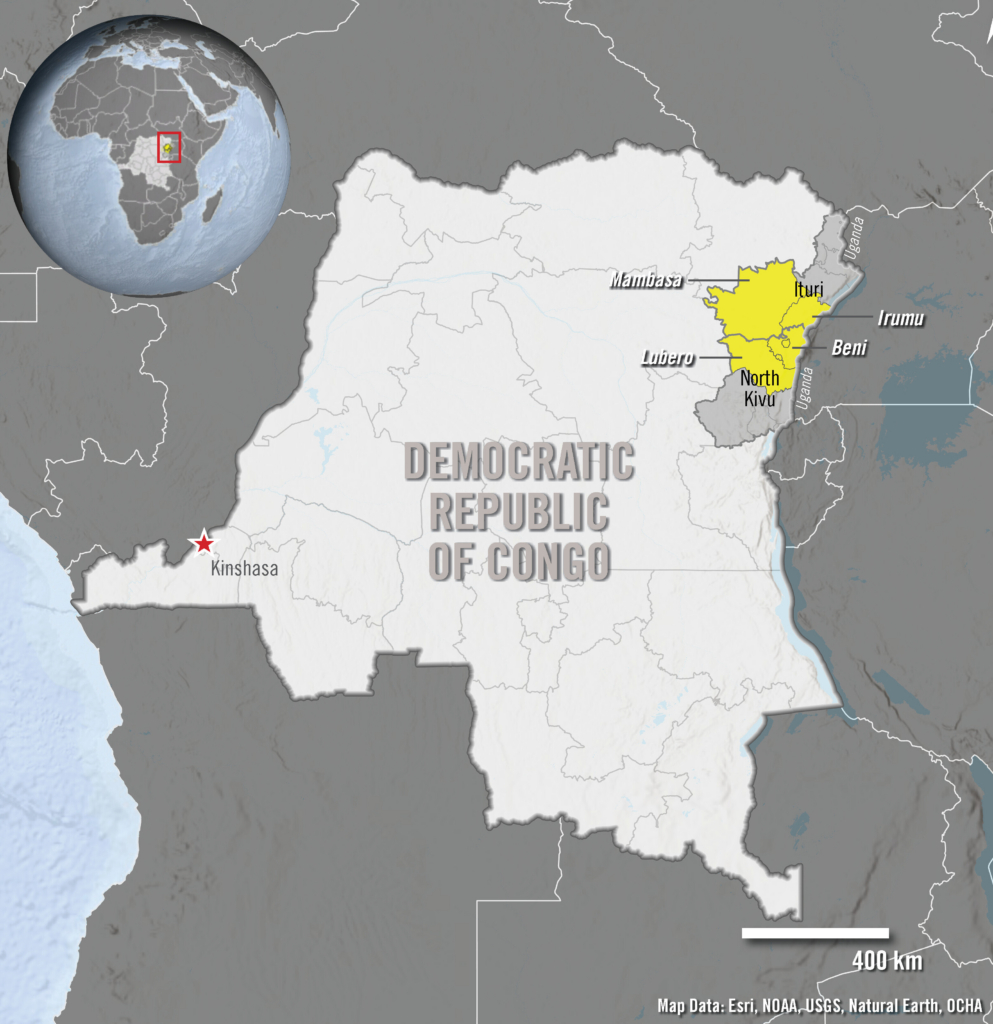
The map shows the four territories – highlighted in yellow – within North Kivu and Ituri provinces where Amnesty International documented abuses by the ADF.
On 8 September 2025, in the village of Ntoyo, ADF fighters disguised themselves as civilians and mingled among mourners attending a wake before suddenly attacking people. The killing spree – using hammers, axes, machetes and guns – left more than 60 people dead amid an absence of security forces.
One witness said he saw fighters kill his sister with an axe. Another witness described how fighters broke into her house and abducted her four daughters. A third witness found the bodies of her parents in the morning; her father had been shot, while her mother had been struck with a hammer. She said: “I’d never seen so many bodies.”
On 12 July 2025, the ADF killed eight people during a raid in Otmaber in Irumu territory in Ituri. One woman told Amnesty International that fighters shot her, her husband, and their seven-year-old son. She said: “After shooting us, they proceeded to burn houses… [My son and] I crawled slowly into a house that wasn’t burned and spent the night there… Even in the morning, [the military] didn’t come. Everyone had to take care of themselves.”
Seros Muyisa / AFP
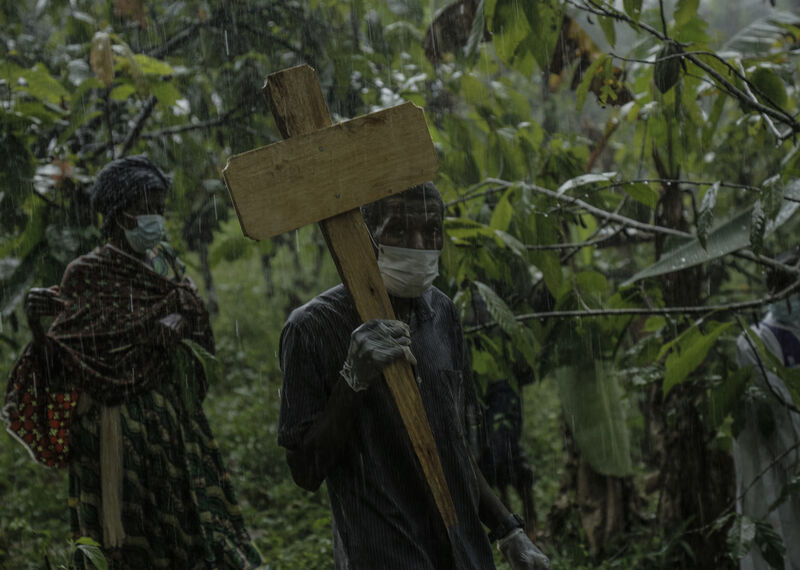
A volunteer holds a cross as a family member follows under heavy rain during a burial ceremony in Ntoyo, on September 10 2025. (Photo by Seros Muyisa / AFP)
The group has also repeatedly attacked health facilities and raided supplies. In November 2025, a health centre in the village of Byambwe was targeted. At least 17 civilians were killed, and four wards were set on fire. An older person who escaped by crawling out of the facility said: “You couldn’t stand; they shot at anything that moved.”
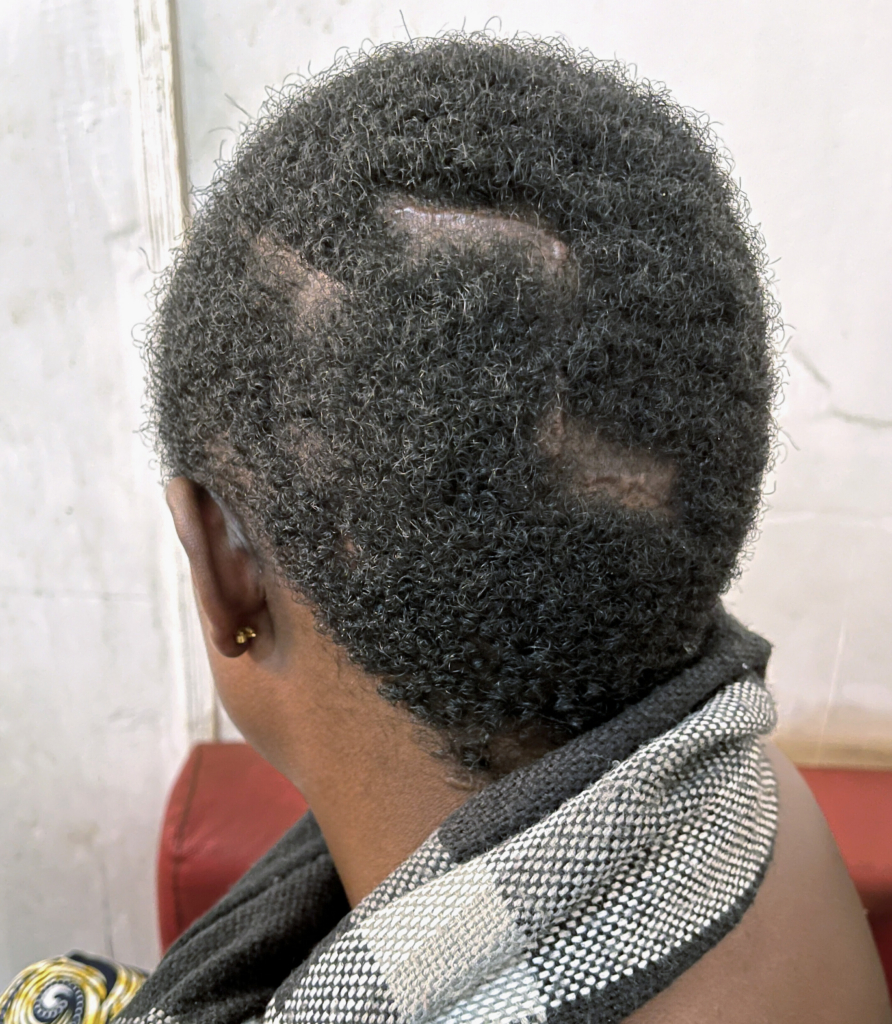
Several witnesses of attacks said they experienced flashbacks and nightmares. One woman survived being hit in the head with a machete, while her child was killed when their house was set on fire in an August 2025 attack. She said: “I have been consumed by fear.”
Another woman who survived the same attack said: “What have we done to deserve these things that are happening to us? How much more must we suffer before this ends?”
Abductions and hostage-taking
Amnesty International documented 46 cases of abduction, including seven cases of hostages held for ransom. Abductees suffered additional abuses and crimes, including forced labour, torture, sexual slavery, and unlawful killings.
Hostages and other abductees were often forced to porter and act as guides for the ADF. Fighters gave them very little food, made them walk for days, and carry heavy loads, all while subjecting them to insults and beatings. Those who showed signs of exhaustion were often killed.
Abductees were moved between camps deep in the forest. Those who were kept for longer periods were compelled to carry out various tasks or face death. This included fetching food and water, cooking, collecting information, picking up deliveries, mining, and performing different tasks during attacks.
One woman who escaped captivity in late 2024 after more than two years told Amnesty International: “They taught us how to kill with weapons and with blades… In the bush, you had to do what you were told. You cannot be weak.”
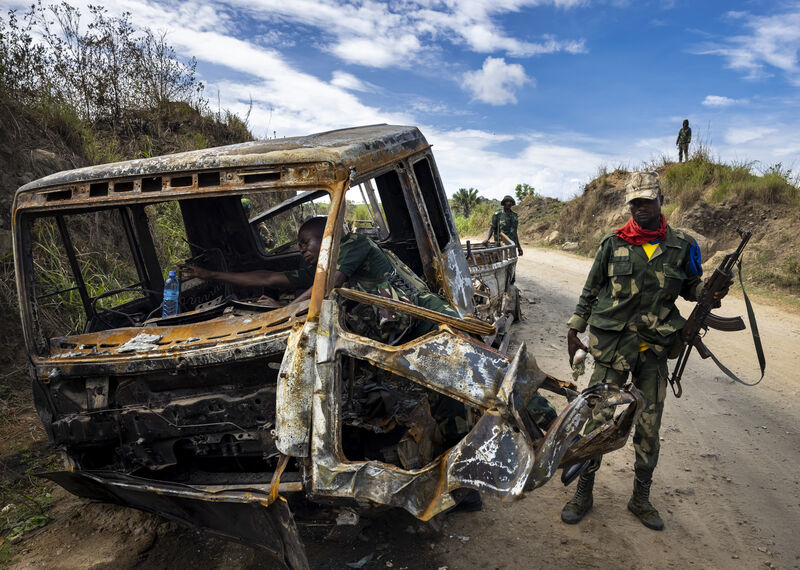
FARDC soldiers inspect the site of an ADF ambush on two vehicles on April 7, 2021 in Mbaou, Beni. (Photo by Brent Stirton/Getty Images.)
Recruitment and use of children
The ADF is listed by the UN among the groups most responsible for recruitment and use of children in the DRC. The group exploits children in various roles, including as fighters, porters, cooks and lookouts. Many former abductees and witnesses said they saw children believed to be as young as 10 participating in the group’s attacks.
Amnesty International interviewed two formerly abducted children, plus three young people abducted when they were children, who were all used by the ADF for various purposes. The interviewees were aged 13-17 when they were abducted.
A young man, who was abducted when he was under 15 and remained in captivity around two years, said: “They put me in a group in charge of looking for food… They preached Islam to us… When it was time to pray, I prayed with them. If you refused, they could kill you.”
A girl who was abducted when she was under 15 said: “They started teaching us Arabic because they were Muslims. After the Arabic lessons they gave us fighting training. When we finished that training, we started taking part in some attacks.”
Subjected to numerous abuses, including torture and other ill-treatment, these children should be viewed as victims first and foremost. They should also afforded additional protections as survivors of trafficking who could not legally consent to their own exploitation.
Violence against women and girls
Amnesty International interviewed five women and two girls who were abducted by the ADF and forced into “marriages”. Witnesses said “extra-marital” relations were not allowed, however, several interviewees mentioned incidents of sexual violence by ADF fighters towards women and girls outside of “marriage”.
Interviews indicate that the ADF gave “wives” – at times multiple ones – to fighters as a recruitment incentive, and that the practice is systematic in the group’s camps. The women and girls were subjected to extended periods of sexual and physical violence.
Women and girls also described being forced to convert to Islam and indoctrinated into the group’s version of the religion. The women and girls said they were explicitly told by women trainers and camp chiefs they had to accept being given “husbands” or face death; several were made to watch the killings of others who refused orders.
One young woman who was abducted when she was a teenager recounted an exchange she had with the camp’s chief: “I said I’m still young. He asked how old I was, and I said 16. He said, ‘That is [old] enough; here we give girls as young as 12 husbands. Either you accept a husband or we kill you’.” She described repeated ill-treatment by her “husband”, who threatened that she would be “slaughtered” if she attempted to flee.
Either you accept a husband or we kill you
A camp chief’s threat to a young woman abducted as a teenager
Six of the seven women and girls who were taken as “wives” said they ended up pregnant as a result of the forced marriages. When these women and girls who are victims of trafficking finally came out of this life of sexual slavery and domestic servitude, they faced suspicions and stigma. One woman said pressure by her in-laws to kill her two children who were born in the bush almost led to her taking her own life.
Several interviewees said they faced severe economic challenges upon release from the group and struggled to access to medical services and specialized care.
Recommendations
Authorities in the DRC must do more to protect civilians, including by working with the UN and local communities, to improve early warning mechanisms and allow for rapid response ahead of attacks. A comprehensive approach to security and justice and accountability, as well as meaningful reintegration programming, are required to address the needs of communities and survivors.
“Survivors told us that peace and security must be urgently restored in the eastern DRC if they are to rebuild their lives,” said Agnès Callamard.
“The Congolese government must take far stronger action to ensure the protection of civilians. The international community must steadfastly support the Congolese state in improving efforts to protect civilians, ensuring justice, and providing long-term, sustainable support to victims and survivors. The disregard in international policy and donor circles to ADF’s expansive threat and crimes will only continue to undermine security and human rights in the eastern DRC.”
Background
The ADF originated in the 1990s in Uganda, as a merger of opposition groups, before taking refuge in Zaire (now the DRC). In 2019, the Islamic State officially recognized a pledge of allegiance by the ADF, and the group ultimately became the Islamic State’s Central Africa Province.
Reacting to the disappearance of Malian lawyer and leading opposition figure Mountaga Tall in the early hours of 3 May, Ousmane Diallo, Senior Researcher on Sahel at Amnesty International’s Regional Office for West and Central Africa, said:
“We are alarmed by the disappearance of Mountaga Tall who was taken from his home by armed men wearing hoods. To date, no one knows if or where he is being held, and if charges have been brought against him. Malian authorities must urgently reveal his fate and whereabouts, and immediately release him or follow due process if he is being accused of any offences.
Authorities must end their restrictions on civic space and attacks on human rights.
Ousmane Diallo, Senior Researcher on Sahel at Amnesty International’s Regional Office for West and Central Africa
“We have observed a pattern of abductions in Mali carried out by agents of the National Agency for State Security (ANSE). Authorities must end their restrictions on civic space and attacks on human rights and uphold the country’s human rights obligations and commitments.”
Background
In the early hours of 3 May 2026, leader of the National Congress for Democratic Initiative (Congrès National pour l’Initiative Démocratique – CNID) Mountaga Tall was abducted from his home in Bamako by armed and hooded men in unlicensed vehicles. In a statement released on 3 May, his family denounced the lack of grounds cited for what they believe is his arrest and the lack of information regarding his fate or detention.
If this abduction was conducted by, or with the support or acquiescence of state agents, it amounts to an enforced disappearance and it places Mountaga Tall outside of the protection of the law and under a high risk of torture or other ill-treatment.
Over the last three years, Mountaga Tall, a key figure in Mali’s political democratization during the 1990s, challenged the dissolution of political parties by the military-led authorities in Malian courts and tribunals, and defended in court several political figures arbitrarily detained.
On 25 April 2026, the armed group the Group for the Support of Islam and Muslims, in coordination with the armed group the Front for the Liberation of Azawad, carried out simultaneous attacks in six cities in Mali, resulting in many casualties, including the Minister of Defence. On 1 May, the military court in Bamako announced that an investigation into the attacks was underway and that several individuals, including politicians and members of the army, have been arrested with further arrests expected.