Syria: Israel’s deliberate destruction of civilian homes in Quneitra must be investigated as war crimes

The Israeli military’s deliberate destruction of civilian homes in Quneitra governorate in southern Syria since December 2024, with no absolute military necessity, should be investigated as war crimes, said Amnesty International today. Israel has an obligation to make reparations for these serious violations of international humanitarian law, which should be tailored towards addressing the specific harms faced by the victims.

On 8 December 2024 – the day the former Syrian government led by Bashar al-Assad fell – Israeli military forces crossed through the Golan Heights, a Syrian territory Israel has occupied since 1967, into three villages and towns located within the UN-Demilitarized zone in the Quneitra governorate in southern Syria, conducting home raids and ordering residents to leave.

Over the following six months, the Israeli military destroyed or damaged at least 23 civilian structures in three villages, which witnesses described as their and their neighbours’ homes and said had the effect of displacing entire families. Amnesty International was able to verify through satellite imagery the damage and destruction to 23 structures in these villages. Witnesses reported that at least two additional homes were destroyed, as well as adjacent gardens and agricultural land, in 2024 and 2025. There were no active hostilities immediately prior, during or after the destruction to civilian buildings. Generally, international humanitarian law applies to any attacks Israel conducts throughout Syrian territory. In areas that Israel occupies, the law of occupation imposes additional obligations, including under the Fourth Geneva Convention.

“The unlawful destruction of civilian property has become a hallmark of Israel’s military operations in the region, documented over the past years in Gaza and Lebanon, and now, as our investigation has established, in Syria as well. Our research has shown how Israeli forces have, repeatedly and deliberately, forced families from their homes and then destroyed them in clear violation of international humanitarian law. Securing Israel’s border cannot be used to justify bulldozing and blowing up people’s homes and villages on the territory of another country,” said Kristine Beckerle, Amnesty International’s Deputy Regional Director for the Middle East and North Africa.

“Families in southern Syria survived a decade-long conflict, many of them having already rebuilt their homes during that period, only to see those homes demolished once again, without any absolute military necessity.”

Amnesty International interviewed eight residents of Quneitra governorate: four whose homes had been demolished, two who witnessed the demolition of their neighbours’ homes, one who had direct knowledge of damage caused by Israeli forces to a governorate building, and a local representative. Interviewee accounts, corroborated by media reports, indicate there were no active hostilities immediately prior, during or after the damage and destruction to civilian buildings in southern Syria. Amnesty International verified 35 videos and images, some of which showed bulldozers demolishing homes or rubble of apparent homes in the villages. It also reviewed media reports, include media based in Israel, statements by the Israeli government, and analysed satellite imagery for each affected area to confirm demolitions within the time frame described by witnesses.

Israel’s pattern of destroying civilian homes in Gaza, southern Lebanon and southern Syria has been carried out with total impunity, displacing and shattering the lives of countless families across the region.

Kristine Beckerle, Amnesty International

Amnesty International identified nine military bases built by Israeli forces since December 2024 in Quneitra and Daraa governorates, both located in southern Syria along the border with the Golan Heights, which Israel has occupied since 1967 and which it unlawfully annexed in 1981. Israel has expanded the portions of Syrian territory it occupies. Some of the documented demolished structures were close to either recently constructed Israeli military bases or to an area where a base was later built in areas beyond the occupied Golan Heights.

Israeli officials have repeatedly made broad claims that their military operations and presence in Syria are necessary to prevent threats from Hezbollah or Iran-linked groups based in Syria or to destroy weapons stockpiles or air defense systems. In December 2025, the Israeli Defense Minister said the Israeli military had no plans to withdraw from newly seized positions in Syria.

On 17 April 2026, the Israeli Prime Minister said that Israel had established a “security buffer zone” whose boundary was marked by what he called the “yellow line”. The zone included parts of Syria where Amnesty International documented civilians’ homes damaged and destroyed. It also included the Israel-occupied Golan Heights and parts of southern Lebanon. The Prime Minister said: “This buffer zone completely removes the near threat of invasion and anti-tank fire. The IDF is stationed there, at the ‘Yellow Line’, to continue defending against the near threat.”

Article 53 of the Fourth Geneva Convention prohibits the destruction of property by an occupying power “except where such destruction is rendered absolutely necessary by military operations”. This prohibition covers not only total but also partial destruction, as well as seizure, of property. The absolute military necessity standard requires that destruction of property be materially indispensable, namely that no other option be available, in the conduct of military operations. In turn, military operations refer to military activities, including movements, manoeuvres and preparation, directly related to fighting or combat.

The absolute military necessity standard does not allow an Occupying Power to carry out destruction of property on the basis of broad or abstract strategic goals, such as deterrence or prevention of future attacks, or to pursue the needs of, or implement security measures. Under Article 147 of the Fourth Geneva Convention, “extensive destruction and appropriation of property, not justified by military necessity and carried out unlawfully and wantonly”, constitutes a grave breach, i.e. a war crime.

The Israeli military entered the UN-Demilitarized zone in Quneitra governorate from the Israel-Occupied Golan Heights, claiming the move was necessary to protect against potential threats. After entering the area, the military began demolishing and destroying homes, despite the absence of active hostilities. The Israeli military also established military positions and bases in the area, and eventually announced the area was part of a “security buffer zone”. Families were displaced and their homes demolished without the provision of alternative shelter, compensation or any timeline for their return.

Amnesty International wrote to the Israeli authorities to ask about the criteria used for deciding which properties would be destroyed, including how they determined whether the absolute military necessity standard had been met, along with other questions. No response had been received at the time of publication.

Amnesty International concluded that the destruction of and damages to civilian structures in southern Syria were carried out without absolute necessity dictated by military operations in violation of international humanitarian law, and amount to grave breaches of the Fourth Geneva Convention.

Al-Hamidiya village and surrounding area

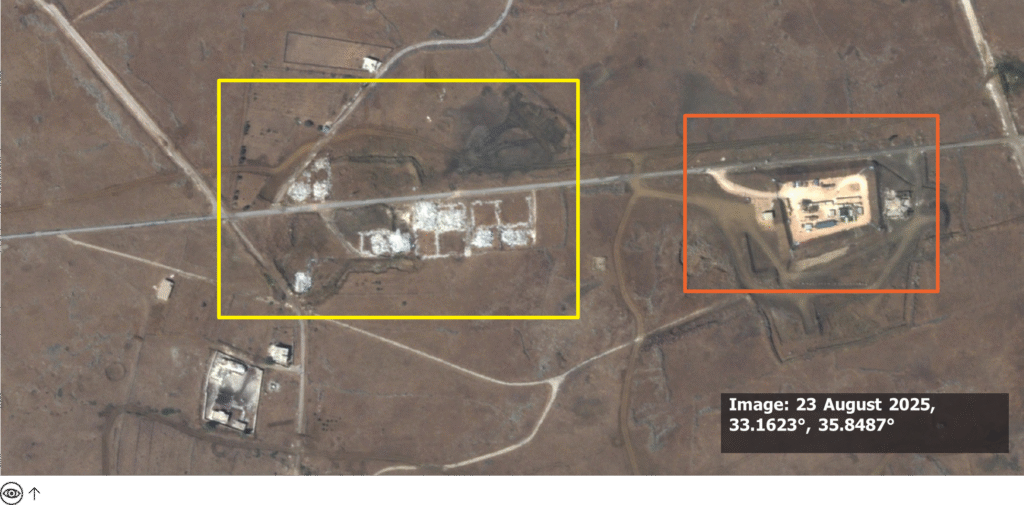
As Israeli soldiers entered al-Hamidiya village on 8 December 2024, two residents told Amnesty International that Israeli soldiers ordered the women and girls to leave their homes at around 11 am while they kept most of the men in their homes for questioning until the afternoon, after which they were allowed to rejoin the women and girls.  Israeli soldiers ordered at least 10 families to leave their homes and move to other parts of the village. Satellite imagery from 17 December 2024 shows new berms have been constructed and, in January 2025, construction of a new base is visible less than 300m east of the affected area.

Two witnesses whose homes had been demolished told Amnesty International that on 16 June 2025 at 9:30pm they saw at least two bulldozers demolishing homes in the village over the course of two days. The bulldozers continued working into the night before stopping and then resuming work early the next day.  A local representative later confirmed to the residents interviewed by Amnesty International, as well as to other families, that their homes had been demolished.

A woman whose home was demolished and garden bulldozed over said: “My husband died during the conflict [in Syria]… He built the house brick by brick. We had a small garden, too. It didn’t give much but enough seasonal vegetables and fruits to save us money on purchasing. My house meant a lot to me and my son… I had a place of my own, and for my son.”

Her neighbour added: “Our home is spacious, next to the house, we have small land with walnuts, pomegranate trees, olive trees and others… everything was bulldozed”. 

High resolution satellite imagery from 23 August 2025 analysed by Amnesty International’s Evidence Lab shows 14 structures and the walls surrounding them were completely destroyed.
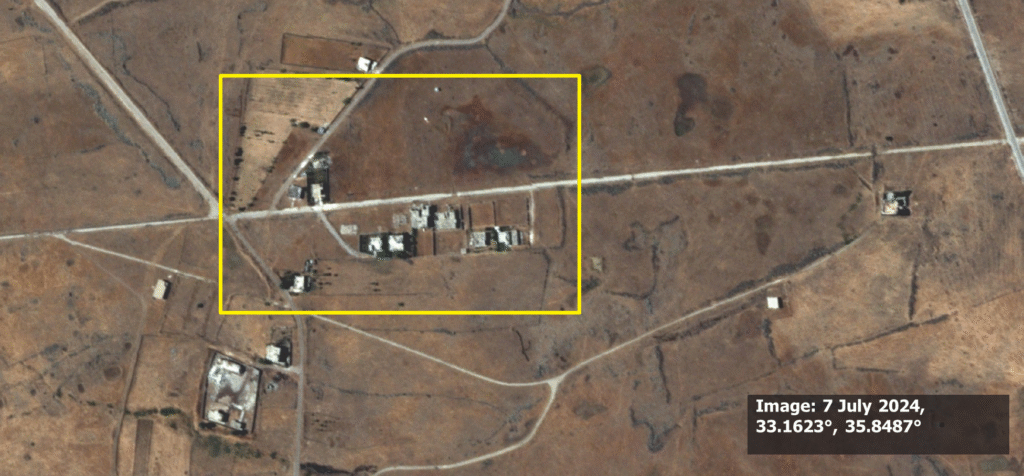
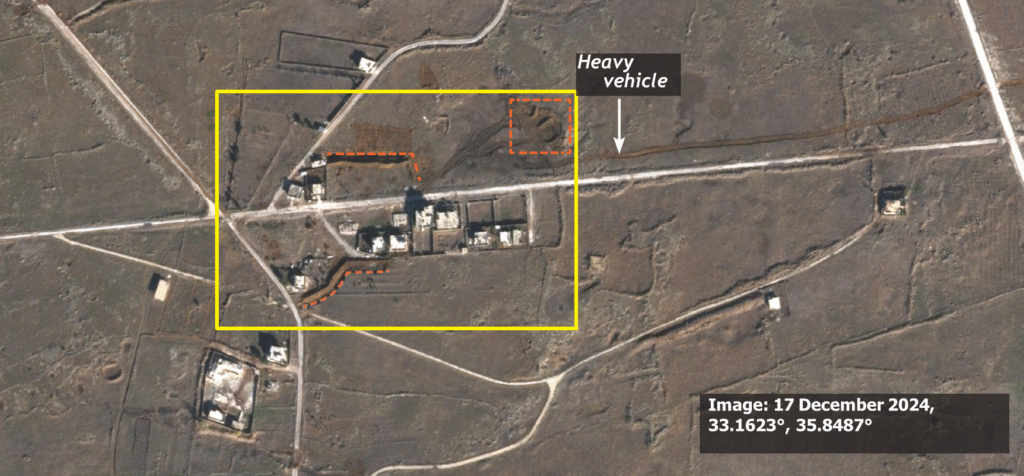
Satellite imagery from 7 July 2024 (top) shows the northern area of Al-Hamidiya before the Israeli military entered. On 17 December 2024 (middle), imagery shows heavy vehicle tracks and new berms, highlighted with orange dashed lines and box. Imagery from 23 August 2025 (bottom) shows 14 structures and the walls surrounding them (located within the yellow boxes on the image) have been destroyed. A new base – highlighted with an orange box – is visible less than 300m east of the destroyed structures. More berms were constructed since December 2024.

Rassim al-Rawadi village and surrounding area

A resident said that Israeli soldiers entered Rassim al-Rawadi village on 8 December 2024 at around 5:30am, detained residents for several hours in the village’s public school and then ordered all of them to leave the village. The families returned around one month later. During that time, at least three homes were damaged and two demolished, the resident said. He added that he saw bulldozers in his village apparently demolishing homes three days after he and his family were forcibly displaced to a nearby village, around 1.5 km away. Amnesty International reviewed videos taken by residents upon their return to their village showing damage and destruction of at least two separate homes.

A resident told Amnesty International that Israeli military forces raided his home and held him, his wife and three children for six hours before ordering them to leave their home. He added that he and the other residents were allowed to return 40 days later, only to find his home reduced to rubble.

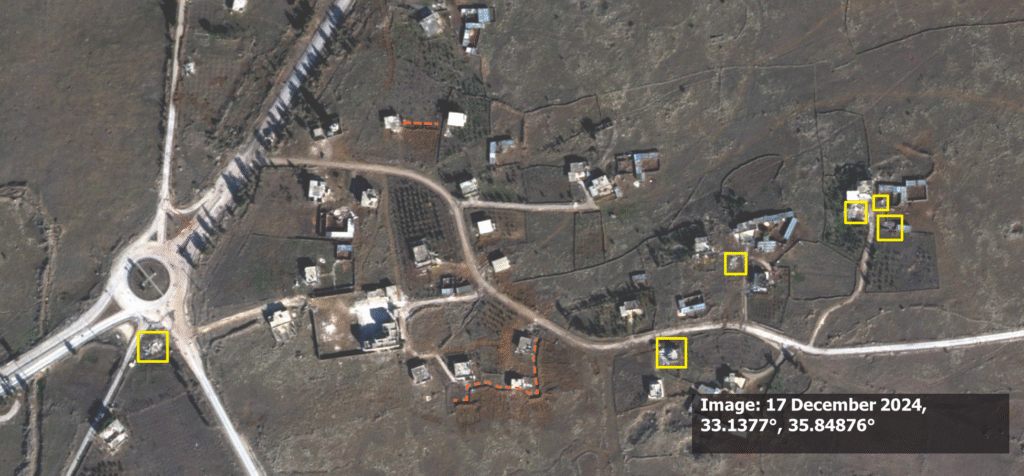
Lower resolution satellite imagery analysed by Amnesty International’s Evidence Lab shows destruction, soil disturbances and trees removed between 10 and 13 December 2024. High resolution imagery captured on 17 December 2024 shows in more detail that six structures across the area appear heavily damaged or destroyed and new berms are visible. Trees on the west side of the main road have been removed. In early January 2025, lower resolution imagery shows clearing for a new military base began approximately 1.5 kilometres south-west of the village, only 300m from al-Quneitra hospital.
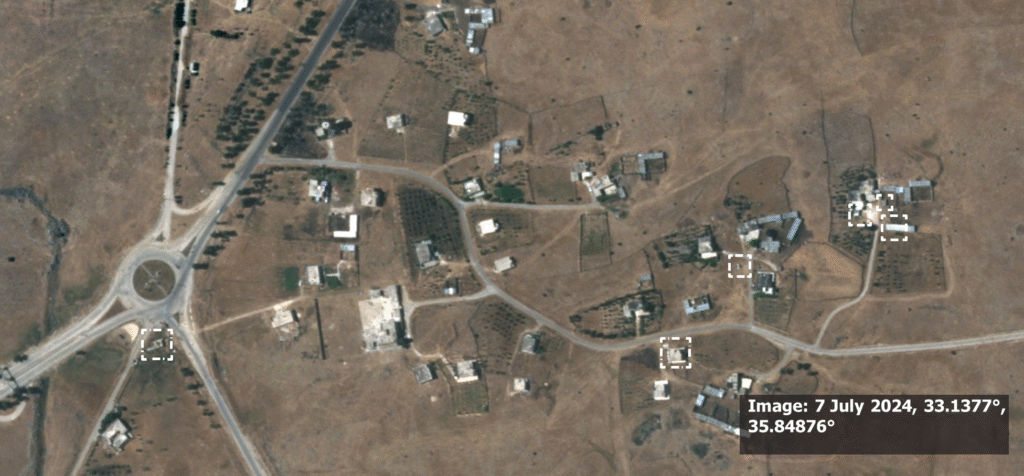
Satellite imagery from 7 July 2024 (top) shows Rassim al-Rawadi village. On 17 December 2024 (bottom), yellow squares highlight six structures that appear heavily damaged or destroyed. Newly built berms are highlighted with orange dashed lines. Trees are removed on the west side of the main road.

Al-Rafeed village

On 20 December 2024, the Israeli forces entered Al-Rafeed village and demolished at least two homes. According to a resident, the families were sleeping at their relative’s home in town, less than a kilometre away, when the demolition happened.

A witness told Amnesty International that the two demolished homes were located around 1.5 km from an Israeli military point in the occupied Golan Heights. He described how he saw the Israeli military forces using a bulldozer and other equipment to destroy the home: “The bulldozer turned the house from bricks to sand in minutes… The two homes belonged to people [two brothers and their families] who were already living in destitution. It was heartbreaking to see them displaced, and their home on the ground.”

The Israeli soldiers also demolished a nearby former military base that belonged to the former government of Bashar al-Assad, the resident said.

Lower resolution satellite imagery analysed by Amnesty International shows probable destruction to structures and trees removed between 19 and 20 December 2024. Higher resolution imagery captured on 25 December 2024, shows in more detail that six structures appear destroyed. Amnesty International’s Evidence Lab verified four videos and six pictures, all published on 20 December 2024, showing Israeli soldiers in the village and destroyed concrete structures.
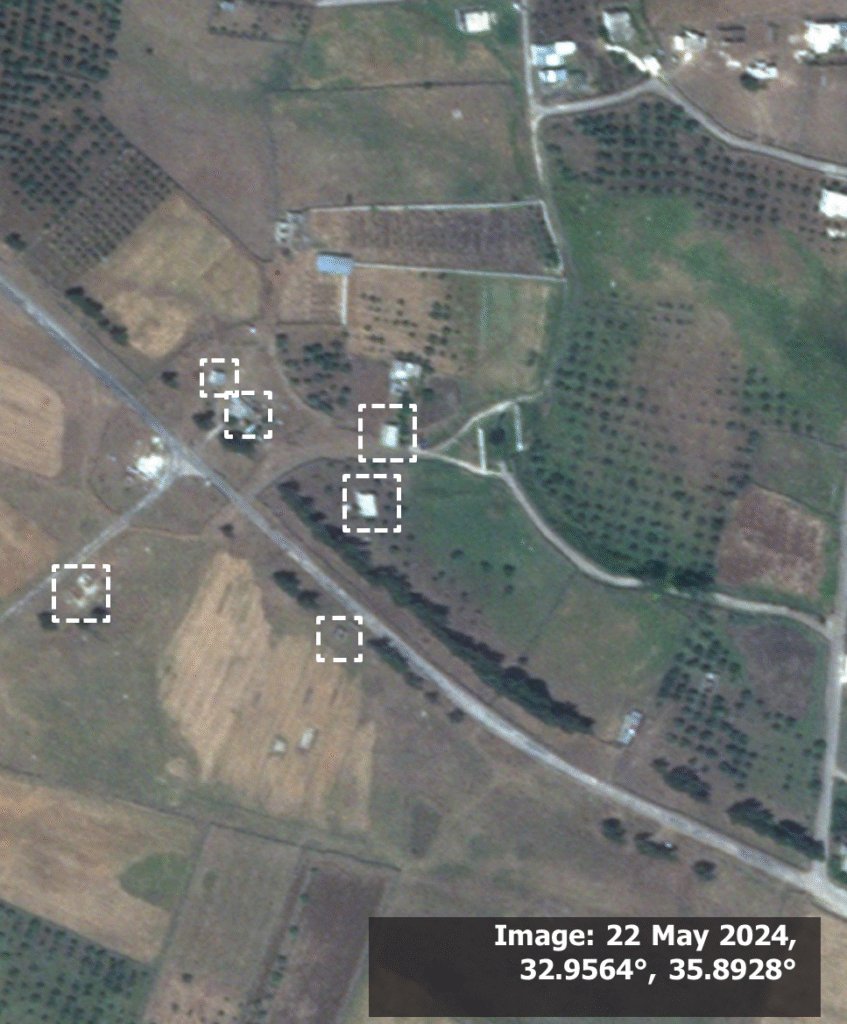
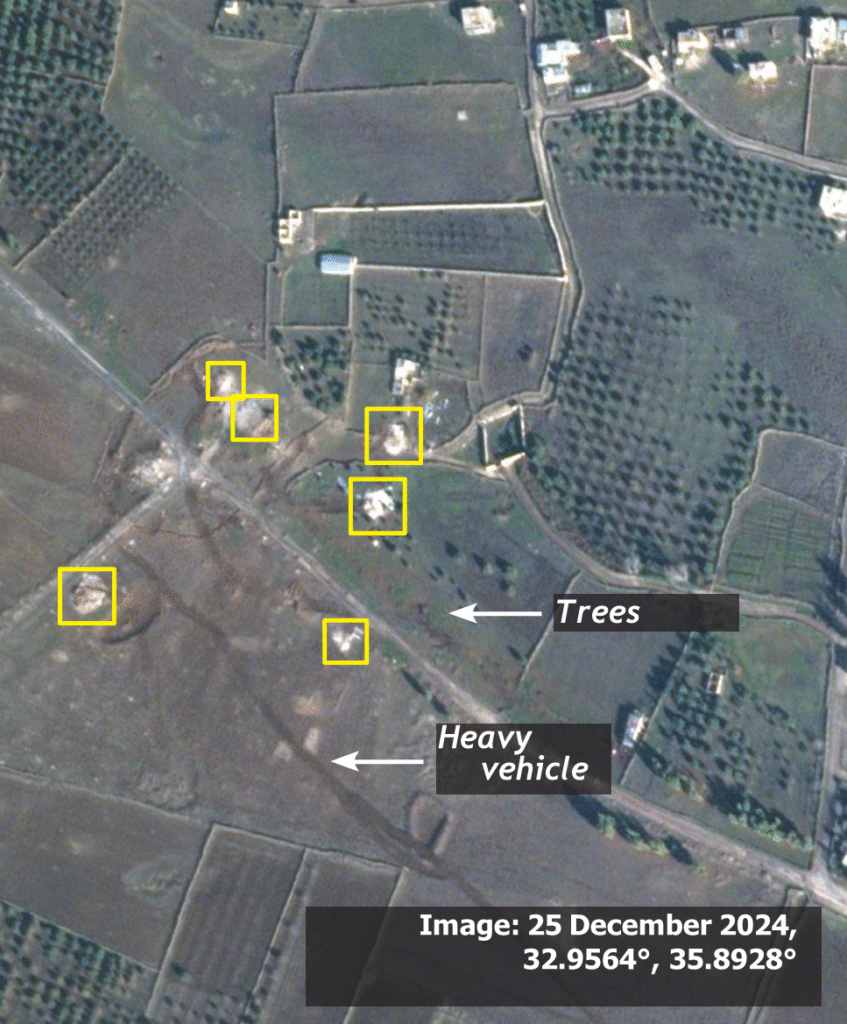
Caption: Satellite imagery from 22 May 2024 shows the western edge of Al-Rafeed village. On 25 December 2024, yellow squares highlight six structures that appear destroyed. Heavy vehicle tracks are visible around the area and many trees lining the road are removed.

“Israel’s pattern of destroying civilian homes in Gaza, southern Lebanon and southern Syria has been carried out with total impunity, displacing and shattering the lives of countless families across the region. The international community must unequivocally condemn these actions and exert real pressure to bring these recurring violations to an end and to prevent further devastation of civilian lives across the region. There must be a demand for accountability for those responsible and reparations for those affected,” said Kristine Beckerle.

The post Syria: Israel’s deliberate destruction of civilian homes in Quneitra must be investigated as war crimes appeared first on Amnesty International.

Algeria: Authorities must release arbitrarily detained journalists and uphold press freedom

The Algerian authorities must immediately and unconditionally release all arbitrarily detained journalists targeted for exercising their right to freedom of expression, including Abdelwakil Blamm, Hassan Bouras and Christophe Gleizes, Amnesty International said today. The call comes ahead of the 14 May trial of Abdelwakil Blamm on bogus terrorism charges, amid the Algerian authorities’ misuse of the criminal justice system to punish independent critical media voices. 

Since November 2025, the Algerian authorities have arbitrarily detained, prosecuted or convicted seven journalists and media workers solely based on their media work or for expressing their opinions. One was sentenced to prison; three were convicted and granted suspended sentences while three others remain in pretrial detention. 

This wave of repression stands in stark contrast to recent government claims. On 4 May 2026, during a ceremony for World Press Freedom Day, Communication Minister Zoheir Bouamama highlighted government efforts to guarantee freedom of expression “free from any pressure or restriction.”  

The Algerian authorities must stop misusing the justice system to punish journalists solely for carrying out their work or for expressing critical or controversial opinions. 

Diana Eltahawy, Deputy Regional Director for the Middle East and North Africa at Amnesty International.  

“While senior officials celebrate World Press Freedom Day and publicly commit to upholding freedom of expression, the reality for media workers critical of the authorities is strikingly different. They risk arrest, prolonged arbitrary detention, prosecution on terrorism and national security charges and travel bans solely for writing critical articles or communicating with other journalists and activists,” said Diana Eltahawy, Deputy Regional Director for the Middle East and North Africa at Amnesty International.  

“The Algerian authorities must stop misusing the justice system to punish journalists solely for carrying out their work or for expressing critical or controversial opinions. They must immediately release unjustly detained journalists and allow journalists to express their views without fear of harassment.” 

Abdelwakil Blamm, who is due to appear before the Dar El Beida tribunal in Algiers on 14 May, is accused of “participating in a terrorist organization,” “disseminating false information,” and “undermining national unity.” He has spent over 16 months in arbitrary pretrial detention following his arrest in December 2024. Authorities denied his family information about his fate and whereabouts for a week following his arrest, subjecting him to enforced disappearance. 

Security forces arrested Abdelwakil Blamm as part of a broader crackdown against an online protest movement campaigning for improved socio-economic conditions and an end to repression in the country. Authorities are prosecuting him for expressing support for the movement on his Facebook page, which has 15,000 followers, and for communicating online with other activists and journalists, including individuals designated as “terrorists” by the Algerian authorities. 

Amnesty International reviewed the case file and found that the prosecution presented no evidence of his involvement in any recognizable crimes, in accordance with international law and standards. In addition, the process of designating individuals or organizations as “terrorist” in Algeria remains contrary to international human rights law.  

The crackdown on independent voices had also targeted Hassan Bouras, a journalist and former member of the dissolved Algerian League for the Defence of Human Rights (LADDH), who has been in arbitrary pretrial detention since 12 April 2026.  

Bouras was arrested in front of his family home in El-Bayadh, 400km south of Algiers, and detained without access to a lawyer, which his family could not secure due to financial and geographical constraints. He suffers from cardiac issues, rheumatism, and asthma, which has worsened in prison where other detainees smoke.  

Authorities must ensure that Hassan Bouras, who started an open-ended hunger strike on 3 May in protest at his arbitrary detention, has access to adequate health care, provided in compliance with medical ethics, including the principles of confidentiality, autonomy, and informed consent. 

Hassan Bouras has previously been detained and convicted for his journalistic work on multiple occasions, most recently in November 2022

Other members of the press have faced politically motivated trials, including a foreign journalist.  

In December 2025 authorities confirmed a seven-year prison sentence for French sports journalist Christophe Gleizes for reporting on a football club in Tizi Ouzou and communicating with local football figures, including individuals designated as “terrorists” by the Algerian authorities due to their affiliation with the Movement for Self-Determination of the Kabylie (MAK). 

Media publisher and activist Abdelkrim Zeghileche is being prosecuted in five separate cases on bogus charges including “offending the president” and “publishing content likely to harm to national interest”, based on digital publications protected under the right to freedom of expression such as a Facebook post from 6 December 2025 in which he called for the release of political prisoners. He is expecting a verdict on 19 May in the first of these trials held on 5 May, while his trial hearings scheduled for 6 and 7 May were postponed to 3 and 4 June respectively.  

In a separate case on 30 September 2025, authorities sentenced him to a suspended prison term without a lawyer, following the decision by a prosecutor to refer him to trial immediately following interrogation which did not allow him adequate time, facility and access to information to prepare his defence. 

On 4 December 2025, the Bir Mourad Raïs tribunal in Algiers sentenced journalist Saad Bouakba to a three-year suspended sentence and a fine for “insulting and defaming the symbols of the National Liberation Revolution” and “disseminating false information likely to harm security and public order,” after holding him in arbitrary pretrial detention for a week. The journalist was already under a travel ban and suffering from a chronic illness. 

Saad Bouakba’s conviction was based on an interview he gave to online media channel Vision TV news on 20 November 2025 in which he discussed allegations of unlawful distribution of funds by Algeria’s first president Ahmed Ben Bella. The appeal trial is scheduled for 2 June 2026. 

In a further attack on independent media, the manager of Vision TV was also prosecuted as an accomplice and handed a one-year suspended prison sentence and a fine. The court also ordered the closure of the channel and the seizure of its equipment. Following this prosecution, the channel has stopped posting content.  

The authorities must stop using the criminal justice system as a tool to stifle the press.

Diana Eltahawy.

“Authorities are resorting to overly broad and vague charges such as insulting ‘national symbols’ that infringe on the right to freedom of expression to silence dissent. Insult is not a recognizable offence under international human rights law and imprisonment is never an appropriate penalty for defamation,” said Diana Eltahawy.

The authorities must stop using the criminal justice system as a tool to stifle the press.” 

Journalist Mustapha Bendjama also continues to be harassed by the authorities. In two separate cases in February and March 2026 courts handed him suspended prison sentences based on his journalistic work and critical social media posts including denouncing Abdelwakil Blamm’s detention. Even though a court lifted his four-year-long travel ban in March 2026, on 16 April 2026 border police prevented him from travelling. On 21 April 2026, police briefly arrested him and opened a preliminary investigation against him after questioning him about the sources for his reporting on a 2020 police shooting.  

The post Algeria: Authorities must release arbitrarily detained journalists and uphold press freedom appeared first on Amnesty International.

Poland: Stop cooperating with ICE on unlawful returns of Ukrainians

Amnesty International and Human Rights First today published a joint letter to Poland’s Deputy Prime Minister and Minister of Interior urging an end to the Polish government’s cooperation with the US administration’s unlawful mass deportations of immigrant communities.

According to information gathered by Amnesty International and Human Rights First, US Immigration and Customs Enforcement (ICE) passed through Polish airports and travelled through Polish territory during at least two operations to remove more than 50 people to Ukraine – an active war zone – in November 2025 and March 2026.

Since the letter was sent, a further ICE flight with an unknown number of people on board has landed at Rzeszów-Jasionka Airport in Poland on 30 April 2026, marking another transfer of Ukrainians via Poland.

The organizations call on the Polish Government to stop cooperating with the Trump administration’s anti-immigrant practices and violations of international law, and for reparations to be made to the individuals forcibly removed.

“Poland has stood by Ukraine’s side since Russia began its war of aggression, providing temporary protection to nearly 1 million Ukrainian refugees. Poland should play no role in these unlawful operations that rip families apart, divide communities and put people’s lives at risk” said Anna Błaszczak-Banasiak, Director of Amnesty International Poland.

“Poland has stood by Ukraine’s side since Russia began its war of aggression, providing temporary protection to nearly 1 million Ukrainian refugees. Poland should play no role in these unlawful operations that rip families apart, divide communities and put people’s lives at risk.” 

Anna Błaszczak-Banasiak, Director of Amnesty International Poland.

“Forcibly transferring Ukrainians into an active war zone, where missiles strike nationwide, shocks the conscience and violates international law. Human Rights First staff who have travelled to Ukraine’s frontlines dozens of times since February 2022 can attest that no area is safe. Poland, which has offered generous safe haven to so many Ukrainian refugees, should refuse to facilitate the Trump administration’s cruel forced transfers that send Ukrainians back to life-threatening circumstances,” said Uzra Zeya, CEO and President of Human Rights First.

In the letter, which was sent to the Polish authorities on 17 April 2026, Amnesty International and Human Rights First detail their concerns about two operations from Phoenix, Arizona to Rzeszów-Jasionka Airport. As the Polish authorities have not responded to the letter, the organizations have decided to publish it.

On 17 March 2026, according to data gathered by Human Rights First’s ICE Flight Monitor, two ICE flights landed at the Rzeszów-Jasionka Airport carrying a number of Ukrainian nationals whose whereabouts are currently unknown.  

On 18 November 2025, another ICE flight landed in Poland. The 50 people on board were then taken to the Shehyni-Medyka border checkpoint and into Ukraine. According to media reports, US officials flew the group to Poland and transported them to the Ukrainian border, while Polish officials escorted them across the border.

Further reports state that some of those on board went to the United States  under the Uniting for Ukraine humanitarian programme – established in 2022 under the Biden Administration to provide a pathway for Ukrainian citizens to stay in the United States–  and had pending applications to renew their stay. As a result of their removal, they were separated from family members who remain in the United States.

In a separate incident on 18 August 2025, ICE announced the removal of an undisclosed number of Ukrainian nationals back to Ukraine, posting two photos on X. This post has now been deleted.

Under international law, Poland has an obligation not to expel or return people to places where their lives or freedom could be at risk. Amnesty International and Human Rights First have repeatedly warned that conditions in Ukraine are not currently safe for returns, though large numbers of Ukrainians will hopefully be able to return safely to their country in the future once the situation on the ground changes. Due to the ongoing armed conflict, the UN Refugee Agency, UNHCR, also calls on states not to forcibly return people to Ukraine.  

Amnesty International and Human Rights First are calling on the Polish government to stand for human rights, justice, and the dignity of all people. The government must deny the Trump administration’s cruel and inhumane mass removal campaign any form of facilitation, cooperation or tolerance.

“The Polish authorities must investigate these incidents, ascertain the whereabouts of individuals involved and ensure they are protected from refoulement, treated with dignity, and provided with an effective remedy,” said Anna Błaszczak-Banasiak.

Background

Since 20 January 2025, the Trump administration has launched a widescale attack on migrants’ rights and ability to remain in the United States by ending humanitarian parole programmes and Temporary Protected Status for many nationalities, putting more than 1.5 million people at risk of deportation.

The Trump Administration has also targeted the Uniting for Ukraine (U4U) humanitarian parole programme – which granted 280,000 Ukrainians entry to the United States and is currently indefinitely suspended for new applications. Ukrainians have faced processing issues and delays on U4U related applications. Ukrainians are increasingly in legal limbo without options for status amid rising uncertainty. 

Amnesty International and Human Rights First also recently raised concerns about the use of Shannon Airport in Ireland as a refuelling stopover for unlawful removal flights by ICE.

Note to editors

ICE Flight Monitor is a data-driven initiative that systematically tracks and documents U.S. immigration enforcement flights based at Human Rights First – see ICE Flight Monitor – Human Rights First. Human Rights First is a U.S.-based, non-partisan non-profit, organization that advocates for human rights globally and for U.S. compliance with its domestic and international human rights commitments.

The post Poland: Stop cooperating with ICE on unlawful returns of Ukrainians appeared first on Amnesty International.

Haiti: Drone attacks raise serious human rights concerns and threaten children 

Responding to the latest figures from The United Nations Integrated Office in Haiti (BINUH) on people killed and injured during security operations against armed gangs in Haiti, including drone attacks reportedly supported at times by a private military company, Ana Piquer, Americas Director at Amnesty International, said:

“The use of armed drones in densely populated urban areas sets an alarming precedent in Haiti and places the population, especially children, at direct risk. Their use is resulting in probable extrajudicial executions. Haitian authorities must prevent their unlawful use and clarify who is operating these drones and under what legal framework they are being deployed.”

“The use of armed drones in densely populated urban areas sets an alarming precedent in Haiti and places the population, especially children, at direct risk.”

Ana Piquer, Americas Director at Amnesty International

Amnesty International warned in a public statement that this new pattern of violence is deepening the crisis already devastating children in Haiti. According to the organization’s February 2025 report, children are being recruited by criminal gangs, subjected to sexual violence and killings, and deprived of access to education, healthcare and even the most basic protection.

“Using armed drones indiscriminately against children is simply shocking and profoundly cruel,” said Ana Piquer. “The Haitian state must protect children, not expose them to new forms of violence through the use of lethal technology. While resources are being directed toward militarization, millions of children are living with fear, hunger and without the possibility of attending school. Protecting children must be at the center of any response to the crisis.”

The Haitian state must protect children, not expose them to new forms of violence through the use of lethal technology. While resources are being directed toward militarization, millions of children are living with fear, hunger and without the possibility of attending school. Protecting children must be at the center of any response to the crisis.”

Ana Piquer, Americas Director at Amnesty International

For more information or to arrange an interview, please contact press@amnesty.org

The post Haiti: Drone attacks raise serious human rights concerns and threaten children  appeared first on Amnesty International.

Fermina Stevens: “We want to protect our Indigenous land in Nevada from the dangerous impact of lithium mining”

Fermina Stevens, 57, is a member of the Te-Moak Tribe of Western Shoshone. She was born and raised in Elko, Nevada, USA. Nevada’s stunning landscape of mountain ranges and valleys has been home to Indigenous Peoples for thousands of years. As Executive Director of the Western Shoshone Defense Project, Fermina works to defend her ancestral lands from the negative impacts of mining, which started over 200 years ago.

Here she tells Amnesty International why lithium mining threatens her community, and how it has become emblematic of the way the US government continues to ignore the rights of the Western Shoshone, despite an 1863 treaty that recognizes the community’s vast territory.

Northeastern Nevada, historically, is a gold mining area. I was a kid in the 1980s when I first noticed a gold boom in Elko. The gold mines are about 20 to 30 miles away. Since then, a lot of people have come into town and the town itself has grown.

We didn’t have a Walmart, for instance, before the boom. There has been an influx of people who work the mines, who may not share our community values. It’s hard to get them to understand the negative effects of mining when they really don’t want to hear about it because it affects their jobs and they see it as a threat to their livelihoods.

Over the years, there’s been a lot of backlash from non-Indigenous people. Because it’s a small town, you don’t want to rock the boat so much. But at the same time, we have to share our concerns about the negative effects of mining whether they like it or not, because it’s the reality we’re living in.

It hasn’t been very long since this lithium boom started, it’s only been about five years since we started hearing about critical minerals and mining for lithium. There’s one active lithium mine in central Nevada. But we have two proposed lithium mines closer to Elko – less than 100 miles from the town – that will be starting up in the next one to two years, possibly.

I haven’t heard too much about those mines and their status, but we anticipate they will take up a large amount of our ancestral land.

Our trees will be destroyed

When these mine companies come in, they start doing a lot of tree cutting. A lot of those trees are the pinyon trees which hold our pine nuts, a very valuable food source traditionally. Over the past few thousand years, pine nuts have been the staple of our sustenance.

Water, of course, is always an issue. Lithium mining requires much more water than gold mining. This concerns us, especially when we’re in a drought and living in the driest state.

It’s the cumulative effect of these mining projects that we worry about, because the state of Nevada is just riddled with gold mines, not just current, but previous ones. We know that there’s a lot of pollution in the ground and in the water. Mining started in Nevada around the 1840s – that’s almost 200 years of mining. Any continued extraction is going to have an effect. Lithium mining exacerbates what’s already been done in the past.

Protecting Shoshone territory

The Western Shoshone Defense Project was started by two Western Shoshone elders, Carrie and Mary Dann. They challenged the requirement to pay for a permit for their cattle to graze on land that’s recognized as ours by the 1863 Ruby Valley Treaty of Peace and Friendship.

This treaty, signed by tribal chiefs and the US federal government, recognizes Western Shoshone territory. While it granted certain rights and privileges to the US government, such as the right to explore for minerals, it did not cede any land to the US government, and our community didn’t give up our sovereignty over this territory.

This land is ours – whether people like it or not. We’re trying to protect the land and its resources for future generations.

Fermina Stevens

Within 10 years of this treaty being signed, one of the original signing chiefs went to Washington DC because he knew that the United States wasn’t upholding their end of the bargain on this treaty.

We aren’t being consulted on our land

The Defense Project is still trying to get the US government to respect this treaty and our land rights. We brought our case to theInter-American Commission on Human Rights and the U.N. Committee on the Elimination of Racial Discrimination. Both determined that the human rights of the Western Shoshone were being violated by the US government.

An example of this is the lack of proper consultations about mining activities with the federal government. The United States government has an obligation to consult with the Tribes because we have sovereignty over this territory. But the government isn’t upholding its end of the deal when they send corporations in to carry out the consultations for them, or in lieu of them.

This land is ours – whether people like it or not. We’re trying to protect the land and its resources for future generations. We’re thinking 40, 60, 80 years from now. Will we even be able to practise our spirituality because of the poisoning that is happening to our land and to the water?

A shared Earth and a shared humanity

Humanity to me means that we’re all related, in some way, shape, or form. We might not be related through blood, but we’re related through kinship, not only in our families or communities, but with the Earth. Humanity, to me, is sharing the one thing that we all have in common, and that’s Mother Earth and what she provides for us.

As humans, we need to come together and open our minds and our hearts to what is real. With all the chaos and confusion that is happening politically today, the one thing that is real is the Earth.

And that’s where we need to find common ground.

Amnesty International has released the report, “We’re here to protect Mother Earth: Indigenous Rights and Nevada’s Lithium Boom” focusing on three massive lithium mining projects in Nevada and the impact it is having on Indigenous Peoples.

Learn more about the human rights abuses linked to the energy transition

The post Fermina Stevens: “We want to protect our Indigenous land in Nevada from the dangerous impact of lithium mining” appeared first on Amnesty International.