Responding to the resumption of the trial of activists who organized Tiananmen vigils in Hong Kong, Amnesty International Hong Kong’s spokesperson Fernando Cheung said:
“As closing arguments begin in this trial, the Hong Kong authorities must confront the basic injustice at its heart: commemorating victims of human rights abuses is compassionate, not criminal. Holding people criminally responsible for peaceful commemoration compounds the injustice suffered by the victims of the Tiananmen crackdown.
“Throughout these trial proceedings, Chow Hang-tung and Lee Cheuk-yan have shown remarkable courage and dignity in the face of prosecution. They did nothing but legitimately exercise their human rights in their Tiananmen commemorations.”
Amnesty International’s Deputy Regional Director Sarah Brooks added:
“The prosecution’s case relies on vague, overly broad and arbitrary definitions of ‘subversion’. The charges against Chow and Lee should be dropped, and the authorities must ensure that people in Hong Kong can freely remember the events of 4 June 1989 without fear of retaliation.
“Chow and Lee are prisoners of conscience, incarcerated simply for exercising their human rights, and they must be immediately and unconditionally released.”
Background
The prosecution and defence are scheduled to deliver their closing statements in the trial of Hong Kong’s Tiananmen activists from 18 May 2026.
Chow Hang-tung and Lee Cheuk-yan were among the members of the Hong Kong Alliance in Support of Patriotic Democratic Movements of China (Hong Kong Alliance) charged with “inciting subversion of state power” under the Beijing-imposed National Security Law in September 2021.
They have been held in pre-trial detention ever since, having been repeatedly denied bail, and face up to 10 years’ imprisonment if convicted. Both have been designated prisoners of conscience by Amnesty International.
Authorities said the annual Tiananmen vigil the Hong Kong Alliance had organized since 1990 was evidence of the group “endangering national security”.
Amnesty International has repeatedly raised concerns that Hong Kong’s National Security Law, enacted in June 2020, is being used to target civil society groups, journalists, political activists and academics for actions that are fully protected under international human rights law.
The Tiananmen vigils commemorated the events of 4 June 1989, when Chinese troops opened fire on students and workers who had been peacefully protesting for political reforms in and around Beijing’s Tiananmen Square. Hundreds – possibly thousands – of people were killed. Tens of thousands more were arrested across China in the suppression that followed.
In the 37 years since the crackdown, all discussion of the incident has been heavily censored in China, and authorities have effectively erased it from their version of history.
While commemorating the Tiananmen crackdown was forbidden in mainland China, in Hong Kong crowds reaching hundreds of thousands of people would gather annually in centrally located Victoria Park to peacefully remember those killed. The vigil participants called on the Chinese authorities to reveal the truth about what happened and accept accountability for the atrocity; local government as a practice did not interfere or object.
The last major vigil organized by the Hong Kong Alliance was held in 2019. The Hong Kong vigil was banned in 2020 and 2021, ostensibly on Covid-19 grounds. Since then, the National Security Law has effectively criminalized peaceful protest in the city – including Tiananmen commemorations.
Commenting on Amnesty International’s designation of Ivan Safronov – a former journalist from Russia sentenced to 22 years’ imprisonment on “high treason” charges – as a prisoner of conscience, Marie Struthers, Amnesty International’s Eastern Europe and Central Asia Director, said:
“The Russian authorities have not presented credible evidence that Ivan Safronov committed high treason. They conducted an unfair trial behind closed doors and issued a chilling 22-year sentence, apparently motivated by the desire to punish him for his journalistic work.
“Ivan Safronov’s case is emblematic of the Russian authorities’ assault on independent journalism and freedom of expression. Reprisals against his lawyers and continuing pressure against Ivan to make him reveal his sources show a system determined to silence journalists and punish those defending their rights.
Ivan Safronov’s case is emblematic of the Russian authorities’ assault on independent journalism and freedom of expression
Marie Struthers, Amnesty International’s Eastern Europe and Central Asia Director
“Ivan Safronov is a prisoner of conscience, imprisoned solely for his work as a journalist and for exercising his right to freedom of expression. The Russian authorities must immediately and unconditionally release him, quash his conviction, and ensure that journalists and lawyers can do their work without fear of reprisals.”
Background
Ivan Safronov worked for Kommersant and Vedomosti newspapers, reporting on Russia’s military and technical cooperation with foreign states, Russia’s defence and space industries, corruption and politics. Shortly before his arrest, he joined the Russian Space Agency (Roskosmos) as an adviser to the Director General.
He was detained by Federal Security Service (FSB) officers in Moscow on 7 July 2020 and charged with “high treason” under Article 275 of the Russian Criminal Code. The authorities alleged that he had passed classified information concerning Russia’s defence and security to a representative of a NATO country’s intelligence service.
On 5 September 2022, Moscow City Court sentenced Ivan Safronov to 22 years’ imprisonment. He is serving his sentence in a high security penal colony in Krasnoyarsk, over 4,000 km from his home in Moscow.
The ongoing siege of Bamako is having unacceptable consequences for civilians’ freedom of movement and may lead to serious violations of their rights to food security, health and life, Amnesty International said today, as it called on the Group for the Support of Islam and Muslims (GSIM) armed group to respect international humanitarian law and ensure the safety of civilians.
Three main roads leading to Bamako have been blocked since 28 April, after GSIM, a non-state armed group affiliated with al-Qaeda, announced a siege of the Malian capital. On 6 May, GSIM attacked a convoy of trucks carrying cargo belonging to civilian companies, including fruit, between Bamako and Bougouni. These trucks were not under military escort and were not carrying military personnel or equipment, according to information gathered by Amnesty International.
“Attacks on civilian vehicles with a civilian purpose are unlawful. Under international humanitarian law, all parties to an armed conflict must always make a distinction between civilians and combatants. Attacks directed against civilians or civilian objects, including vehicles and infrastructure indispensable to the survival of the civilian population, are prohibited” said Marceau Sivieude, Amnesty International’s Regional Director for West and Central Africa.
Sieges should not violate the economic and social rights of the civilian population.
Marceau Sivieude, Amnesty International’s Regional Director for West and Central Africa.
A siege against the rules of war
On 28 April, a GSIM spokesperson announced in an online video a siege of Bamako, starting that day. In contrast to the siege announced in September 2025, when fuel trucks supplying Bamako were exclusively targeted, the current siege appears to apply to all trucks going into the capital.
As of 15 May, at least three of the six main roads leading to Bamako and connecting it to regional ports were disrupted by attacks against incoming traffic, cutting off the capital from vital routes for the movement of goods and the supply of provisions to residents. The media and residents Amnesty International spoke to reported on rising prices for certain basic necessities.
“Sieges should not violate the economic and social rights of the civilian population. GSIM must respect the rules of international humanitarian law. They must ensure that the civilian population of Bamako still has access to adequate water, food, and other necessities,” said Marceau Sivieude.
On 5 May, the UN’s OHCHR called for an immediate end to the fighting and urged all parties to uphold international humanitarian law and international human rights law, including by ensuring protection of civilians and civilian infrastructure.
On 6 May, GSIM announced an easing of the siege and said that people seeking healthcare would be allowed to travel to Bamako. Amnesty International has not been able to verify whether this announcement is being implemented.
Unlawful and deadly attack by GSIM on convoy reported by survivor
Amnesty International spoke with the driver of a fuel truck that was targeted during GSIM’s previous siege on Bamako. In September 2025, GSIM announced its intention to block and disrupt all fuel supply towards Bamako from regional ports and attacked several incoming trucks from Dakar on the Kayes-Bamako Road. In November, GSIM announced that fuel truck drivers would be targeted and considered as combatants.
Amnesty International calls on GSIM to immediately cease all attacks targeting civilians, including indiscriminate attacks.
Marceau Sivieude, Amnesty International’s Regional Director for West and Central Africa.
On 29 January 2026, the driver was part of a fuel truck convoy under military escort that was attacked between Diboli and Kayes. Several drivers and their driver apprentices caught while fleeing were executed, according to the driver. “Twenty kilometres from Diboli, we were attacked by jihadists on motorcycles who shot at the convoy. There were more than two hundred of them,” the driver told Amnesty International on condition of anonymity.
“After the attack, three military pickup trucks arrived as reinforcements and the soldiers on board were killed by the jihadists, who then set the pickup trucks on fire.At least 12 drivers and apprentices were captured by the jihadists and held until the following day. They made them dig graves for the few jihadists who died in the ambush and then slit their throats.”
“International humanitarian law must be respected by all parties to the conflict. Amnesty International calls on GSIM to immediately cease all attacks targeting civilians, including indiscriminate attacks. We are calling on the Malian authorities to investigate these abuses as potential war crimes. Victims and survivors of crimes under international law have a right to truth, justice and reparations,” said Marceau Sivieude.
Background
On 25 April, GSIM or Group for the Support of Islam and Muslims, also known as Jama’at Nusrat al-Islam wal-Muslimin – JNIM and the Azawad Liberation Front (FLA) carried out simultaneous attacks on Bamako, Kati, Mopti, Sévaré, Gao and Kidal, targeting military camps and the residences of key Malian politicians and military. In Kati, defence minister Sadio Camara was killed along with several members of his family, after his home was targeted by a vehicle-borne improvised explosive device.
On 6 May, GSIM assailants attacked the villages of Kori Kori and Gomassagou, in Central Mali, causing ‘several losses in human life and property’ according to regional authorities, leaving at least 40 people dead and several persons unaccounted for, according to local sources contacted by Amnesty International.
Reflections from a trans community organizer in Beirut
Y. is a Lebanese transman based in Beirut. He is a senior campaigner on gender justice. Y. is also an artist, writer and community organizer.
When I was a little girl, I took a certain mischievous pleasure in getting under my father’s skin during the men’s World Cup. While we watched the matches together, I would deliberately cheer for Germany, the arch-rival of his beloved Brazil, just to provoke him.
With every World Cup, Beirut, the Lebanese capital, would, and still does, transform into a mosaic of flags draped across balconies, storefronts, and even cars. Spain, France, England, Italy, and of course Germany and Brazil — the two most passionately followed teams. It’s a striking spectacle for a country shaped by so many waves of colonization.
Football was always the thread that bound me to my father, a man of few words. We didn’t talk much, but we shared a quiet understanding: we would watch matches side by side, on television, or sometimes in one of Lebanon’s few stadiums. Football was our language of love.
I was 13 when the whistle blew for the World Cup final between Brazil and Germany on June 30, 2002, at the International Stadium in Yokohama, Japan. I remember our family gathering vividly — uncles, aunts, and cousins of all ages, bursting with the kind of excitement only kids can muster, surrounded by an abundance of food and drinks. In front of that screen, we all became children. There was no difference between young and old, or women and men.
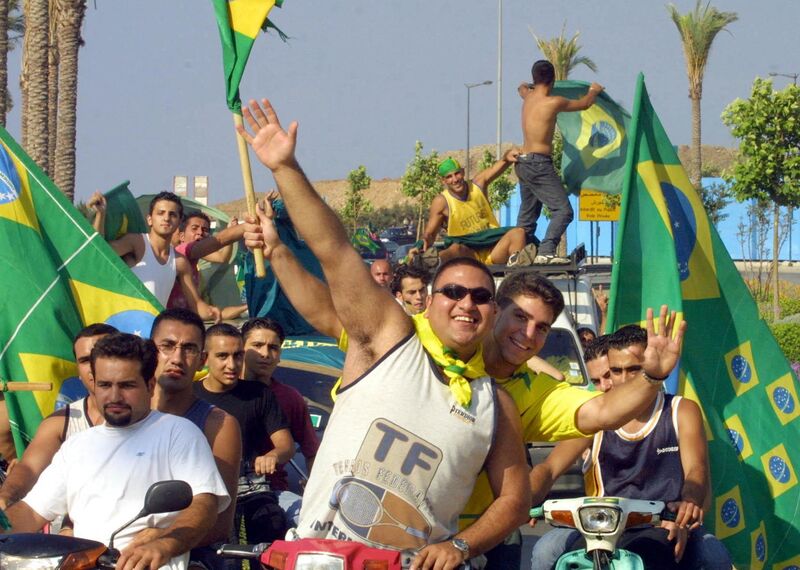
Lebanese fans of the Brazilian soccer team celebrate in Beirut 30 June 2002 after Brazil defeated Germany 2-0 in the World Cup final in Yokohama.
That day, Brazil won its fifth title with two goals. I was left with a quiet bitterness and decided, then and there, to stop cheering for Germany. Why entrust my heart to someone who wouldn’t take care of it?
That same year, I was the only girl at school who not only loved football, but was good at it. Najwa was the only one who could match me. She was a few years older than me, yet we were remarkably similar, both in spirit and in our “tomboyish” appearance.
Finally becoming at home in my body
For years, Najwa and I endured the objections and harsh criticism of teachers, who urged us to stop playing football “like boys”. As girls, we were expected to stay on the sidelines.
But in truth, none of it ever mattered to me. Deep within me lived an unshakeable belief that football belongs to everyone, without exception. I couldn’t understand what all the fuss was about, nor why my father once said, with disappointment and frustration: “You’re a young woman now. Stop playing football like the boys!”
He and my mother tried to steer me toward other passions, like basketball or tennis, sports they deemed “more feminine”. I remember standing there, torn. Should I say to my father, “What’s the difference between a girl and a boy, anyway?!”, or confess to him: “But I am, in truth, a boy, Baba.”
I chose silence.
But at school, I did not stay silent. Together with Najwa, I launched a campaign called “Football for All”, demanding that the administration and the PE teacher form a girls’ team. After a long stretch of mockery and bullying, the school finally relented and assigned Mr Aref to set up the team. But we were given no ball, no time, no real support. Our team became little more than a punchline.
Deep within me lived an unshakeable belief that football belongs to everyone, without exception.
Y, artist, writer and community organizer
Still, I refused to stop playing football. Until one day, I saw Najwa as I had never seen her before, in a pink dress, her hair neatly tied back, long earrings brushing her cheeks. She walked toward me on the field, hesitant, sorrow in her eyes, and said, “My father banned me from playing. I’m sorry.”
That was the last day I ever played football. After that, even my love for the game faded, and with it my excitement for matches and the World Cup.
Everyone around me rejoiced. Only I carried the sadness for years.
For the biggest part of my life, I suffered a deep-seated sense of dread, unexplained ailments, irrational fears and debilitating anxiety. My own gender identity was so well-repressed that I could only “admit” it to myself at 29 years old. Well-surrounded and supported by my queer and feminist friends, I slowly explored my masculinity like a boy going through puberty. First, I tried switching my pronouns to He/Him and loved it. Then with medical supervision, I started my hormonal replacement therapy. In a few months, I was finally home in my body.
Enduring war and loss in Lebanon
I am now a 37-year-old man, living in what is considered a safer part of Beirut.
When the first Israeli shells fell on the suburbs of Beirut, where my family lives, it was around three in the morning on March 2, 2026. I immediately called a taxi to pick up my parents, then stood on the balcony, waiting for them to arrive.
When the car pulled up, they stepped out slowly, exhausted. For the tenth time in my life, I watched them carrying bags filled with their belongings and essential documents, fleeing their home. This time, though, they looked older and needed my help to carry everything upstairs. One question kept circling in my mind: if the war drags on and spreads, will we still be able to reach the hospital for my mother’s treatment? Will there still be medicine?
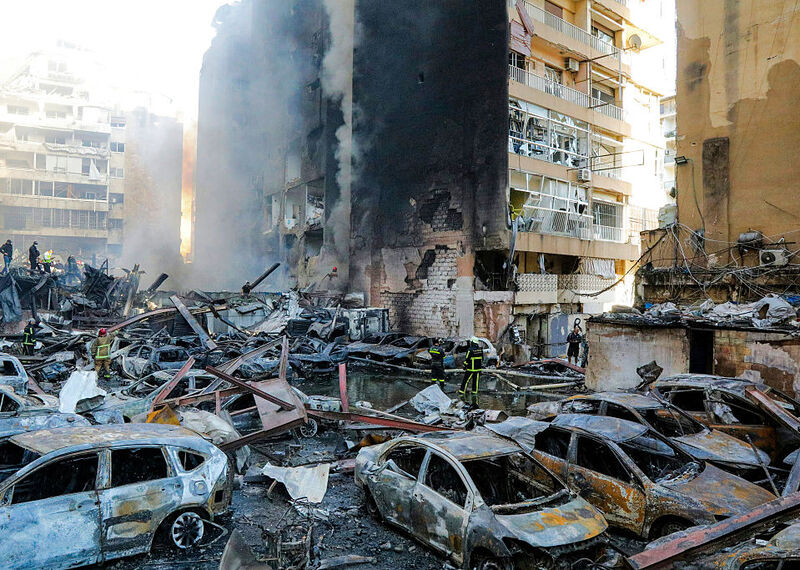
Firefighters attempt to extinguish a fire following an Israeli strike at the Corniche al-Mazraa neighbourhood of Beirut on April 8, 2026.
In the first days, still reeling from the shock of war and its terrifying sounds, I had not fully grasped what it meant to have my parents living with me again, seven years after my gender transition. Our relationship had taken many winding paths, shaped by closeness and distance, acceptance and rejection, acknowledgment and denial, tenderness and estrangement. For years, I had been completely cut off from them while transitioning into myself.
The last time we had lived under the same roof, I was 19. Now, I had to readjust to my mother’s fixation on tidiness, her insistence on aligning the rugs just so, and my father’s habit of monopolizing the couch and the television. The same news and images on loop, as if repetition might soften the grief.
One afternoon, I noticed a stack of papers beside him. The same map, printed three times, one enlarged. Our village and home flattened and reduced to a satellite image. This is the third time my father will lose his land in a single lifetime. Forced out, occupied, erased. Three copies. Three occupations. Repetition never softens the grief.
Family and football should make space for everyone
My parents make me laugh. They have a wonderful sense of humour, even when they don’t mean to.
Warmth fills my home. And then, I catch myself noticing. They get pronouns right, and when they slip, they apologize and correct themselves immediately. We share morning coffee and evening tea, gather around the table for meals that are both delicious and nourishing. They treat my friends with kindness and respect my privacy. And my cats adore them.
I am fully myself, without fear, without hiding, without restraint, and I am met with complete acceptance and love.
Y, artist, writer and community organizer
I feel like a child again, held in a love that is real and, this time, unconditional. I am fully myself, without fear, without hiding, without restraint, and I am met with complete acceptance and love.
The road here was incredibly hard, but that only makes the arrival more beautiful. There is war outside, yes. But after decades, there is finally peace in our home.
Is it a coincidence that my reunion with my family comes just weeks before the 2026 FIFA World Cup, set to take place in the United States, Canada, and Mexico?
Or is it a message from the universe?
My father and I will once again watch football together. It doesn’t matter in the slightest which side he chooses to support or which I do. What matters is that we will be sitting side by side, in the same room, in front of the television, cheering.
Both family and football should make space for everyone. The world and the World Cup belong to all of us. Humanity must win over discrimination, fear and prejudice.
In response to reports that former police chief Ronald ‘Bato’ dela Rosa has fled the Philippines Senate building allowing him to evade an International Criminal Court (ICC) arrest warrant, Ritz Lee Santos III, Executive Director of Amnesty International Philippines, said:
“We are deeply alarmed at the obstruction of justice and chaotic scenes witnessed at the Philippines Senate.
“Ronald dela Rosa’s position as Senator offers him no special protection from an ICC arrest warrant, neither under domestic nor international law. It is hugely concerning that fellow Senators and others appear to have assisted him in evading arrest and in delaying the execution of the arrest warrant – effectively facilitating his escape for now.
“Despite seeking to distance themselves from these events, President Marcos and relevant agencies remain ultimately responsible for ensuring Dela Rosa’s arrest.
“Dela Rosa held a key role in the ‘war on drugs’ under former President Duterte, is a clear flight risk and appears intent on avoiding accountability. He should be promptly located, arrested and surrendered to the ICC to answer allegations of crimes against humanity.
“The place for Dela Rosa to challenge his case and the crimes against humanity he is alleged to have committed is in The Hague, in impartial and independent trial proceedings. Political authority must not place anyone above the law. In the interest of justice for victims, survivors and their families, those alleged to have committed grave crimes must be held to account, no matter how long it takes.”
Background
After a three-day standoff between law enforcement and Senator Ronald ‘Bato’ dela Rosa at the Philippines Senate, reports emerged that Bato left the Senate building at 2.30am local time on Thursday 14 May 2026. His whereabouts are currently unknown.
The night before, gunshots were fired inside Senate premises while some Senators and media were still inside. There remain conflicting reports on what led to the shooting. Various senior administration representatives, including President Ferdinand Marcos Jr, denied that there were attempts to execute an arrest warrant.
On 11 May, the ICC confirmed it had issued an arrest warrant for the sitting Senator. The warrant states that the ICC’s Pre-Trial Chamber found there were “reasonable grounds to believe” Dela Rosa had committed the crime against humanity of murder, citing incidents in which 32 people were killed between 2016 to 2018.