Responding to the assault and torture of a supporter of the opposition Citizens Coalition for Change (CCC) by members of the Zimbabwe Republic Police on 17 March, Muleya Mwananyanda, Amnesty International’s Deputy Director for Southern Africa, said:
This brutal and vicious assault against Godfrey Karembera is meant to intimidate political opposition supporters in Zimbabwe ahead of the upcoming by-elections
Muleya Mwananyanda, Amnesty International's Deputy Director for Southern Africa
“This brutal and vicious assault against Godfrey Karembera is meant to intimidate political opposition supporters in Zimbabwe ahead of the upcoming by-elections. This attack is a chilling reminder of the country’s history of unlawful use of force by police brutality around elections.
“It sends a message to supporters of the opposition that they will pay a price for aligning with the political party of their choice.
“The police claim that Godfrey Karembera, known as Madzibaba Veshanduko, used abusive language against them or tried to deface the statue of Mbuya Nehanda holds no water. Police are trained to enforce the law and not to break it themselves – they must use the proper process to deal with suspected criminals including bringing them to court for a fair trial.
“The police in question must be investigated and those found responsible must be brought to justice.”
Background
Photos of assaulted Karembera appeared on social media on 17 March. Justifying the assault, Zimbabwean police said in a statement that he was “engaging in unsanctioned political activities in the Harare Central District”. Violence against the opposition has been escalating in Zimbabwe in recent weeks.
On 27 February, a gang appeared at Mbizo 4 shopping centre in Kwekwe, to stop the CCC from holding a political rally. The gang allegedly used not only machetes but also beer bottles, iron bars, spears and bricks to attack supporters while Nelson Chamisa, the leader of the CCC, was giving a speech. At least 1 person died and 17 were injured.
A CCC Candidate Thokozile Dube was surrounded by the ruling ZANU-PF militia who assaulted her and destroyed property for failing to withdraw her candidature in Umzingwane constituency. On 26 February, Zimbabwe’s Vice President, Constantino Chiwenga, sent a warning to the CCC, saying the ruling ZANU-PF party would “crush the party like lice”.
Amnesty International’s Crisis Evidence Lab is a multidisciplinary team that uses cutting-edge digital investigation tools to document human rights violations remotely. It helps to ensure that information emerging from conflict areas is timely, accurate and meets the needs of human rights work in crises situations.
This is particularly important in situations where it is dangerous for researchers to be on the ground, and in an era when disinformation and misinformation can spread rapidly.
How does the Evidence Lab work on Ukraine?
The Evidence Lab has been working hard to identify and verify the details of possible unlawful attacks which have killed or injured civilians, and destroyed or damaged civilian infrastructure in Ukraine. This documentation provides essential evidence which can later be used to hold perpetrators of violations accountable.
The Evidence Lab collects audio-visual material and analyzes it for evidence of violations of international law. This material includes satellite imagery, video footage and photos of air strikes and other attacks, and of the aftermath of these attacks, as well as images of weapons remnants. Where possible, evidence is corroborated by interviewing witnesses to the attacks.
Below is a list of attacks by Russian forces in Ukraine which the Evidence Lab has verified to date. Some of these – including strikes on hospitals and schools, indiscriminate attacks which killed or injured civilians, and the use of banned cluster munitions – may constitute war crimes under international law.
Evidence Lab verifying video footage on human rights violations in Nigeria.
Part of Amnesty’s Crisis Response Programme, the Evidence Lab brings together open source and visual investigators, remote sensing experts, weapons analysts, data scientists, developers and other experts to conduct digital investigations and tell the stories of people most affected by conflict.
The Evidence Lab website provides an online space to share best practices, new techniques, resources and guides, helping human rights investigators to take advantage of the vast amount of information which is shared online every day.
How does the Evidence Lab identify attacks to investigate in Ukraine?
The Evidence Lab receives information from a variety of sources, including what is known as “citizen evidence” - material that has been collected by someone other than an established human rights investigator.
This sort of documentation is frequently shared publicly through social media networks such as Twitter, Facebook and YouTube, and often exposes in great detail abuses which might have otherwise gone unnoticed. The Lab also receives evidence directly from witnesses on the ground.
How does the Evidence Lab verify attacks?
Depending on what they are looking for, Evidence Lab researchers use a range of verification methods. These include:
Chrono-location
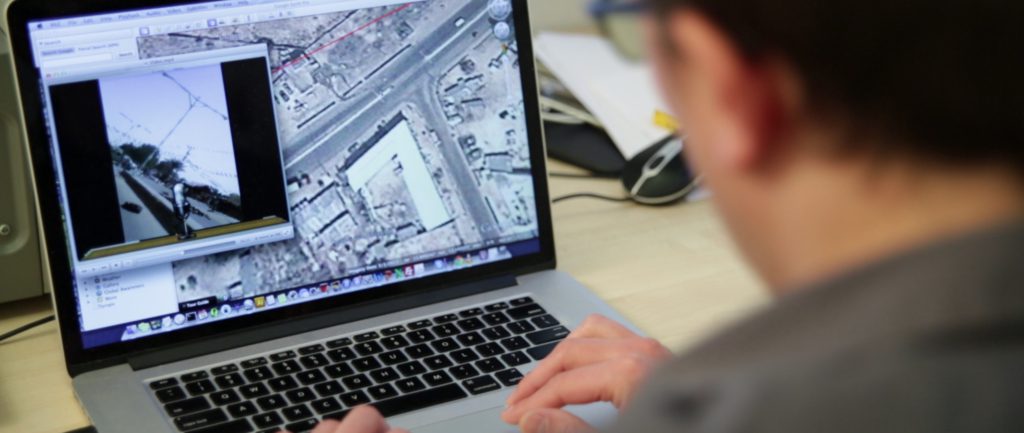
Confirming where and when a video or photo was taken. This can be done by cross-checking the material with satellite imagery, ground level photography and other publicly available information. A researcher can look at the landscape, trees, buildings, and streets in the images, and check if they match with street views or other photos from a known location.
The researchers can also analyze weather patterns and shadows to see if they match the conditions that prevailed when the photo or video was claimed to have been taken.
Remote sensing
The researchers use satellite imagery and other sensors such as Radar and LiDAR to look for tell-tale signs of attacks like destroyed buildings, craters, debris, troop or weapon movements. A bird’s eye view is also important to cross-check and verify potential targets and understand the dynamics of these attacks.
Weapons identification
Amnesty International’s arms experts analyze photos, videos and other data to verify which weapons are being used and if they lead to human rights violations. This could include studying the shape of a crater left by a missile, watching footage of air strikes, or examining photos of weapons remnants. The researchers also analyze weapons trade data to understand ownerships of these weapons
Eyewitnesses
Importantly, the Evidence Lab works with researchers who interview eyewitnesses to attacks and collect testimonies that might corroborate the digital evidence.
Preservation
The Evidence Lab catalogues and preserves all the original evidence, together with all its verification and analysis for accountability and justice mechanisms. We aim to support relevant justice actors, and hand over our evidence to ensure perpetrators are held to account.
Why is it important to verify attacks?
The Evidence Lab works both intensively, documenting individual attacks in great detail, and in a big picture way, looking for broad patterns of violations and building a detailed timeline of events. A key goal is to provide an accurate account of events, combating the misinformation and disinformation that is often rampant during conflicts and other crisis situations.
These documentation efforts are also useful in compiling a log of reliable evidence that could later be used to hold perpetrators of human rights violations to account.
More broadly, we help to tell the stories of people who are directly affected by these crises and to give them a voice.
END THE AGGRESSION
AND PROTECT CIVILIANS IN UKRAINE
Demand that the Russian authorities stop this act of aggression and protect civilians now.
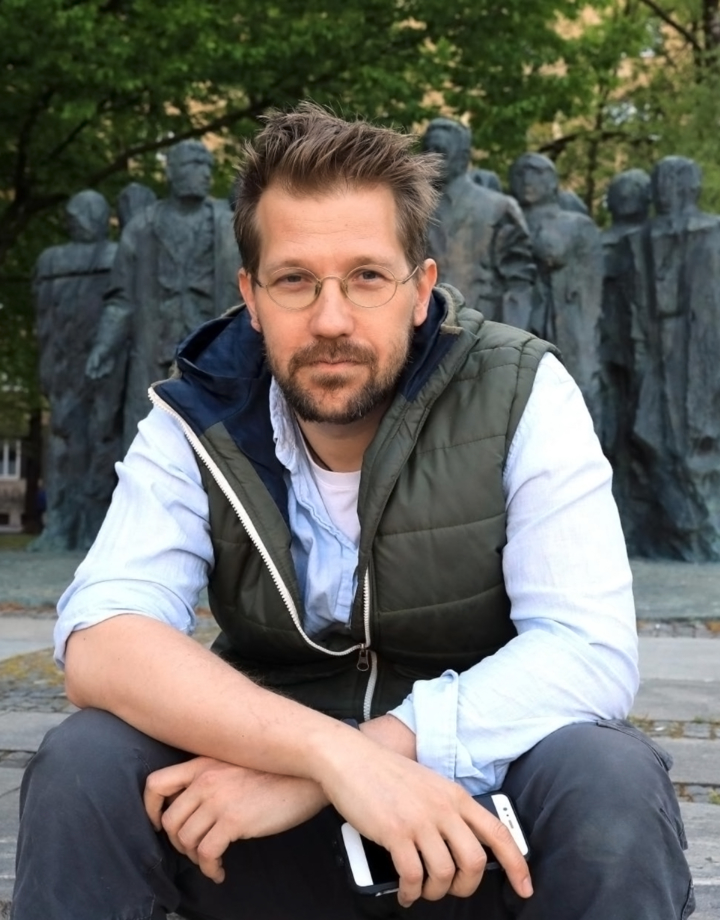
Activist and theatre director Jaša Jenull (PHOTO BY: Private)
Slovenian activist and theatre director Jaša Jenull is being made to pay nearly 35,000 Euros to reimburse the authorities for the cost of policing a protest he attended in June 2020.
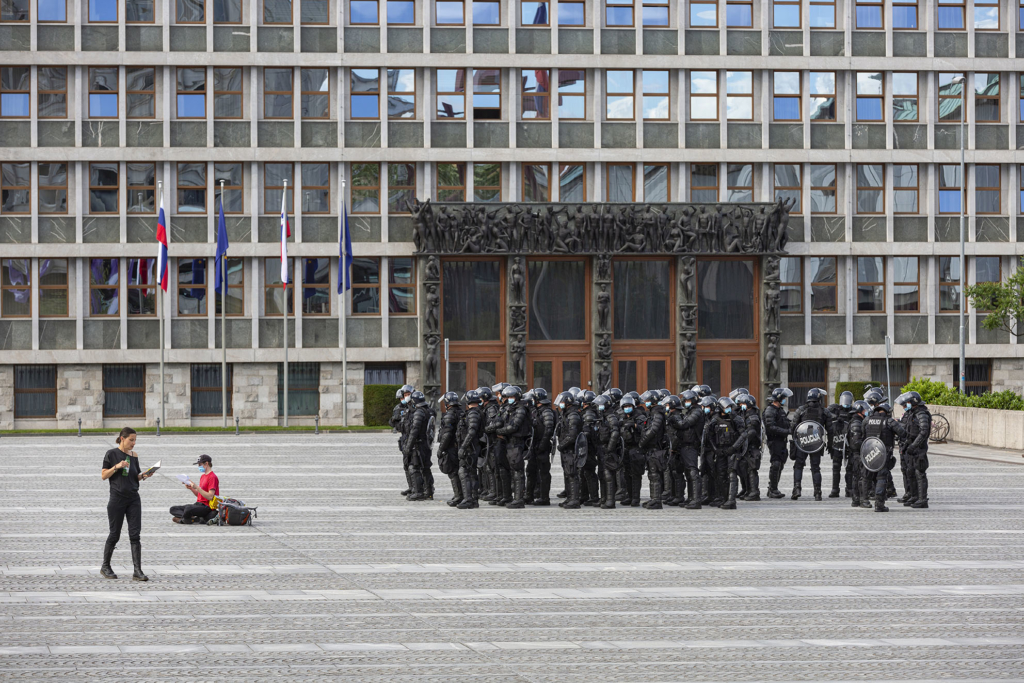
He and several others sat on the ground on the Republic Square to read the Constitution aloud, in protest against broad restrictions on the rights to freedom of expression and peaceful assembly imposed in the context of the Covid-19 pandemic. This action was followed by a further, larger protest by other participants.
Along with two separate proceedings to cover policing costs from previous protests, he now faces a bill of nearly 40,000 Euros. And he’s not alone.
Slovenian authorities have announced they will claim more than 970,000 Euros from peaceful protesters to cover for policing services. To date, 28 claims are already being processed for almost 270,000 Euros.
Making protesters pay the costs of policing demonstrations they attend is an attempt to silence dissent and a clear violation of their right to freedom of peaceful assembly.
Peaceful reading of the Constitution in front of the Slovenian parliament in June 2020. (Photo by Borut Krajnc/Mladina)
The right to freedom of peaceful assembly is protected under various international and regional human rights treaties to which Slovenia is a state party, including the International Covenant on Civil and Political Rights (ICCPR) and the European Convention of Human Rights.
According to these standards, States have an obligation to allow and actively facilitate demonstrations, including spontaneous assemblies. This includes the need to provide adequate services such as security, cleaning services and first aid, which should not be expected to be covered by the organizers nor the participants of the protest.
The Slovenian authorities have tried to justify their claims for policing costs on the basis that the protests were held without notifying the authorities which, according to the police, required additional resources to ensure public safety due to the lack of planning. But under international human rights law, spontaneous assemblies are equally protected under the right to freedom of peaceful assembly.
Attempting to impose financial sanctions on this basis is an illegitimate interference with the right to freedom of peaceful assembly and violates international and regional human rights standards.
It is of further concern that some individuals with more public visibility, like Jaša Jenull, who has repeatedly rejected claims that he was the organizer of the protests, appear to have been particularly targeted by the authorities in an attempt to amplify the intimidatory message to other protesters.
Creeping restrictions on right to protest
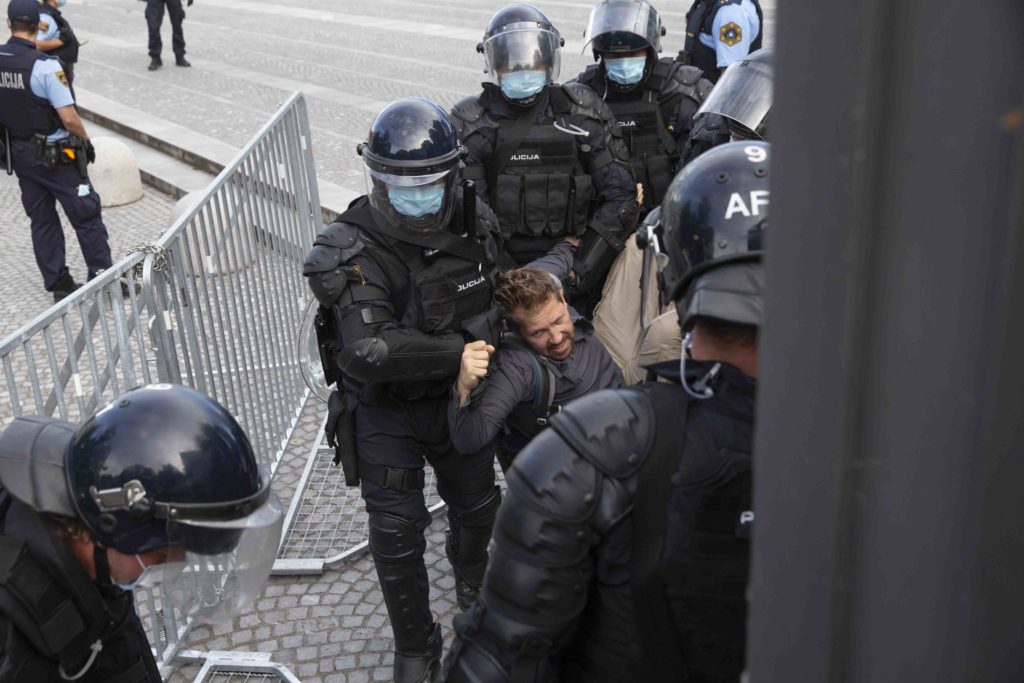
Police forcibly removed Jasa from the square. (Photo by Borut Krajnc/Mladina)
In recent years, concern has been growing over measures taken by the Slovenian authorities to curb people’s participation in protests, including through fines, intimidation, closing public spaces for protests, and imposing a blanket ban on protests for months at end during the Covid-19 pandemic.
As Amnesty International previously pointed out to the authorities, blanket bans constitute a disproportionate restriction on the rights to freedom of expression and peaceful assembly, even when put in place in the context of a public health emergency like that of Covid-19.
Using such blanket bans on protests to now impose further penalties for those who peacefully exercised their rights only compounds the concerns over the growing restrictions aimed at curbing the right to freedom of peaceful assembly in Slovenia.
Creeping restrictions on the right to protest in Slovenia must stop. The authorities must ensure they facilitate the right to peaceful assembly and ensure people can freely join protests without fear of reprisals.
Tell Slovenia to
ENABLE THE RIGHT TO PEACEFUL PROTEST
Starting by withdrawing claims that make peaceful protesters like Jaša Jenull pay back the costs of policing.
Civilians in Izium in Kharkiv Region in eastern Ukraine are on the brink of a humanitarian disaster as Russian forces relentlessly bombard the town, new testimony gathered by Amnesty International has revealed.
Residents of Izium have been under a constant siege-like situation since 28 February, and warned that diminishing food and water supplies have left them at breaking point, as remaining civilians hide in their basements.
Between 9 and 12 March, Amnesty International interviewed 26 residents of Izium, immediately after their evacuation to Svyatohirsk, a town in Donetsk Region that largely remains under Ukrainian control and has been under incessant Russian fire.
The testimonies we have gathered from Izium reveal the terror experienced by the town’s civilian population
Marie Struthers
“Dozens of small towns and villages in Ukraine are under relentless attack, with their desperate inhabitants finding themselves caught in the crossfire or under siege by attacking Russian forces,” said Marie Struthers, Amnesty International’s Director for Eastern Europe and Central Asia.
“The testimonies we have gathered from Izium reveal the terror experienced by the town’s civilian population, trapped in their basements with almost no food or water, and under constant attack.
“Izium and other towns on the frontline now urgently need humanitarian corridors to enable the safe evacuation of civilians wishing to leave, and the delivery of humanitarian supplies to reach those who remain behind.”
Reports of Russian military attacks on Izium first appeared on 28 February, and the town has been exposed to constant rocket fire since 3 March.
Most of the town’s residential areas are cut off from electricity, gas, heating, and mobile communication as a result of attacks. According to the Ukrainian Prosecutor General’s Office, eight civilians, including two children, were killed in strikes on 3 March, which also caused significant damage to the town’s central hospital. Further casualties have been reported since that time.
‘Everything was under fire’
Interviewees told Amnesty International that Russian forces carried out attacks that have killed and injured civilians, and destroyed or damaged civilian infrastructure, including residential houses, schools, kindergartens, medical facilities, and food stores. Some of the attacks appear to have been indiscriminate, and therefore unlawful.
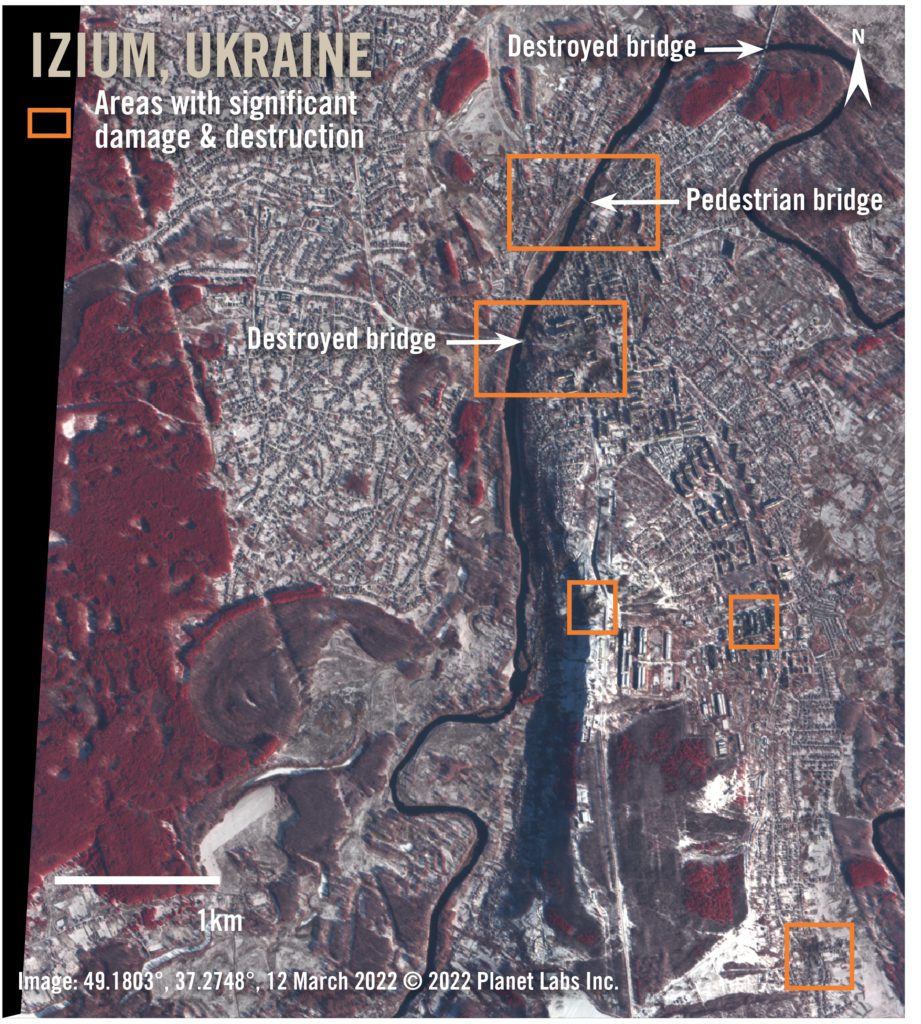
Satellite imagery from 12 March reviewed by Amnesty International clearly showed craters and damage close to locations reported by open street maps as children’s schools and hospitals.
Svitlana, a 72-year-old internally displaced person, has been living in Izium since relocating from Donetsk, which has been controlled by Russian-backed armed groups since 2014.
She told Amnesty International: “When they began to bomb us, on 3 or 4 [March], we couldn’t go outside anymore. Day and night, rockets were being shot… If this continues for a few more days, the people and the town will be finished off.”
Since the attacks began and several grocery stores were closed or destroyed, Izium’s population has been completely dependent on humanitarian aid and personal food supplies. Access to electricity, gas, heating and any form of communication has been cut, and they are also suffering due to lack of sanitation and water shortage.
Tetyana, who stayed in a shelter in the town with her five-month-old baby, said: “When we were leaving [evacuating], there were three five-litre containers left for 55 people. I don’t know how they are going to survive.”
Humanitarian aid and bread have been delivered to the town sporadically. However, due to shortages and the ongoing lack of communications, this has only reached some civilians, mainly those hiding in larger bomb shelters, which are often located in schools.
Interviewees told Amnesty International that people who lived in residential neighbourhoods in individual family houses were struggling to access food as their neighbourhoods were among the most damaged, and most houses had no basement or just a very small basement to seek safety.
Natalia, a resident of a private house, said: “We spent six days in the cellar. It’s very small, you have to stand in it, it’s impossible to lie down. As soon as there was a pause [in attacks], we would quickly run out, and get some eggs from the hens… Our child was hungry, since we hardly ate. All we had was leftover dry bread, apples from the cellar, canned pickles, and jam… We couldn’t get any other food anywhere; we couldn’t leave our house. Everything was under fire.”
Two interviewees said they were caught in crossfire as battle raged in the town’s populated urban setting. One man said that several Ukrainian fighters – who would be considered lawful targets of attack under the rules of war – were based in one of the flats in their building which came under attack. Other Izium residents told Amnesty International that there were no military bases or other military objectives in the vicinity of their bombed-out neighbourhoods.
Humanitarian corridors urgently needed
On 9 March, according to local sources, constant strikes and indirect fire meant that local authorities were able to evacuate only 250 people from Izium, instead of the planned 5,000. On 10 March, a further 2,000 people were evacuated. Along with local authorities, local volunteers and activists used private cars to evacuate civilians. Many civilians, primarily older people and people with disabilities, chose to stay or were not able to leave.
International humanitarian law prohibits deliberate attacks on civilians and civilian objects, as well as indiscriminate and disproportionate attacks. Russian forces must take all feasible precautions to spare civilians and civilian objects.
Ukrainian forces should also take all feasible precautions to protect the civilian population and civilian objects under their control from the effects of attacks. In particular, they should avoid operating from civilian neighbourhoods, where they could draw fire that results in harm to civilians and civilian objects.
In response to reports that Nazanin Zaghari-Ratcliffe and Anoosheh Ashoori have been released from detention in Iran and are about to leave the country, Sacha Deshmukh, Amnesty International UK’s CEO, said:
“This is fantastic news, but it hasn’t come a moment too soon.
“Nazanin and Anoosheh should never have been detained in the first place – they were both jailed on trumped-up national security charges, a familiar tactic in Iran.
“Nazanin and Anoosheh have unquestionably been used as political pawns by the Iranian authorities – and the Iranian authorities have acted with calculated cruelty, seeking to wring the maximum diplomatic value out of their captivity.
“The Government needs to follow up on Nazanin and Anoosheh’s release by immediately renewing its calls for the release of the UK nationals Morad Tahbaz and Mehran Raoof, both of whom are still going through an ordeal all too similar to Nazanin and Anoosheh’s.
“It’s been clear for years that the Iranian authorities are targeting foreign nationals with spurious national security-related charges to exert diplomatic pressure, and it’s more important than ever that Britain works multilaterally to combat this insidious practice.”