Russia: Opposition leader Aleksei Navalny sentenced to 9 years in prison in cynical deprivation of his human rights

Responding to the news that Russian opposition leader and prisoner of conscience Aleksei Navalny has been sentenced to 9 years in prison for his overt criticism of Vladimir Putin and peaceful political activism, Amnesty International’s Director for Eastern Europe and Central Asia, Marie Struthers, said:

“Navalny faces nine years in prison for calling out the Russian elite for corruption and abuse of power. This sentence is predictable but nonetheless shocking. The world must not overlook this sentence and its significance amid the horrific human rights violations we have seen as a result of Russian aggression against Ukraine.

Navalny faces nine years in prison for calling out the Russian elite for corruption and abuse of power. This sentence us predictable but nonetheless shocking

Marie Struthers, Amnesty International’s Director for Eastern Europe and Central Asia

“After surviving an assassination attempt, Navalny was swiftly imprisoned, and his organization was declared extremist in a mockery of justice. Against the backdrop of the Russian authorities’ blatant disregard for international, European and its own laws, many more may face similar injustice.

“I applaud Navalny’s commitment to challenging corruption and other abuses, even in the face of years behind bars. He used the court room to speak agains Russia’s aggression in Ukraine, likely risking additional charges.”

Background

On 22 March, the Lefortovo District Court of Moscow delivered its verdict at a hearing held in penal colony IK-2 in Pokrov, Vladimir Region, where Aleksei Navalny is serving his previous, arbitrary 2.5-year sentence. The court found him guilty of “fraud on an especially large scale” and “contempt of court”. The politician has been accused of siphoning off approximately US$ 25,000 from donations to organizations he founded.

Amnesty International analyzed his case and concluded that this prosecution was politically motivated and based on the arbitrary application of law which wrongfully criminalized Aleksei Navalny.

Aleksei Navalny faces further reprisals from the Russian state. In September 2021 the authorities opened a new criminal case against him and his associates under the trumped-up charge of creating an “extremist association.” The Anti-Corruption Foundation and the Citizens’ Rights Protection Foundation, both founded by Navalny, were arbitrarily officially labelled “extremist” and banned in June 2021.

The post Russia: Opposition leader Aleksei Navalny sentenced to 9 years in prison in cynical deprivation of his human rights appeared first on Amnesty International.

Algeria: End prosecution of activists who exposed torture of a child in police custody

Algerian authorities must drop all charges against five activists facing bogus accusations after they exposed torture testimony, including attempted rape, of a child in police custody, said Amnesty International, on their first trial hearing today.

Hirak movement activists Mohamed Tadjadit, Malik Riahi, Noureddine Khimoud, Souheib Debbaghi and Ahmed Tarek Debbaghi, who have been held in pre-trial detention for almost a year, face prosecution on charges including “publishing fake news”, “undermining the private life of a minor child by publishing a picture that may harm the child” and “defaming public institutions and the judiciary”.  Their arrest came after Tadjadit and Debbaghi published a video on Facebook in April 2021, in which a 15-year-old boy sobs uncontrollably and says that he was sexually assaulted by the police.   

“Despite the fact that this video went viral in Algeria, causing outrage over the reports of torture of a child, including attempted rape, the Algerian authorities’ response was to silence the messengers instead of investigating the reports,” said Amna Guellali, Amnesty International’s Deputy Regional Director for the Middle East and North Africa.

“The charges brought against all five are related to their exercise of freedom of expression in publicizing a child’s testimony. The Algerian authorities must immediately drop all charges, release the five activists and respect their obligations under international law to protect victims and witnesses of torture and other ill-treatment from retaliation.”

The video was taken by Mohamed Tadjadit and Soheib Dabbeghi outside a police station where the minor was detained after participating in a peaceful protest. Several activists waited outside the police station to condemn his arrest and demand his immediate release.  In the video, the minor sobs as both activists ask him if he was sexually assaulted by the police. In a subsequent video, the child confirmed that the police attempted to rape him, and his mother said that she saw them beating him when she visited the station to check on him.

 On 4 April 2021, the police arrested Mohamed Tadjadit in an apartment in Ain Beniane where he was with his friend Malik Riahi. They placed both in police custody before transferring them to prison.

On 5 April 2021, police arrested Souheib Debaghi, Noureddine Khimoud and Tarik Debaghi while they were driving in Barika (Batna). They were transferred to Algiers (Cavaignac police station) in the evening. Three days later, a tribunal in Sidi M’hamed in Algiers ordered their provisional detention in connection with the video.

The Algerian authorities must immediately drop all charges, release the five activists and respect their obligations under international law to protect victims and witnesses of torture and other ill-treatment from retaliation.

Amna Guellali, Amnesty International

During a press conference on 5 April, the public prosecutor of the appeals court in Algiers announced the opening of an investigation into the child’s allegations. On 8 April, the public prosecutor of the appeals court in Algiers, confirmed at a press conference that all five activists were being prosecuted in relation to publishing and sharing that video.  In that conference, the prosecutor discredited the minor’s allegations, saying he was a “drug user” and had a “suspicious relationship” with one of the accused, making homophobic remarks about the five activists, as well as accusing them of exploiting the child for political purposes. He also announced that the authorities had launched an investigation into the ties of the minor as well as the five activists with the political movement Rachad, which the authorities accuse of terrorism. He also accused the five of receiving foreign funding to undermine national unity. 

In a communication to the Algerian government, several UN special rapporteurs expressed “alarm at the reports of police violence, including sexual, on the person of a minor” and at “ the statements of the Public Prosecutor questioning these allegations and accusing the child morally, which is likely to call into question the impartiality of the ongoing judicial investigation.”

“The circumstances of the activists’ arrests, alongside the prosecutor’s hateful and unsubstantiated accusations, point to this being an act of reprisal for the release of the video,” said Amna Guellali.

On 28 February 2022, the five activists started a hunger strike to demand their release or the start of their trial. Mohamed Tadjadit, Malik Riahi, Soheib Debbaghi were subsequently kicked, slapped, and beaten in prison to dissuade them from continuing their hunger strike, according to one of their lawyers, who asked not to be named. The prison administration then transferred all five men from Al Harrach prison to Al Bouira prison at 4 am without showing them or their lawyers a transfer order from the public prosecutor and without notifying their lawyers or families. All five stopped their hunger strikes at different times during the third week of the strike, as their demand for the beginning of the trial was finally met and a date was announced.

As a state party to the UN Convention against Torture, Algeria is legally obliged to promptly and impartially investigate all complaints and reports of torture. The UN Committee against Torture, the expert body charged with overseeing the Convention’s implementation, has emphasized that states must protect victims of torture as well as witnesses and others who intervene on their behalf against intimidation and retaliation at all times.

Background

The Hirak is a peaceful protest movement that started in February 2019 calling for radical political change in Algeria.

The five activists face a trial under charges of insulting a public servant, defaming the judiciary, “publishing fake news”, “corruption of a minor”, incitement of a minor to debauchery under articles 144, 146, 196 bis, 326, and 342 of the penal code, as well as “undermining the private life of a child by publishing a picture that may harm the child”,  and “exploitation of a minor through the means of communication in immoral matters” under articles 140 and 141 of the law on the protection of minors. They are also accused of possession of drugs under law 04-18 of 2004 on drugs.

Mohamed Tadjadit, nicknamed “the poet of the Hirak” for his poems and speeches during the Hirak gatherings, was previously sentenced to 18 months in prison under the charge of ‘undermining national unity’ for his participation in peaceful protests. He spent several months in detention before his release in January 2020.

On 16 March 2022, Malik Riahi was tried separately in relation to the case of whistleblower Mohamed Abdellah on charge of “displaying to the public publications that prejudice the national interest”, which could get him three years in prison. His trial is still ongoing.

The post Algeria: End prosecution of activists who exposed torture of a child in police custody appeared first on Amnesty International.

Myanmar: Momentum for justice as US to label Rohingya crackdown genocide

Responding to reports that the US Secretary of State Antony Blinken is set to announce that Myanmar’s military has committed genocide and crimes against humanity during its violent campaign against the Rohingya minority, Erwin van der Borght, Amnesty International’s Interim Regional Director, said: 

“Nearly five years after 740,000 people were driven from their homes at gunpoint in 2017, Rohingya families and survivors have yet to receive justice for the unimaginable horrors inflicted upon them. Momentum for international justice must be accelerated to end the rampant culture of impunity in Myanmar, where no senior figures have ever faced the consequences of their appalling campaign against the Rohingya people.

“Without accountability, Myanmar’s military will continue to believe it has a blank check to murder innocent people, bomb their homes, and destroy their families. Amnesty International supports the call for the investigation and prosecution of senior military officials for crimes under international law in Myanmar, which include crimes against humanity, war crimes and genocide. 

“The same generals who implemented the authorities’ brazen campaign of bloodshed against the Rohingya seized power in a 2021 coup. In response to a nationwide protest movement, they then turned their weapons on youth protesters in Myanmar’s biggest cities, deploying violent tactics previously used to target ethnic minorities for decades.” 

Background:

The administration of US President Joe Biden is set to formally declare on 21 March that the Myanmar military’s 2017 campaign against the Rohingya amounted to genocide and crimes against humanity. Secretary of State Antony Blinken is expected to make the announcement at the US Holocaust Memorial Museum. 

Myanmar’s military drove out more than 740,000 Rohingya from Rakhine State into Bangladesh in a brutal campaign of extrajudicial killings, arson and sexual assault. An estimated one million Rohingya refugees now live in Bangladesh, and many of their homes back in Rakhine State have been wiped from the map. 

The UN Fact-Finding Mission on Myanmar previously called for Senior General Min Aung Hlaing and other senior officials to be investigated and prosecuted for war crimes, crimes against humanity, and genocide. Min Aung Hlaing seized power in a coup in the early hours of 1 Feb. 2021.  

There are multiple international efforts to provide justice to the Rohingya people, including a genocide case brought by The Gambia against Myanmar in the International Court of Justice (ICJ). A separate case is ongoing in Argentina under the concept of universal jurisdiction. 

Amnesty International has called on the UN Security Council to refer the situation in Myanmar to the International Criminal Court. 

In 2017, Amnesty International’s research in Rakhine State detailed a vicious system of institutionalized discrimination and segregation that severely restricted the human rights of the minority Rohingya Muslims. This system – amounting to apartheid – threatens and undermines freedom of movement, ability to access adequate food and healthcare, and right to an education. 

The post Myanmar: Momentum for justice as US to label Rohingya crackdown genocide appeared first on Amnesty International.
The El Hiblu 3: three years waiting for justice in Malta

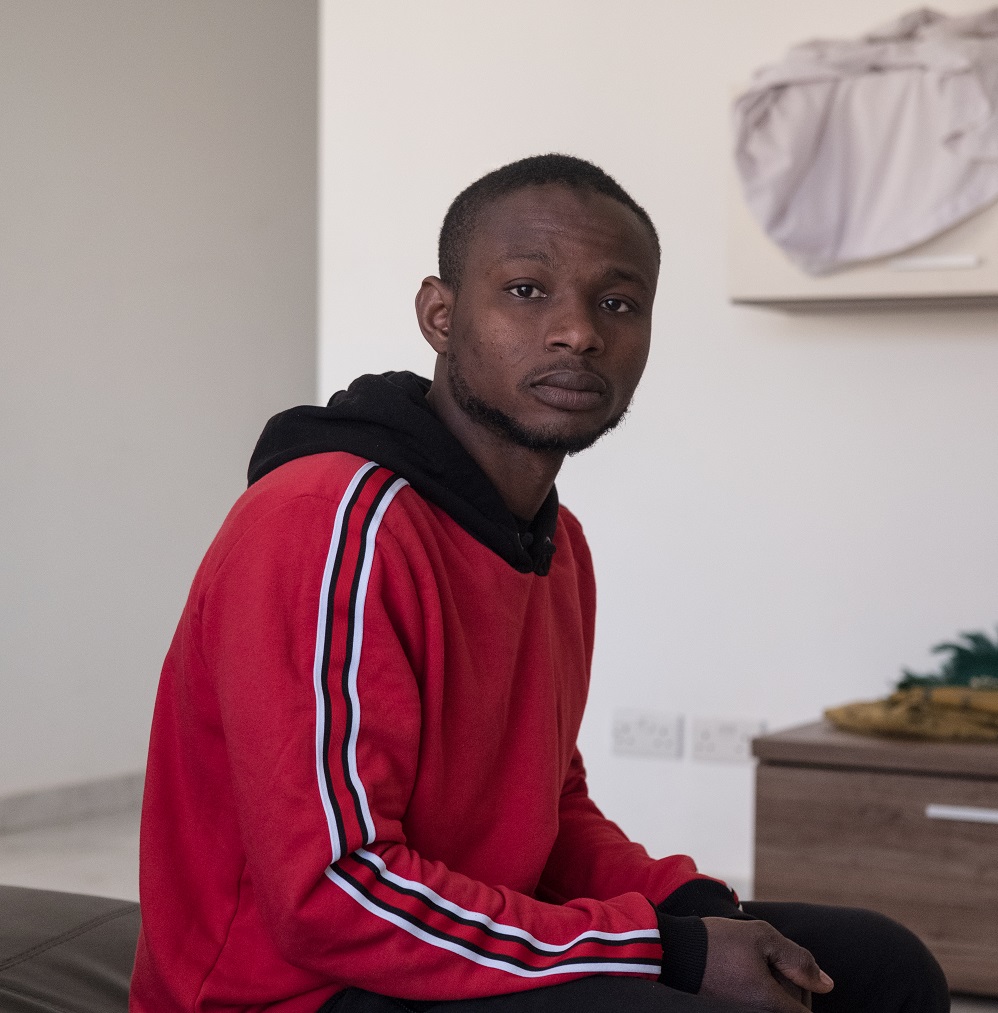
“Mhux problema”, says 19-year-old Kader, smiling. He’s wiping down the kitchen table and I’m in the way.  “That’s ‘no problem’ in Maltese”.

It’s a Saturday afternoon and I’m in the spotlessly clean apartment on the outskirts of Valletta that Kader shares with Amara and other West African youths. Abdalla has just arrived from across town after finishing his shift in a toy warehouse, and Amara prepares coffee for everyone. These three young men are the El Hiblu 3 – and they’re facing years in prison.

It’s three years since Amara, Kader and Abdalla arrived in Malta, having fled Libya with 100 others on a rubber boat. They were 15, 16 and 19 years old respectively. When the boat began to deflate, it was rescued by a cargo ship, the El Hiblu. The captain promised to take them to Europe. Hours later, some of the people on board recognised the lights of the Libyan capital, Tripoli, drawing closer. They weren’t heading towards Europe after all.

Panic set in. People were threatening to jump off the boat – prepared to die before returning to Libya to face more horrific abuses. It’s well-known that Libya isn’t a safe country for migrants. In fact, taking them back there would have been unlawful. The captain needed to restore calm. He asked Amara, Kader and Abdalla to reassure the desperate passengers and to interpret for him into French. Eventually he changed course to Malta. 

On arrival, the three youths were arrested and detained. They had no idea why. The charges they face are so severe, some carry a life sentence.

Amara, the El Hiblue 3
Amara

Amara speaks English fluently. He had always hoped his language skills would be the key to a brighter future – and despite everything that’s happened, he still does. “I hope to be a translator one day. I thought my English would help people. We just wanted to help”. 

But it’s hard to plan for the future when you’re facing life-changing charges and living under strict bail conditions. All three keep as busy as possible to try to distract themselves from the worry of the case. They work long hours, and Abdalla has his hands full with his 16-month-old daughter. In their free time they play football, cook, and work on their English. Kader waves his phone towards me so I can see his progress on the DuoLingo app. Amara explains the “heavy load” they carry every day:

“We are between life and death. They are playing with our lives… I try to be strong but it’s eating me up…I don’t feel free.”

Amara

“We are between life and death. They are playing with our lives. We have no power. I used to be a happy man. Now I can feel myself withdrawing. I try to be strong but it’s eating me up – I just work and sleep. I don’t feel free.”

After a while we switch on the TV to watch some football. It’s clearly very painful for them to talk about their situation. Cameroon are playing Gambia in the African Cup of Nations. Their home teams, Guinea and Cote D’Ivoire, are already out, so everyone’s supporting Gambia. They’re rooting for the underdogs.

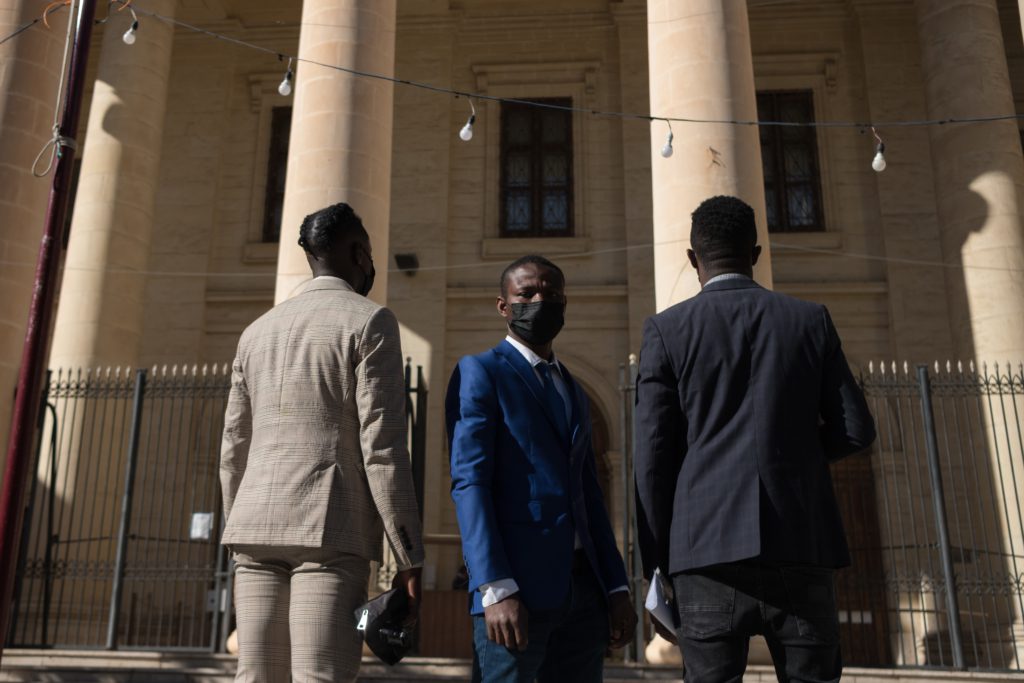
The El Hiblu 3 outside court in Malta
The El Hiblu 3 outside court in Valletta, Malta

A few days later, I meet them again outside the Courts of Justice in Valletta for their latest hearing. They’re all dressed extremely smartly – Abdalla’s gingham suit complete with matching tie and handkerchief. They’re used to these hearings by now, aware that often nothing much happens. They’re still nervous, though. The small court room is full of supporters observing proceedings. One of the migrants on board the El Hiblu is called as a witness. The young man from Ivory Coast describes what happened at sea at length. His testimony is entirely consistent with what the El Hiblu 3 told Amnesty’s researchers. It’s not clear why it took two years for these witnesses to be called – in that time, many of those who were on board the El Hiblu have left Malta. But it prolongs the uncertainty.

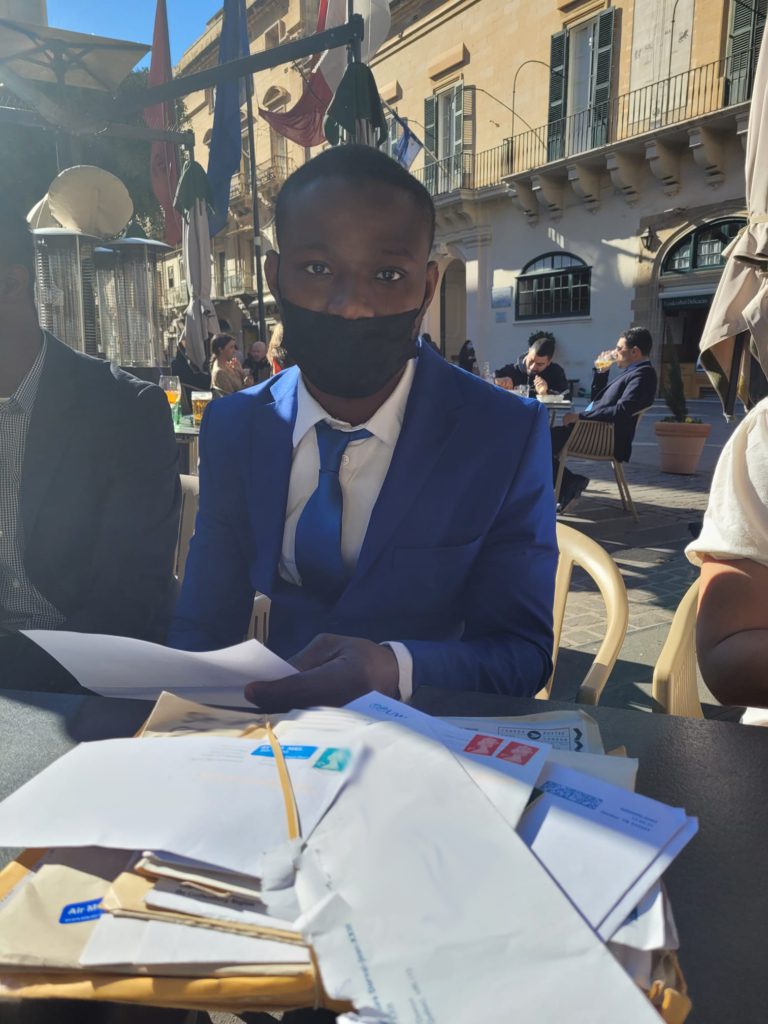
After the hearing, we all sit outside in a nearby square. The youths’ lawyer hands them a large bundle of mail. In 2020 the El Hiblu 3 were part of Amnesty’s Write for Rights campaign [insert link], and received thousands of letters and cards expressing support from all over the world. And they’re still coming. Abdalla, Amara and Kader open a few and read them carefully. The envelopes bear stamps from Singapore, Ukraine, France, the UK. This particular batch has lots from Quebec too, written in French by school children. “We stand with you”, one letter reads.

Amara reads letters of support

“They give us hope, and they give us strength” explains Kader thoughtfully. 

One card has a picture of a lilac ‘forget-me-not’ flower. Below, someone has written ‘El Hiblu 3’. These three young men know the world hasn’t forgotten them. Thousands of people around the world stand with them and are demanding justice.

Join them.

3 youths. 3 years. 3 words.

DROP THE CHARGES

The post The El Hiblu 3: three years waiting for justice in Malta appeared first on Amnesty International.
Turkey: Osman Kavala and co-defendants must be acquitted of all charges

Ahead of the fifth, and possibly final, hearing in the trial of human rights defender Osman Kavala and seven other defendants on 21 March, Amnesty International is calling for their acquittal and Kavala’s immediate release.

In his final opinion, the prosecutor requested that Osman Kavala and Mücella Yapıcı — one of his co-defendants, who served as the spokesperson of Taksim Solidarity at the time of the Gezi Park protests — be found guilty of “attempting to overthrow the government”. They face a possible aggravated life sentence.

“This weekend, Osman Kavala marked his 1,600th day in jail. Despite committing no internationally recognized crime, he remains arbitrarily detained on baseless charges in a facility far away from his family,” said Nils Muižnieks, Amnesty International’s Europe Director.

“Since 2017, the prosecuting authorities have tried to conjure a crime out of thin air, but have repeatedly failed. On the contrary, each tortuous twist in this politically motivated prosecution has further exposed the hollowness of the Turkish justice system.”

In January, the Council of Europe’s Committee of Ministers took the rare decision to begin the formal process of infringement against Turkey over their failure to release Osman Kavala. This came two years after the European Court of Human Rights found that the Turkish authorities have violated Osman Kavala’s right to liberty with the ulterior motive of silencing him, and called for his immediate release.

Strikingly, the prosecutor also said in his final opinion that the “espionage” charge Kavala is currently being held in prison for is included in the charge he would like Kavala to be found guilty of. Yet it was in response to this exact charge that the European Court of Human Rights ruled there was no reasonable suspicion that he had committed a crime to justify his imprisonment pending trial. Meanwhile, the Turkish authorities have spent the last two years arguing over the meaning of “espionage” in order to justify his imprisonment.

“Osman Kavala will never get back the four-and-a-half years he has already spent behind bars for no other reason than his civil society activism,” said Nils Muižnieks.

“But this shameful farce can only have one just outcome: the acquittal of Osman Kavala and all of his co-defendants. Crucially, Kavala himself must also be immediately and unconditionally released from prison.”

Background

Osman Kavala was first charged with organizing the Gezi protests — mass demonstrations in 2013 against an urban development project in Istanbul. After a court acquitted Kavala, the authorities immediately rearrested him for allegedly being behind the 2016 failed coup attempt. They also accused him of “espionage”.

Last summer, the court’s decision to merge the Gezi prosecution with that of 35 football supporters — a move that would have prolonged Kavala’s time behind bars, despite mounting pressure to implement the European Court of Human Right’s ruling and release him — was suddenly overturned at the last hearing in February following a request from the prosecutor.

Turkey is only the second country to face infringement proceedings for failing to implement a binding ruling of the European Court of Human Rights.

For more information or to arrange an interview, please contact: Stefan Simanowitz, press@amnesty.org

The post Turkey: Osman Kavala and co-defendants must be acquitted of all charges appeared first on Amnesty International.