
FIFA: Time to compensate migrant workers in Qatar


Qatar hit the headlines in December 2010 when football’s world governing body FIFA awarded it the right to host the 2022 men’s football World Cup, the first to be held in the Middle East.

It was clear that a global event of this magnitude would mean Qatar would need to deploy immense resources and rely on vast manpower to build new stadiums, roads, hotels and other facilities and infrastructure to cater for football fans from across the globe.

With migrant workers making up more than 90% of the country’s workforce, it was clear that the weight of delivering these projects would rest overwhelmingly on the shoulders of all those who travelled to Qatar in the hope of securing a better livelihood.

take action

The road to #Qatar2022 will soon reach its destination. Goals will be scored, winners will be crowned, and amends must be made. @FIFACom must compensate the workers and their families who suffered to make #WorldCup2022 happen. #PayUpFIFA

Widespread abuse to be compensated, before the World Cup can be celebrated

Every fan is desperate to see their nation compete for a place in history. The thrill of a last-minute winner, the despair of a glaring miss, the suspense of a penalty shoot-out – these are emotions that unite people from every corner of the world. But can our eagerness to support our favourite teams be matched with support for migrant workers making the competition possible

It should have been no secret to anyone that migrant workers in Qatar faced systemic labour abuses and exploitation and that their toil would be essential for the World Cup to take place there. At the heart of the abuse was Qatar’s ‘Kafala’ system of sponsorship-based employment which legally bound foreign workers to their employers, preventing them from changing jobs or even leaving the country without their employer’s permission. Despite this, FIFA granted the multi-billion-dollar tournament to Qatar without imposing on it any conditions to ensure labour protections for migrant workers, despite the foreseeable risk to their human rights. As a result, over the past 12 years, hundreds of thousands of migrant workers hired to build or provide services for projects related to the World Cup have been exploited and otherwise abused.

All our dreams vanished when my brother passed away. He hoped to improve all of our living standards but most of his wages were used to repay the cost of migration.

Didarul Islam, brother of Mohammad Kaochar Khan, 34, from Bangladesh who was found dead in his bed on 15 November 2017 in Qatar.
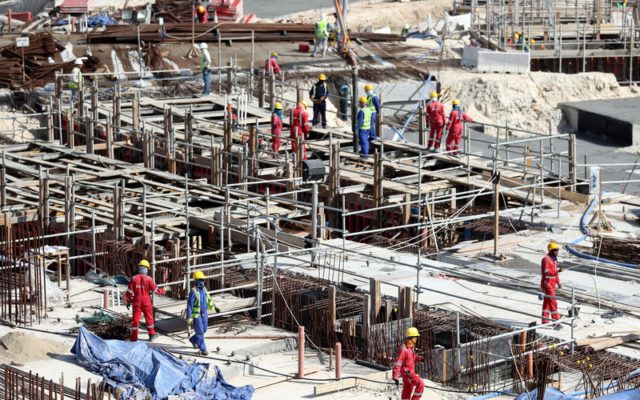
Workers are seen during a tour at the construction site of the Al Bayt Stadium and the workers accommodation on January 9, 2017 in Doha, Qatar.
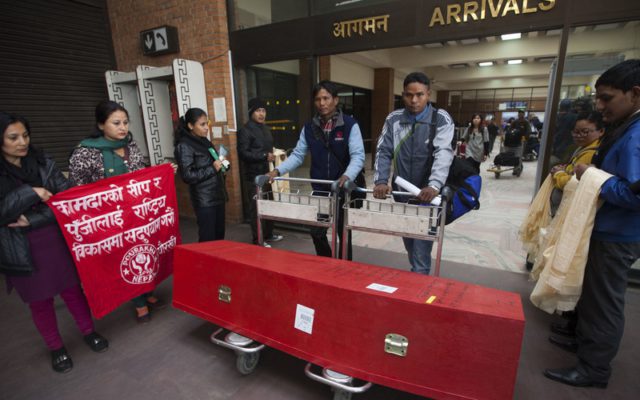
Migrant worker Tika Ram Tharu (r) and Anil Chaudhary (l) arrive along with a red coffin containing the body of their friend Buddiram Tharu, 42, at the International Airport in Kathmandu, Nepal on 18 December 2013. Buddiram went to Qatar in June 2012 as a migrant worker and died on 8 December
2013 after a heart attack. © Narendra Shrestha/EPA/Shutterstock

Labour abuse and exploitation in Qatar

For many years, Amnesty International has documented and exposed the labour abuse and exploitation of low-paid migrant workers in the country.

1. Unpaid wages

Wage theft is one of the most common abuses faced by migrant workers. Amnesty International alone has documented cases involving thousands of workers who have not been paid their salary and benefits, or have been underpaid, for months and even years at a time. Having often taken out high-interest loans to pay costly and illegal recruitment fees, such delays can be devastating for workers, particularly when they are supporting not only themselves but families in their home countries.

2. Unexplained deaths of migrant workers

Since 2010, thousands of migrant workers have died suddenly and unexpectedly in Qatar, despite undergoing medical tests before travelling to the country. But even though there is evidence of links between premature deaths and unsafe working conditions, the Qatari authorities have failed to investigate the underlying causes of these deaths. As a result, bereaved families are left not knowing what happened to their loved ones and are denied the possibility of compensation from the employers or the Qatari authorities.

3. Forced labour

Some migrant workers are made to work extremely long hours and are denied rest days, under the threat of having their wages cut. This can amount to forced labour. For example, security guards told Amnesty International that they regularly have to work 12 hours a day, seven days a week without a single day off for months and even years on end. If they take a weekly day off, they risk their employer deducting their wages by up to six days’ pay.

The promise of reform: shortcuts taken on the road to Qatar 2022

Under persistent pressure, Qatar and its World Cup organizing bodies did gradually go some way to reforming the kafala system and better protecting migrant workers. In 2017, the government started to introduce promising legal reforms to improve the working and living conditions, including introducing a law for domestic workers and legislation to protect workers from heat stress, setting up new labour courts and putting in place initiatives to compensate those who suffered abuses such as wage theft. Importantly, migrant workers are now legally allowed to change jobs and leave the country without their employer’s permission.

In addition to these reforms made by Qatar, FIFA and the Supreme Committee for Delivery and Legacy (Qatar’s World Cup organizing body) introduced the Workers’ Welfare Standards to raise the standards of working and living conditions for construction workers on FIFA World Cup tournament sites in 2014. In 2020 they jointly published a new Sustainability Strategy aimed at ensuring respect for the human rights of people contributing to the delivery of the World Cup, as well as other human rights and environmental issues.

Change came on paper but on the ground, it has not changed… It is still appalling.

Jacob, a migrant worker from Kenya.

However, due to constant structural problems coupled with lack of proper enforcement means that many thousands of migrant workers continue to face abuse and exploitation today. Employers still have excessive control over their workforce and can cancel worker’s visas or file ‘absconding’ charges against them if they try to change jobs, putting them at risk of arrest and deportation. Thousands continue to face wage theft, unsafe working and living conditions, and sometimes insurmountable barriers to changing jobs. They are still prohibited from forming and joining trade unions to collectively fight for their rights, while justice evades them and compensation for abuse remains scarce.

The impact of all these failures has also meant that past abuses have gone unchecked and in many thousands of cases neither the victim nor their family has received compensation for the suffering endured, or adequate redress for the deaths caused.
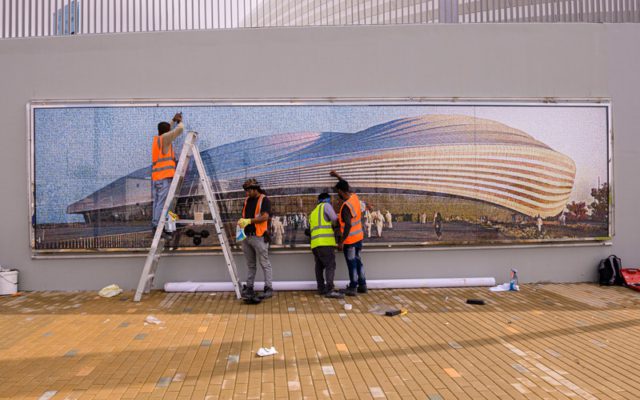
DOHA, QATAR – DECEMBER 16: A view of workers at Al Janoub Stadium facade putting a Banner on December 16, 2019 in Al-Wakrah, Qatar.
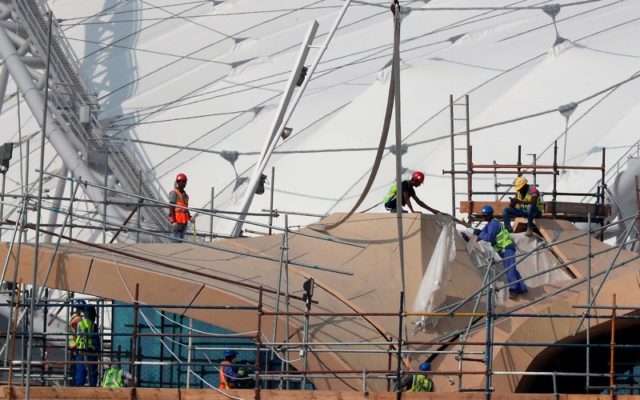
Workers are pictured on scaffolding at the Khalifa International Stadium on November 18, 2018, in Doha.

What do workers and their families say?

We are 6 months away from the 2022 FIFA World Cup in Qatar, but what is the situation for migrant workers on the ground? These are the words of migrant workers and their families explaining their reality.

“We work January to January, Sunday to Sunday. No day off. If you absent yourself, they will deduct two or more days’ wages.”

Godfrey, a migrant worker from Uganda.

@cesdavolio

“You work in the scorching sun in 52 degrees. You sweat until your t-shirt is salty, I would feel wet in my shoes. I have a headache every day. They care about what you do, not how you live”

Lawrence, a migrant worker from Kenya.

@cesdavolio

“We were living on food charity – the company did not pay our salaries for months and we had no money.”

Deepak, a migrant worker from Nepal

@cesdavolio

We don’t know what to do… We are heading to seven months without salary. Me, personally, I am okay, but what about my kids? Now my eldest child is at home, he cannot go to school.

Daniel, a migrant worker who worked at Qatar Meta Coats, a design and construction company involved in the building of Al Bayt Stadium

What should FIFA and Qatar do now?

With six months to go before the World Cup kicks off, abuses will continue unabated unless the action plan put in place by FIFA and its partners is properly implemented. However, it is already too late to erase the past suffering, and it is time for FIFA and Qatar to put things right.

Qatar has a clear obligation to prevent human rights abuses and compensate abuse. But FIFA also has important responsibilities that we must all make sure it lives up to. By awarding the World Cup to Qatar without conditions on improving protections for workers’ rights, FIFA has contributed to human rights abuses on a significant scale, beyond just those employed to build and service official FIFA sites. In line with international standards, this means that FIFA must now ensure remedy for past labour abuses linked to the 2022 World Cup. This should include workers building or servicing the stadiums, transport infrastructure, accommodation and other projects related to the tournament.

FIFA should work with Qatar and other partners to set up a programme to provide remedy for hundreds of thousands of workers involved in projects linked to the World Cup. To help fund this, FIFA should reserve an amount at least equivalent to the $440 million prize money provided to teams participating in the tournament. This can be invested in funds to compensate workers, and initiatives to improve workers’ protections for the future. This is easily doable given the organisation will make over $6 billion in revenues from the tournament and has over $1.6 billion of reserves.

$200 billion
is how much Qatar spent on the World Cup.
$6 billion
is how much FIFA is expected to generate from the World Cup.
$400 million
is how much FIFA should reserve to compensate workers.

Tell FIFA to compensate migrant workers

As the road to Qatar 2022 is reaching its destination, Amnesty International is urging FIFA and Qatar to:

  • Take immediate and decisive action to prevent further abuses of migrant workers engaged in World Cup-related projects and services.
  • Ensure that migrant workers and their families who have suffered to make the World Cup happen receive full and adequate remediation, including by:
    • Preventing further abuses of migrant workers engaged in World Cup-related projects and services.
    • Establishing a programme to compensate migrant workers.
    • Reserving an amount not less than the World Cup prize money to compensation funds and programmes to protect workers’ rights.

take action

The road to #Qatar2022 will soon reach its destination. Goals will be scored, winners will be crowned, and amends must be made. @FIFACom must compensate the workers and their families who suffered to make #WorldCup2022 happen. #PayUpFIFA

The post FIFA: Time to compensate migrant workers in Qatar appeared first on Amnesty International.

Amnesty International has left Hong Kong but there will still be candles in the darkness

By Chow Hang-tung, human rights activist, Tiananmen vigil organizer and barrister, currently jailed in Hong Kong

It was a sad moment when Amnesty International closed its Hong Kong offices after standing for more than 40 years in my city.

This organization is very important to me – and not just because they have campaigned for my release since I was imprisoned last year.

Amnesty has been the window that gives an international perspective to my human rights work. Seeing its demise is like watching parts of myself disappear, leaving an empty shell floating in the rubble.

My connection with Amnesty did not start in Hong Kong, but while I was in the UK studying at Cambridge. At that time, as an ignorant college student, I assumed there would be plenty of societies dedicated to the Tiananmen crackdown or other China-related issues.

But finding none that specialized in that particular area, I enrolled in Cambridge University Amnesty International (CUAI).

It was only after I joined that I learned that Amnesty is the world’s largest membership-based human rights organization, with millions of members in more than a hundred countries – democratically deciding on the issues and directions it wants to focus on, independent of any political power or national force. I was struck by the notion that the unifying power of an idea could be so great.

The bottom-up approach in the organization can transcend cultures and borders, bringing together the power of ordinary people into a force that no country can ignore. I got up the nerve to run for the executive committee and became an executive member – organizing letter-writing groups for prisoners of conscience around the world, as well as exhibitions, lectures, debates, screenings, fundraising galas, even competitive letter-writing contests.

I felt good that I, as an individual and a member of a collective, could do something to fight injustice.

CUAI’s most iconic event is CAGE! A group of students are locked up in relay in a cage perched on the King’s College lawn for 24 hours a day, while asking people to sign, donate or take action. Now I am one of those prisoners of conscience we were campaigning for, and I really do sleep on a hard bed in jail. But I don’t really feel that uncomfortable.

The CUAI has a high degree of freedom, and my first attempt to organize a June 4 memorial in Cambridge was under the CUAI umbrella. Amnesty was the inspiration for my advocacy. Without that period of experimentation and experience, I probably would not be the person I am now.

When I returned to Hong Kong in 2010, I represented Amnesty – working alongside colleagues all over the world. I learned that by listening more to other people’s stories and struggles, you feel less trapped in your own problems. It helps you realize yours is not the only struggle.

For a decade I have been passionately involved in the Hong Kong Alliance in Support of Patriotic Democratic Movements of China (the Alliance), which organized the city’s Tiananmen vigil – until it was forced to disband last year with many of our most prominent members detained.

The Alliance is a world away from Amnesty. It was a small, single-issue organization run by dedicated and enthusiastic members, yet it is respected and beloved among people in Hong Kong.

I had the privilege of experiencing a time when Hong Kong was still open and pluralistic, and when global human rights organizations were not viewed with suspicion and hostility because of their international status. People were able to participate in both local and international organizations, to collaborate and interact with a variety of groups, so that different experiences could complement each other and civil society as a whole could grow and progress in a diverse and communicative way, making Hong Kong truly a world city.

That is not the Hong Kong the next generation stands to inherit. Hong Kong as a society is going exactly in the opposite direction – denying diversity, hostile to foreign views, with a disjointed and battered civil society increasingly afraid to collaborate with each other. That makes it hard for groups like mine to survive, which is of course the intention.

The departure of Amnesty is an unmistakable warning sign to the outside world about just how dire the state of human rights is in Hong Kong. There can be no more pretence of freedom.

The post Amnesty International has left Hong Kong but there will still be candles in the darkness appeared first on Amnesty International.

Ukraine/Russia: The rights of Ukrainian prisoners of war from Azovstal must be respected

Responding to the news that the Ukrainian soldiers who were besieged in Mariupol’s Azovstal steel plant for months have surrendered themselves to Russia’s armed forces, Denis Krivosheev, Amnesty International’s Deputy Director for Eastern Europe and Central Asia, said:

“Ukraine’s soldiers deployed in Mariupol area have been dehumanized by Russian media and portrayed in Putin’s propaganda as ‘neo-Nazis’ throughout Russia’s war of aggression against Ukraine. This characterization raises serious concerns over their fate as prisoners of war.

“Amnesty International has documented summary killings of captives by Russia-backed separatist forces in eastern Ukraine, as well as the extrajudicial executions of Ukrainian civilians by Russian forces in recent weeks. The soldiers who surrendered today must not meet the same fate.

“Prisoners of war must not be subjected to any form of torture or ill-treatment, and should be given immediate access to the International Committee of the Red Cross. The relevant authorities must fully respect the rights of prisoners of war in accordance with the Geneva conventions.”

Prisoners of war must not be subjected to any form of torture or ill-treatment, and should be given immediate access to the International Committee of the Red Cross

Denis Krivosheev, Amnesty International’s Deputy Director for Eastern Europe and Central Asia

Background

On 17 May, Ukraine‘s armed forces confirmed that the soldiers who were holed up in Mariupol’s besieged Azovstal steel works had been ordered to surrender to Russia-led  forces.

According to Ukrainian Ministry of Defense, 264 soldiers, including 53 wounded servicemen, have already left Azovstal and now are being held in Novoazovsk and Olenivka, two villages under the control of the self-proclaimed Donetsk People’s Republic.

The post Ukraine/Russia: The rights of Ukrainian prisoners of war from Azovstal must be respected appeared first on Amnesty International.

Armenia/Azerbaijan: Nagorno-Karabakh conflict caused decades of misery for older people – new reports

The conflict between Armenia and Azerbaijan over the Nagorno-Karabakh territory has caused decades of misery for older people, Amnesty International said in two new reports published today. 

The conflict – first fought from 1988 to 1994, and then during another escalation in late 2020 – sawolder people unlawfully killed, tortured, and forcibly displaced; abuses which have marked their lives ever since. 

One report, Last to Flee: Older People’s Experience of War Crimes and Displacement in the Nagorno-Karabakh Conflict, documents how older ethnic Armenians were disproportionately subjected to violence in the recent conflict, including war crimes such as extrajudicial executions, as well as torture and other ill-treatment while in Azerbaijani detention.

The other report, ‘Life in a Box’: Older People’s Experiences of Displacement and Prospects for Return in Azerbaijan, details the suffering experienced by older Azerbaijanis who were forced from their homes in Nagorno-Karabakh and seven surrounding districts during the first conflict.

The conflict in Nagorno-Karabakh highlights the unique risks that older people face in armed conflicts

Laura Mills, Researcher on Older People with Amnesty International’s Crisis Response team

“The conflict in Nagorno-Karabakh highlights the unique risks that older people face in armed conflicts. Often the last to flee, they also suffer the consequences of war for decades on end,” said Laura Mills, Researcher on Older People with Amnesty International’s Crisis Response team.

“In both Armenia and Azerbaijan, older people have struggled to rebuild their lives in displacement – yet their loss of independence and dignity is treated as inevitable or irrelevant.

“With tensions high – and further conflict still possible – both Armenian and Azerbaijani authorities should make clear and firm commitments to prioritize the protection of older people, and ensure their human rights, including rights to housing and health, are protected.”

Last to Flee

When active fighting broke out in Nagorno-Karabakh in September 2020, older people in ethnic Armenian communities were almost invariably last to flee their homes, and were disproportionately impacted by violence as a result.

During the early stages of the conflict, men aged between 18 and 55 were typically mobilized to fight or to serve the war effort as volunteers. By the time Azerbaijani forces advanced on ethnic Armenian villages and towns, the only people remaining were often older people, and particularly older men.

Many older people encountered obstacles while trying to leave. Physical disabilities and health problems made it difficult for some to flee. In other cases, some older people with psychosocial disabilities or dementia found it difficult to comprehend the necessity or urgency of leaving. Others chose not to leave because they had strong attachments to their homes, or were reluctant to abandon land or livestock. 

Older people who fled their homes have languished in displacement in the years since. They reported a lack of access to adequate housing and a loss of livelihoods, which further entrenched feelings of helplessness and isolation. They also suffer due to an extreme lack of mental health or psychosocial support services.

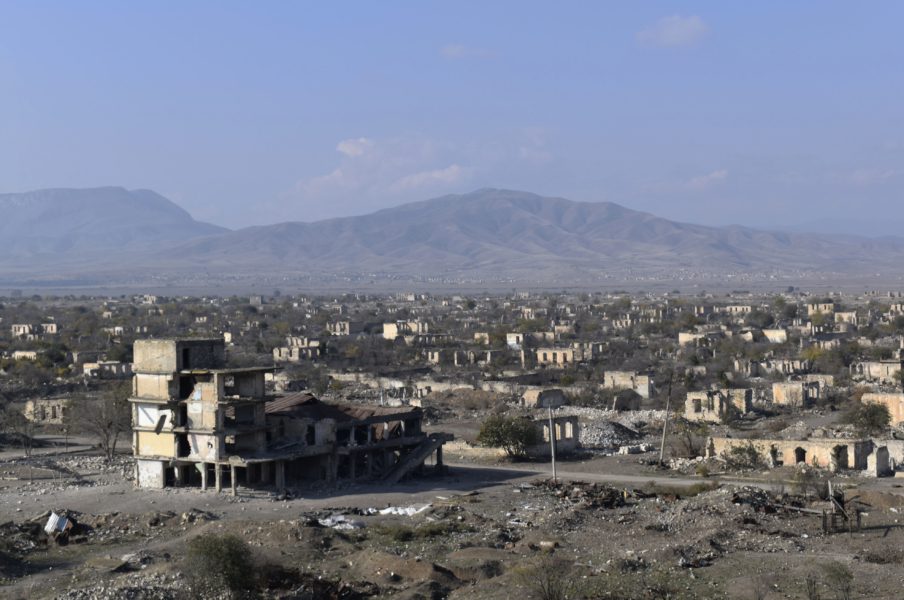
 Destroyed buildings in the town of Aghdam © AFP/Getty Images

On the ethnic Armenian side, more than half of civilian deaths were among older people. Many interviewees told Amnesty International of extrajudicial executions by Azerbaijani forces. They described killings where victims were beheaded or shot at point-blank range, constituting the war crime of wilful killing. Some appeared to have been tortured prior to their deaths, and some corpses were mutilated afterwards. 

Amnesty International was able to verify many of these cases through testimony from witnesses and relatives, as well as by reviewing and verifying death certificates, official forensic examinations undertaken by the Armenian authorities, and videos posted to social media.

Slavik Galstyan, 68, who lived with his family in the village of Mets Tagher and had a psychosocial disability, did not want to leave his home in October 2020. His body was found more than two months later. A death certificate issued by the Armenian authorities concluded that his death was caused by traumatic blood loss from gunshot wounds to his chest, stomach, and other internal organs. 

His son, Ashot, identified the corpse at the morgue and said his father’s body appeared to have been mutilated. Ashot told Amnesty International: “His head was crushed. It was as if all the bones in his body had been broken. He was like a [slab of] meat.”

Sedrak Petrosyan, 90, was brutally kicked and beaten while in captivity, and his 56-year-old son went missing after being taken into Azerbaijani custody. He said: “I want to die. I wanted to die in prison but somehow I survived.”

Other interviewees reported beatings and other forms of physical violence – and in one case, a mock execution – and other ill-treatment. Older men appear to have been targeted because Azerbaijani soldiers believed they had participated in Armenia’s war effort during the 1990s.

While displacement can be devastating to all people, it poses particular challenges for older people

Laura Mills

“The Azerbaijani government must ensure that any members of its armed forces responsible for the war crimes committed – including willful killings, torture or inhuman treatment, or enforced disappearances – are prosecuted in fair trials,” said Laura Mills.

“While displacement can be devastating to all people, it poses particular challenges for older people. The Armenian government and de facto authorities in Nagorno-Karabakh must do more to ensure that older people are able to rebuild their lives on an equal basis with others. They must also reform their approach to humanitarian response, to ensure that older people are provided with much-needed support.” 

‘Life in a Box’

An older woman in Baku, Azerbaijan © Ahmed Muxtar / Amnesty International

During the initial conflict over Nagorno-Karabakh from 1988 to 1994, more than half-a-million ethnic Azeri civilians from the region and seven surrounding districts were forcibly displaced. Many civilians, including older Azeri civilians, were unlawfully killed and subjected to other violence. Those who were displaced have lived in other parts of Azerbaijan ever since.

For decades, many lived in overcrowded tent camps, dormitories and schools, or abandoned railway cars, sheds, or buildings. They shared toilets and showers with dozens of people, and sometimes lived without electricity, heat, or running water. They struggled to meet their basic needs, or pay for food and medication.

In 2020, Azerbaijan reclaimed much of the territory lost in the initial conflict, and there are plans to resettle potentially hundreds of thousands of displaced persons. However, there are significant barriers to doing so: Armenian forces laid anti-personnel landmines on a massive scale, and also committed and oversaw the widespread destruction and seizure of property.

Many older people raised concerns about returning permanently to their home regions. Mehriban M*, 72, told Amnesty International: “I have huge security concerns when it comes to living close to Armenians. There is lots of trauma between our two nations. I know lots of people who were killed.”

Despite significant progress in recent years, it is estimated that as many as 100,000 displaced people still live in difficult conditions in informal housing in Azerbaijan. These residences are overcrowded and often difficult to physically access, meaning that older people are forced to rely on assistance from relatives or others simply to leave their homes. 

Manzar A*, an 81-year-old displaced woman living in a dormitory, told Amnesty International: “This is like a prison, there is no air… I can’t go downstairs to buy food. I cannot go out. If I really need to, people have to help me.”

All displaced persons have the right to return to their original homes in conditions of dignity and security

Laura Mills

Amnesty International also spoke to older people who said that they had virtually no employment opportunities, or felt excluded from resettlement conversations.

Famil M*, 71, said: “Right now I’m just waiting around… Seventy is nothing, I don’t feel old and I’m perfectly fit. But every company tells me I’m too old.”

Malik C*, 67, said: “I feel that my opinion is not heard because I don’t participate anywhere now. As a pensioner I spend most of my days in the garden. Nobody knows [my home village] better than me, but strategy is formed by people from Baku.”

Amnesty International is calling on the Azerbaijani government to ensure any process of return fully respects the rights and needs of a diverse range of older people, including older women, older people with disabilities, and that all older people are meaningfully included in decisions related to returns and provided information transparently and accessibly, so that they can make informed, voluntary decisions.

“All displaced persons have the right to return to their original homes in conditions of dignity and security, and the unique risks to older people must be taken into consideration. The Azerbaijani authorities must ensure they have access to appropriate housing and can earn a living on an equal basis with others,” said Laura Mills.

“The Armenian forces’ destruction of civilian objects and seizure of civilian property, as well as their widespread use of landmines, violate international humanitarian law. Not only do these violations continue to undermine the right to return of displaced people, they pose a serious obstacle for Azerbaijan’s efforts to resettle displaced populations in conflict-affected regions.”

Methodology and background

For the report, Last to Flee: Older People’s Experience of War Crimes and Displacement in the Nagorno-Karabakh Conflict, Amnesty International interviewed 69 people, including 42 older people (22 older women and 20 older men, aged between 60 and 90 years old). The organization sought a diverse group of interviewees to represent a wide age range, a mix of genders, and numerous disabilities.

For the report, ‘Life in a Box’: Older People’s Experiences of Displacement and Prospects for Return in Azerbaijan, Amnesty International interviewed 40 displaced older people, including 23 older men and 17 older women aged between 58 and 88.

Under international law, there is no specific definition of older age. While chronological age is often used as a benchmark, this does not always reflect whether a person is exposed to risks commonly associated with older age. Amnesty International prefers a context-specific approach to older age, as supported by the UN Office of the High Commissioner for Human Rights. 

Amnesty International does not take a position on the dispute over the territory of Nagorno-Karabakh,but emphasises that return to original homes in conditions of dignity and security is the right of all displaced people.

The post Armenia/Azerbaijan: Nagorno-Karabakh conflict caused decades of misery for older people – new reports appeared first on Amnesty International.

Honduras: Berta Cáceres’ family must get justice and reparation as soon as possible

On Wednesday, 18 May, the National Criminal Sentencing Court in Tegucigalpa, Honduras, is scheduled to announce the sentence imposed on David Castillo, former manager of the company Desarrollos Energéticos and in charge of the Agua Zarca hydroelectric project, who was convicted nine months ago as a co-author of the killing of human rights defender Berta Cáceres in 2016. 

“Knowing the punishment handed down on those who participated in the heinous crime against Indigenous leader Berta Cáceres is a key moment in the search for truth, justice and reparation for her family, who have endured a wait of more than six years for this. The Honduran authorities must show themselves equal to the task and ensure that the sentence, including its implementation, is in line with the highest human rights standards, ensuring that Berta’s killing does not go unpunished,” said Erika Guevara-Rosas, Americas director at Amnesty International. 

“Unfortunately, this process does not end here. Around the world, the wait continues to know the full truth about the killing of Berta Cáceres so that all those responsible can be held accountable. Berta Cáceres’ case must set a precedent for access to justice for human rights defenders in Honduras who continue to lose their lives in order to save our planet.”

Knowing the punishment handed down on those who participated in the heinous crime against Indigenous leader Berta Cáceres is a key moment in the search for truth, justice and reparation for her family, who have endured a wait of more than six years for this

Erika Guevara-Rosas, Americas director at Amnesty International

Further information

On 2 March 2016, Berta Cáceres, a courageous defender of the environment and Indigenous rights, was shot dead by armed men in her home in Intibucá, Honduras. She was the coordinator of the Civic Council of Popular and Indigenous Organizations of Honduras (COPINH) and campaigned against the Agua Zarca hydroelectric dam project and the impact it would have on the territory of the Lenca Indigenous people. 

Human rights defenders in Honduras continue be attacked with impunity. Killings are the biggest danger faced by environmental defenders in the country, which, according to Global Witness has the world’s second-highest homicide rate per capita. The start of 2022 has been particularly deadly for environmental defenders in Honduras, with two activists found dead in January.

Amnesty International has also documented threats, including disappearances, targeting environmentalists. Today, the whereabouts of four members of the Garifuna Indigenous community belonging to the Black Fraternal Organization of Honduras (OFRANEH), who have been missing since July 2020, remain unknown.

Despite the seriousness of the attacks on these defenders, Honduras has not yet signed the Escazú Agreement, the first environmental human rights treaty in Latin America and the Caribbean, which obliges signatory states to protect environmental defenders and entered into force on 22 April 2021.

For more information or to arrange an interview, please contact Duncan Tucker: duncan.tucker@amnesty.org

The post Honduras: Berta Cáceres’ family must get justice and reparation as soon as possible appeared first on Amnesty International.