
What is Council of Europe Charter on Education for Democratic Citizenship and Human Rights Education and how Amnesty International helps to implement it

Twelve years ago 47 member states of the Council of Europe signed a Charter on Education for Democratic Citizenship and Human Rights Education. The document took several years to prepare and although not legally binding, it serves as an essential tool in developing human rights education. The Charter’s drafters are certain that education plays a vital role in promoting democracy, human rights and the rule of law and the core values of freedom, equality and justice. Human rights education is a powerful tool which helps preventing future human rights violations and violence as well as fight racism, extremism, xenophobia, discrimination and intolerance.
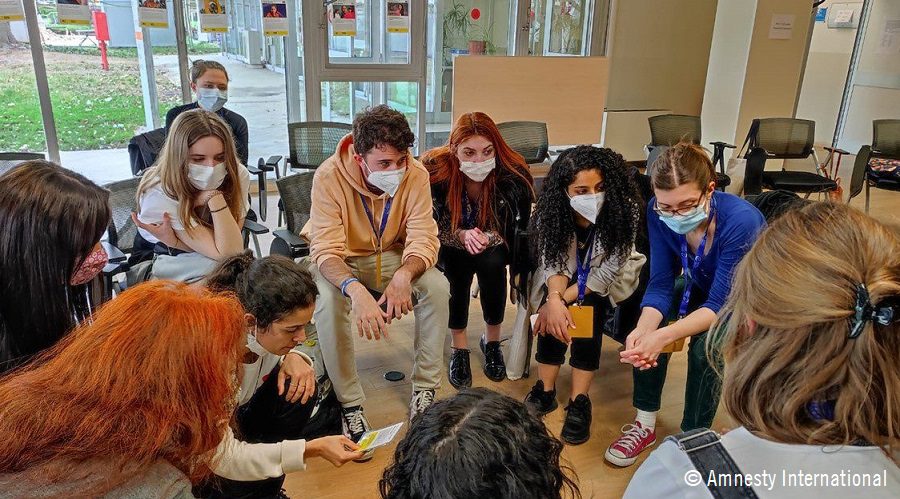
Amnesty International wholly shares this vision and has long made human rights education one of its work’s priorities. It actively engages with young people all over the world in cooperation with partners in dozens of countries creating a multilingual education community.

In 2021 alone more than 4 million people from 212 countries and territories, engaged with HRE programmes organised by Amnesty International and its partners. And in April 2022 in Turin the Council of Europe, the Italian government as its presidency and Amnesty International along with other partners conducted a regional Forum on the present and future of citizenship and human rights education in Europe with young people.

More than 500 human rights activists and educators, education officials and youth leaders participated in the forum. They all worked to review the Charter’s implementation in the past 5 years and to draft proposals to the Council of Europe and its member countries on ways to improve the quality of human rights education in light of the present-day realities, including the aftermath of COVID-19 pandemic and reduced access to human rights education in some European countries, such as Russia, Turkey, Belarus, Hungary and Poland.

Human rights education is a vital tool to ensure that we build societies that are more inclusive, diverse and respectful of human rights. But human rights education in our region is under attack — from smear campaigns against educators in Poland and censorship of discussions about LGBTI rights in Hungary to almost complete elimination of human rights education in Belarus and Russia. Young people everywhere are paying for our leaders’ failures

Stasya Denisova, Amnesty International Human Rights Education Coordinator for Europe and Central Asia

Challenges to human rights education

In many countries of the region, including those named above, in the past few years there has been a significant increase in legal and political restrictions concerning human rights education. These can be a direct prohibition of such education in schools, restricted access for non-governmental organisations to education institutions, direct censorship of education programmes, including on the issues of gender identity or reproductive health. Moreover, in the past two years young people across the continent faced serious restrictions to access to education, including human rights education, due to the pandemic. Also, Russia’s recent invasion threatens to nullify all Ukraine’s latest achievements in developing human rights education due to a number of factors.

Meanwhile, in Russia itself, human rights education is underrepresented within the official education system as well as outside it, and the situation is only getting worse. In the recent years a number of international organisations implementing human rights education programmes were declared “undesirable” (Association of Schools of Political Studies of the Council of Europe, Prague Civil Society Centre to name but a few) and Russian organisations designated as “foreign agents” also lost access to educational institutions. Furthermore, in March 2021 a new law came into force that requires all state educational establishments, including schools and higher education institutions, to seek approval for any international cooperation with foreign organisations. The requirement to obtain prior approval from government bodies and Russian authorities’ obsessive stifling of any alternative views on history and culture in favour of those formulated by the government that drives it, effectively represents an open censorship on educational activities.

In Russia “propaganda of non-traditional sexual relations among minors” has been prohibited by law since 2013 which in effect blocks any educational or awareness raising activities on LGBTI rights in both formal and informal education systems. Liquidation of the Historical and Educational Society “Memorial” and closure of its 20-year-old school education programme across Russia, whereby schoolchildren worked on research projects into family history, the history of GULAG and Stalin’s repressions, became a blatant attack against all the work on young people’s civil education.

The exclusion of Russia from the Council of Europe threatens yet further degradation of education for democratic citizenship and human rights education, whereas growing repressions against civil society threaten to kill off the last remaining initiatives in this area.

The situation is bleaker still in Belarus, which is not in the Council of Europe but nonetheless has connections with Europe through numerous agreements covering culture and education and thus has an obligation to “encourage democratic and inclusive environment in schools”. In the past two years human rights sector has been almost entirely eliminated, including human rights education in schools, higher education establishments and other institutions. Those few educational projects that continued until summer 2021 were closed down while most non-governmental organisations working on human rights education were liquidated. Furthermore, educators and students were persecuted. Today, it can be said that human rights education in Belarus is in fact fully delegitimised.

In such countries as Turkey, Hungary and Poland, human rights community and human rights education are also under attack. The authorities in these countries put special emphasis on supressing sexual education, gender equality and protection of LGBT+ rights. Also, there is deteriorating situation with cooperation between schools and human rights organisations and independent education centres in Poland and especially in Turkey where human rights activists are effectively denied access to the education system.

What can Amnesty International do

Against this background, at the forum in Turin, representatives of Amnesty International’s national sections in Poland and Hungary supported by the International Secretariat held a working group “Threats to human rights education: How to act?” to discuss ways of overcoming the crisis in human rights education in the region.

Amnesty International aims to use all its experience to counter and where possible to reverse the degradation of human rights education in these countries. The organisation’s task is to develop further its education projects in Europe and Central Asia and adapt them to local conditions. Today in the region the organisation is running 85 projects in total and they are implemented in cooperation with 26 civil society organisations; 46 of these projects are being implemented within the official education system.

In 2021 Amnesty International and its partner organisations engaged 628,703 people from within the official education system and outside it in their education projects. The previous year 2020 was particularly remarkable as the pandemic led to an increase in online education all over the world. The audience of Amnesty International’s Human Rights Academy, the movement’s main platform for online education, grew exponentially. By the end of the year the Academy had more than 200,000 registered students enrolled on 84 different courses in 25 languages.

Moreover, another interactive micro education platform aimed at young people, Human Rights Workout, was also active. Here the rulings of the European Court of Human Rights are reviewed using game-based methods. The platform was launched in 2019 and as of December 2021 the number of students learning on the Human Rights Workout reached 10,000. The platform has three interactive modules in English, Ukrainian, Romanian, Italian, Slovak and Russian.

In 2021 Amnesty International made a certain breakthrough in Central Asia after research into the state of human rights education in Kyrgyzstan with active cooperation of the civil society and the country’s authorities. Having discussed the research, the government made a decision to strengthen human rights education within mainstream school curriculum which is what Kyrgyzstan’s Ministry for Education is currently working on along with civil society partners, academics and Amnesty International.

However, without expanding international efforts and strengthening solidarity of the civil society in all the European and Central Asian countries without exception, the integration of human rights education into the school curricula will remain an impossible dream. This is why Amnesty International has drawn up recommendations for the Council of Europe and its member states calling them to do their utmost to engage youth leaders in discussions about plans in the area of education, consider the interests of vulnerable groups, seek to involve non-governmental organisations in the official education system and in respect to Ukraine, Belarus and Russia support youth activism in every way, as well as independent civil society organisations, academic and teacher communities. This is especially poignant in case of Russia who is trying to isolate itself from the international community. The exclusion of the Russian civil society which is already subject to repressions from the Council of Europe’s attention and specifically from its educational activities, will result in an irreparable damage to all without exception – to the Russian society and to the Europeans.

The post What is Council of Europe Charter on Education for Democratic Citizenship and Human Rights Education and how Amnesty International helps to implement it appeared first on Amnesty International.

Yemen: Huthi authorities must release four journalists sentenced to death

Yemen’s Huthi de facto authorities must quash the death sentences and order the immediate release of four Yemeni journalists who are facing execution following a grossly unfair trial, Amnesty International said today ahead of an appeal hearing on 22 May before the Specialized Criminal Appeals Division in Sana’a, Yemen.

Since 2015, the Huthi authorities have arbitrarily detained Akram Al-Walidi, Abdelkhaleq Amran, Hareth Hamid and Tawfiq Al-Mansouri without charge or trial for more than four years; subjecting them to a range of human rights abuses including forcible disappearance, intermittent incommunicado detention and solitary confinement, beatings and denial of access to medical care. The Specialized Criminal Court in Sana’a sentenced them to death in April 2020 after an unfair trial; a verdict that the defendants have since been appealing.

“The Huthi de facto authorities must quash these death sentences and release these journalists immediately. This has been a sham of a trial since the beginning and has borne a terrible toll on the men and their families. Pending their overdue release, the journalists must be provided with urgent medical care – the denial of medical treatment for the seriously ill is an act of cruelty which amounts to torture and other ill-treatment,” said Lynn Maalouf, Amnesty International’s Deputy Director for the Middle East and North Africa

“The Huthi authorities must also immediately release all those it is currently detaining simply to settle political scores or exercise control – these include journalists, human rights defenders, political opponents, members of religious minorities. The Huthis de facto authorities are bound to respect the basic and inalienable rights of individuals under their control.”

 In October 2020 the four journalists were transferred to the Exchange House prison, in the Central Security Camp in Sana’a, expecting to be released as part of a prisoner exchange deal. Despite the Prosecutor General’s order, dated 30 October 2020, to release them they were maintained in detention. According to their lawyer, the Huthis denied the four men visits from their families and lawyers, subjected them to cruel treatment, and deprived them of access to adequate and timely medical care.

Tawfiq al-Mansouri is in critical health condition. He suffers from a prostate condition as well as chronic illnesses including heart disease and diabetes. Amnesty International interviewed a former detainee who had been held with the four journalists in the Central Security Camp in Sana’a, who confirmed that they were denied medical treatment, that they were being held in appalling detention conditions, denied family visits, and only provided with drinking water for half an hour per day, through the toilet’s tap water. Tawfiq’s brother also told Amnesty International that their family was not even allowed to bring him any medication, despite learning from released detainees that Tawfiq’s health was very concerning. Since 2020, Tawfiq al-Mansouri has not been allowed to be transferred to a hospital for treatment.  

Background

All parties to the conflict in Yemen have perpetrated grave human rights violations, including arbitrary detention, enforced disappearance, torture and other ill-treatment, and unfair trials. 

In areas they control, Huthi forces have arbitrarily arrested and detained critics including journalists, human rights defenders, and members of the Baha’i community, and subjecting scores of people to unfair trials, incommunicado detention and enforced disappearance.

In May 2021, Amnesty International published a report investigating the experiences of civilians released as part of political deals in 2020 and documenting the release conditions which forced a number of released persons into exile, with the United Nations (UN) facilitating their departure, and eight other detainees banished to other parts of the country.

Conditions in Huthi-run prisons and detention centres are catastrophic, with severe overcrowding, insufficient food and clean drinking water, and poor sanitation.

Reporters Without Borders has reported that 14 journalists are currently detained in Yemen solely for their work, and that two journalists have been killed in 2022.

Amnesty International opposes the death penalty in all cases without exception regardless of the nature of the crime, the characteristics of the offender, or the method used by the state to kill the prisoner. The death penalty is a violation of the right to life and the ultimate cruel, inhuman and degrading punishment.

The post Yemen: Huthi authorities must release four journalists sentenced to death appeared first on Amnesty International.

Qatar: Joint open letter to Gianni Infantino regarding remedy for labour abuses behind the 2022 World Cup

Joint letter urging Mr Gianni Infantino, FIFA President, to work with the Qatar government, trade unions, the International Labour Organization (ILO) and other actors to establish a comprehensive programme to ensure all labour abuses to which FIFA contributed are remedied, and to set aside appropriate financial resources.

Mr. Gianni Infantino
President
Fédération Internationale de Football Association
FIFA-Strasse 20
P.O. Box 8044
Zurich
Switzerland

17 May 2022

Dear Gianni Infantino

RE: REMEDY FOR ABUSE OF MIGRANT WORKERS’ RIGHTS IN QATAR

With six months until the opening of the FIFA World Cup Qatar 2022, hundreds of thousands of migrant workers have not received adequate remedy, including financial compensation, for serious labour abuses they suffered while building and servicing infrastructure essential for the preparation and delivery of the World Cup in Qatar. We therefore urge you, as the President of FIFA, to work with the Qatar government, trade unions, the International Labour Organization (ILO) and other actors to establish a comprehensive programme to ensure all labour abuses to which FIFA contributed are remedied, and to set aside appropriate financial resources.

We recognise that progress has been made in strengthening protections for workers through the Qatar government’s labour reforms, as well as Supreme Committee for Delivery and Legacy initiatives. Qatar’s legal reforms, for example, have the potential, if fully implemented, to improve protections for workers right across the country. However, for many workers these reforms came too late and have only been partially enforced, while the vast majority of workers essential to the preparation of the World Cup also fall outside the Supreme Committee’s initiatives, meaning abuses persist. Critically, however, even if these reforms were now effectively implemented, this would not negate FIFA’s responsibilities and Qatar’s obligations to address and remedy past labour abuses.

FORESEEABLE RISKS

In 2010, when FIFA awarded Qatar the right to host the World Cup, it was well documented that labour abuses and exploitation were rife in the country. The rights of migrant workers, who formed about 95% of the country’s workforce, were severely limited by the country’s kafala sponsorship system and undermined by poor enforcement of labour laws, allowing unscrupulous employers to abuse migrant workers with impunity. While there has been progress in recent years, human rights abuses persist.

When FIFA awarded the tournament to Qatar, it knew or should have known the risks this would pose to migrant workers’ rights given the country’s poor human rights record and the ban on trade unions. And yet it did so without placing on Qatar any conditions for the protection of labour rights. In awarding the 2022 World Cup without imposing any conditions to avoid foreseeable labour rights abuses and subsequently failing to take timely and effective preventive measures in this regard, FIFA contributed to the widespread abuse of migrant workers on World Cup-related projects that followed.

WIDESPREAD HUMAN RIGHTS ABUSES

The scale of human rights abuses linked to the World Cup is significant. Over the last 12 years, the vast majority of migrant workers in Qatar have had to “pay to work” in the country, with substantial illegal recruitment fees to secure their jobs, and many thousands have been subjected to widespread wage theft. Before 2020, no migrant worker could change jobs or leave the country without their employer’s permission, while human rights organizations and trade unions have documented numerous cases of excessive working hours, forced labour and other abuses. While some workers may have received some form of remedy, large numbers of abuses remain poorly addressed or not addressed at all.

Workers have been injured or even paid the ultimate price while employed in Qatar. On projects across Qatar – including those related to the World Cup and those not – Qatari authorities have failed to investigate the causes of deaths of thousands of migrant workers since 2010. A significant number of these deaths may be linked to working in the country’s extreme heat and humidity without adequate protection, and could have been prevented with effective health and safety measures.

RESPONSIBILITY TO REMEDY

Qatar is obligated under international human rights law to prevent such widespread human rights violations, and to ensure remedy for every abuse on its territory, whether linked to the World Cup or not. But FIFA too has its own clear human rights responsibilities under the United Nations Guiding Principles on Business and Human Rights, and as recognized by FIFA’s own policies, to remedy abuses to which it has contributed.

However, to date, neither FIFA nor Qatar have fulfilled their respective responsibilities and obligations in this regard.

FIFA’s responsibility covers not only workers directly employed on World Cup projects such as stadiums and training sites, but also the hundreds of thousands of workers employed to build and service a wider range of projects and infrastructure necessary for tournament preparation and delivery, including transport infrastructure and accommodations, the provision of security and cleaning, among others.

FIFA and Qatar should therefore work together with trade unions, the ILO and civil society to put in place a comprehensive and participatory programme to provide remedy for all abuses related to the 2022 World Cup.

This programme should learn from models established elsewhere to provide remedy for thousands of workers and families who lost loved ones. It should be established and governed in a participatory way following consultation with stakeholders including migrant workers, surviving family members, and trade unions; be easily accessible to workers and their families, many of whom will no longer be in Qatar; and be able to offer timely remedy for a wide range of unaddressed abuses since 2010.

While this process should seek to strengthen existing remedial mechanisms available in Qatar, such as those provided by the Ministry of Labour and Supreme Committee, it is also likely to require the development of additional systems capable of dealing with past and ongoing abuses on such a vast and transnational scale. For example, while the Labour Committees established in 2018 offer workers greater opportunities to seek remedy for unpaid wages, they only accept claims within a year of an abuse being committed.

The principle that abuses should not be repeated is fundamental to providing an adequate remedy.

FIFA should also support and contribute financially toward initiatives designed to support migrant workers, such as a Migrant Workers’ Centre, as well as enhance and strictly implement its human rights criteria for future events and strengthen its human rights due diligence processes.

FINANCIAL CONTRIBUTION

Qatar, FIFA, the Supreme Committee and other actors including employing companies all bear a responsibility, independent of each other, to contribute financially to a remediation programme.

Paying for the scale of remedy for families of those who have died, to compensate for unpaid wages, to reimburse illegal recruitment fees, and to support initiatives to protect workers’ rights in the future will require a significant investment proportional to the abuses suffered.

FIFA should reserve an amount not less than the US$440 million prize money offered to teams participating in the World Cup, to be invested in funds to support remediation. This would represent just a small percentage of FIFA’s anticipated US$6 billion revenues from the tournament and the US$1.6 billion it holds in reserves. This amount reflects a likely “floor” for the scale of harm suffered and the need to invest in programmes to ensure that abuses are not repeated in the future. The final amount required for remedy will be determined by the scale of the need, the harms to be redressed and reparation measures to be offered, should be decided through a participatory process and subject to an independent evaluation.

The kick-off of the first World Cup to be held in the Middle East should be a moment of joy and pride for football lovers across the globe. But until all workers are compensated and harms remediated, the tournament cannot be truly celebrated. We the undersigned call on FIFA to urgently:

  • Commit to establishing with Qatar a comprehensive remediation programme to address abuses suffered by migrant workers in the preparation and delivery of the 2022 World Cup that remain outstanding;
  • Set aside no less than US$440 million to fund remedy of such abuses, with the harms to be redressed and reparation measures to be offered being decided through a participatory process and subject to an independent evaluation; and
  • Enhance and strictly implement its human rights criteria for future events and strengthen its human rights due diligence processes.

SIGNATORIES

The post Qatar: Joint open letter to Gianni Infantino regarding remedy for labour abuses behind the 2022 World Cup appeared first on Amnesty International.

Belarus: New death penalty law is the ultimate attack on human rights

Belarusian authorities have adopted a new law which introduces the death penalty for “attempts to carry out acts of terrorism.” Marie Struthers, Amnesty International’s Director for Eastern Europe and Central Asia, said:

“Belarus is the only state in Europe and Central Asia which still uses the death penalty, the ultimate cruel, inhuman and degrading punishment. This law, which is against Belarus’ international obligations, expands the application of this cruel and inhumane punishment and for acts that do not qualify as intentional killing, is the latest display of Belarusian authorities’ profound disregard for human rights.

Belarus is the only state in Europe and Central Asia which still uses the death penalty, the ultimate cruel, inhuman and degrading punishment

Marie Struthers, Amnesty International’s Director for Eastern Europe and Central Asia

“It is particularly alarming given that the Belarusian authorities have a dangerously vague definition of ‘terrorism,’ with terrorism-related charges used to prosecute political dissent. Authorities have systematically equated peaceful protest and free expression to violent crimes, and this law is a chilling signal that they are ramping up their repression and raising the stakes to deadly new heights.  

“Amid a suffocatingly repressive political climate in Belarus, opponents of the government now face the prospect of being shot if they dare to speak out. We call on Belarus to abandon this cruel, inhuman and degrading punishment once and for all, and to stop its shameful campaign of persecution of political opponents and human rights activists.”

Amid a suffocatingly repressive political climate in Belarus, opponents of the government now face the prospect of being shot if they dare to speak out

Marie Struthers, Amnesty International’s Director for Eastern Europe and Central Asia

Background

On 18 May, Alyaksandr Lukashenka gave presidential approval to new legislation which introduces the death penalty for “attempts to carry out acts of terrorism.” The law will come into force 10 days after its publication.

In April, the Belarusian parliament passed the bill widening the application of the death penalty, a move believed to be a response to recent incidents of sabotage on the country’s railway network.

Such incidents have reportedly been used as a covert tactic by opponents of the Russian invasion of Ukraine, to prevent Russian forces stationed in Belarus from travelling across the border.  

According to Human Rights Center Viasna, dozens of political activists have already been charged with “attempted terrorism.” Among them is Sviatlana Tsikhanouskaya, the exiled Belarusian opposition leader, and Alyaksandr Lukashenka’s main contender in the widely-disputed 2020 presidential elections.

Currently, the death penalty is usually applied in Belarus for aggravated murder but is also a possible punishment in legislation for acts of terrorism that cause loss of life.

The post Belarus: New death penalty law is the ultimate attack on human rights appeared first on Amnesty International.

Algeria: Campaign against increasing government repression of human rights

#NotACrime: Online campaign calls on Algerian authorities to stop their assault on civic space and fundamental freedoms 

A year ago, Algerian authorities shut down the “Hirak” pro-democracy protests in most of the country. Since then, the number of unfounded terrorism prosecutions has soared, problematic amendments to the Penal Code were adopted, legal actions were initiated against civil society organizations and opposition political parties, and the crackdown on human rights defenders and the media has intensified, while authorities have continued to obstruct independent unions’ registration and activity. 

#NotACrime is an online campaign aiming to draw attention to the ways in which Algerian authorities have increasingly attempted to stifle dissenting voices and independent civil society. Launched by 38 Algerian, regional and international organizations, the campaign will be conducted between 19-28 May on the organizations’ respective social media accounts. 

The campaign calls on Algerian authorities to end their repression of human rights, immediately and unconditionally release those detained solely for the peaceful exercise of their human rights and allow everyone to freely enjoy their rights. Those suspected of responsibility for grave human rights violations should be brought to justice in fair trials, and the authorities should provide access to justice and effective remedies for victims. The campaign calls on all individuals, organizations and relevant parties to contribute to collectively demanding an end to the criminalization of the exercise of fundamental freedoms in Algeria, using the #NotACrime hashtag. 

At least 300 people have been arrested since the beginning of 2022 (as of 17 April) for exercising their right to free expression, peaceful assembly or association, according to Zaki Hannache, a human rights defender, though some have since been released. Arrests and sentencing of peaceful activists, independent trade unionists, journalists and human rights defenders have continued unabated, even after the protest movement was shut down. Algerians jailed for their speech have repeatedly carried out hunger strikes – El Hadi Lassouli since 3 May for instance – above all to protest their arbitrary imprisonment. According to the Algerian League for the Defense of Human Rights (LADDH), these figures underrepresent reality because many cases are not communicated due to fear of reprisal. 

The death in detention of Hakim Debbazi on 24 April, after he was placed in pretrial detention on 22 February for social media postings, shows what is at stake when people are detained simply for exercising their human rights. 

While international scrutiny has remained scarce, the UN High Commissioner for Human Rights Michelle Bachelet, in her update to the Human Rights Council on 8 March 2022, expressed concern over “increasing restrictions on fundamental freedoms” in Algeria and called on the government “to change course.” Ahead of the examination of Algeria’s human rights record in November by the UN Human Rights Council, within the Universal Periodic Review process, the undersigned organizations express serious concern and hold Algerian authorities responsible for the dangerous backsliding in Algeria, notably in the rights to express one’s opinion, assemble and associate peacefully, and share and access information. 

The campaign will extend until the anniversary of the death of Kamel Eddine Fekhar, a human rights defender who died in detention on 28 May 2019 after a 50-day hunger strike to protest his imprisonment for expressing views critical of the government. He had been charged with undermining state security and inciting racial hatred. On 11 December 2016, a British-Algerian journalist, Mohamed Tamalt, also died in custody following a hunger strike during his imprisonment for Facebook posts deemed offensive by the authorities. Algerian authorities have failed to adequately investigate both of their deaths. 

Exercising the fundamental freedoms of peaceful assembly, association and expression, and defending human rights is #NotACrime. 

Signatures 

  1. Action by Christians for the Abolition of Torture (ACAT-France) 
  2. Action for Change and Democracy in Algeria (ACDA) 
  3. AfricanDefenders (Pan-African Human Rights Defenders Network) 
  4. Algerian League for the Defence of Human Rights (LADDH) 
  5. Amnesty International 
  6. ARTICLE 19 
  7. Autonomous General Confederation of Workers in Algeria (CGATA, Algeria) 
  8. Autonomous National Union of Electricity and Gas Workers (SNATEG, Algeria) 
  9. Autonomous National Union of Public Administration Staff (SNAPAP, Algeria) 
  10. Burkinabè Coalition of Human Rights Defenders (CBDDH) 
  11. Burundian Coalition of Human Rights Defenders (CBDDH) 
  12. Cairo Institute for Human Rights Studies (CIHRS) 
  13. Canadians for Justice and Peace in the Middle East (CJPME) 
  14. Civil Rights Defenders (Sweden) 
  15. Collective Action-Detainees (Algeria) 
  16. Collective of the Families of the Disappeared in Algeria (CFDA) 
  17. Confederation of Trade Union Workers’ Commissions (CCOO, Spain) 
  18. CIVICUS: World Alliance for Citizen Participation  
  19. DIGNITY – Danish Institute against Torture 
  20. Euro-Mediterranean Federation against Enforced Disappearances (FEMED) 
  21. Euromed Rights 
  22. Free Algeria 
  23. Front Line Defenders 
  24. General Confederation of Labour (CGT, France) 
  25. Human Rights League (LDH, France) 
  26. Human Rights Watch 
  27. International Federation for Human Rights (FIDH) 
  28. International Labour Network of Solidarity and Struggles 
  29. International Union of Food, Agricultural, Hotel, Restaurant, Catering, Tobacco and Allied Workers’ Associations (IUF) 
  30. Ivorian Coalition of Human Rights Defenders (CIDDH) 
  31. Justitia Center for Legal Protection of Human Rights in Algeria 
  32. MENA Rights Group 
  33. Public Services International (PSI) 
  34. Riposte Internationale (Algeria) 
  35. Shoaa for Human Rights (Algeria) 
  36. Syndicate Union – Solidaires (France) 
  37. Tharwa N’Fadhma N’Soumer (Algeria) 
  38. Trade Union Confederation of Productive Forces (COSYFOP, Algeria) 

The post Algeria: Campaign against increasing government repression of human rights appeared first on Amnesty International.