Responding to reports that Myanmar’s military authorities have carried out executions for the first time since the late 1980s, Amnesty International’s Regional Director Erwin van der Borght said:
“These executions amount to arbitrary deprivation of lives and are another example of Myanmar’s atrocious human rights record. The four men were convicted by a military court in highly secretive and deeply unfair trials. The international community must act immediately as more than 100 people are believed to be on death row after being convicted in similar proceedings.”
These executions amount to arbitrary deprivation of lives and are another example of Myanmar’s atrocious human rights record.
Amnesty International’s Regional Director Erwin van der Borght
“For more than a year now, Myanmar’s military authorities have engaged in extrajudicial killings, torture and a whole gamut of human rights violations. The military will only continue to trample on people’s lives if they are not held accountable.”
“At a time when more and more countries take steps to abolish the death penalty, the resumption of executions after more than three decades not only puts it at odds with the global trend, but is also contrary to the goal of abolition enshrined under international human rights law and standards. Myanmar’s isolation could not be any more glaring. We urge the authorities to immediately establish a moratorium on executions as a first critical step.”
Background:
According to Myanmar state media, four executions have been carried out.
Phyo Zeya Thaw, a former member of Aung San Suu Kyi’s National League for Democracy, and prominent democracy activist Kyaw Min Yu, also known as Ko Jimmy, were convicted of and sentenced to death by a military tribunal in January for offenses involving explosives, bombings and financing terrorism under the Anti-Terrorism Law – charges that Amnesty International believes to be politically motivated. Two other men, Hla Myo Aung and Aung Thura Zaw, convicted of the alleged murder of a woman believed to act as an informer for the military in Hlaing Tharyar in Yangon, also had their death sentences confirmed.
All four were named in the report in state-run newspaper Global New Light of Myanmar.
The proceedings before a military-controlled court were secretive and grossly unfair.
Following Myanmar military’s issuance of Martial Law Order 3/2021, the authority to try civilians was transferred to special or existing military tribunals where individuals are tried through summary proceedings without right to appeal.
These courts oversee a wide range of offences including those punishable with the death penalty.
Under international law and standards, executions carried out following unfair trials violate the prohibition against arbitrary deprivation of life, as well as the absolute prohibition of torture and other cruel, inhuman or degrading punishment.
Myanmar’s last known execution was in the late 1980s. Since the military coup in February 2021, Amnesty International has recorded an alarming increase in the resort to the death penalty in Myanmar, where it has become a tool for the military in the ongoing persecution, intimidation and harassment of all who dare to challenge the authorities.
Amnesty International opposes the death penalty unconditionally, in all cases and under any circumstances. More than two-thirds of countries all over the world have abolished the punishment in law or practice.
Russian prosecutors today appealed a court’s decision to acquit Yulia Tsvetkova, an artist and LGBTI activist who was charged with ‘disseminating pornography’ for posting drawings of female bodies online. Yulia was acquitted just one week ago, on 15 July, by the Central District Court of Komsomolsk-on-Amur.
“Last week we described Yulia Tsvetkova’s acquittal as a rare triumph of justice over repression in Russia. That triumph was short-lived.
Marie Struthers, Regional Director for Eastern Europe and Central Asia
“Last week, we described the acquittal of Yulia Tsvetkova as a rare triumph of justice over repression. But this triumph, and Yulia’s freedom from harassment, were painfully short-lived. Today Russian authorities have reiterated their fervent commitment to oppression and cruelty,” said Marie Struthers, Regional Director for Eastern Europe and Central Asia.
“Since her arrest in 2019, Yulia has endured house arrest, travel restrictions, and the constant threat of years in prison. She has also faced relentless reprisals for her defence of LGBTI rights, including being heavily fined under Russia’s deeply homophobic ‘gay propaganda’ legislation.
We are urging Russian authorities to end the inane mockery of justice which has put a young woman’s life on hold for nearly three years.
Marie Struthers
“If Yulia’s acquittal is overturned, she could face up to six years in prison. We are urging Russian authorities to drop this appeal immediately, and end the inane mockery of justice which has put a young woman’s life on hold for nearly three years.”
The new Sri Lankan President must immediately stop the shameful, brutal assault on peaceful protestors, Amnesty International said today after the military carried out a pre-dawn attack on the peaceful protest site outside the Presidential Secretariat, ‘GotaGoGama’, hours before the protestors were due to vacate the area in Colombo.
In the early hours on Friday, a massive joint operation by the military, police and special forces forcefully removed protestors sleeping in tents at a peaceful protest site established in Colombo in April this year. Protestors were beaten and assaulted. The area was blocked, preventing access to media, lawyers and activists. According to reports, more than 50 were injured and 9 people have been arrested.
Amnesty International strongly condemns the pre-dawn attack by security forces on peaceful protestors at Galle Face. It is shameful that the new government resorted to such violent tactics within hours of coming to power.
Kyle Ward, Amnesty International’s Deputy Secretary General
“Amnesty International strongly condemns the pre-dawn attack by security forces on peaceful protestors at the iconic protest site ‘GotaGoGama’ at Galle Face. It was the main anti-government demonstration site and had drawn global attention to the dire situation faced by the people of Sri Lanka following the economic crisis in the country. It is shameful that the new government resorted to such violent tactics within hours of coming to power. The people’s right to protest needs to be respected. Any pending charges against those arrested for peacefully exercising their right must be immediately dropped,” said Kyle Ward, Amnesty International’s Deputy Secretary General.
“The protesters have a right to demonstrate peacefully. Excessive use of force, intimidation and unlawful arrests seem to be an endlessly repetitive pattern in which the Sri Lankan authorities respond to dissent and peaceful assembly. These repressive actions clearly do not meet Sri Lanka’s obligations under international human rights law including with regard to people’s freedom of expression.”
Assault and ill treatment of protestors
At around 01:00 local time (19:30 GMT Thursday), the military and police armed with riot gear violently descended on the protest camps, indiscriminately beating and assaulting everyone and everything in their way, dismantling the tents in which protestors had been sleeping for over three months.
All access points to the protest site were blocked ahead of the raid. Eyewitness accounts and media reports say that the military attacked many protesters, especially those trying to film the developments. Soldiers broke apart ‘one tent after the other’ in the stretch leading to Presidential Secretariat and dismantled the protest site.
An eyewitness interviewed by Amnesty International early morning of Friday at the attack site recounted, “There were about 200-300 demonstrators at that time, I would say. Suddenly (the forces) came out from (behind) the barricades and totally destroyed and broke down the tents. There were enough police and military to swamp the area. The police and especially the army beat up peaceful protesters.”
“(The military) did these acts in anger. We saw some of the demonstrators engaged in (the protest) had brought their guitars. We saw them take those and smash it on iron fences. We saw them beat up people… The crackdown was brutal.” Video footage shared by media also show unarmed individuals/protesters being assaulted by security forces.
(The military) did these acts in anger. We saw some of the demonstrators engaged in (the protest) had brought their guitars. We saw them take those and smash it on iron fences. We saw them beat up people… The crackdown was brutal.
Eyewitness
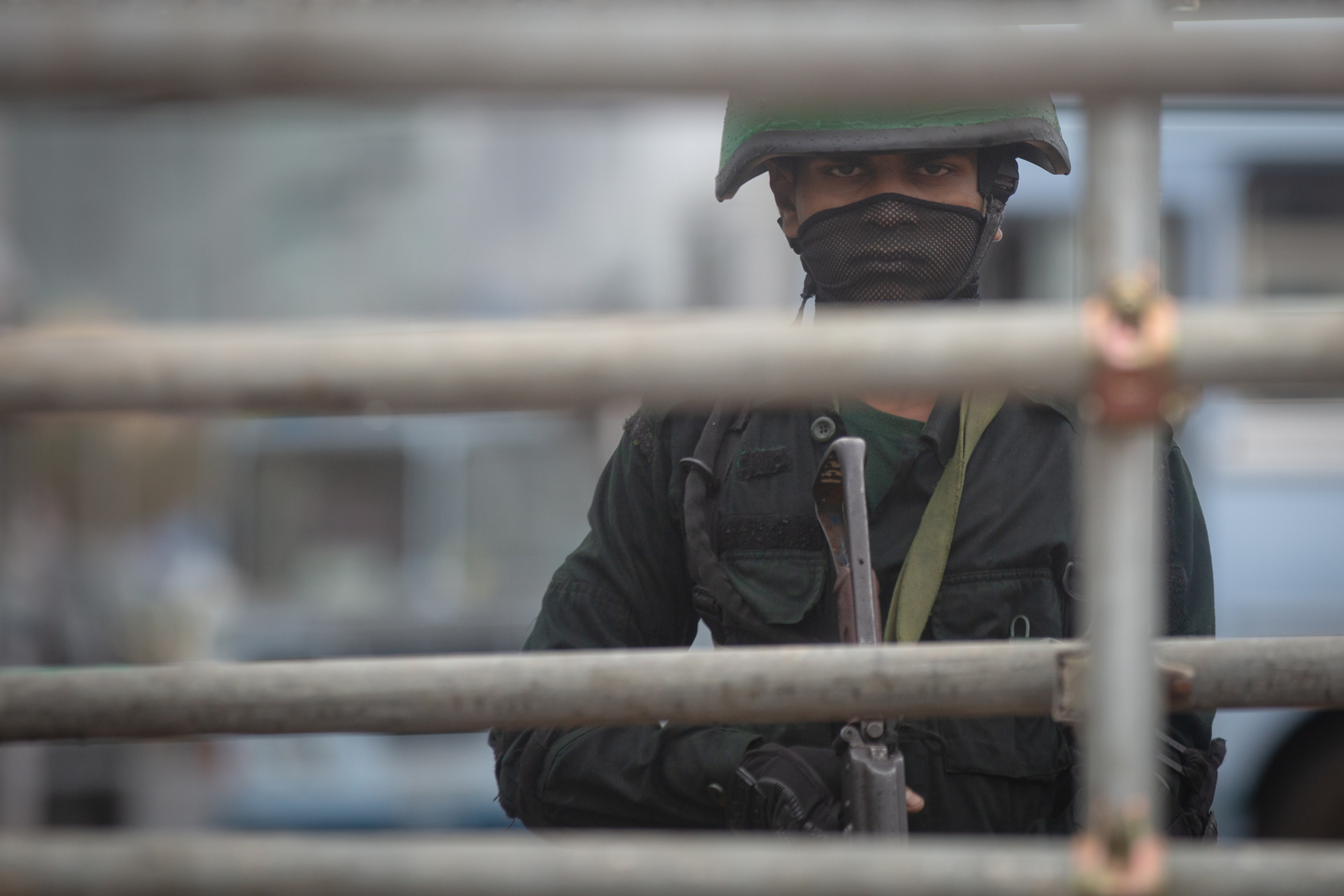
Photo by Abhishek Chinnappa/Getty Images
COLOMBO, SRI LANKA – JULY 22: A soldier stands behind barricades in front of the Presidential Secretariat on July 22, 2022 in Colombo, Sri Lanka. Sri Lankan soldiers raided the anti-government protest camp established outside the Presidential Secretariat in the early morning hours of July 22, breaking down tents and forcibly removing activists. (Photo by Abhishek Chinnappa/Getty Images)
No warning given
Eyewitness accounts suggest that the attack on protestors and their tents came as a complete surprise, even though there had been some rumours that there may be an attack. Protesters had been caught off-guard as they could not understand the reasons behind such an attack. There was no warning given to vacate the area by the military and police personnel before the use of brute force against the protestors.
Another female eyewitness, who had been asleep at the protest site when it was raided, told Amnesty International, “At around 1.30 a.m. there was shouting (from other protestors) saying ‘they have surrounded us, they have surrounded us, get up, get up.’ When I went outside, I saw a large group of army people coming towards us. Some of them had covered their faces so I don’t know who they are… There was no announcement… They hadn’t told (us) to move out. Suddenly, they had started hitting the tents around us. They hit the youth the same way they hit the tents.”
Amnesty International calls for an independent and impartial investigation into the incident. The perpetuators of the violence, and those who commanded the attack, must be identified and held accountable for their actions.
They hadn’t told (us) to move out. Suddenly, they had started hitting the tents around us. They hit the youth the same way they hit the tents.
Eyewitness
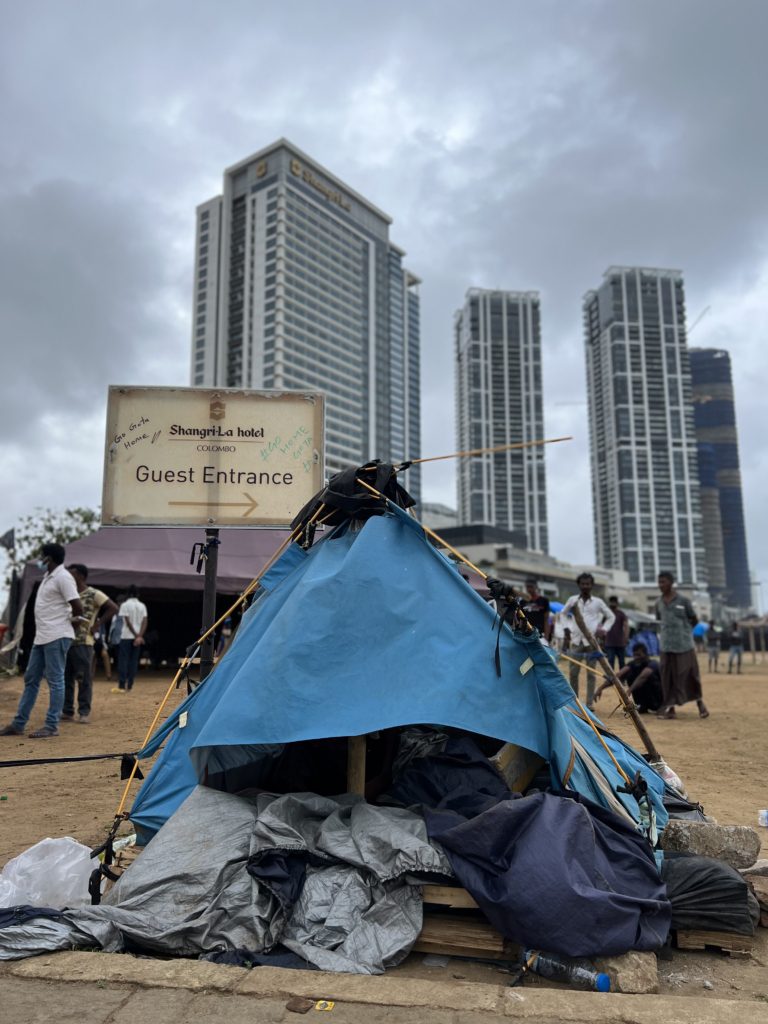
Sri Lanka: Broken tent at protest site. Photo by Thyagi Ruwanpathirana/Amnesty International
Denial of access to lawyers and media
The newspaper The Hindu reported that around 3.00 a.m. as news of the attack spread, media and activists reached the spot but were denied access as raids were ongoing. A security personnel stationed on Galle Road leading to the protest site reportedly said, “No one can go. Not even the media or lawyers.”
A BBC video journalist was reportedly beaten by the military and his phone snatched by a solider and videos deleted.
Lawyers who sought to intervene in their professional capacity were also reportedly prevented from doing so by security forces. At least two were reportedly assaulted.
Several journalists and at least one lawyer has reportedly been detained.
“Sri Lankan authorities must refrain from arresting people for exercising their right to peaceful assembly within sight and sound of the intended target of the protest’s claims. In addition any arrest must follow due process safeguards such as prompt access to legal counsel. We are very concerned by the human rights violations currently taking place in Sri Lanka as the authorities are using unlawful force and restrictions on movement in an attempt to quell dissent,” said Kyle Ward.
No one can go. Not even the media or lawyers.
Security personnel to media
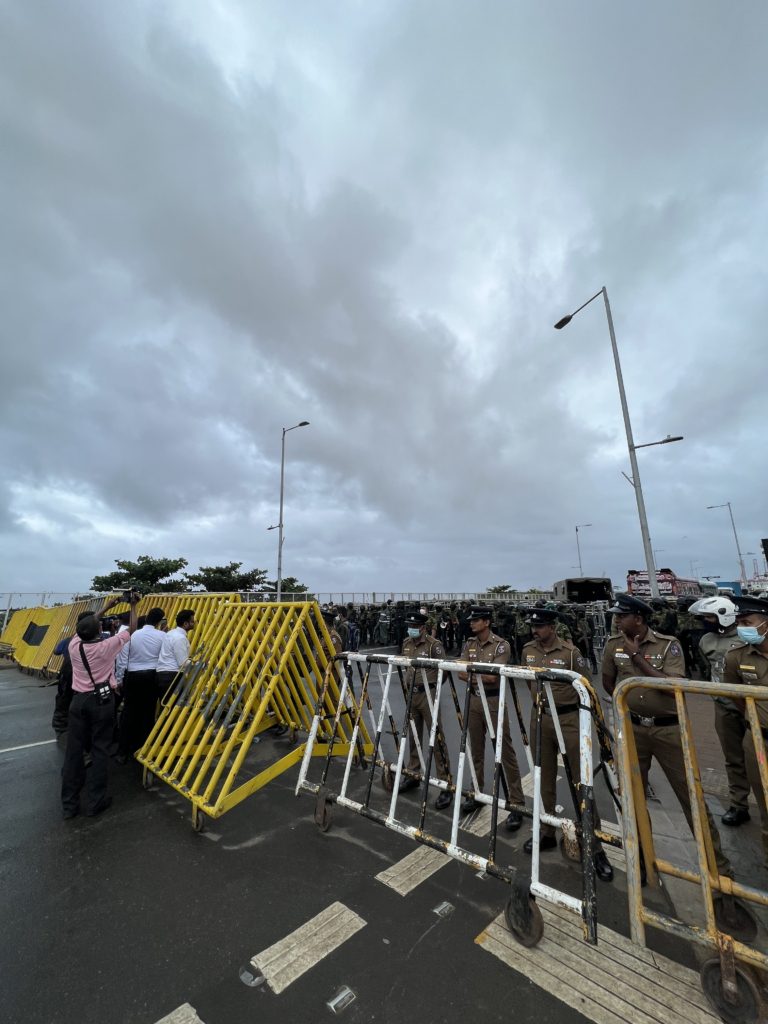
Security cordon in Colombo. Photo credit Thyagi Ruwanpathirana/Amnesty International
Security cordon in Colombo. Photo credit Thyagi Ruwanpathirana/Amnesty International
Tents of monks, deaf and mute demonstrators’ and soldiers with disabilities attacked
The security personnel aggressively dismantled protesters’ tents put up at the demonstration site, including those of the deaf and mute community and soldiers with disabilities who had been part of the peaceful protests since April.
‘I saw them hitting people on both sides and coming towards us. We ran the other way since they were chasing us… The deaf and mute demonstrators’ group had a very young translator with them. That group is usually in that area. No one knows what happened to them… no one could find them. At the ‘war heroes’ tent there was a small group of soldiers with disabilities, there were some monks in front as well… they had hit them also,” recounted an eyewitness to Amnesty International.
Widespread anger and fear
Ranil Wickremesinghe was sworn in as President on Thursday after ex-president Gotabaya Rajapaksa fled the country last week. A new Prime minister took oath today. After a 100 days of protest, there was a pledge by the protestors to vacate parts of the protest site on Friday. But the military’s aggressive takeover of the protest site under cover of darkness less than 24 hours after the change in regime, is shocking.
“We think what the government did, attacking a peaceful struggle was wrong,” said a protestor and an eyewitness to the Friday morning incident.
We think what the government did, attacking a peaceful struggle was wrong.
Eyewitness
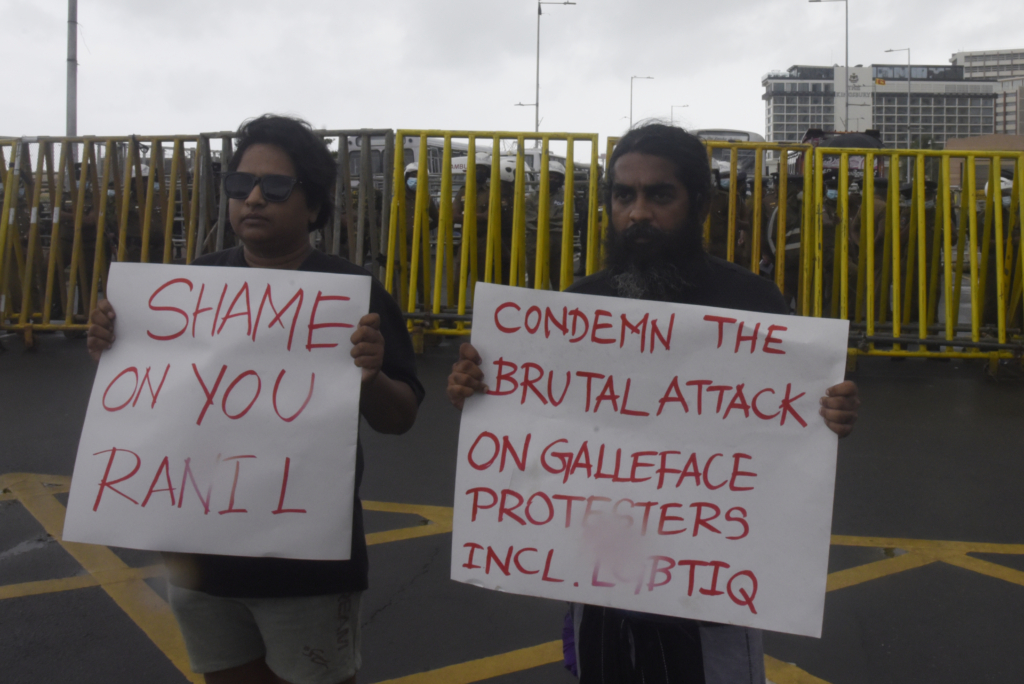
Photo by Akila Jayawardana/NurPhoto via Getty Images
Civil activists protests during protest against early morning military attack in Gota Go Gama near in Colombo, Sri Lanka July 22, 2022 (Photo by Akila Jayawardana/NurPhoto via Getty Images)
Amidst appeals to the international community to assist Sri Lanka, Amnesty International calls on the authorities to take action immediately to protect the rights of those peacefully protesting at GotaGoGama in Colombo and in other places in Sri Lanka. The charges against all the protesters must be dropped as they were detained solely for peacefully exercising their human rights.
“Justice and accountability from the Sri Lankan authorities is the need of the hour as Sri Lanka looks towards stability ahead of an IMF bailout to address the economic crisis. Amnesty has repeatedly called for restraint from security forces amidst the emergency regulations enforced in the country. Using them as a pretext for more human rights violations is deeply concerning and reflects poorly on the new administration in Sri Lanka. They must not lose their chance to start afresh and break off from the cycle of repression of people’s rights which further compounds the mistrust and fear in the people of Sri Lanka. Their right to peaceful protest must be protected,” said Kyle Ward.
The right to peaceful protest must be protected.
Kyle Ward
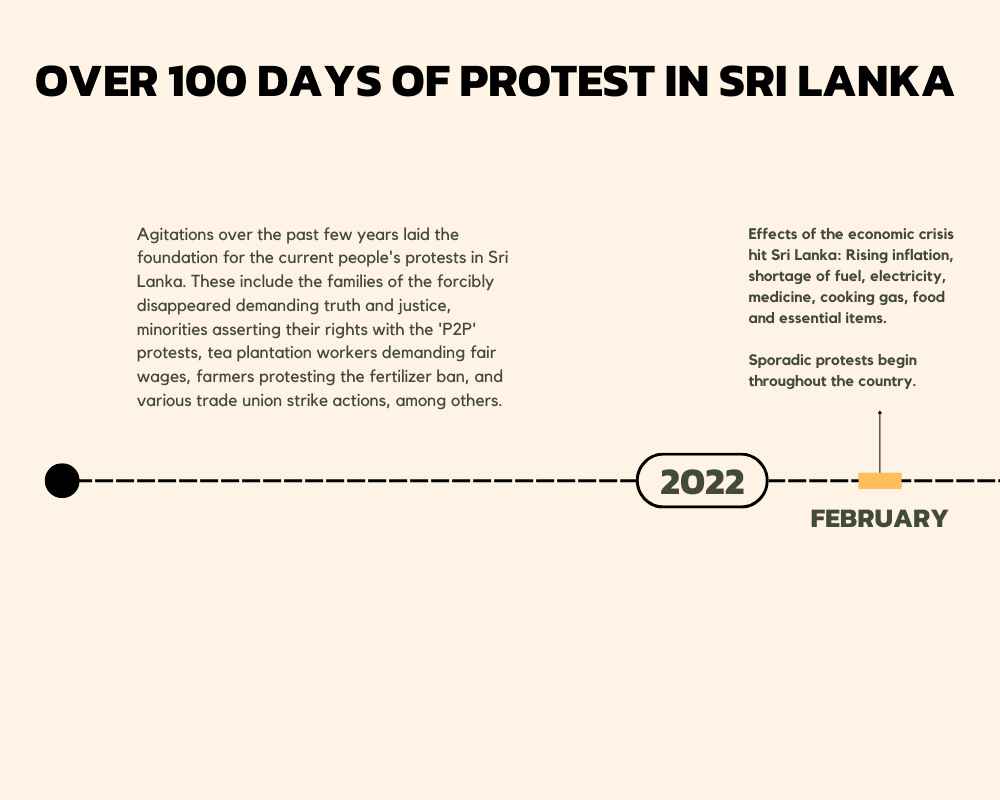
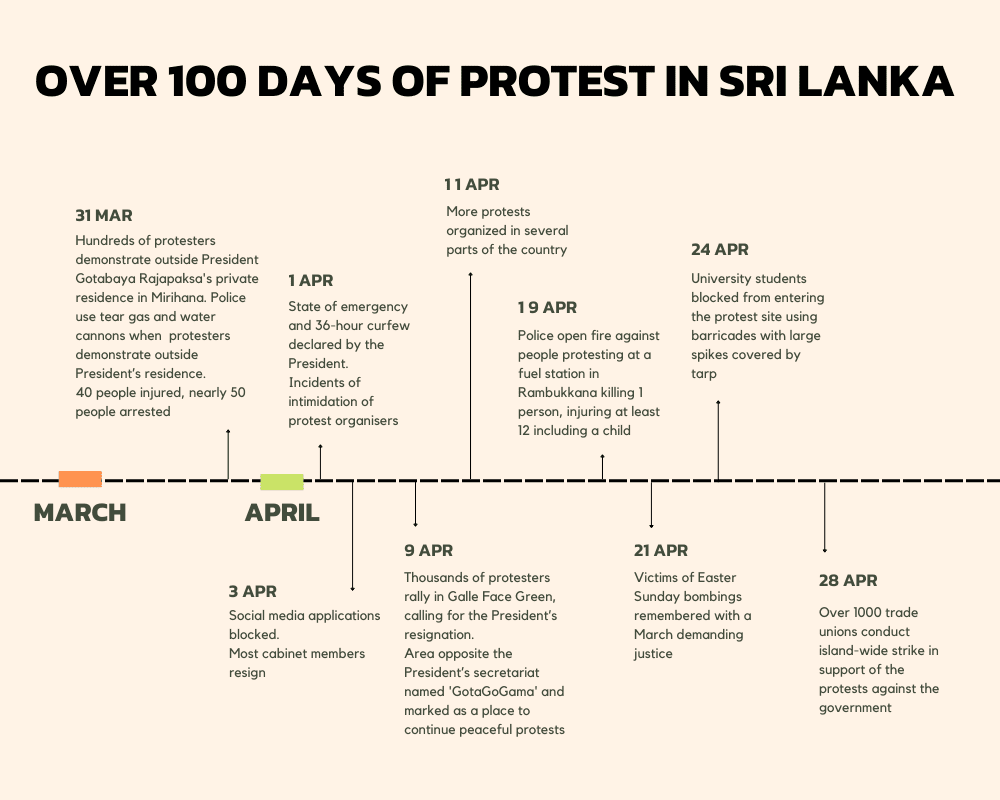
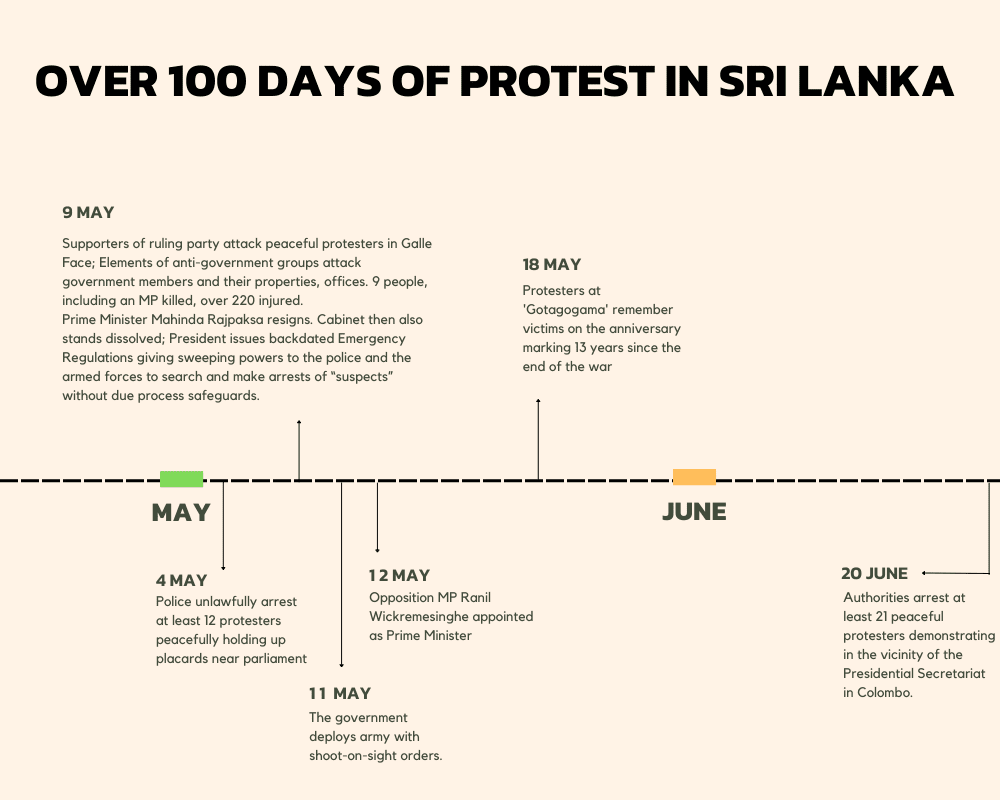
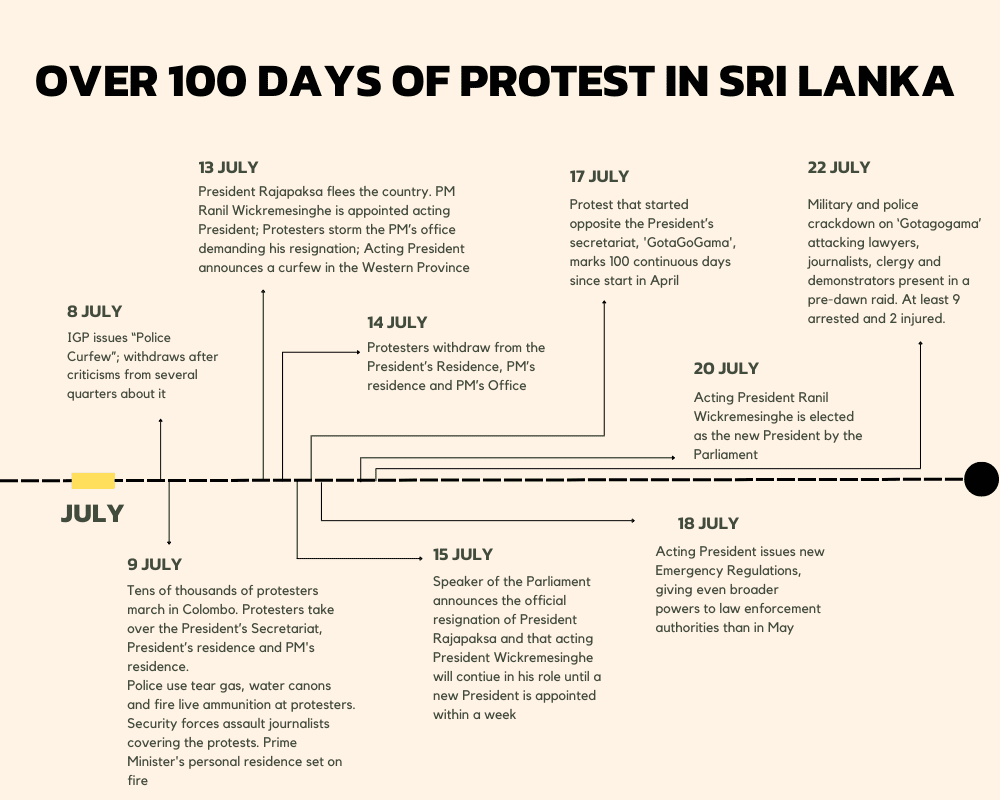
Timeline of over 100 days of protest in Sri Lanka:
Last week, Meta released its first annual Human Rights Report, covering all the company’s platforms and products including Facebook, Instagram and WhatsApp.
Meta – beleaguered by a wave of scandals following shocking revelations from the leaked “Facebook Papers” – says the report is inspired by the requirement under the UN Guiding Principles on Business and Human Rights that companies “know and show” that they respect human rights.
However, the Human Rights Report appears to be a cursory and selective analysis of the company’s human rights impacts, conspicuously failing to disclose any information on the most pressing threats the company is posing to human rights worldwide.
What about the business model?
The Human Rights Report makes no mention of the root cause of Meta’s systemic threat to human rights – the surveillance advertising business model, which drives the company to collect ever more – and ever more personal – data on users, to then sell targeted ads.
As Amnesty International highlighted in the 2019 Surveillance Giants report, Meta’s business model represents a serious threat to human rights including the rights to privacy, freedom of expression and non-discrimination. This is a glaring omission in Meta’s assessment – indeed, the business model is the core problem regarding the company’s adverse impacts on human rights across the globe.
Many of the human rights harms caused by the company stem from their need to maintain user engagement and keep people on their platforms. It may be a tough pill to swallow, but Meta simply cannot claim to be serious about human rights – particularly the right to privacy – whilst continuing to track users across the internet and in their day-to-day lives.
Absence of algorithms
Similarly, the report makes no mention of how the content-shaping algorithms on Meta’s social media platforms actively amplify harmful content including hate and discrimination, to keep people engaged and drive further advertising profit.
The design of these algorithms means that Meta risks contributing to ethnic violence across the world. UN experts have already found that the Facebook platform played a role in the dehumanisation of Rohingya Muslims in Myanmar in the lead up to, and during, the campaign of violence led by the Myanmar military in 2017.
In 2021, Meta whistleblower Frances Haugen accused the platform’s algorithms of “literally fanning ethnic violence” in places like Ethiopia.
Given that the risks these algorithms present is greatly heightened in the Global South where Meta-owned platforms such as Facebook are synonymous with the internet, it is extremely concerning that they have not been included in Meta’s Human Rights Report.
Lack of transparency on India
Meta published only a summary of the long-awaited independent Human Rights Impact Assessment (HRIA) on India – an unacceptable decision, given that civil society groups, including Amnesty International, have repeatedly called for the publication of the full report. This demonstrates a complete lack of transparency regarding the human rights risks identified, and how Meta mitigates these in the Indian context. Researchers have already pointed out the role that the Facebook platform played in spreading hate in India – what we need to know is how Meta will ensure that this does not happen again.
It has been well-documented that Meta has struggled to tackle problematic content on the Facebook platform, particularly in the Global South. However, simply ignoring the problem will not make it go away. Meta should show they are serious about learning the lessons of the past and publish the full HRIA on India.
It is particularly important that Meta show they are learning the lessons of the past in India, the country with the highest number of Facebook users. Transparency is crucial in order to address the harms of Meta’s business model globally. Instead, it seems clear that Meta is refusing to publish the HRIA because it does not want the wider world to know the truth about its operations in the country.
Failure to assess and address human rights risks
While it is welcome that Meta has made a firm commitment to respect human rights in line with international standards, the Human Rights Report fails to address some of the company’s most pressing human rights impacts. In particular, the lack of transparency on the India HRIA is an appalling attempt to whitewash Meta’s impacts in the country and a missed opportunity for the company to demonstrate a serious commitment to human rights.
Meta must be willing to grapple with difficult questions around their business model, in order to fully address the human rights risks of their platforms. Until they are, their alleged efforts to respect human rights will consist more of style than substance.
Responding to the reported execution of Nazeri bin Lajim in Singapore today, Amnesty International’s death penalty expert Chiara Sangorgio said:
“Five people have been hanged this year in Singapore, in a period of less than four months. This relentless wave of hangings must stop immediately. The use of the death penalty in Singapore, including as mandatory punishment for drug-related offences, violates international human rights law and standards.”
“Everyone executed in Singapore in 2022 has been sentenced to the mandatory death penalty for drug-related offenses. Rather than having a unique deterrent effect on crime, these executions only show the utter disregard the Singaporean authorities have for human rights and the right to life.”
Rather than having a unique deterrent effect on crime, these executions only show the utter disregard the Singaporean authorities have for human rights and the right to life.
Chiara Sangorgio, death penalty expert at Amnesty international
“We call on governments, the United Nations Office on Drugs and Crime, and the International Narcotics Control Board to increase pressure on Singapore so that international safeguards on the death penalty are respected and drug control policies are rooted in the promotion and protection of human rights. Singapore’s highly punitive approach does neither.”
Background
Singapore national Nazeri bin Lajim’s execution was on Friday, 22 July 2022. Nazeri was sentenced to the mandatory death penalty in 2017 after being found guilty of possession of 33.39 grams of diamorphine (heroin) for the purposes of trafficking in 2012.
International law and standards prohibit the imposition of mandatory death sentences, and require that the use of the death penalty be restricted to the “most serious crimes” or crimes of extreme gravity involving intentional killing.
Singapore has carried out five executions this year, all of people convicted of drug offences, after a pause of over 2 years during the pandemic. Going against a worldwide trend towards abolishing the death penalty, Singapore is just one of four countries known to have executed people for drug-related offenses in recent years.
Both the United Nations Office on Drugs and Crime (UNODC) and the International Narcotics Control Board (INCB) – the UN bodies tasked with crime prevention and drug policy – have condemned the use of the death penalty for drug-related offences and have urged governments to move towards abolition. In fact, the UN Common Position on drugs has always been to urge governments to shift away from punitive responses because of their ineffectiveness in reducing drug trafficking or in addressing the use and supply of drugs.
Amnesty International opposes the death penalty in all cases without exception. As of today, 110 countries have abolished the death penalty for all crimes and more than two-thirds are abolitionist in law or practice.