Myanmar: Former UK ambassador, artist husband jailed for one year

Responding to reports that former UK ambassador Vicky Bowman and her Burmese husband Htein Lin have been sentenced to one year in prison on immigration charges, Amnesty International’s Deputy Regional Director for Campaigns Ming Yu Hah said:

“Since the coup, we have seen activists, artists, journalists, students, business owners, and medical professionals arbitrarily detained and jailed by the military on the slightest pretext.

“The latest reports on the conviction of the former UK ambassador and her Burmese artist husband are extremely concerning. Myanmar’s military has a notorious track record of arresting and jailing people on politically motivated or trumped-up charges.

“More than 15,000 people have been arrested since the military seized power in a coup last year, and many are languishing in a vast network of detention and interrogation facilities where they have faced torture or other ill-treatment.”

Background:

Media reports on 2 September said Vicky Bowman and her husband Htein Lin had been sentenced to a year in prison. The military authorities previously said in a statement that both had been accused of violating immigration laws with regard to their registered address.

Bowman is the head of the Myanmar Centre for Responsible Business, which advises companies on human rights issues in the country. She was the UK ambassador to Myanmar from 2002-2006. Her husband, Htein Lin, is a former political prisoner and prominent artist.

Myanmar has arrested more than 15,000 people since the military seized power in a coup on 1 February, 2021, according to the Assistance Association for Political Prisoners. It has also carried out four executions, the first in the country for decades.

Those detained include peaceful protesters, former civilian leader Aung San Suu Kyi, and several of her top allies such as ousted President Win Myint. Both are facing numerous trumped-up or politically motivated charges.
Conditions in Myanmar detention facilities are dire, as Amnesty International documented the recent report “15 Days Felt like 15 Years,” which showed how torture and other ill-treatment is used to crush resistance to the coup.

The post Myanmar: Former UK ambassador, artist husband jailed for one year appeared first on Amnesty International.

India: The Government must end the repression of rights in Jammu and Kashmir


India: The Government must end the repression of rights in Jammu and Kashmir

The Indian government has drastically intensified the repression of rights in Jammu & Kashmir in the three years since the change in status of the region, Amnesty International said in a new briefing released today.

The new briefing, “We are being punished by the law”: Three years since of abrogation of Article 370 in Jammu & Kashmir, documents how civil society at large and journalists, lawyers, human rights defenders in particular have faced relentless interrogations, arbitrary travel bans, revolving door detentions and repressive media policies while blocking access to appeals or justice in courts and human rights bodies.

“For three years now, civil society and media in Jammu and Kashmir have been subjected to a vicious crackdown by the Indian government, which is determined to stifle dissent using draconian laws, policies and unlawful practices in their arsenal,” said Aakar Patel, chair of the board of Amnesty International India.

“By harassing and intimidating critical voices, authorities are targeting all credible, independent sources of information in and about Jammu and Kashmir. There is a silence achieved on all dissent through heavy handed repression which has spread fear and uncertainty in the region.”

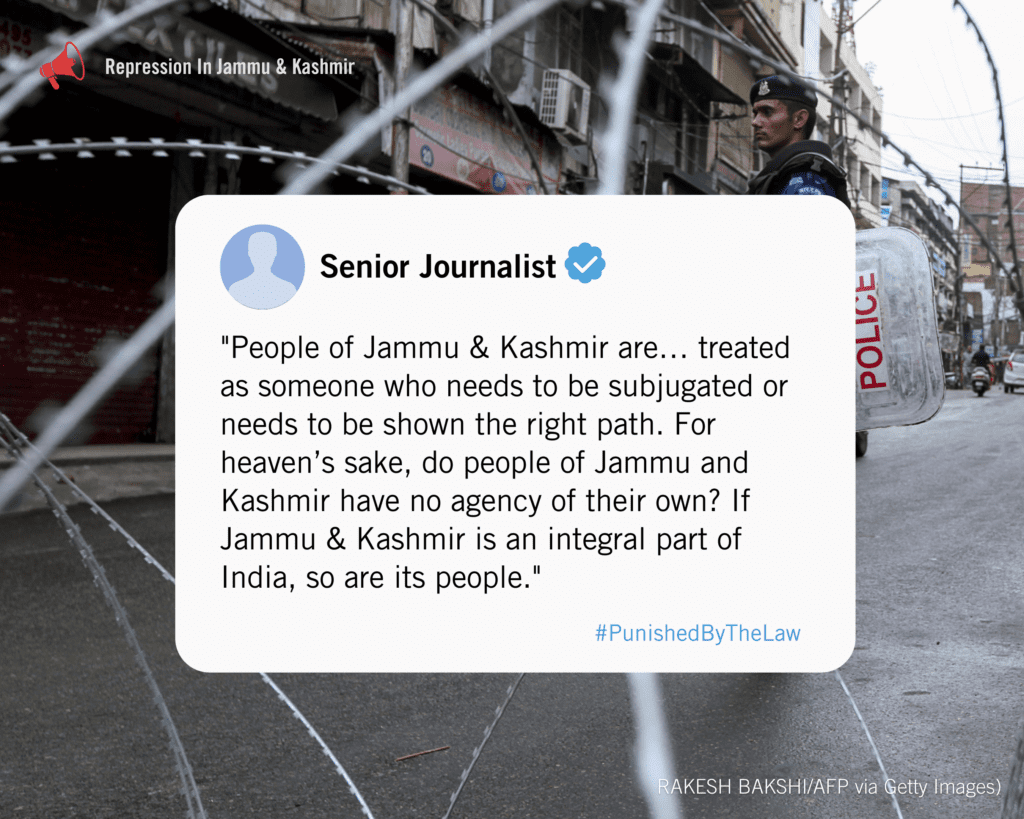
"People of Jammu & Kashmir are… treated as someone who needs to be subjugated or needs to be shown the right path. For heaven’s sake, do people of Jammu and Kashmir have no agency of their own? If Jammu & Kashmir is an integral part of India, so are its people." says a senior journalist from Kashmir

none

For three years now, civil society and media in Jammu and Kashmir have been subjected to a vicious crackdown by the Indian government which is determined to stifle dissent.

Aakar Patel, chair of the board of Amnesty International India

none

Assault on Freedom of Expression and Movement

Amnesty International has recorded at least 60 instances of crackdown on journalists and human rights defenders since August 2019.

A Kashmiri journalist who has been harassed by the authorities told Amnesty International, “They (security forces) tell you in so many ways – subtle as well as brazen – that the cost of pursuing journalism in Jammu & Kashmir is huge.”

The Indian government has total control on information coming of out of the region after passing restrictive media policies such as the 2020 Revised Media Policy and 2021 Film Policy. After an initial six-month internet shutdown, the Indian authorities still often suspend internet services in various parts of Kashmir often without any prior notice. In addition, the sudden forced closure of the Kashmir Press Club in 2022 by the Indian government was a big blow to the already disintegrating media pool.

Amnesty International also found that in the last three years, at least six individuals including journalists, human rights activists and academics were stopped from travelling abroad (despite having requisite travel documents) in violation of their right to freedom of movement through arbitrary executive actions not backed by any court order or warrant or even a written explanation.

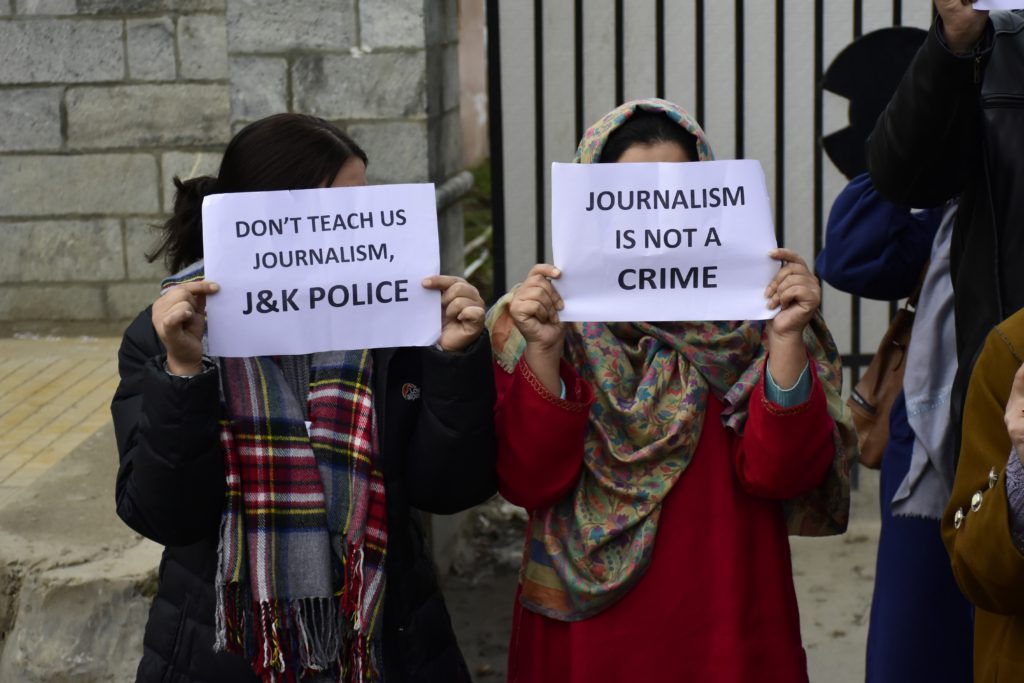
Kashmiri journalists hold placards during a protest against the high handedness of Indian forces in Srinagar, Indian Administered Kashmir on 18 December 2019. Journalists took to the streets after some of the journalists were beaten by Forces yesterday while they were covering the student protests in old city srinagar. (Photo by Muzamil Mattoo/NurPhoto via Getty Images)

none

©Amnesty International

Abuse of security laws and agencies

According to the data gathered by Amnesty International, at least 27 journalists have been arrested and detained by the Indian authorities since 5 August 2019. 

Several journalists including Fahad Shah, Aasif Sultan and Sajad Gul have been subjected to ‘revolving door’ arrests. In a continuing pattern, they have been arrested under one law, granted bail by the court, and then re-arrested almost immediately under the Unlawful Activities (Prevention) Act (UAPA) – India’s primary anti-terror law in Jammu & Kashmir, keeping them perpetually detained.

A lawyer who handles such cases in southern Kashmir told Amnesty International, “Since 2016, the increased malicious use of anti-terror laws makes it difficult for people to secure bail. [It] provides more flexibility to the police in keeping the person in pre-trial detention for 180 days even though the… chargesheets filed by the police [reads] nothing less than a fiction book or novel.”

Amnesty International reviewed 1346 cases available on the website of the High Court of Jammu & Kashmir. It found that by 1 August 2022, the number of writ petitions have increased by 32%, indicating an increase in unlawful detention in the last three years. Amnesty International also reviewed the data published by National Crime Record Bureau and found that there has been a 12% increase in the use of UAPA in Jammu & Kashmir since 2019. This emerging trend of using the draconian UAPA in addition to the much-abused Public Safety Act (PSA) is also evidenced by an analysis of information on the High Court’s website.

Other intimidation tactics include malicious investigations and raids by the National Investigation Agency (NIA), and the Enforcement Directorate. 

A senior editor of a prominent daily newspaper told Amnesty International, “When the NIA raids a journalist’s house or the Enforcement Directorate threatens an editor with false cases, it does not only impact that journalist or editor but the entire community. They fear they can be next. It has become impossible for journalists to continue their work independently.”

In 2020, the NIA conducted multiple raids on the residences and offices of well-known human rights defenders like Khurram Parvez, three of his associates and Parveena Ahanger. Raids have also been carried out on the offices of the newspaper Kashmir Times,NGOs Athrout and GK Trust and on the residence of Agence France-Presse’s Kashmir correspondent Parvez Bukhari.

Amnesty International spoke with Khurram Parvez’s wife, Sameena after his subsequent arrest. She recounted, “The NIA officials seized the (personal) phones of everyone (in the joint family) including our domestic help along with office laptops. In total, there were 21 devices… they kept asking about some of the names in his (old) diary and on a bunch of visiting cards. How can that be used to charge Khurram under India’s anti-terror law and accuse him of waging a war against the country?”

Raids without a legal basis constitute a clear violation of the right to freedom of expression, as enshrined in the International Covenant on Civil and Political Rights.

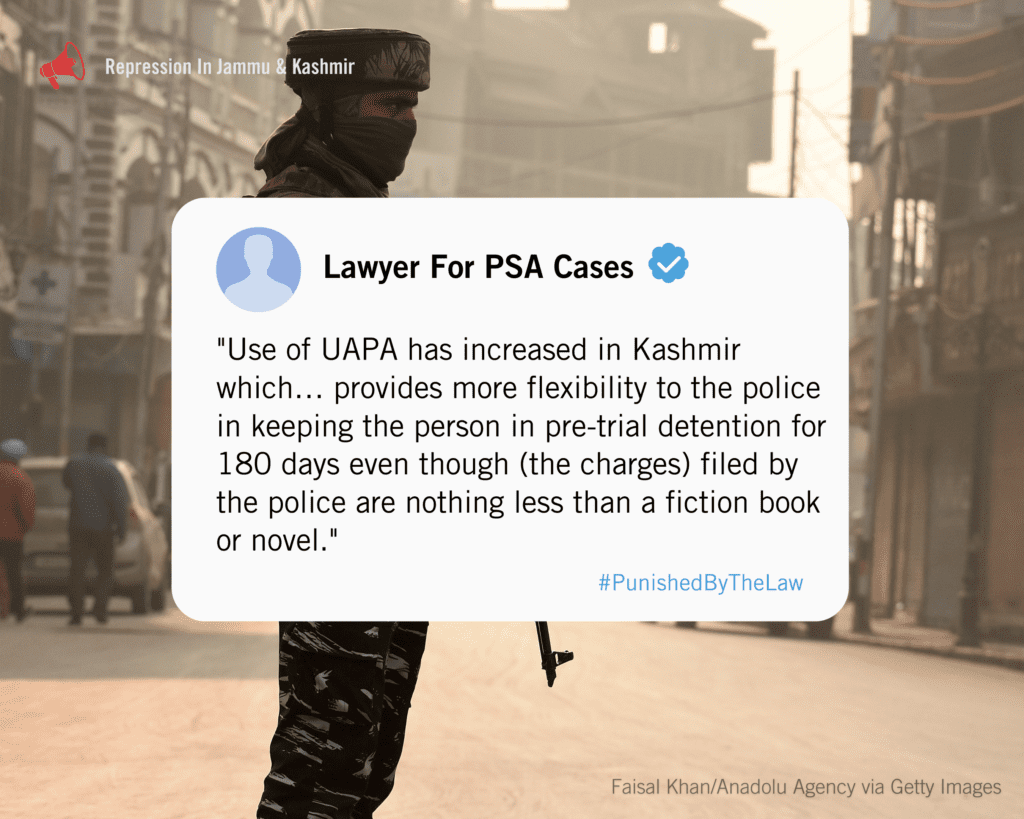
"Use of UAPA has increased in Kashmir which… provides more flexibility to the police in keeping the person in pre-trial detention for 180 days even though (the charges) filed by the police are nothing less than a fiction book or novel." says a Lawyer for PSA cases in kashmir
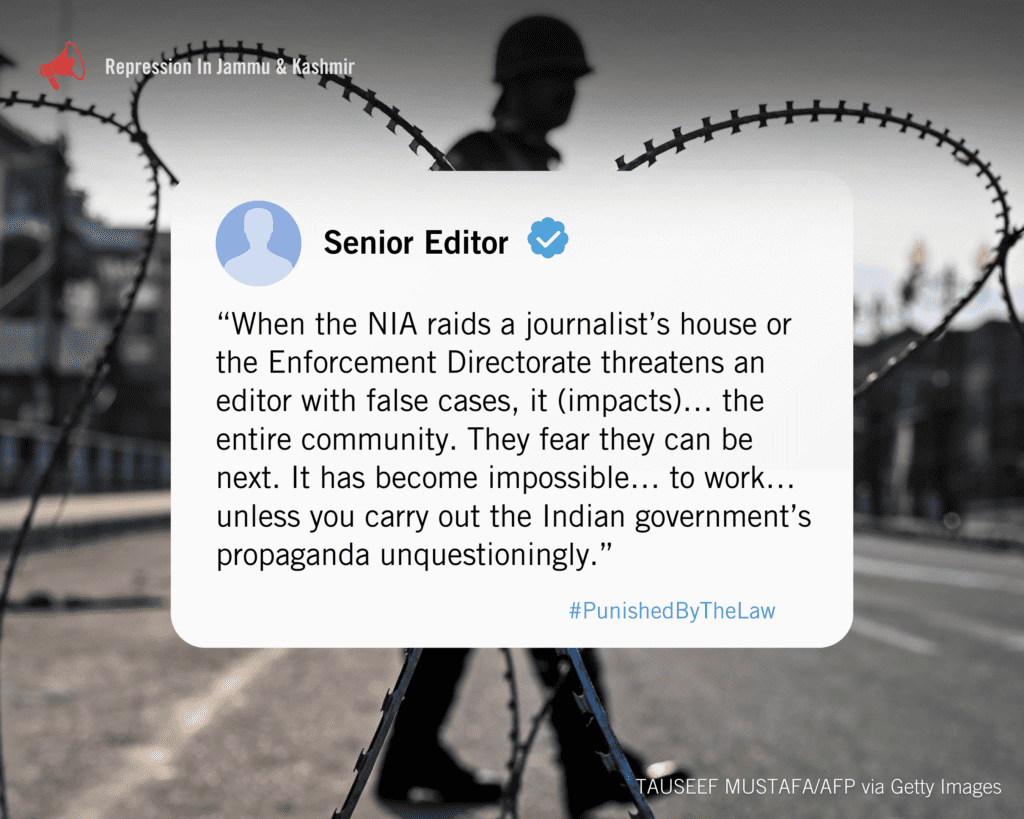
“When the NIA raids a journalist’s house or the Enforcement Directorate threatens an editor with false cases, it (impacts)… the entire community. They fear they can be next. It has become impossible… to work… unless you carry out the Indian government’s propaganda unquestioningly.” Says a senior editor in Kashmir

none

Unlawful Killings

The people of Jammu & Kashmir, in particular the Hindu minority community have faced unlawful killings by armed groups which have recently increased. An analysis of the official data by the Government of India shows that unlawful killings of civilians by armed groups have increased by 20% in the past three years. 

Additionally, the government recently revealed that Jammu & Kashmir accounted for the highest number of deaths involving the police (police encounters) in India between April 2020 and March 2022. There is a lack of accountability for use of force in the region by the police due to the continued enforcement of the Armed Forces (Special Powers) Act (AFSPA) which grants them additional powers and impunity and falls short of international human rights standards.

The government has a duty under international law to take measures to protect civilians and to bring to justice those who order, plan and carry out such attacks or killings in a fair trial without resorting to the death penalty.

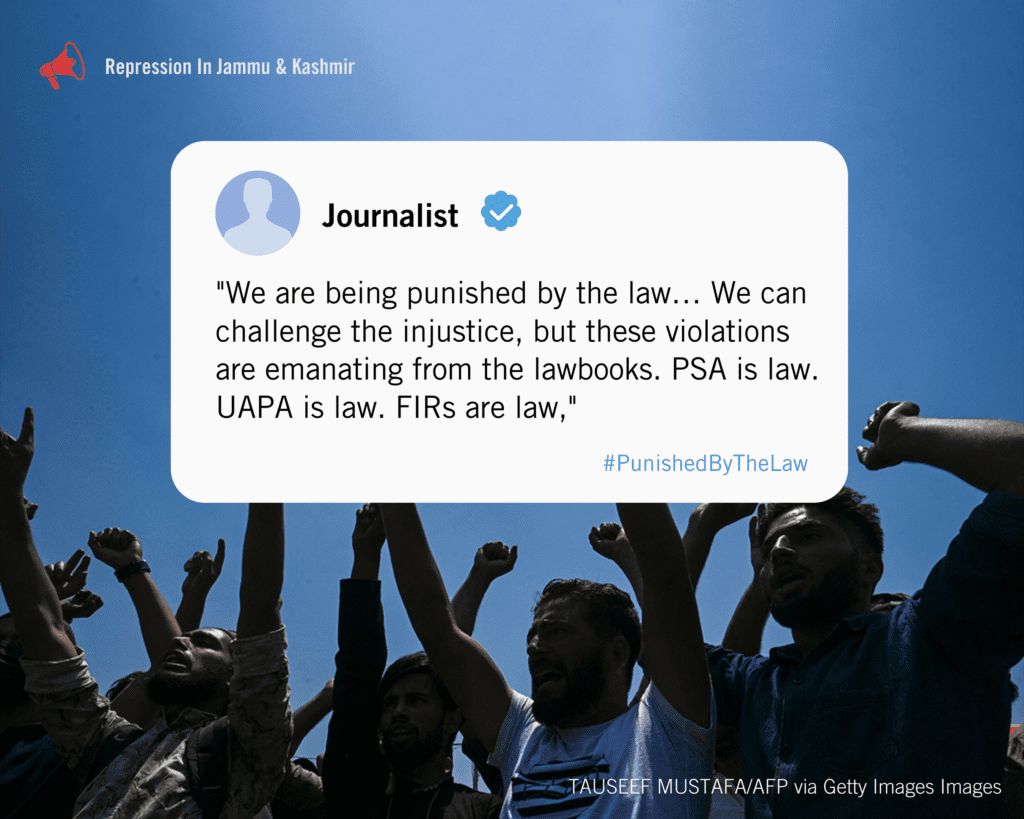
"We are being punished by the law… We can challenge the injustice, but these violations are emanating from the lawbooks. PSA is law. UAPA is law. FIRs are law," says a journalist in kashmir

The Indian authorities must end the long-drawn repression in Jammu and Kashmir immediately.

Aakar Patel

none

Amnesty International calls on the Indian government to immediately release those arbitrarily detained under administrative detention and other repressive laws and ensure that they are tried promptly and fairly in a regular court.

Amnesty International also calls on the international community to hold the Government of India accountable for its grave human rights violations in Jammu & Kashmir and ensure its cooperation with United Nations Mechanisms and facilitate immediate and independent investigation in the region.

“The government’s use of unlawful measures and unjust barriers impeding various rights in the region must be removed without further delay. The Indian authorities must end the long-drawn repression in Jammu and Kashmir immediately,” said Aakar Patel.

The post India: The Government must end the repression of rights in Jammu and Kashmir appeared first on Amnesty International.

Kuwait: Authorities must stop targeting pro-Bidun protesters as elections loom

Kuwaiti authorities have arrested 18 people in Kuwait, including three candidates for upcoming parliamentary elections, for taking part in a peaceful demonstration the previous week in support of Kuwait’s stateless Bidun community, Amnesty International said today.

On 31 August 2022, the Office of Public Prosecution summoned them for investigation on charges that could lead to up to nine months imprisonment and ordered their pre-trial detention pending further investigation.

“This is a blatant attempt by the Kuwaiti authorities to intimidate people who are exercising their rights to freedom of expression and of peaceful assembly. Instead of listening to the demonstrators’ calls for the rights of stateless Bidun people to nationality, education and healthcare, the authorities are seeking to silence and punish them,” said Amna Guellali, Amnesty International’s Deputy Regional Director for the Middle East and North Africa.

“The authorities must drop any and all legal action against these peaceful protesters. Ahead of parliamentary elections in September, the Kuwaiti authorities must respect the rights of everyone in Kuwait to participate freely and peacefully in public affairs, which includes the right to join peaceful demonstrations and to freely express their demand for basic rights.”

On 30 and 31 August, Kuwaiti officials from the Ministry of Interior summoned 18 people and brought them before the Office of Public Prosecution for interrogation in relation to their participation in a 26 August demonstration. Four were summoned on the night of 30–31 August and the other 14 were summoned the next day, 31 August. All remain in detention for further questioning by the Office of Public Prosecution.

Instead of listening to the demonstrators’ calls for the rights of stateless Bidun people to nationality, education and healthcare, the authorities are seeking to silence and punish them.

Amna Guellali, Amnesty International

The 18 individuals face prosecution under Kuwait’s Law on Public Meetings and Gatherings for participating in an unauthorized demonstration and failing to disperse from the gathering after being ordered to do so. Under Articles 16 and 20 of that law, together these two charges carry a sentence of up to nine months in prison.

In addition to the Bidun organizers of the demonstration on 26 August, six legally recognized Kuwaiti nationals took part and are among those brought before the Office of Public Prosecution. The demonstration in the Taima area of al-Jahra province, west of Kuwait City, was organized by Bidun activists calling for the dissolution of the government agency which regulates Bidun affairs, the Central System for the Remedy of the Situation of Illegal Residents, which Bidun activists accuse of perpetuating their statelessness and increasing restrictions on their access to education, healthcare and other services.

The Central System accuses the Bidun of being “non-natives” who entered the country “illegally”. ‘Bidun’ (also bedoon or bidoon) means ‘without’, short for ‘without nationality’. However, tens of thousands have been born in Kuwait, many have documents showing that their parents and grandparents were born in Kuwait, and under international law such as the Convention on the Rights of the Child, to which Kuwait is a party, all children have the right to a nationality. There are tens of thousands of stateless Bidun people in Kuwait, who lack access to the same level of services as recognized Kuwaiti nationals. The International Covenant on Civil and Political Rights, which Kuwait has ratified, protects the right to freedom of expression (Article 19) and the right to freedom of peaceful assembly (Article 21). It also recognizes the rights of all to education and to the highest attainable standard of health.

The post Kuwait: Authorities must stop targeting pro-Bidun protesters as elections loom appeared first on Amnesty International.

Yemen: Huthis ‘suffocating’ women with requirement for male guardians

The Huthi de facto authorities must end their mahram (male guardian) requirement, which bans women from travelling without a male guardian or evidence of their written approval across governorates under Huthi control or to other areas of Yemen, Amnesty International said today.     

Increasingly since April, tightened Huthi restrictions have hindered Yemeni women from carrying out their work, especially those who are required to travel. The restraints imposed by the mahram requirement also apply to Yemeni female humanitarian workers who have struggled to conduct fieldwork, thereby directly impacting access to aid for Yemenis in need and particularly for women and girls.

“The Huthi de facto authorities must immediately lift the mahram requirement. This restrictive rule constitutes a form of gender-based discrimination and entrenches the discrimination faced by women in Yemen on a daily basis. Yemeni women urgently need to be able to move around the country freely in order to work, to seek health care and to give or receive humanitarian aid,” said Diana Semaan, Acting Deputy Director of the Middle East and North Africa.

“The international community should pressure the Huthis to stop imposing mahram restrictions on women. Yemen is already facing a catastrophic humanitarian crisis, and there is now a very real risk that women and girls will stop receiving aid if women humanitarian workers continue to be banned from travelling without a male guardian.”

Under international humanitarian law, all parties to the armed conflict in Yemen, including the Huthis, must facilitate rapid and unimpeded passage of impartial humanitarian assistance to civilians in need and ensure the freedom of movement of humanitarian relief personnel without discrimination. The mahram restriction is contrary to this obligation.

The mahram requirement, which is not part of Yemeni law is being enforced by the Huthis through verbal directives.  Since April, the Huthi de facto authorities have increasingly insisted on the mahram requirement to restrict the movement of women across areas they control in northern Yemen, including Saada, Dhamar, Hodeidah and Hajjah governorates, and Sanaa.

This [mahram requirement] restrictive rule constitutes a form of gender-based discrimination and entrenches the discrimination faced by women in Yemen on a daily basis.

Diana Semaan, Amnesty International

Amnesty International interviewed five women activists and members of local organizations, all of whom were subjected to the mahram requirement when attempting to travel for work between April and August, and seven experts with knowledge of how mahram restrictions have impacted the delivery of humanitarian aid.

‘They are suffocating us’

In early August, multiple car rental companies told Afrah*, 36, that she could not rent a car to travel from Sanaa to Aden governorate for work unless she travelled with a male guardian.

“My husband had to take leave from his work, and I had to take my daughter out of her school so that I could meet the mahram requirement and be able to travel to Aden for my work,” she told Amnesty International. “We had to submit to the authorities copies of our IDs, the family record that proves we are married, and a birth certificate for my daughter to be able to rent a car and travel.

“The mahram restriction gives men more control over our lives and allows them to micromanage our movement and activities. They are suffocating us.”

Noura*, 48, was blocked from renting a car to travel across governates in July unless she could provide written approval from her younger brother.

“My brother, who is supposed to be my mahram, is 10 years younger than me,” she told Amnesty International. “When he gave me his written approval note, he apologized that he had to do this for me.”

When Eman*, 35, was travelling in a rental car from Sanaa to Aden governorate in April, she was stopped at a security checkpoint in Sanaa for six hours. Despite presenting written approval from her mahram, the checkpoint officer verbally harassed her and threatened to physically assault her if she got out of the car.

She told Amnesty International: “The man in charge of the checkpoint was yelling at me. He said ‘where is your mahram? Aren’t you ashamed of travelling alone? How did your parents allow you?’ … Then, he took all my documents and my bag, and asked me where I was going and if I worked with an NGO… He said ‘I will not let you go without a problem’.”

Impeding access for humanitarian aid workers

According to seven experts with knowledge of the humanitarian situation and a recent report on humanitarian access in Yemen by the United Nations Office for the Coordination of Humanitarian Affairs, the mahram requirement became prevalent across Huthi controlled areas in the second quarter of 2022, which made the travel of female national staff very challenging for all humanitarian agencies and led to the repeated cancellation of humanitarian aid deliveries.

The experts told Amnesty International that women aid workers who do not have a mahram for travel purposes are increasingly unable to carry out their work. This reality has particularly limited women and girls’ access to desperately needed aid and healthcare services that are only provided by female aid workers. They added that mahram restrictions could lead to women aid workers leaving their positions at humanitarian organizations and consequently struggling to support their families.

One expert told Amnesty International: “The mahram requirement impedes the ability of humanitarian organizations to access all parts of the community and country to deliver aid in a timely manner, and this affects all humanitarian programming, which requires female humanitarian workers to work closely with women and girls. If female staff can’t get access to different parts of the country, it not only stops them from being able to do their lifesaving work, but it negatively impacts the quality of the humanitarian response.”

A second expert added: “The mahram requirement is not only affecting protection programmes but also health care and reproductive programmes and any humanitarian assistance that requires local female staff to be present and deliver aid to women and girls.”

Background

According to local rights organization Mwatana for Human Rights, Huthi restrictions for women have grown increasingly repressive since 2017. Women and girls have been denied access to reproductive health care, banned from working in some governorates, forced into gender segregation in public spaces, and required to follow the mahram restrictions.

*Names changed to protect identities.

The post Yemen: Huthis ‘suffocating’ women with requirement for male guardians appeared first on Amnesty International.

China: Long-delayed UN report must spur accountability for crimes against humanity in Xinjiang

Responding to the long-awaited release of the UN Office of High Commissioner for Human Rights’ report on serious human rights violations in China’s Xinjiang Uyghur Autonomous Region, Amnesty International’s Secretary General Agnès Callamard said: 

“This 46-page document lays bare the scale and severity of the human rights violations taking place in Xinjiang – which Amnesty International previously concluded amounted to crimes against humanity. There can be little doubt why the Chinese government fought so hard to pressure the UN to conceal it. 

This 46-page document lays bare the scale and severity of the human rights violations taking place in Xinjiang – which Amnesty International previously concluded amounted to crimes against humanity.

Agnès Callamard, Amnesty International's Secretary General

“The inexcusable delay in releasing this report casts a stain on the OHCHR’s record, but this should not deflect from its significance. It mirrors reporting by Amnesty and other credible organizations documenting patterns of torture or ill-treatment as well as incidents of sexual and gender-based violence. Crucially, it finds that the “‘extent of arbitrary and discriminatory detention of members of Uyghur and other predominantly Muslim groups … may constitute … crimes against humanity.’” 

“Now that the OHCHR has finally made its findings public, it is time for the UN Human Rights Council to set up an independent international mechanism to investigate these crimes under international law and other serious human rights violations in Xinjiang.  

“All member states have a moral obligation to support proposals to discuss the report and establish an investigatory mechanism, or else be left on the wrong side of history. There must be accountability for the Chinese government’s crimes against humanity, including through the identification and eventual prosecution of those individuals suspected of responsibility.  

“Beijing’s repeated denial of the human rights crisis in Xinjiang rings ever-more hollow with this further recognition of the evidence of ongoing crimes against humanity and other human rights violation in the region.   

“The Chinese authorities must immediately release all individuals arbitrarily detained in camps or prisons, end the persecution of Uyghurs, Kazakhs and other predominantly Muslim minorities in Xinjiang, and immediately allow true unfettered access to independent human rights monitors and investigators.” 

Now that the OHCHR has finally made its findings public, it is time for the UN Human Rights Council to set up an independent international mechanism to investigate these crimes under international law.

Agnès Callamard

Background 

The OHCHR’s assessment on Xinjiang was released today, almost a year after High Commissioner Bachelet informed the UN Human Rights Council, in September 2021, that it was being “finalized”. 

In May 2022, Bachelet made an official visit to China, including Xinjiang, but she failed to acknowledge serious human rights violations in the country. Her statement at the end of her trip undermined efforts to advance accountability in the region, instead giving the impression she had walked straight into a highly predictable propaganda exercise for the Chinese government.  

She admitted afterwards that she could not speak to any detained Uyghurs or their families while in Xinjiang, and was accompanied by state officials at all times in the region. 

In a draft letter to Bachelet leaked by the media last month, Chinese authorities reportedly urged the High Commissioner “not to publish” her office’s assessment of Xinjiang. 

Bachelet’s mandate as High Commissioner ends on 31 August 2022 after she decided not to seek a second term. 

Since 2017, there has been extensive documentation of China’s crackdown against Uyghurs, Kazakhs and other predominantly Muslim ethnic minorities in Xinjiang, carried out under the guise of fighting terrorism. In 2021, a comprehensive  report  by Amnesty International demonstrated that the systematic state-organized mass imprisonment, torture and persecution perpetrated by Chinese authorities amounted to crimes against humanity.  

Amnesty International’s Free Xinjiang Detainees campaign has, to date, profiled 120 individuals who are among the perhaps one million or more people in arbitrary detention in internment camps and prisons in Xinjiang.  

The post China: Long-delayed UN report must spur accountability for crimes against humanity in Xinjiang appeared first on Amnesty International.