

Ibu Volcano Volcanic Ash Advisory: CVGHM REPORT VA TO FL070 AT 02/0736Z EST VA DTG: 02/0730Z

Svartsengi volcano update: no activity in fissure, but earthquakes continue

The distribution of earthquakes on the Reykjanes Peninsula (image: Icelandic Met Office)
Judging from webcams, the eruption site seems to show any signs of the activity within the craters.
A faint glow is being visible in the fissure and the lava flow field.
However, the seismic activity and ground deformation are still present due to magma intrusions in the dike. The seismic instrument detected the main distribution of earthquakes about 20 km to the south of the southern tip of the eruptive fissure.
The Icelandic Met Office added: „The seismic activity is still at considerable depth and there is no sign that the magma that is moving is seeking the surface. According to model calculations this afternoon, it was estimated that about 15 million cubic meters of magma had flowed from Svartsengi into the magma tunnel under the Sundhnúk crater series and only a fraction of that amount has returned to the surface. Before the eruption began, about 22 million cubic meters had been added to the magma accumulation area under Svartsengi from the last eruption and it is therefore possible that there is still room for further magma movements.“
While the seismic activity and ground deformation continue to be elevated, new eruptive fissures could open suddenly.
Source: Icelandic Met Office volcano activity update 2 April 2025

A bird-eye view on the eruptive fissure and curtains of lava yesterday (image: RÚV English/x.com)
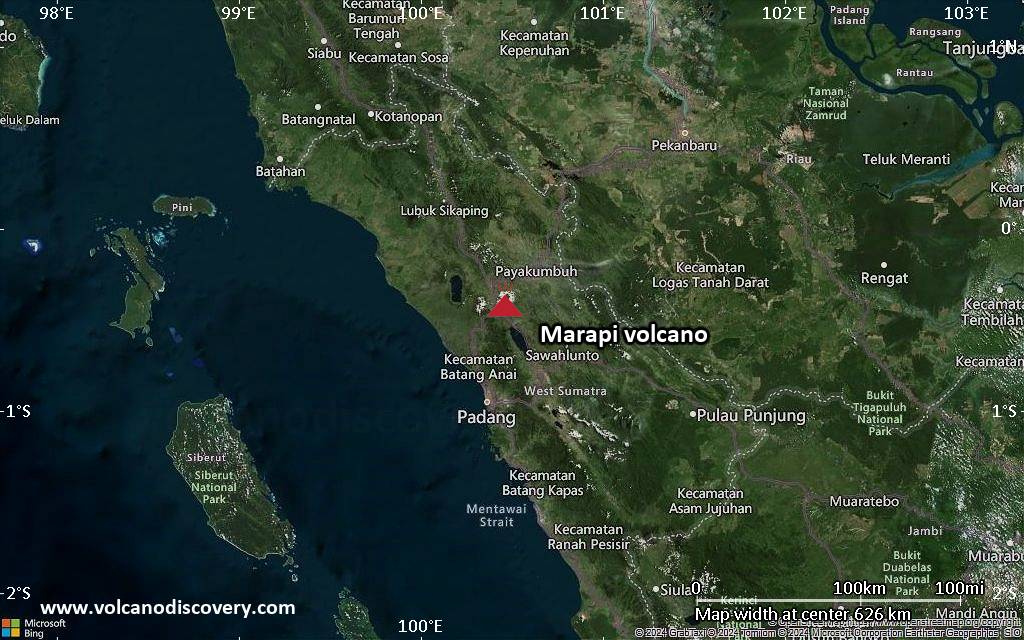
Marapi Volcano Volcanic Ash Advisory: VA TO FL110 REPORTED AT 01/2325 EST VA DTG: 02/0000Z to 11000 ft (3400 m)
Svartsengi volcano update: Eruption subsides but earthquakes continue, magma seems migrating northeast

Today’s quakes near the eruption site (oldest in green, latest in red)
The eruption north of Grindavík has decreased a lot or even paused,with little activity visible on webcams and recent drone flights.
However, seismic activity continues. Seismic activity has subsided in the southern part of the magma tunnel, near Grindavík, but activity at the northern end of the magma tunnel continues at a similar intensity and has moved even further north in recent hours. This includes a magnitude 5 quake 6 km east of Vogar at 16.54 local time, which was felt widely in the area.
The seismic activity is now almost 9 km north of the northernmost fissure in this eruption sequence that formed in August 2024. The largest earthquakes have been about magnitude 3 and are clearly felt in Vogar, which is about 7 km NW of the activity.
Deformation measurements show that magma is still flowing from Svartsengi into the magma tunnel on the Sundhnúksgígar series. The seismic activity indicates that the magma is moving northeast. The seismic activity is at a depth of about 4-6 km and work is underway to analyze deformation data in that area. While seismic activity is still considerable and deformation is still being measured, the possibility of magma re-emerging at the Sundhnúk crater series or near the area of greatest seismic activity must be considered.
Source: Icelandic Met Office (IMO)

Map of the lava from today’s eruption (image: IMO)