
The Good Kid Project: Stories That Teach Compassion and Equality

It’s no secret that children are the key to a more progressive future and a more compassionate world. The Good Kid Project highlights exceptional young people who go above and beyond for animals, fellow humans, and the environment. Check out the stories of Tabitha, the 8-year-old who decided to focus on ending animal experimentation; Genesis, who was PETA Kids’ Cutest Vegan Kid in 2015 and has her own TEDx Talk; and many others. The Good Kid Project has also developed fictional stories and lesson plans for educators and students in grades K–5 that emphasize the importance of treating all sentient beings with kindness.

SAMPLE STORY FROM THE GOOD KID PROJECT

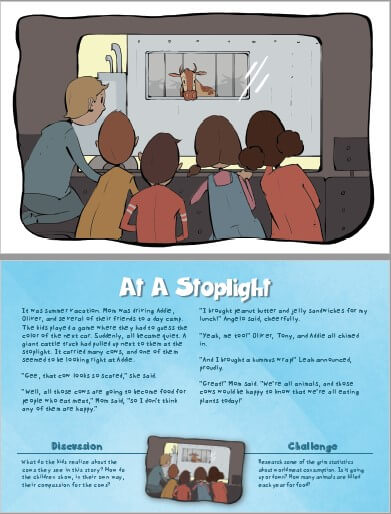
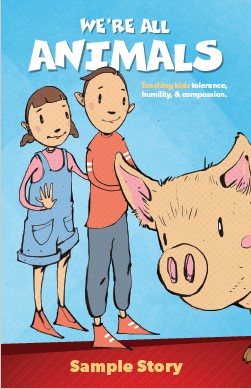
This free sample story from The Good Kid Project’s We’re All Animals box set describes the reactions of the main characters—Addie, Oliver, and friends—as they come across a truck transporting cows at a stoplight. After reading it, encourage students to answer the following discussion questions and challenge questions provided by The Good Kid Project (and get the K–5 Lesson Guide to help you integrate this activity into your curriculum):
Discussion Questions

  1. What do the kids realize about the cows they see in this story?
  2. How do the children show, in their own way, their compassion for the cows?

Challenge Questions

  1. Research some of the grim statistics about world meat consumption. Is it going up or down?
  2. How many animals are killed each year for food?
“Great!” Mom said. “We’re all animals, and those cows would be happy to know that we’re all eating plants today!”

TEACHKIND PARTNERSHIP WITH THE GOOD KID PROJECT

Be sure to grab a 20% discount on the We’re All Animals box set by using the coupon code TeachKind20. TeachKind receives $3 each time the coupon code is used, which will go toward supporting our work promoting compassion for animals in the classroom. It’s a win-win situation for you, your students, TeachKind, and all animals.

Check Out Our Other Lessons Here!

The post The Good Kid Project: Stories That Teach Compassion and Equality appeared first on PETA.

Urgent From PETA: Hot-Weather Survival Tips for Animals in Roanoke Rapids

With high temperatures forecast for the Roanoke Rapids area, animals—who can quickly succumb to heatstroke if left outdoors or in a parked car—are at risk. Twenty-one animals have already died this year from heat-related causes—and since social distancing because of COVID-19 extends store wait times and prolongs errands, PETA is concerned that this summer could see an unprecedented number of hot weather–related animal deaths.

Anyone who leaves animals outside or in vehicles to suffer in severe weather may be prosecuted for cruelty.

The following tips will help keep animal companions safe in hot weather:

  • Never leave an animal inside a hot vehicle. Temperatures can quickly soar in parked cars, and a dog trapped inside can die from heatstroke within minutes—even if the car is in the shade with the windows slightly open, which has little to no effect on lowering the temperature inside the car. PETA offers an emergency window-breaking hammer for help with intervening in life-or-death situations.
  • Keep animals indoors. Unlike humans, dogs can sweat only through their footpads and cool themselves by panting, so even brief sun exposure can have life-threatening consequences. Anyone who sees animals in distress and is unable to help should note their locations and alert authorities immediately.
  • Avoid hot pavement. When outdoor temperatures reach the 80s, asphalt temperatures can climb to 140 degrees, causing pain, burns, and permanent damage to dogs’ paws after just a few minutes of contact. Walk dogs on grass whenever possible, and avoid walking in the middle of the day. Never run with dogs in hot weather—they’ll collapse before giving up, at which point, it may be too late to save them.

PETA has released a warm-weather public service announcement featuring Mckenna Grace. For more information, visit PETA.org.

The post Urgent From PETA: Hot-Weather Survival Tips for Animals in Roanoke Rapids appeared first on PETA.

Will Tampa Fight COVID-19 by Going Vegan?

As the number of COVID-19 cases continues to rise in Tampa, PETA sent a letter this morning asking the city’s mayor, Jane Castor, to encourage all residents to help prevent future pandemics, safeguard their own health, and save animals’ lives by going vegan.

PETA—whose motto reads, in part, that “animals are not ours to eat” and which opposes speciesism, a human-supremacist worldview—is also sending the mayor a box of delicious vegan chocolates shaped like chickens, frogs, and bats, noting that these “animals” can be eaten without risking the next pandemic.

“The next SARS, swine flu, bird flu, or COVID-19 will be just around the corner as long as people keep eating animals,” says PETA Executive Vice President Tracy Reiman. “PETA stands ready with free starter kits and mentors to help the residents of Tampa boost their immune system and help prevent future pandemics through delicious, humane, vegan meals.”

Luckily, going vegan has never been easier. Several popular Tampa eateries, such as Pure Kitchen, Farmacy Vegan Kitchen & Bakery, and Loving Hut, serve tasty vegan fare. For more information, please visit PETA.org.

PETA’s letter to Castor follows.

July 16, 2020

The Honorable Jane Castor
Mayor of Tampa

Dear Mayor Castor,

Greetings from PETA. As cases of COVID-19 continue to spike in Tampa, putting public health at risk, I’m writing with a lifesaving suggestion: Encourage all residents to eat vegan. PETA stands ready to help them make the switch by providing them with resources such as our free vegan starter kits, our free vegan mentor services, and more. We’ll also be sending you a box of dairy-free chocolates in the shapes of chickens, frogs, and bats—the only kind of “animals” that can be eaten without contributing to the next pandemic.

COVID-19, swine flu, avian flu, mad cow disease, SARS, Ebola, and AIDS are all linked to meat production or consumption, and the Centers for Disease Control and Prevention warns that approximately 75% of recently emerged infectious diseases affecting humans originated in other animals. As long as we continue breeding animals, confining them in their own filth, and slaughtering them, it’s not a matter of if another pandemic will occur but when.

Fruits, vegetables, whole grains, and other wholesome vegan foods are cholesterol-free, generally low in saturated fat, and high in fiber and other nutrients, and they can even prevent—and in some cases, reverse—life-threatening diseases as well as boost immunity. In fact, Corinne Bush, science director of the American Nutrition Association and a representative of the Personalized Nutrition & COVID-19 Task Force, advises people to eat plenty of produce in order to boost their immune system and ward off COVID-19 and other health problems. Dr. Mehmet Oz agrees, pointing out that fruits and vegetables “enhance your immune response,” and he shared antioxidant-rich smoothie recipes on TODAY.

We’re ready to help Tampa residents turn over a healthy new vegan leaf, so please let us know how we can be of assistance. We look forward to hearing from you.

Sincerely,

Tracy Reiman
Executive Vice President
People for the Ethical Treatment of Animals

The post Will Tampa Fight COVID-19 by Going Vegan? appeared first on PETA.

Chocolate Giant Barry Callebaut Bans Animal Experiments

Following communications with PETA and its affiliates, Barry Callebaut—“the world’s leading manufacturer of high-quality chocolate & cocoa products,” with net sales of more than $7 billion last year—publicly announced that it will not conduct, fund, or commission any animal experiments unless they are explicitly required by law.

Prior to this compassionate decision, PETA uncovered experiments on animals that the company contributed to—which were not required by law—published between 2007 and 2019.

“Barry Callebaut has unwrapped the golden ticket, and consumers will be delighted,” says PETA Vice President Shalin Gala. “PETA is urging other food manufacturers, such as MSG giant Ajinomoto, to follow Barry Callebaut’s lead by banning cruel, wasteful, curiosity-driven experiments on animals.”

As part of its campaign to end animal testing in the global food industry, PETA has exposed how for decades manufacturers have conducted or funded cruel laboratory tests in which thousands of animals have been cut open, tormented, and killed—all in misguided attempts to make marketing claims about products ranging from ramen noodles to candy bars to breakfast cereals to liquor. Read more about these food- and beverage-industry experiments here.

Barry Callebaut joins a growing list of dozens of companies—including Barilla, The Coca-Cola Company, General Mills, House Foods, Kellogg Company, Kikkoman, Lipton, Ocean Spray, PepsiCo, POM Wonderful, Robertet S.A., Welch’s, and Yakult Honsha—that have worked with PETA scientists to replace animal tests with effective, ethical, economical, non-animal research models.

PETA—whose motto reads, in part, that “animals are not ours to experiment on” and which opposes speciesism, a human-supremacist worldview—also applauds Barry Callebaut’s sweet pledge earlier this year to turn a German factory into one that produces solely vegan chocolate “to satisfy the growing consumer demand for plant-based indulgence.”

For more information, please visit PETA.org or click here.

The post Chocolate Giant Barry Callebaut Bans Animal Experiments appeared first on PETA.