
‘Too Hot for Spot and Tot’: Urgent Hot-Weather Safety Tips From PETA

As temperatures remain high across the country and amid reports that two children had to be rescued after being left in a hot car in Hanover, PETA is taking action with an ad campaign, “Too Hot for Spot and Tot,” warning people never to leave dogs or children in parked cars on hot days. Even a “quick” errand can turn fatal, since social distancing because of COVID-19 extends store wait times and prolongs errands and forgetfulness—being distracted by running into a friend, taking a phone call, or otherwise being delayed—can take a vulnerable life.

This year, 10 children and at least 21 dogs and cats have died from heat-related causes. PETA suggests doing the following in order to safeguard humans and animals:

  • Never leave anyone inside a hot vehicle. On a 78-degree day, the temperature inside a parked car can soar to 100 degrees in just minutes, and on a 90-degree day, the interior temperature can reach as high as 109 degrees in less than 10 minutes. Dogs, who don’t sweat and can cool themselves only by panting, can rapidly succumb to heatstroke, even if a vehicle is parked in the shade with the windows slightly open, which has little to no effect on lowering the temperature inside.
  • If you see an animal and/or a child left alone inside a car, call local humane authorities or 911 immediately and remain on the scene until the situation has been resolved. If authorities are unresponsive or too slow and a life appears to be in imminent danger, find a witness who will back up your assessment before carefully removing the child or animal from the car and carrying them into the shade. PETA offers an emergency window-breaking hammer for help with intervening in these life-or-death situations.
  • To treat an animal suffering from suspected heatstroke, wrap a cool, wet towel around the head and neck without covering the eyes, nose, or mouth and wring out, resoak, and reapply it every few minutes. Pour lukewarm water over his or her body, and wipe excess water away, especially from the abdomen and between the hind legs. When authorities arrive, ensure that the animal is taken to a veterinarian for further care.

Law-enforcement officials across the country are also warning people of the dangers of hot weather. “Every year, we alert people to the danger of leaving children or pets inside cars in the summer,” says Chief of Police James R. Kruger Jr. from Oak Brook, Illinois. “The temperature inside a vehicle climbs approximately 43 degrees in just an hour. The loss of a defenseless animal in this manner is avoidable and should never happen. There is no reason to take your pet out in extreme heat without adequate air conditioning and water.”

Anyone who leaves a child or an animal to bake to death in a vehicle could face felony charges.

For more information, visit PETA.org.

The post ‘Too Hot for Spot and Tot’: Urgent Hot-Weather Safety Tips From PETA appeared first on PETA.
Burgerlords Wins Award for Revolutionizing Its Menu

A Vegan Business Award is on its way from PETA to Burgerlords for unveiling a new eco- and animal-friendly all-vegan menu amid COVID-19, which originated in a meat market.

“Growing up working in my family’s restaurant, I always wanted to have my own place that represented how I ate,” says owner Frederick Guerrero. “We’ve gone back and forth with the idea of going all vegan with the restaurants, so we figured that now was [as good a] time as any to make the leap.” The new menu includes the Sourdough Garlic Melt (a house-made vegan patty topped with dairy-free provolone, 2,000 Island sauce, grilled onions, and garlic oil), the Buffalo Ranch Tofu Burger (a battered tofu patty topped with vegan ranch, Buffalo sauce, and carrot celery slaw), and Tahini Milkshakes.

“As COVID-19 forces the world to face the dangers of the meat industry, Burgerlords is busy becoming the king of delicious meat-free burgers,” says PETA Executive Vice President Tracy Reiman. “PETA is recognizing this beloved business’s crowd-pleasing cuisine for showing that the future of dining is vegan.”

PETA notes that confining and killing animals for food has been linked to SARS, swine flu, bird flu, and COVID-19—and a new strain of swine flu with “pandemic potential” has been spreading from pigs to humans in China. The meat industry has allowed slaughterhouse workers to face a nearly unchecked spread of the novel coronavirus. Less than half of slaughterhouses report offering testing to their employees, and more than 36,000 cases among workers have been recorded—a rate that’s nine times higher than the overall U.S. infection rate.

Every person who goes vegan saves the lives of nearly 200 animals each year; reduces their own risk of suffering from heart disease, cancer, strokes, and numerous other health conditions; and significantly reduces their carbon footprint, as the meat and dairy industries are leading producers of the greenhouse gases driving the worst effects of the climate crisis.

Burgerlords will receive a framed certificate.

PETA—whose motto reads, in part, that “animals are not ours to eat”—opposes speciesism, a human-supremacist worldview. For more information, please visit PETA.org.

The post Burgerlords Wins Award for Revolutionizing Its Menu appeared first on PETA.

USDA Tried to Keep Its Failures Secret—PETA Helped Force Transparency

After three long years, the legal battle over the U.S. Department of Agriculture’s (USDA) assault on transparency and open government has ended!

PETA along with co-plaintiffs the Physicians Committee for Responsible Medicine, Born Free USA, Beagle Freedom Project, and Lewis & Clark Law School Assistant Clinical Professor and Animal Law Litigation Clinic Director Delcianna Winders successfully settled their lawsuits against the USDA. The plaintiffs were represented by the public interest law firm Eubanks & Associates.

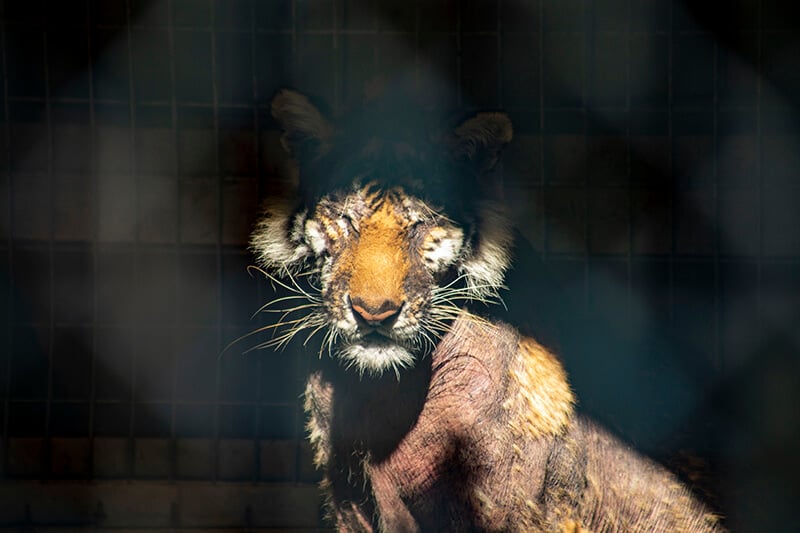
tiger with severe hair loss at Waccatee Zoo

The plaintiffs filed the lawsuits to force the USDA to restore vital records related to animal-exploiting enterprises that the agency illegally removed from its website in February 2017. The settlement includes the agency’s sworn statement that it has restored and will continue to provide public access to those records on its website.

The so-called “USDA blackout” litigation together with immense public pressure inspired Congress in late 2019 to require the USDA to restore the records. The plaintiffs kept the lawsuits active until they could confirm that the agency was complying with Congress’ mandate.

The USDA chronically under-enforced the federal Animal Welfare Act (AWA) during and after the information blackout.

In the sworn statement, the USDA admitted that it has not issued any letters of warning nor entered into any settlement agreements with any animal-exploiting operations since December 20, 2019.

This is a damning admission. Settlement agreements and warnings are the agency’s primary means of enforcing the AWA.

In fiscal year 2017, the USDA initiated 273 AWA enforcement actions, but so far in 2020, the agency has initiated only two. This ever-worsening enforcement by the USDA demonstrates that access to public records is crucial to exposing the agency’s appalling failures.

The Washington Post previously reported on the USDA’s reckless decline in AWA enforcement. It’s clear that the situation is dire for the millions of animals the agency is supposed to protect.

The USDA fails, so we must get loud for animals!

No thinking, feeling being wants to be mutilated in torturous experiments or perform confusing circus tricks under the threat of a beating. Animals would rather raise their families and live free from harm. No lion, bear, or any other animal would choose living in a cramped, dingy cage at a roadside zoo over playing, swimming, and socializing with their friends and families. By their very nature, places that use animals are ripe with potential for abuse and neglect.

We’re thrilled about this victory and glad that the records have been restored. But it shouldn’t have taken litigation or an act of Congress to force the USDA to be transparent about its derelict enforcement of the AWA.

PETA will keep pushing the negligent agency to do its job and thoroughly inspect laboratories, circuses, roadside zoos, and anywhere else exploiters can neglect and abuse animals.

The post USDA Tried to Keep Its Failures Secret—PETA Helped Force Transparency appeared first on PETA.

John Lewis Encouraged Us All to Make Noise and Cause ‘Good Trouble’

Rep. John Lewis, who died on July 17, spent his life getting into what he called “good trouble.” A stalwart civil rights leader, he was one of the original 13 Freedom Riders and a founder of the Student Nonviolent Coordinating Committee. He helped organize the March on Washington, led demonstrations against racial segregation, and headed the march across the Edmund Pettus Bridge in Selma, Alabama, which led to the passage of the Voting Rights Act of 1965. People are sometimes surprised that Lewis—known as the “conscience of Congress”—cared about animal protection.

Known for his electrifying speeches, he honed his oratory skills as a child by preaching to the chickens on his family’s farm—even holding weddings, baptisms, and funerals for his flock. “They never quite said ‘Amen,’ but they tended to listen to me much better than some of my colleagues listen to me today in the Congress,” he joked in 2004.

Lewis never stopped working for civil rights, and he spoke out on other issues of justice, too. He called for people to defend animal rights in a statement for Earth Day and attended VegFest in Washington, D.C.

“Do not get lost in a sea of despair. Be hopeful, be optimistic,” he tweeted in 2018. “Never, ever be afraid to make some noise and get in good trouble, necessary trouble.”

In Lewis’ memory, may we all be inspired to be bold, speak out against injustice anywhere we find it, and get into some “good trouble.”

The post John Lewis Encouraged Us All to Make Noise and Cause ‘Good Trouble’ appeared first on PETA.