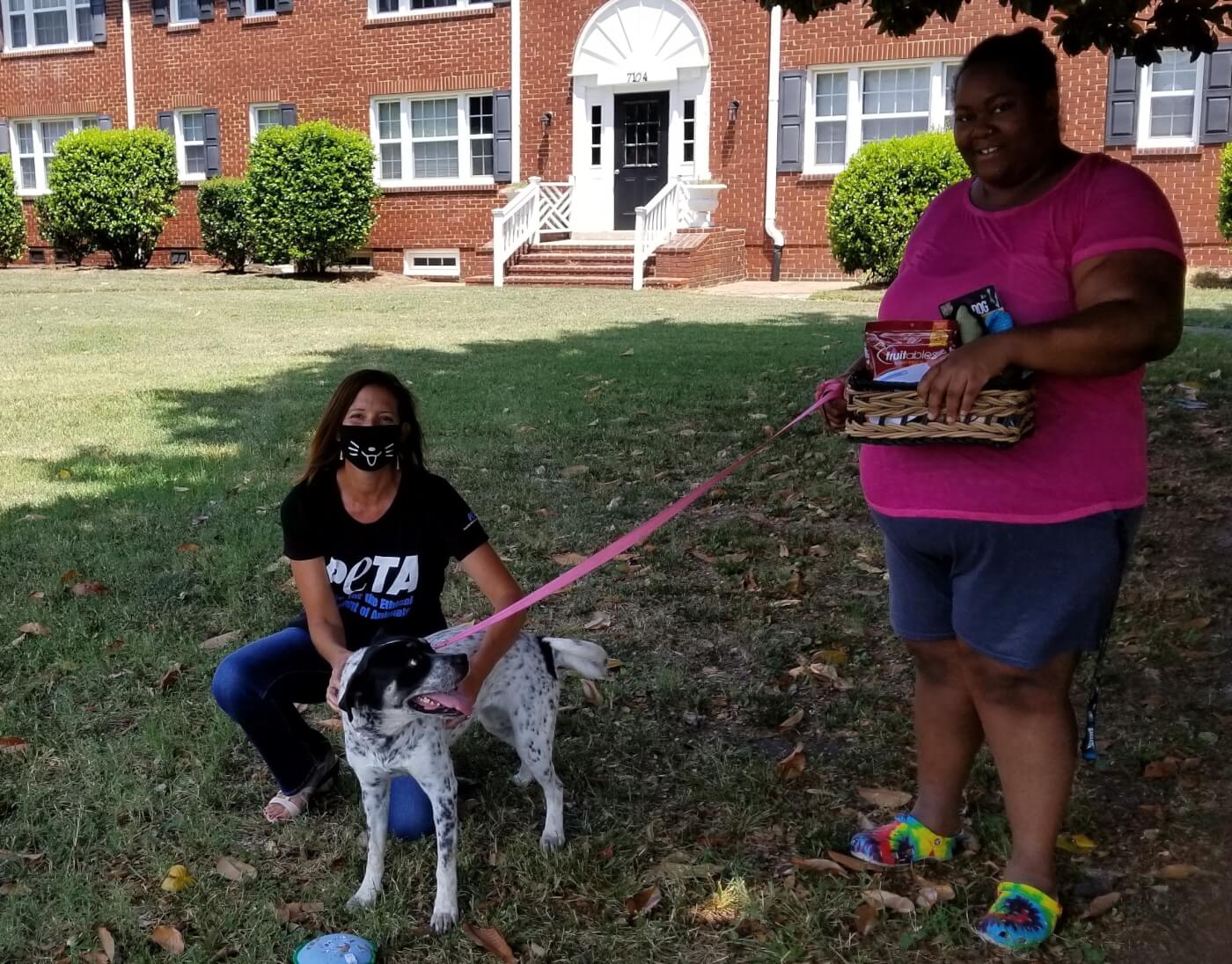
Rachel, Regina, and her canine companion, Amaya
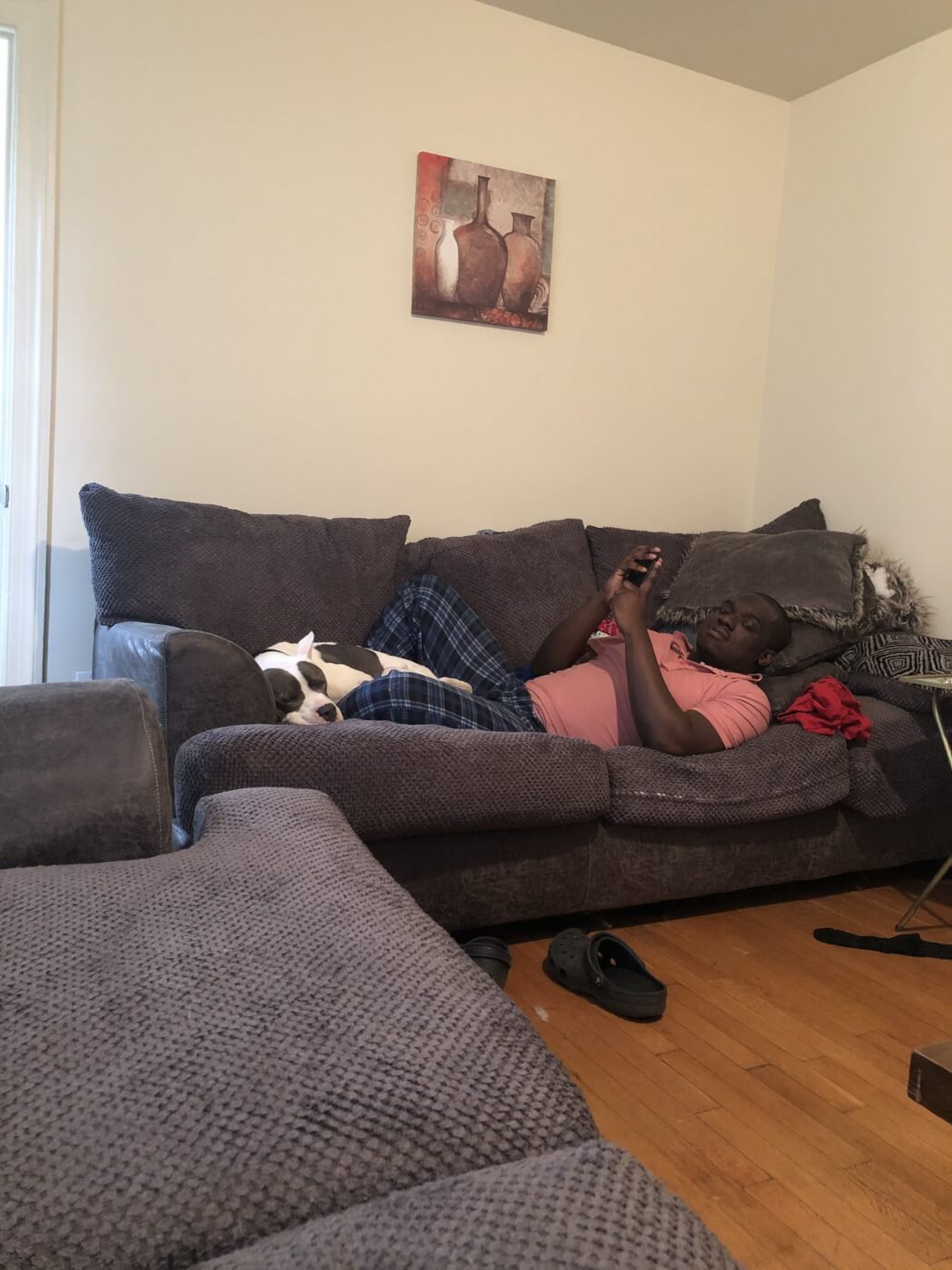
Lucious and Regina’s partner, Ezekiale
The post Photos: Dog Rescuer Thanked With $1,500 Reward, Gift Basket for Her Own Canine Companion appeared first on PETA.

respect nature & human rights
Rachel, Regina, and her canine companion, Amaya
Lucious and Regina’s partner, Ezekiale
The post Photos: Dog Rescuer Thanked With $1,500 Reward, Gift Basket for Her Own Canine Companion appeared first on PETA.
What will classrooms look like this fall? Classroom teaching—if it takes place at all—will look very different when the next school year begins. As school administrators consider making sweeping changes to classroom learning, PETA is pushing teachers to tell school officials that animals are individuals with unique needs and wants, not disposable “teaching tools” for children.

When the school year resumes, not a second can be wasted on cruel and unnecessary classroom practices involving animals. Whether teaching students takes place in person, virtually, or in a hybrid setting this fall, teachers must be the voice of reason at their schools. It’s vital to teach students that animals—no matter their size—feel the same emotions that they do.
Teachers will already have to begin the school year making up for lost instructional time. They will also be responsible for the social and emotional well-being of students, many of whom will be struggling after prolonged school shutdowns. To create a healthy, safe classroom environment, teachers must protect animals from needless suffering and show students the importance of consent and respect. The guidelines below can help.
Cutting up dead frogs, pigs, and cats—each of whom wanted to live—has never been essential, let alone acceptable. Modern science curricula and standards no longer require—or even refer to—animal dissection, and not a single medical school in the U.S. or Canada requires medical students to dissect animals. No student enrolled in biology or anatomy courses has to cut apart animals in order to learn about their organs or compare them to those of humans.
Digital dissection programs are superior in a number of ways—they save animals, eliminate student exposure to toxic chemicals such as formaldehyde (a carcinogen), save schools money, and often include helpful features like spoken instructions and built-in assessments. Teachers can also use 3-D paper models that allow kids to study biology and get creative at the same time.
When life as we knew it came to a screeching halt this past spring, we all felt stressed, confused, and scared. Young students—many of whom thrive in the structured environment of school and need meaningful interactions with their peers to grow and learn—bore the brunt of this sudden but necessary upheaval.
Most kids care about animals, so teachers can use that natural tendency to help them develop social and emotional core competencies. That way, they can deal effectively and ethically with life’s challenges and contribute to their communities in a positive way for years to come.

With so much going on in the world right now, it’s important for students to know that some things are still within their control—like how they treat others, including animals.
Ostensibly designed to teach students about life cycles, chick-hatching projects involve placing fertilized chicken eggs in classroom incubators until they hatch—but they totally miss the mark.
Even before chicks are born, they need their mothers, who carefully rotate the eggs up to 30 times a day in order to maintain the proper temperature, moisture, and positioning. Chicks grown in an incubator can become sick and deformed as they develop, because their needs aren’t met during incubation. And if they hatch at night, on a weekend, or amid the chaos of another sudden school shutdown, no one will be around to care for them.
Many educators have stopped doing chick-hatching projects to teach embryology and developmental biology because of concerns about animal welfare and student safety. According to the Centers for Disease Control and Prevention (CDC), chicks can look healthy but still harbor deadly bacteria like E. coli and salmonella. Children who hold, cuddle, or kiss them—or even touch things around the birds’ living area—can be exposed to the bacteria. The CDC warns that young children are especially at risk for illness because their immune systems are still developing and because they’re more likely than others to put their fingers or other things into their mouth.
Any school that conducts chick hatchings is a potential breeding ground for these and other pathogens, including West Nile virus, which domestic fowl can contract. As we work to combat a global pandemic, the last thing that we should be doing is compromising students’ immune systems by introducing dangerous pathogens into the classroom.
Traditional class field trips will likely remain off the table during the COVID-19 pandemic, but that doesn’t mean students can’t explore the world around them safely and humanely.
Students can observe animals in their natural habitat without disturbing them or leaving home with one of the many live animal cams available online. From watering holes in Africa to the Arctic tundra, live video feeds allow students to experience what life is like for animals on their own terms, not ours.
Virtual field trips not only excite students and teach them about the natural world but also instill in them an important lesson—that animals are not ours to hold captive in roadside zoos, marine parks, or circuses and use for our entertainment.
Keeping animals as classroom “pets” is a bad idea. Neglect (intentional or not) and abuse are widespread. Animals have extensive and complex needs—which are unlikely to be met in a busy, bustling, and brightly lit classroom setting. In addition, animals can trigger students’ allergies and asthma.
Thankfully, there are countless fun, creative, and interesting ways to teach your students about responsibility, animal-companion care, life cycles, and animal science that won’t put anyone’s well-being at risk.
As COVID-19 continues to grip the world, students are very likely questioning just how we got here. Discussing this major event and the role that exploiting animals plays in outbreaks of infectious diseases can expose them to important new facts and help them synthesize information about events that might otherwise seem overwhelming. This will allow them to draw their own conclusions and make informed decisions.
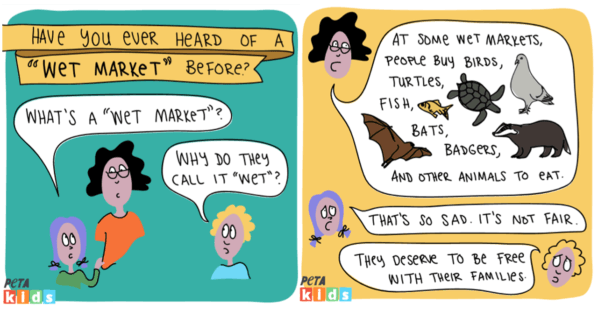
Students of all ages must be taught to connect the dots between killing and eating animals and the prevention of future pandemics and explore possible solutions, such as going vegan.
The post Animal-Free Classrooms? PETA’s Hopes for Education in the Age of COVID-19 appeared first on PETA.
As the number of COVID-19 cases continues to rise in Pennsylvania, PETA sent a letter this afternoon to the chair of Derry Township—the home of Hershey, the chocolate capitol of the U.S.—to encourage all residents to help prevent future pandemics, safeguard their own health, and save animals’ lives by going vegan.
PETA—whose motto reads, in part, that “animals are not ours to eat” and which opposes speciesism, a human-supremacist worldview—is also sending the chair a box of delicious vegan chocolates shaped like chickens, frogs, and bats, noting that these “animals” can be eaten without risking another pandemic. COVID-19 apparently originated in a Chinese “wet market,” in which animals are sold for human consumption. PETA is encouraging the township’s residents to extend compassion to all animals, including chickens and cows.
“The next SARS, swine flu, bird flu, or COVID-19 will be just around the corner as long as people keep eating animals,” says PETA Executive Vice President Tracy Reiman. “PETA stands ready with free vegan starter kits and mentors to help everyone boost their immune system and help prevent future pandemics through delicious, humane, vegan meals.”
Luckily, going vegan has never been easier. PETA’s website offers a list of vegan-friendly restaurant chains. For more information, please visit PETA.org.
PETA’s letter to Derry Township Chair Chris Abruzzo follows.
July 29, 2020
The Honorable Chris Abruzzo
Chair of Derry Township
Dear Mr. Abruzzo,
Greetings from PETA. As cases of COVID-19 continue to spike in Derry Township and throughout Dauphin County, putting public health at risk, I’m writing with a lifesaving suggestion: Encourage all residents to eat vegan. PETA stands ready to help them make the switch by offering resources such as our free vegan starter kits and our free vegan mentor services. We’ll also be sending you a box of dairy-free chocolates in the shapes of chickens, frogs, and bats—the only kind of “animals” that can be eaten compassionately and safely.
COVID-19, swine flu, avian flu, mad cow disease, SARS, Ebola, and AIDS are all linked to the production or consumption of meat, and the Centers for Disease Control and Prevention warns that approximately 75% of recently emerged infectious diseases affecting humans originated in other animals. As long as animals are bred, confined in their own filth, and slaughtered, it’s not a matter of if another pandemic will occur but when.
Fruits, vegetables, whole grains, and other wholesome vegan foods are cholesterol-free, generally low in saturated fat, and high in fiber and other nutrients, and they can even prevent—and in some cases, reverse—life-threatening diseases as well as boost immunity. In fact, Corinne Bush, science director of the American Nutrition Association and a representative of the Personalized Nutrition & COVID-19 Task Force, advises people to eat plenty of produce in order to boost their immune system and ward off COVID-19 and other health problems. Dr. Mehmet Oz agrees, pointing out that fruits and vegetables “enhance your immune response,” and he shared antioxidant-rich smoothie recipes on TODAY.
We’re ready to help Derry Township residents turn over a healthy new vegan leaf, so please let us know how we can be of assistance. We look forward to hearing from you.
Sincerely,
Tracy Reiman
Executive Vice President
People for the Ethical Treatment of Animals
The post Will Hershey Fight COVID-19 by Going Vegan? appeared first on PETA.
The post PETA’s Ads Warn: NIH’s Monkey Fright Experiments Are a Nightmare! appeared first on PETA.
As the number of COVID-19 cases continues to rise, PETA India is exposing live-animal markets (aka “wet markets”) and wildlife meat markets, which are filled with bodily fluids, raw meat, and sick, stressed animals. Such places operate in rampant violation of India’s Wildlife Protection Act, 1972; The Prevention of Cruelty to Animals Act, 1960; the Prevention of Cruelty to Animals (Slaughter House) Rules, 2001; and the Food Safety and Standards Act, 2006.
The unsanitary conditions are ideal for spreading disease, and experts believe that the novel coronavirus—which has already killed hundreds of thousands of people worldwide—first infected humans through wildlife in a wet market in Wuhan, China, although one theory links the disease to factory-farmed pigs.
PETA India is calling on authorities to close down all such live-animal and wildlife markets and follow the lead of China, where there is a plan to phase out live-poultry markets like those found throughout India because they risk spreading disease.
The footage shows men at Ghazipur Murga Mandi in Delhi slitting live chickens’ throats, skinning the birds, and sorting through their flesh, which was soaked in blood and guts, with their bare hands. There were bags of live, struggling crabs and eels at a fish market in Malancha, West Bengal.
Captured dogs were killed and sold for meat at the Keera Bazaar in Dimapur, Nagaland, and near Mao Market in Kohima, Nagaland. While Nagaland has just decided to stop dog-meat sales, the illegal trade continues in other states. In Manipur, sellers at the Nute Bazaar handled the charred remains of wild animals—including monkeys, wild boars, porcupines, and deer—and at the Churachandpur market, meat from various wild animals was sold.
All such markets are potential breeding grounds for and opportunities to spread zoonotic diseases (which jump from other species to humans). COVID-19, H5N1 avian influenza, SARS, and H1N1 swine flu are among those zoonotic diseases linked back to the treatment of animals used for food. The only way to make these markets safe is to close them.
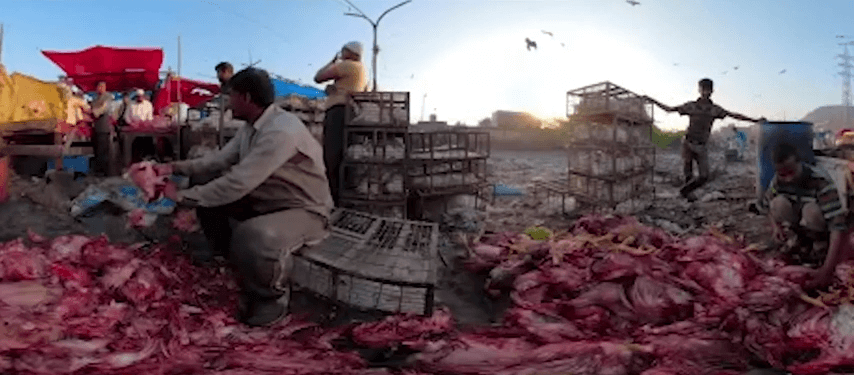
Blood, excrement, and other bodily fluids can easily get on sellers’ and customers’ shoes and be tracked into homes. As the video footage shows, workers who handle the animals often don’t wear protective gear. Flies swarm around decomposing bodies, and the countertops and floors are bloodstained from slaughtering animals.
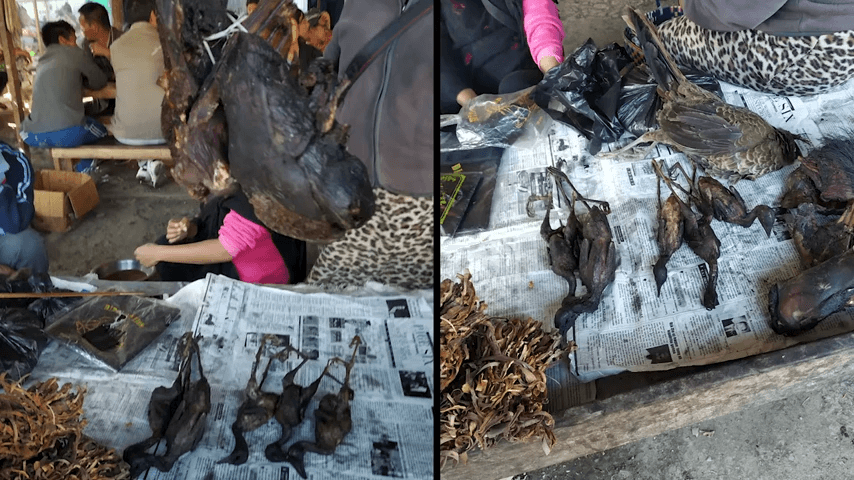
PETA India has already written to the Ministry of Health and Family Welfare; the Ministry of Environment, Forest and Climate Change; and the Ministry of Fisheries, Animal Husbandry and Dairying requesting that they close these cruel and dangerous operations immediately.
You can help today by signing our action alert to urge the World Health Organization to help shut down live markets worldwide.
Help Us Shut Down Disease-Prone ‘Wet Markets’
The post PETA India Exposes Blood-Soaked Live-Animal Markets appeared first on PETA.