A Compassionate Business Award is on its way from PETA to locally based Brookfield Asset Management for displaying warning signs about the dangers of leaving dogs and children in parked cars across its properties.
“Every year, PETA receives reports of dozens of dogs and other animals who have baked to death after being left in a parked car,” says PETA Executive Vice President Tracy Reiman. “Brookfield Asset Management could save countless lives by reminding shoppers never to leave a vulnerable family member in the car.”
Twenty-five animals have already died this year from heat-related causes—and since social distancing because of COVID-19 extends store wait times and prolongs errands, PETA is concerned that this summer could see an unprecedented number of hot weather–related animal deaths. The group offers an emergency window-breaking hammer for intervening in such life-or-death situations.
Dogs showing any symptoms of heatstroke—including restlessness, heavy panting, vomiting, or loss of coordination—should be taken into the shade, given water to drink, and cooled off with a cool towel placed on their heads and chests. A veterinarian should be called immediately.
Brookfield Asset Management will receive an award letter, a framed certificate, and a box of delicious vegan chocolates.
PETA—whose motto reads, in part, that “animals are not ours to abuse in any way”—opposes speciesism, which is a human-supremacist worldview. For more information, please visit PETA.org.
What is an alpaca? They’re actually quite remarkable animals. (Duh!) And just as acclaimed author Gene Stone and PETA President Ingrid Newkirk tell us in Animalkind, there are many important “ways to show them compassion.” So absorb these notable alpaca facts and discover the one simple thing that we can all do to show these vulnerable animals kindness:
What is the difference between a llama and an alpaca?
Alpacas are a mix of vicunas (a South American member of the camel family) and llamas—they’re “human-made” animals who are raised so that their fleece can be violently sheared off their bodies, made into sweaters and scarves, and sold by companies such as Anthropologie.
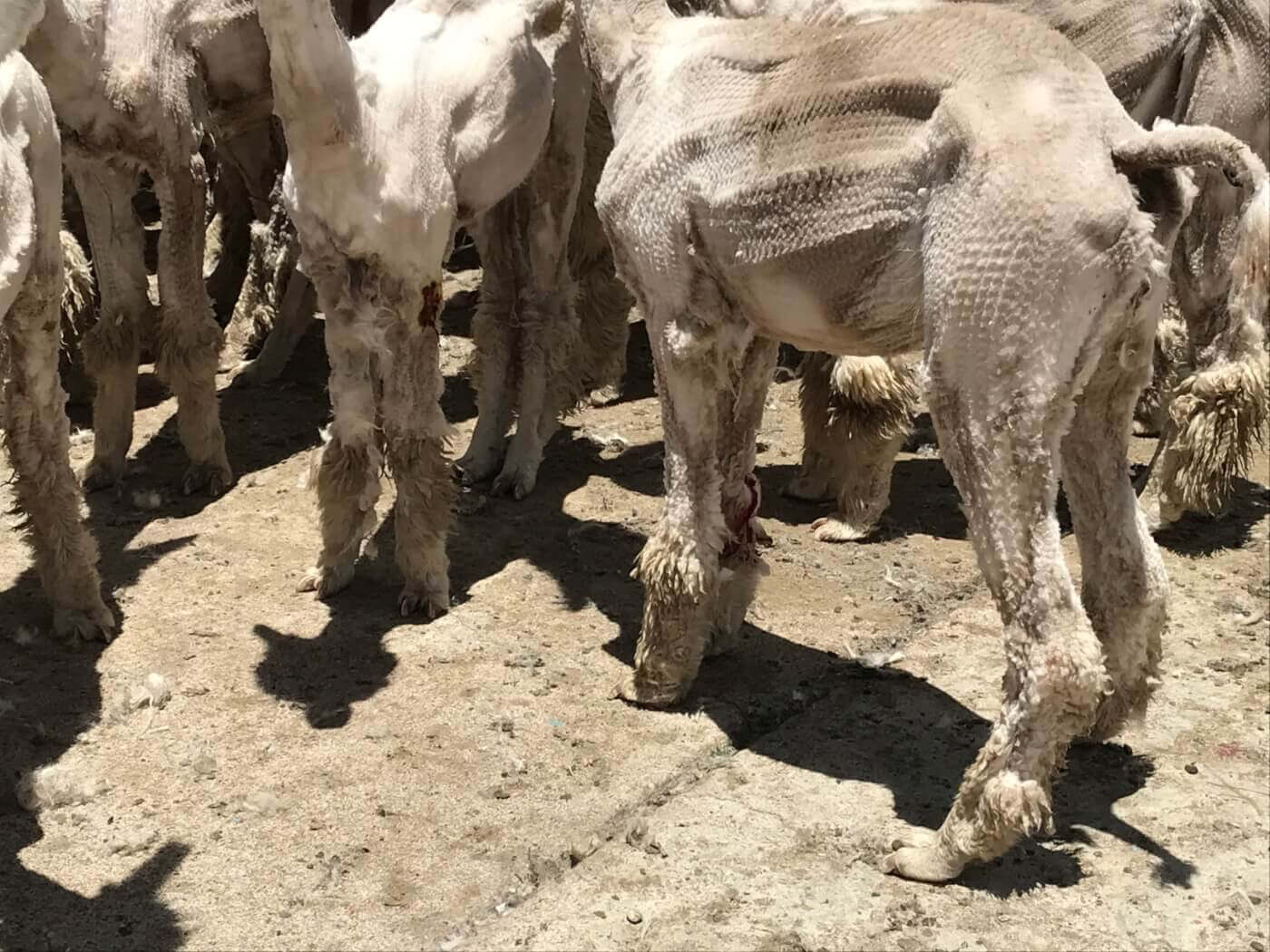
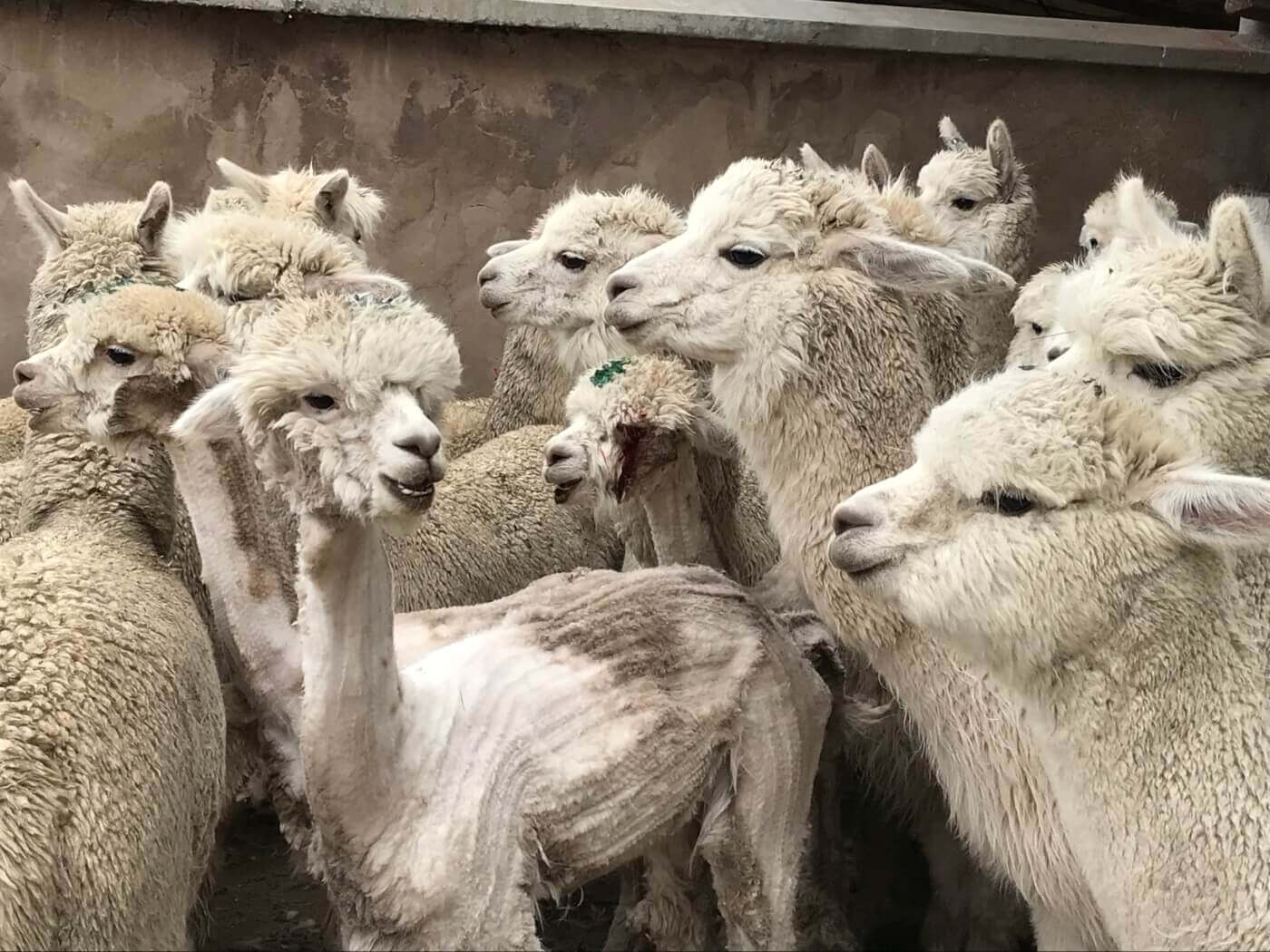
In the alpaca fleece industry, shearers work quickly and carelessly, leaving the animals bleeding from deep, painful wounds. These alpacas bled from their forelimbs.
Like “designer” dogs inbred at the expense of their own health and tiger/lion hybrids bred to suffer for an exhibitor’s quick buck, alpacas were created by greedy humans looking to profit from fleece that isn’t theirs to take.
Our animal companions and alpacas are more similar than you might think.
Like cats with their litterboxes, alpacas don’t do their business just anywhere—they have a designated place where they relieve themselves. Those in a herd all use the same “bathroom” area, much like certain lemurs and other animals, which can help control the spread of parasites.
“Are alpacas dangerous?” No—just like our canine friends, alpacas can be described as docile, gentle, curious, and social. Some can be shy and timid. For alpacas, it’s the humans raising and shearing them who are dangerous.
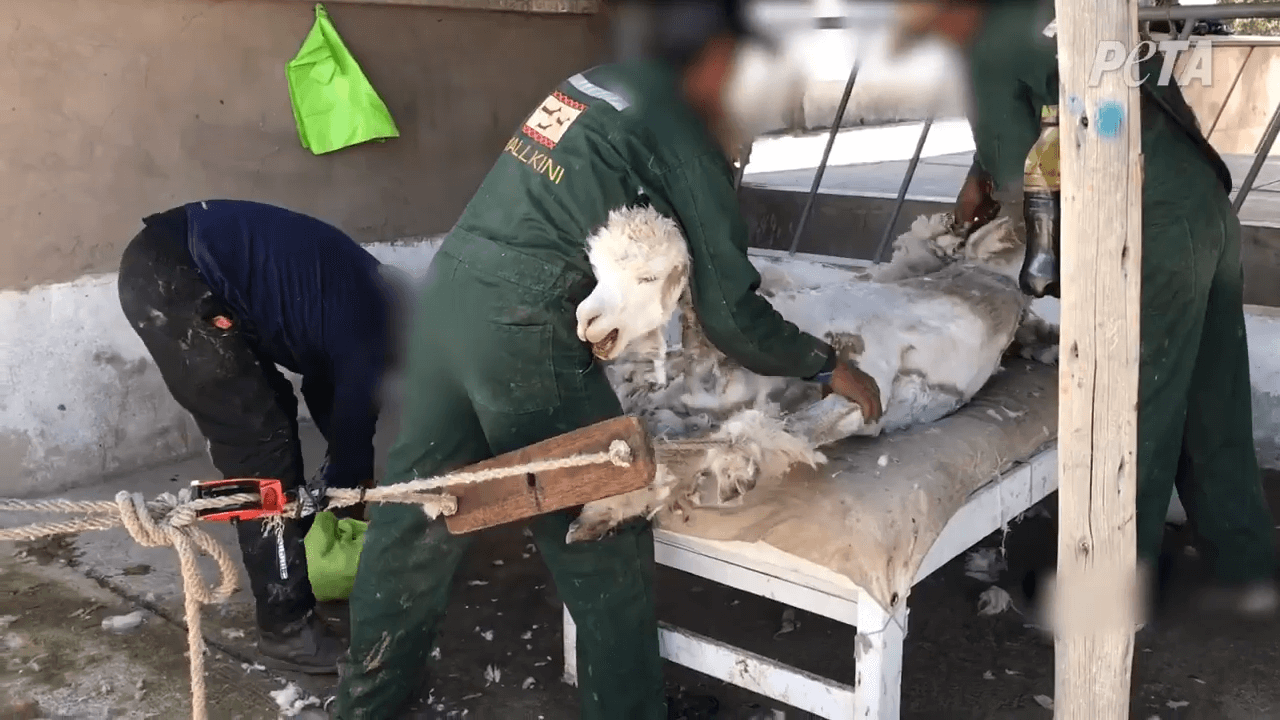
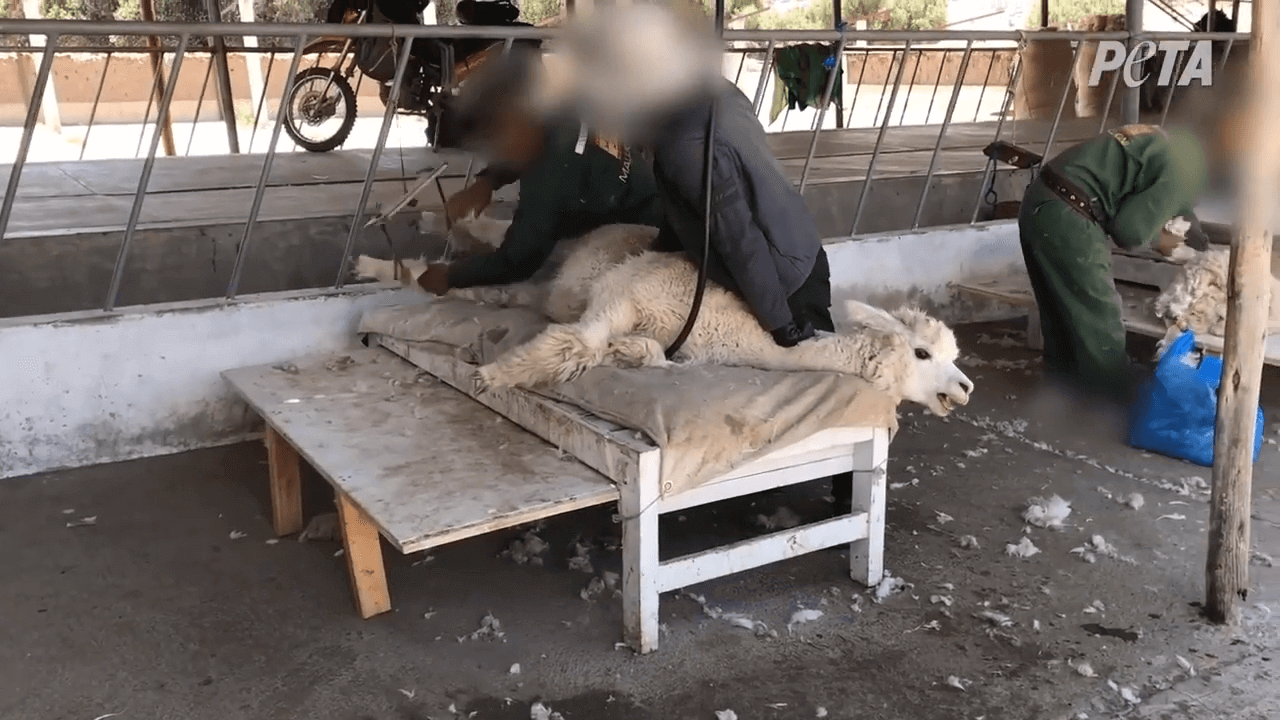
At the world’s top alpaca exporter’s farm, workers slammed the animals onto tables, tied them to a medieval-looking restraining device, and pulled hard, nearly wrenching their legs out of their sockets.
Alpacas have their own version of barking or meowing, too: humming. They hum to communicate with their herd and express their emotions.
Alpaca moms carry their cria (or baby) for roughly 355 days.
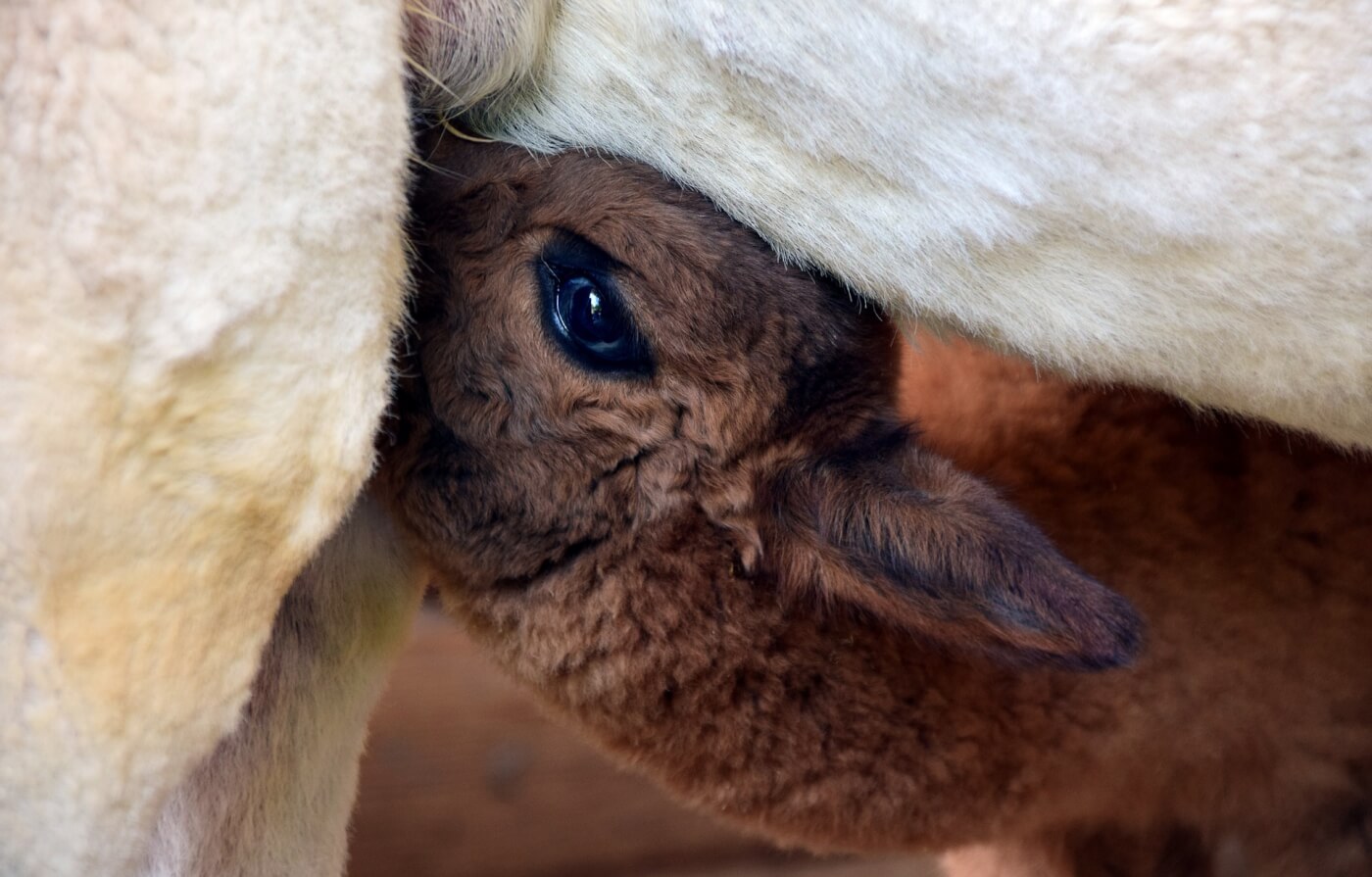
An expectant alpaca has a gestation period of 11 to 11.5 months. Alpacas give birth to one baby—called a cria—at a time. Like many mothers, alpaca moms are very protective of their young, who typically nurse for six to eight months.
In the fleece industry, expectant alpacas are seen merely as hair-producing pieces of equipment. In a first-ever exposé of the alpaca industry, PETA’s undercover investigation showed pregnant alpacas slammed onto tables, all just for sweaters, scarves, or balls of yarn.
At the world’s largest privately owned alpaca farm, workers hit, kicked, tied down, and mutilated crying alpacas—some of whom were pregnant.
Just like us, alpacas feel fear.
“Why do alpacas spit?” is a commonly asked question about the animal. Like camels, they often spit because they’re distressed—typically, when they feel threatened. When they feel that they’re in danger, alpacas may shriek, too.
PETA’s investigation exposed how alpacas used for their fleece have much to fear. At Mallkini—the world’s largest privately owned alpaca farm in Peru—workers hit, kicked, tied down, and mutilated crying alpacas. Able to hear, smell, and see what was happening, other alpacas huddled together in fear.
In May 2020, PETA released the first undercover investigation to pull back the curtain on violent shearing that leaves alpacas bleeding and crying out.
Restraint is highly distressing to alpacas, who are prey animals and fear that they’re about to be killed. At Mallkini, terrified alpacas cried out, spit, and vomited in fear as workers grabbed them by the ears.
True or false: Alpacas are killed for their fleece?
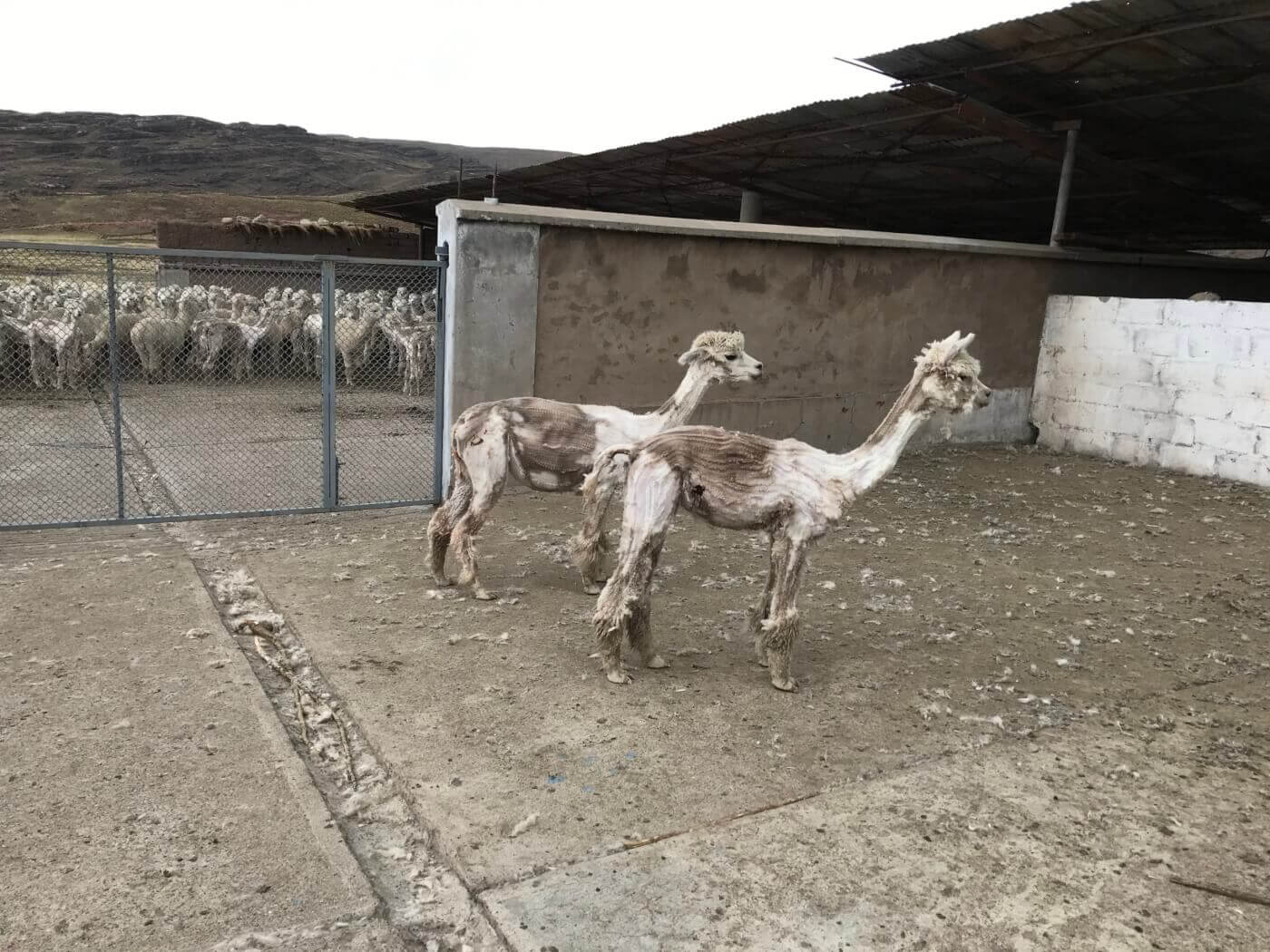
These shorn alpacas are bleeding from the torso and hips. There’s a good chance that once they’re considered “useless” by the fleece industry, they’ll be killed for their flesh and sold as food.
Alpacas Need Our Help
The best thing that you can do for alpacas is refuse to buy anything made of their fleece! It’s easy to check the label when you’re shopping. If it includes the word “alpaca,” leave it on the shelf. Please also ask Anthropologie to drop alpaca items immediately in favor of animal-friendly materials:
We should all always strive to be the compassionate humans alpacas—our fellow living, feeling beings—deserve. They, like all other animals, deserve to coexist with us in peace.
Note: PETA participates in the Amazon Services LLC Associates Program, an affiliate advertising program designed to provide websites with a means to earn advertising fees by advertising and linking to Amazon.com.
Today, PETA released disturbing excerpts from the 74 videos it had received after prevailing in its open records lawsuit against Oregon Health & Science University (OHSU). The taxpayer-funded experiments on threatened Japanese macaques, also called “snow monkeys,” took place at the OHSU-administered Oregon National Primate Research Center (ONPRC) in the laboratory of Elinor Sullivan, who received $5.2 million in taxpayer money between 2011 and 2019 alone.
In a letter sent today to OHSU President Danny Jacobs, PETA also called for an end to all experiments on monkeys and the closure of the primate center, which has a long history of animal welfare violations.
The video shows some of Sullivan’s “junk food” experiments, which involved impregnating monkeys and feeding some of them high-fat food. The babies were separated from their mothers or friends, placed in an unfamiliar room, and locked inside a small, barren cage, where they were deliberately frightened in “human intruder tests,” in which experimenters threatened the terrified, traumatized animals by staring at them—which they see as an aggressive act. Experimenters killed most—if not all—of the young monkeys when they were just 13 months old.
PETA filed a lawsuit against OHSU last year after the school denied the group’s request for the footage pursuant to Oregon’s Public Records Law.
“It’s easy to see why OHSU tried so hard to hide these cruel, pointless ‘junk food’ experiments,” says PETA Vice President Dr. Alka Chandna. “This indefensible abuse of sensitive monkeys must stop now.”
The ONPRC—which receives tens of millions in taxpayer money every year and currently holds more than 6,000 monkeys—has a long history of violating animal protection laws and guidelines. Monkeys have been burned when left unattended on heating pads, subjected to painful procedures that weren’t approved, and denied pain medication after major surgeries. Monkeys given the wrong dose of insulin had to be euthanized, as did another who became entangled in PVC pipes. One monkey died while trapped behind a cage because no one noticed that he was missing.
Other experiments at the facility have included forcing animals to eat lard and addicting them to nicotine and alcohol. PETA previously obtained footage from OHSU of a publicly funded experiment that Sullivan helped to coordinate in which young monkeys were deliberately frightened with a Mr. Potato Head toy.
PETA—whose motto reads, in part, that “animals are not ours to experiment on”—opposes speciesism, a human-supremacist worldview. The group’s letter to Jacobs is available upon request. For more information, please visit PETA.org or click here.
As if going to the grocery store during a pandemic weren’t stressful enough, certain food choices may be increasing your risk of catching COVID-19.
Imported chicken from Brazil and packaging of imported shrimp from Ecuador, both contaminated with the novel coronavirus, have found their way into China. As the world scrambles to deal with the danger of this deadly new pathogen, guess which country isn’t testing meat for it?
BREAKING: After frozen chicken wings in China tested positive for #COVID19, the @USDA REFUSES to order US slaughterhouses to test meat for the virus.
How many more animals, slaughterhouse workers, and now consumers will die before you stop eating meat? https://t.co/KMXaxu8MC2
Even though our country leads the world in coronavirus cases and deaths and there have been report after report of COVID-19 outbreaks in slaughterhouses, the U.S. Department of Agriculture (USDA) is failing to take the pandemic seriously (yet again) by not testing meat for the virus.
The U.S. imports billions of pounds of meat per year, including from Latin American countries that have reported similar COVID-19 outbreaks in slaughterhouses.
The Physicians Committee for Responsible Medicine (PCRM) filed a lawsuit against the USDA after authorities rejected a petition that requested new requirements to test meat for the novel coronavirus as well as labels to warn shoppers that meat could carry it. The nonprofit organization is asking federal courts to mandate coronavirus testing in slaughterhouses and to make those findings publicly available.
Our country’s lack of testing meat for the virus affects not only Americans but also the entire rest of the planet. The U.S. is one of the world’s top exporters of chicken flesh and body parts.
“The agency didn’t test a thing and it doesn’t seem to care,” Mark Kennedy, attorney for PCRM, told Yahoo Finance. “This is the agency that’s in charge of protecting this part of the food chain and they just said no.”
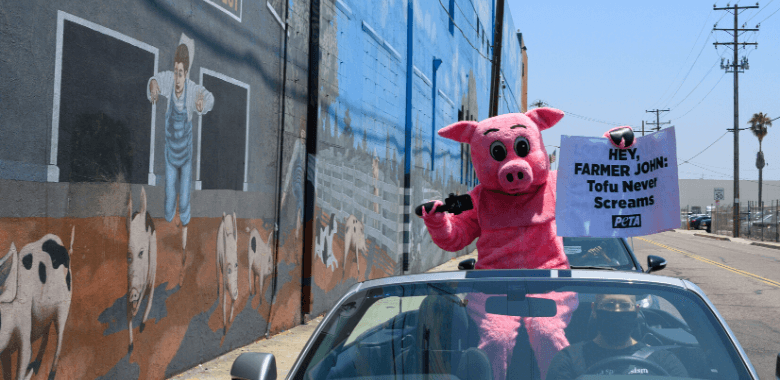
After 153 workers tested positive for COVID-19 at the Farmer John slaughterhouse in L.A., PETA urged it to close down or produce only vegan meat like something its parent company, Smithfield, already makes.
PETA has called for immediate slaughterhouse closures and has led numerous protests over the reopening of facilities that have had high infection rates. Over 40,000 slaughterhouse workers across the nation have contracted COVID-19, and at least 189 of them have died.
While food handling isn’t believed to be the main way COVID-19 is spread, the Centers for Disease Control and Prevention stated, “It may be possible that a person can get COVID-19 by touching a surface or object that has the virus on it and then touching their own mouth, nose, or possibly their eyes.”
Eating animals puts the whole world at risk of contracting dangerous viruses.
Deadly outbreaks of mad cow disease, swine flu, and other zoonotic diseases have stemmed from capturing or farming animals. The novel coronavirus may have originated in a live-animal market in China—but when it comes to spawning dangerous pathogens, animal markets andslaughterhouses around the world all pose a danger.
Speciesism, a human-supremacist worldview, deprives animals of their dignity—and we’ve seen firsthand how this can lead to devastating consequences.
The easiest way to avoid contaminated meat is to go vegan. Period.
As long as we continue to raise and kill animals for food, live-animal markets and filthy factory farms will keep breeding deadly diseases like COVID-19. No one needs to eat meat, eggs, or dairy.
Below, please find a statement from PETA Senior Vice President Kathy Guillermo in response to the defendants’ attorney Howard Taylor’s misleading claims about the settlement of the horse-doping lawsuit Tretter v. Bresnahan:
Attorney Howard Taylor’s statement on Tretter v. Bresnahan was carefully worded and misleading. It was Jeff Tretter’s request—not the defendants’—that $7,500 be donated to the horse rescue charity after the $20,000 figure had already been agreed upon. Mr. Tretter wanted it to be on the record that the horse was the ultimate victim. The defendants delayed and frustrated the legal process by refusing to respond to discovery fully, forcing motions to compel, and attempting to obstruct nonparty discovery. Mr. Taylor’s characterization of the settlement agreement as a “business decision” is no doubt accurate from his perspective. The defendants reached that “business decision” when it became clear that they faced risk of a judgment many times the amount that Mr. Tretter should have won. Furthermore, Mr. Taylor does not know the amount of legal fees spent in prosecuting the claims against his client. The facts stand: Tests showed Tag Up and Go was doped with EPO, this amounted to cheating bettors, and the trainer and owner had to pay up. This should be the first of many such lawsuits.
PETA—whose motto reads, in part, that “animals are not ours to use for entertainment”—opposes speciesism, which is a human-supremacist worldview. More information about this lawsuit is available here.