
The post U.S. Rigging & Pelican Rope appeared first on PETA.
PETA Demands Criminal Probe Into Horse Beating at Equestrian Show
This morning, PETA sent a letter to Riverside County Sheriff Chad Bianco calling on him to investigate the vicious whipping of a horse at a show at Desert International Horse Park.
Video footage from January 30 shows competitive German Grand Prix jumper Kevin Lemke forcefully striking a horse named Good Luck with a whip six times—so harshly that the sound of the strikes can be heard on the video replay—after the horse refused a jump. Lemke was subsequently disqualified for excessive use of the whip. After beating the horse, he attempted the jump again, causing Good Luck to collide with the fence and knock over the poles. PETA notes that the incident appears to violate California Penal Code § 597(b), which prohibits cruelty to animals.
“If a handler beat a dog in the middle of a show, he’d be investigated for cruelty,” says PETA Senior Vice President Kathy Guillermo. “California’s anti-cruelty law exists to protect animals like this horse, and PETA is calling on the Riverside County Sheriff’s Department to file all appropriate charges against Kevin Lemke.”
PETA has also sent letters to the United States Equestrian Federation (USEF) and the International Federation for Equestrian Sports (FEI) calling on them to investigate the incident, revoke Lemke’s eligibilities and memberships, and ban him from USEF- and FEI-sanctioned events, respectively.
PETA—whose motto reads, in part, that “animals are not ours to use for entertainment or abuse in any other way”—opposes speciesism, which is a human-supremacist worldview. For more information, please visit PETA.org or follow the group on Twitter, Facebook, or Instagram.
The post PETA Demands Criminal Probe Into Horse Beating at Equestrian Show appeared first on PETA.
Advocating for an End to the Iditarod With Your Elementary School Students (Grades 3–5)
Do you teach about the Iditarod as part of your curriculum? Hundreds of dogs start the race each year, forced to pull heavy sleds an average of 100 miles per day, with only 40 hours of rest mandated during the eight- to 14-day event. As many as half of them are pulled off the trail because they become sick, injured, or exhausted during the trek across frozen rivers, jagged mountain ranges, dense forests, and desolate tundra through biting winds, blinding snowstorms, and subzero temperatures. The remaining dogs then have to work even harder.
Since the first Iditarod, 150 dogs have died running the event—including five in 2017 alone—and those are just the reported deaths. That doesn’t include all the others who died during the off-season while chained up outside like bicycles or those who were killed because they lacked the speed and stamina to make the grade. The leading cause of death for dogs used in the race is aspiration pneumonia, caused by inhaling their own vomit.
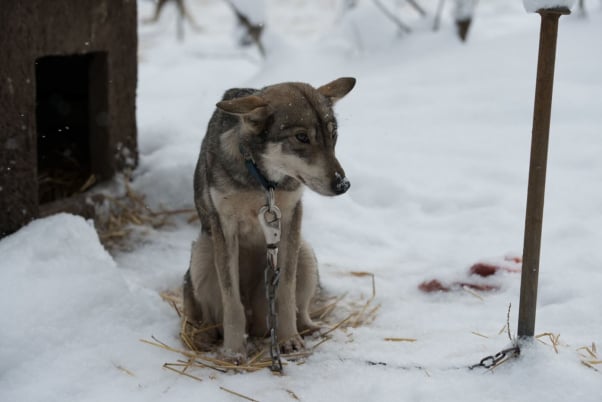
Encourage students to learn about the cruelty in the dog-sledding industry and to speak out against using animals for entertainment. While abusive industries always romanticize their exploitation of animals, exposing students to the whole story in an age-appropriate manner can help them develop informed opinions. Have them watch the following clips from the documentary Sled Dogs, and engage them in a class conversation using the corresponding questions.
(Please note: This link to Sled Dogs should not be shared on social media. Sled Dogs is now available on Amazon Prime in the U.S.)
Living Conditions for Dogs in the Sledding Industry (Film clip 27:12–28:00)
In this clip, the living conditions for the dogs used in the sledding industry are shown. Have students pay attention to the number of dogs living at this kennel and how they’re treated. Consider the following questions with your students:
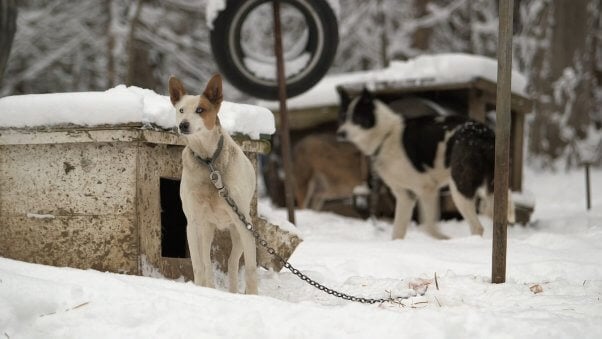
- How are these dogs prevented from running away? (They’re tethered by a chain that’s secured to a stake in the ground. They can move around only as much as their chain lets them.)
- How are the living conditions for the dogs in the clip different from the living conditions for the dogs we share our homes with? (Our dogs get to live comfortably indoors and have the freedom to move around as they please. The dogs in the clip are limited to a small space. They also have to stay outside all the time, even in the rain, freezing temperatures, blistering heat, and more. They don’t have the opportunity to cuddle up in a warm bed or be near a loving guardian, and no one gives them any affection.)
Dog Sledding and the Tourism Industry (Film clip 13:35–14:34)
In addition to being forced to race in the Iditarod, dogs are used in the tourism industry. Consider the following questions with your students:
- How are the dogs being used for human gain? (If students need an additional prompt, ask them to think about ways the dog-sledding industry benefits humans and if there are any benefits to the dogs. The dogs are being used every time a tourist pays for a ride or a picture. They are subjected to the strain and stress of pulling a human and do not benefit in any way. In fact, they suffer as a result of being used by humans.)
- Is it ever acceptable to take advantage of someone in order to make money? Explain your answer. (No. And it’s wrong for the humans who run these operations to take advantage of dogs in order to make money while forcing them to live chained up outside. Explanations may vary.)
Misperceptions (Film clip 58:30–59:18)
Debunk the misperceptions that people have about dogs used in the sledding industry. Consider the following questions:
- Gina Phillips, co-owner of Krabloonik, the largest tourist dog-sledding operation in the U.S., states, “The biggest thing that I think we need to educate the public on is that there are ‘sled dogs’ and there are dogs.” Explain why this statement is untrue. (There’s no such thing as a “sled dog.” They’re not “super dogs” or pieces of equipment—they’re the same as the dogs we share our homes with. All dogs deserve to live indoors, safe from the elements and other dangers. They all deserve to be loved and to have their other needs met. Dogs used in the sledding industry don’t get the care, attention, and shelter they deserve.)
- In the next part of the clip, Markey Butler, former mayor of Snowmass, Colorado, talks about tethering. She believes that tethering household dogs is cruel, while tethering dogs used in the sledding industry is not. We already know that there’s no difference between dogs who live indoors with humans and “sled dogs.” Why is tethering always cruel? (Tethered animals have only a small amount of space to move around in. They might get hurt or might not be able to reach their food and water if they get tangled up in their tether, and they can’t escape from people or other animals who might try to hurt them. They have little shelter to protect them from the rain, snow, hot sun, or freezing cold.)
Advocacy for Animals in Action (Film clip 30:30–32:28)
In this clip, the advocacy group Voices for the Krabloonik Dogs is introduced. Consider the following questions:
- Bill Fabrocini and Leigh Vogel are part of Voices for the Krabloonik Dogs. Why do you think they decided to speak up for dogs raised at Krabloonik, the facility shown in the film clip 58:30–59:18? (They wanted to change the living conditions for these dogs and make their lives better.)
- How many dogs did Leigh say were living at Krabloonik when the group counted? (At the time, 300 dogs were chained up there.)
- Why did Bill call the place where the dogs lived a “storage facility”? (He states that the “dogs are just here to be stored until [someone] can make money.” They were left to fend for themselves. Bill was able to walk on the property without being approached or kicked out. No one cared about the dogs’ well-being.)
- Voices for the Krabloonik Dogs spoke up for dogs at a Snowmass Village Town Council meeting. How do you think you could use your voice for animals? (Answers will vary. Remind students that they, too, can attend town council meetings in their community to speak up for animals. They can also tell an adult when they see someone hurting an animal.)
Call to Action
It’s important to remember that even small acts of courage can make a big difference. Every call to action presents more opportunities for awareness of issues, such as the cruelty of the dog-sledding industry. Students should feel empowered knowing that their voice and actions for animals matter—they’re moving society in a kinder and more empathetic direction.

Empower your students by having them participate in PETA’s latest campaign against the Iditarod. Millennium Hotels and Resorts is one of the last major sponsors of the race. Following PETA campaigns, ExxonMobil, Jack Daniel’s, Coca-Cola, Alaska Airlines, Chrysler, Wells Fargo, and several other major companies cut ties with the Iditarod. One way to help dogs used in the sledding industry is to urge businesses not to sponsor cruel races. As a class, send e-mails to Millennium Hotels and Resorts urging the company to end its sponsorship of the Iditarod.
Students could also write cards they’d imagine sending to the dogs used in the industry. Have students flex their empathy muscles by putting in writing what they would say to them. They can take the activity a step further by drawing a picture portraying how the dogs’ lives would be different in a loving home.
Discuss the Iditarod with students in grades 6–12 using the following TeachKind feature:
Iditarod—the Cruelest Race (Grades 6–12)
The post Advocating for an End to the Iditarod With Your Elementary School Students (Grades 3–5) appeared first on PETA.
Alan Cumming to Starbucks Canada Exec: ‘Stop Penalizing Vegans With Upcharges’
Today, PETA Honorary Director Alan Cumming—who just filmed a new show for Apple TV+ in Vancouver—sent an appeal to Starbucks Canada Senior Vice President Lori Digulla, writing, “More than a year ago, Starbucks acknowledged that cow’s milk is the company’s biggest source of carbon dioxide emissions. Yet it continues to penalize customers for making green and humane choices by charging them extra for vegan milk.”
Cumming’s appeal to the Toronto-based subsidiary comes just after CEO Kevin Johnson declared at a Starbucks investor meeting, “[T]he most dominant shift in consumer behavior … is this whole shift to plant-based products. And that is a shift both in beverage and in food.” Starbucks refuses to join other chains like Toronto-based Balzac’s Coffee Roasters and Vancouver-based Breka Bakery & Cafe that don’t charge extra for vegan milk. The upcharge has been particularly controversial among Black customers, many of whom are lactose intolerant.
Cumming’s full letter appears below. PETA—whose motto reads, in part, that “animals are not ours to eat”—opposes speciesism, a human-supremacist worldview.
For more information, please visit PETA.org or follow the group on Twitter, Facebook, or Instagram.
Cumming’s letter to Digulla follows.
February 25, 2021
Lori Digulla
Senior Vice President and General Manager
Starbucks Canada
Dear Ms. Digulla:
As a vegan and an honorary director of PETA, I was heartened to read that Starbucks will expand its vegan menu to meet the increasing demand for plant-based food and to work toward its sustainability commitment. However, there is one simple action that Starbucks could take right now to show that it’s serious about cutting its carbon emissions and reducing waste: Stop charging customers more for choosing environmentally and animal-friendly vegan milk.
It’s time to wake up and smell the coffee. More than a year ago, Starbucks acknowledged that cow’s milk is the company’s biggest source of carbon dioxide emissions. Yet it continues to penalize customers for making green and humane choices by charging them extra for vegan milk. This also unfairly harms people who are lactose intolerant—most of whom are people of color.
If Starbucks really wants to help the planet, it must do more than just talk about its goals. It’s time to take action. The secretary-general of the United Nations has urged world leaders to declare a “climate emergency,” and President Biden has signed an executive order for the U.S. to rejoin the Paris climate agreement. As you know, greenhouse gases are released at nearly every stage of milk production, and manure from dairy farms contaminates our waterways and creates dead zones in the oceans where no life can survive.
The most responsible move would be to stop selling cow’s milk altogether, but at the very least, Starbucks can—and must—end the vegan milk upcharge. My friends at PETA and I will sing your praises when you do!
Sincerely,
Alan Cumming
PETA Honorary Director
The post Alan Cumming to Starbucks Canada Exec: ‘Stop Penalizing Vegans With Upcharges’ appeared first on PETA.
Students, Level Up Your Activism—Sign Up Now for SOS’ Spring Retreat
The post Students, Level Up Your Activism—Sign Up Now for SOS’ Spring Retreat appeared first on PETA.