‘Cowspiracy’ Team Dives Below the Surface: 6 Lessons From ‘Seaspiracy’

If you’re wondering how detrimental consuming fish is, sea for yourself: In the new Netflix documentary Seaspiracy, director Ali Tabrizi lays bare how commercial fishing devastates marine animals—and what will happen if humans continue to consume fish. Created by the same team that made the illusion-shattering feature Cowspiracy, Seaspiracy goes below the surface to reveal the depths of cruelty in the global fishing industry.

Here are six eye-opening truths from Netflix’s Seaspiracy:

1. Fish feel.

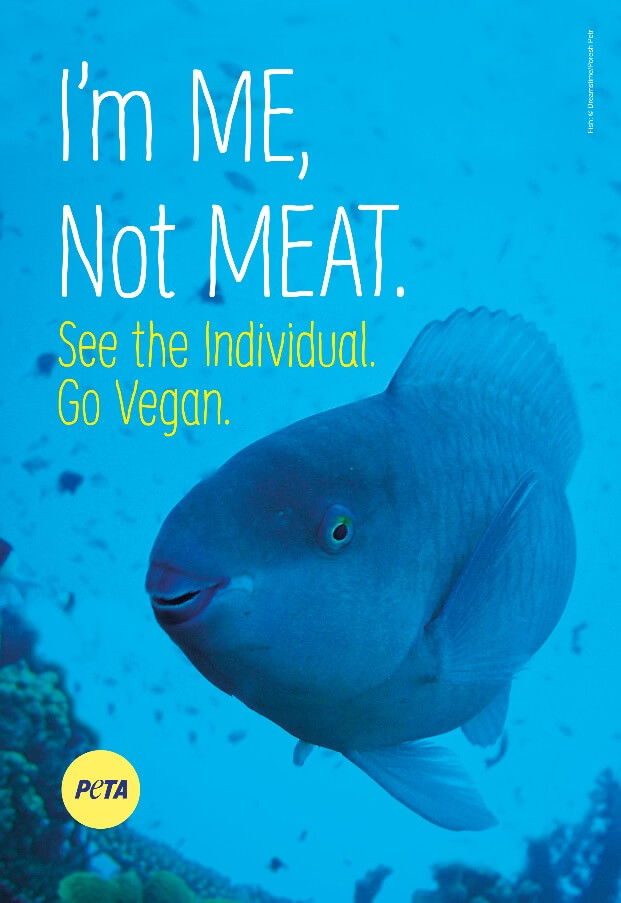
Each fish is an individual with a unique personality and the desire to live. Fish experience pain in a way similar to humans, communicate in complex ways (herrings, for example, signal each other by farting), and can feel fear.

So, when massive commercial-fishing nets rip the animals from their homes, pack them so tightly that their eyes may burst out of their skulls, drag their sensitive scales along the ocean floor, and force them to undergo decompression—which often ruptures their bladders and pushes their stomachs out of their mouths—fish likely experience an excruciating, terrifying journey to the surface. Then, if they are still alive, fishers often cut their gills and leave them to bleed out or toss them onto ice to freeze or suffocate slowly. You wouldn’t want to be kicked, thrown, suffocated, or hacked to death on a chopping block—and neither do they.
2. There’s no such thing as killing fish “sustainably” for food.

Companies use deceptive labels (aka “greenwashing”) to dupe consumers into believing that killing certain types of fish for food are “sustainable,” but they’re all wet. For example, it’s estimated that the Scottish salmon-farming industry produces as much organic waste as the entire human population of Scotland does each year, yet the fish flesh that it sells is marketed as “sustainably produced.” Commercial fishing is even more damaging than oil spills—the fishing industry in the Gulf of Mexico destroyed more animals in a single day than the largest oil spill in history, Deepwater Horizon, did in months.

There isn’t even an agreed-upon definition of the term “sustainable” among marine “conservation” groups, so the label is pretty much meaningless. There’s no way to decimate wildlife populations sustainably. The only real sustainable and ethical choice is to leave fish in peace and go vegan.

3. If fishing trends continue, oceans will be desolate in less than 30 years.

Yes, you read that right. Oceans will be empty by 2048 unless we take action now, and there aren’t plenty of fish in the sea. We must stop supporting the greedy and cruel fishing industry, which kills 2.7 trillion fish every year. Fish play a vital role in sustaining the ocean’s entire ecosystem. Without them, other animals—including coral reefs, whales, dolphins, and seabirds—would starve and die.

4. The “plastic straw” debate is a red herring.

Heartbreaking videos of sea turtles with straws stuck in their nostrils have persuaded many restaurants and consumers to switch to paper or ditch straws altogether. That’s a good thing, but it’s a drop in the ocean—plastic straws kill 1,000 sea turtles globally every year, but in the U.S. alone, fishing vessels capture, injure, or kill an estimated 250,000 sea turtles annually. Hardly anyone is addressing the trash heap in the room: Straws account for 0.03% of plastic in the ocean, while nearly half of the Great Pacific Garbage Patch is made up of—you guessed it—fishing nets.

5. Commercial fishing is never “dolphin safe.”

“Dolphin Safe” labels on tuna cans may make consumers feel better, but they’re worth less than the paper that they’re printed on. Every year, 300,000 dolphins and whales are killed after being caught in fishing nets—and because overfishing has depleted so many fish populations, fishers in certain areas routinely slaughter dolphins they view as “competition.” One “dolphin-safe” tuna-fishing vessel slaughtered 45 dolphins to catch eight tuna—and no tuna is “tuna safe”! How can you know your eating habits won’t endanger the safety of any animals? Just go vegan. It’s that simple!

6. There’s no justification whatsoever for eating fish.

Eating fish harms marine animals, the environment, and yes, even you. A plate of fish flesh likely comes with a side of toxic heavy metals, dioxins, plastics compounds, and other pollutants. And as for omega-3 fatty acids? Fish don’t even make them. They get their omega-3s from the algae that they eat—and we can get omega-3s by taking algae oil supplements and feasting on fortified vegan seafood products.

“I realized the single best thing I could do every single day to protect the ocean and the marine life I loved, is to simply not eat them.” —Ali Tabrizi, Seaspiracy director

It’s not too late to start protecting fish who are killed by an industry that’s destroying the entire ocean. Start today by going vegan and taking PETA’s simple actions to help fish.

Host a Watch Party for Seaspiracy

The post ‘Cowspiracy’ Team Dives Below the Surface: 6 Lessons From ‘Seaspiracy’ appeared first on PETA.
Get Inspired to Save Animals With this Fun Outdoor Activity!

Here’s a quick pop quiz for students: Do fish feel pain?

The answer is yes, of course! And just like us, fish want to be free and live in their natural homes with their friends and families. Unfortunately, because of littering and fishing, there’s a lot of trash in the ocean, lakes, ponds, and other marine habitats. The fish, turtles, frogs, birds, and other animals who live there can get entangled in it or accidentally eat it, which can harm or even kill them. That’s why “trash fishing”—a fun, easy, animal-friendly activity thought up by father-and-son team Tom and Mark—is the perfect way to teach your students about the importance of “catching” trash instead of fish in order to help keep the great outdoors clean and safe for everyone.

What Is Trash Fishing?

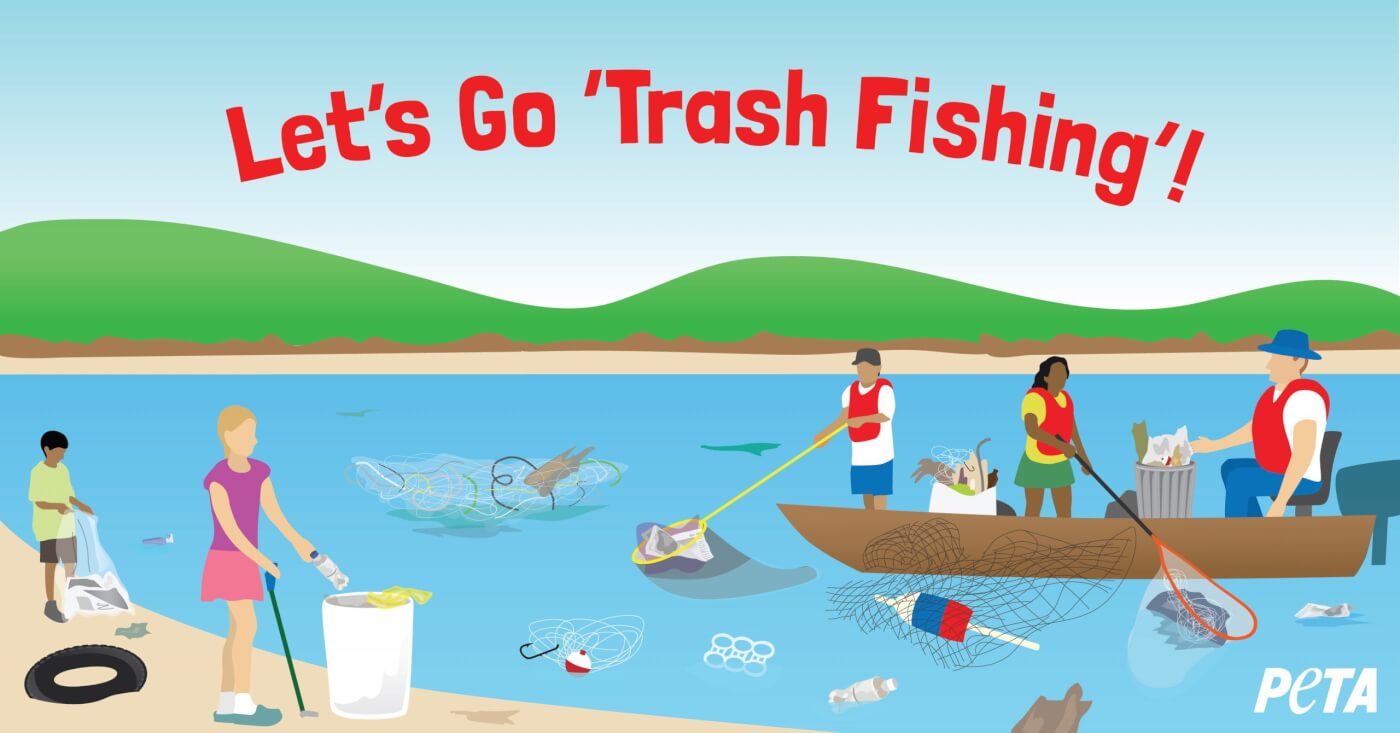
It’s fishing for trash instead of animals! So instead of tormenting fish by yanking them out of the water, your students can help clean up their homes in nature.

what is trash fishing

Trash fishing can be a great socially distant activity to participate in on a field trip to a local waterway, or students can do it on their own time for extra credit. Everyone benefits—animals get a cleaner home, the students get exercise and fresh air, the environment becomes healthier, and the whole community enjoys the beautified natural area.

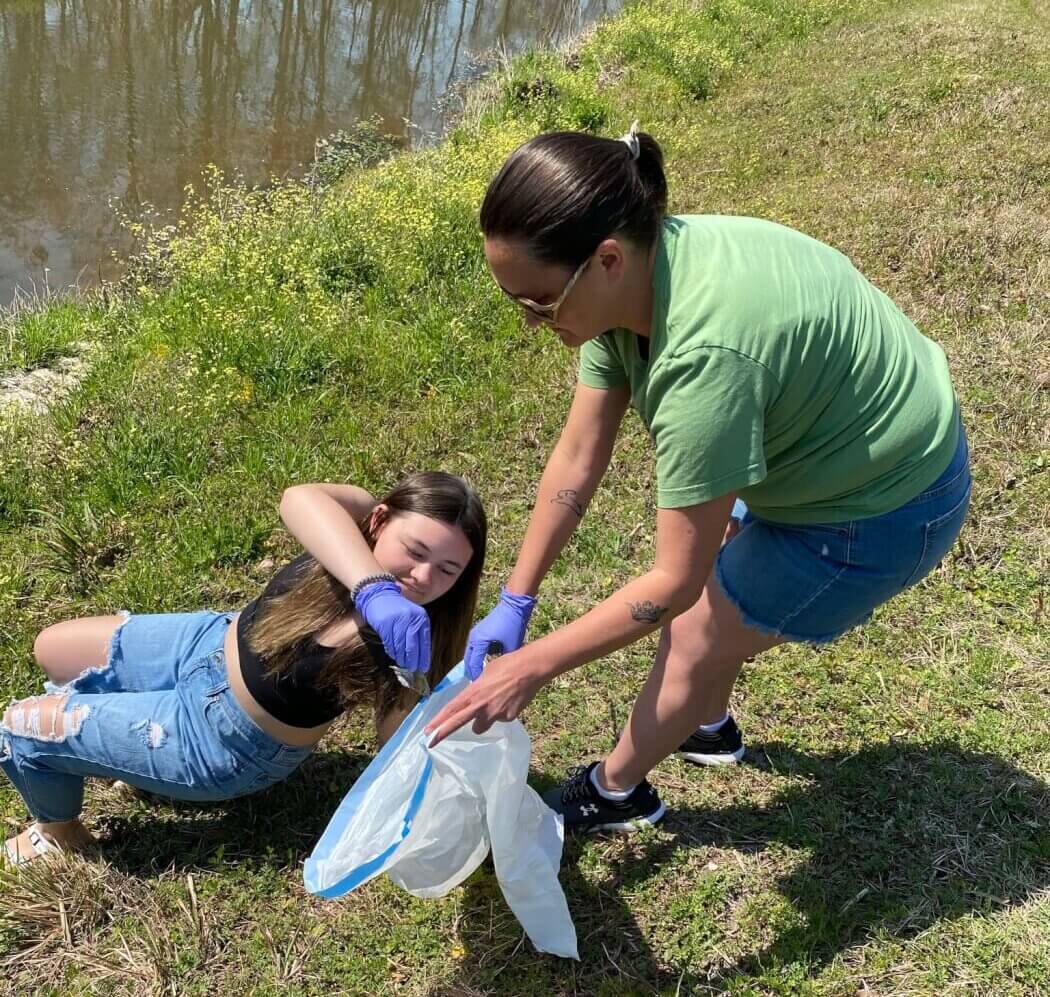
TeachKind’s very own Samantha and her daughter, Elliot, go trash fishing.

Interview With Tom and Mark

Read PETA Kids’ interview with Tom and Mark to learn more about trash fishing and their inspiration for creating this activity.

What Materials Do Students Need for Trash Fishing?

Students just need gloves, something to collect garbage in (plastic 55-gallon drums or biodegradable extra-large trash bags are good options), and a can-do attitude. They can also use nets, trash grabbers, or whatever other tools they may find helpful. And boats are optional! Students can walk along the shoreline of any body of water and pick up trash—it’s super-easy to do. Remind them to dispose of the garbage that they collect in a recycle bin or trash can.

What If My Students Don’t Live Near a Body of Water?

That’s no problem. They can still clean up litter in any outdoor area—it all helps animals and the environment.

Why Is Trash Fishing Better Than Fishing?

Fishing hurts fish as well as other aquatic animals and birds who get caught in or eat the discarded fishing line, nets, and other gear. And other trash pollutes waterways, hurts land animals, and is unsightly, too.

*****

We ♥ trash fishing! Tom and Mark continue to help animals and encourage others to do so as well with their trash-fishing events, in which residents of their community join them on the water and see who “catches” the most trash! Check out their events here, and challenge your students to start their own trash-fishing groups.
The post Get Inspired to Save Animals With this Fun Outdoor Activity! appeared first on PETA.

PETA Mobile Billboard to Circle Chinchilla Mill, Owner’s Law Office

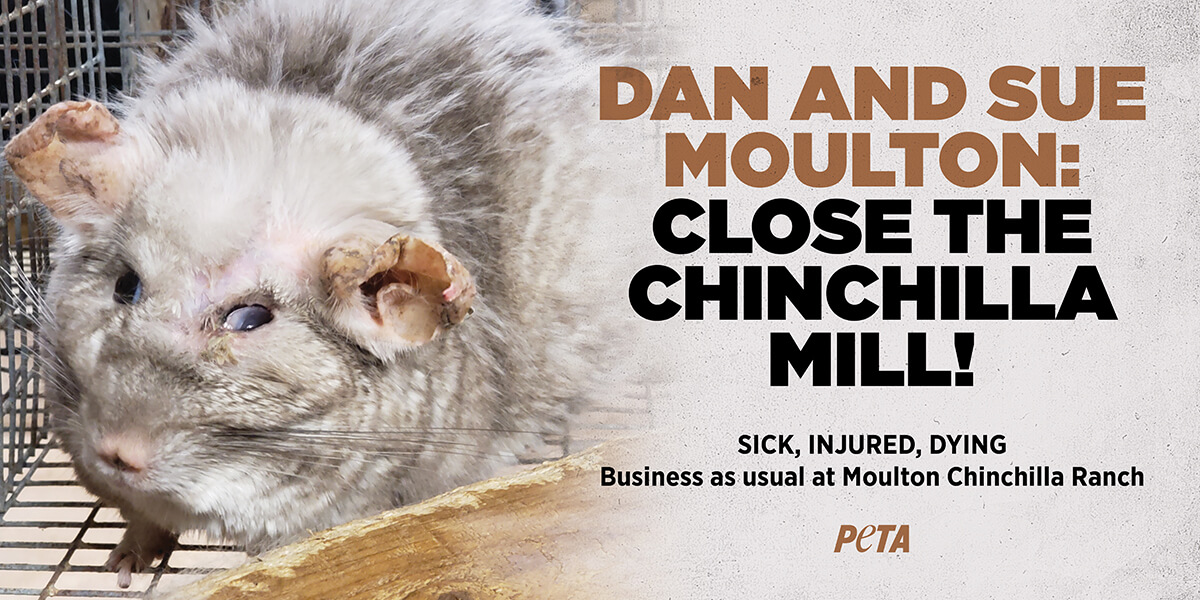
A PETA undercover video investigation into Moulton Chinchilla Ranch (MCR) revealed horrific animal suffering: Chinchillas had open wounds, exposed bones, and other painful injuries. Now PETA is running a mobile billboard in Chatfield, Rochester, and Preston today calling on the mill’s owner and operator, Dan Moulton, and his wife, Sue, to shut the facility down and release the long-neglected chinchillas to organizations equipped to provide them with humane care. Last week, PETA ran a radio PSA on Minnesota 97.5 FM alerting locals to the rampant animal neglect found at MCR.

A PETA eyewitness who worked at MCR—which has supplied animals to laboratories and the pet trade for decades—gathered evidence showing that nearly 1,000 chinchillas were constantly confined to cramped, fully exposed wire cages and denied even the opportunity to hide, burrow, or exercise in any way, which are vital natural forms of behavior for the species. The animals were also chronically deprived of desperately needed veterinary care for abscesses and pus-filled eyes, among other painful conditions. One chinchilla died after suffering from a raw, bloody open wound for weeks, and another died after the Moultons’ dog attacked and injured her and she was left to suffer overnight without any care.

“This breeder won’t provide chinchillas with even basic care, and his wife has evidently turned a blind eye to the suffering in her own backyard,” says PETA Senior Vice President of Cruelty Investigations Daphna Nachminovitch. “PETA is calling on this couple to let these vulnerable animals finally get the care they need and deserve.”

After hearing from PETA, Atlas Pet Supply dropped MCR as a supplier—its CEO calling conditions there “entirely unacceptable”—and Rochester Community and Technical College’s veterinary technician program ended its class field trips to the mill.

Photos from the investigation are available here. PETA—whose motto reads, in part, that “animals are not ours to abuse in any way”—opposes speciesism, a human-supremacist worldview. For more information, please visit PETA.org or follow the group on Twitter, Facebook, or Instagram.

The mobile billboard will circle MCR in Chatfield (32846 County Road 5), Dan Moulton’s law office in Rochester (976 14th Ave. S.W.), the Fillmore County Courthouse in Preston (101 Fillmore St. E.), and the Fillmore County Sheriff’s Office in Preston (901 Houston St. N.W.).

The post PETA Mobile Billboard to Circle Chinchilla Mill, Owner’s Law Office appeared first on PETA.

Feds Find Turkeys Suffocated at Farbest Foods; PETA Seeks Criminal Probe

Armed with a damning U.S. Department of Agriculture report documenting that at least 20 turkeys suffocated to death at a Farbest Foods, Inc., slaughterhouse, near Huntingburg, PETA sent a letter this morning to Dubois County Prosecuting Attorney Anthony D. Quinn, asking him to review the matter and, as appropriate, file criminal cruelty-to-animals charges against the facility and the workers responsible. PETA just obtained the federal report via a Freedom of Information Act request.

The federal report notes that the workers intentionally stacked approximately 50 live turkeys—in two or three layers—into two crates and then left for a break. When they later removed the birds, 10 to 12 turkeys in each crate had died.

“Up to two dozen turkeys endured slow, terrifying deaths, buried beneath other struggling birds,” says PETA Senior Vice President Daphna Nachminovitch. “PETA is calling for a criminal investigation and urging anyone disturbed by this cruelty to help prevent animals from going into slaughterhouses in the first place by going vegan.”

PETA—whose motto reads, in part, that “animals are not ours to eat”—opposes speciesism, a human-supremacist worldview. For more information, please visit PETA.org or follow the group on Twitter, Facebook, or Instagram.

PETA’s letter to Quinn follows.

April 5, 2021

The Honorable Anthony D. Quinn

Dubois County Prosecuting Attorney

Dear Mr. Quinn:

We’re writing to request that your office (and the local law-enforcement agency, as you deem appropriate) investigate and file applicable criminal charges against Farbest Foods, Inc., and the workers responsible for stacking approximately 50 turkeys into coops—which killed at least 20 of them—on January 20, 2020, at its slaughterhouse located at 4689 S. 400 W., near Huntingburg. The U.S. Department of Agriculture’s Food Safety and Inspection Service (FSIS) documented the incident in the attached report, which PETA just obtained via a public records request.

According to the report, an FSIS inspector found that several workers had put approximately 25 turkeys—in two or three layers—into each of two crates before leaving for a break. When workers removed the birds, 10 to 12 turkeys were evidently found dead in each crate. When the FSIS agent asked a worker if all the birds were alive when they were put into the crates, the worker allegedly nodded in affirmation. The FSIS inspector concluded that the workers had intentionally stacked the animals on top of one another and that, as a result, up to 24 birds had died of suffocation.

This conduct may violate IC § 35-46-3. Importantly, FSIS action doesn’t preempt criminal liability under state law for slaughterhouse workers who perpetrate acts of cruelty to animals.

Please let us know if we can assist your office.  Thank you for your consideration and for the difficult work that you do.

Sincerely,

Daniel Paden

Vice President of Evidence Analysis

Cruelty Investigations Department

The post Feds Find Turkeys Suffocated at Farbest Foods; PETA Seeks Criminal Probe appeared first on PETA.