The post Ripley, Believe It or Not, Has Been Languishing at SeaWorld Parks Since 1996 appeared first on PETA.
PETA to Host a Local … Fishing Event?
Tomorrow, PETA supporters will gather at Garfield Lake Park for a new “trash fishing” initiative, inspired by the father-and-son duo who decided to tackle trash—from tires to tin cans—in Michigan’s Detroit River. PETA along with Canada Geese Protection Colorado (CGPC) will supply attendees with eco-friendly gloves, compostable trash bags, and vegan snacks like Swedish Fish candy.
When: Saturday, April 10, 11 a.m.
Where: Garfield Lake Park, 3600 W. Mississippi Ave. (at the intersection of S. Newton Street and W. Arizona Avenue.), Denver
“PETA’s ‘trash fishing’ initiative is a fun way to enjoy nature, reduce pollution, and protect marine life in all its fascinating forms,” says PETA Director of Campaigns Danielle Katz. “No one would hook a dog or a cat through the mouth, and fish should be no different.”
PETA notes that traditional fishing is a cruel practice of hooking gentle animals through their sensitive mouths, watching them slowly suffocate, and sometimes even gutting them while they’re still alive. Even though they’re now known to feel pain as acutely as mammals do, more fish are killed for food each year than all other animals combined. And fishing doesn’t just hurt fish—every year, millions of birds, turtles, and other animals sustain debilitating injuries after swallowing hooks or becoming entangled in fishing line. Wildlife rehabilitators say that discarded tackle is one of the greatest threats to aquatic animals.
CGPC—which was founded in 2019 by concerned residents after 1,662 geese were rounded up from local parks and killed—will also be holding additional trash fishing events at area lakes in the coming weeks.
PETA—whose motto reads, in part, that “animals are not ours to eat”—opposes speciesism, a human-supremacist worldview. For more information, please visit PETA.org or follow the group on Twitter, Facebook, or Instagram.
The post PETA to Host a Local … Fishing Event? appeared first on PETA.
PETA to Support Neighborhood Slaughterhouse Permit—on One Condition
Residents are rallying against a chicken slaughterhouse approved for construction on Tranquility Drive in Easton, so in advance of the public hearing scheduled for May 3, PETA sent a letter this morning to John Harris, chair of the Easton Zoning Board of Appeals, expressing its support of the slaughterhouse—if, that is, the facility is built with at least one glass wall so that operations are visible to the public.
“If you put a chicken on your dinner table, you can’t oppose a slaughterhouse down the street,” says PETA President Ingrid Newkirk. “A slaughterhouse with a glass wall would at least show the public the fear and torment the birds endure and would likely create some new vegans.”
PETA—whose motto reads, in part, that “animals are not ours to eat”—opposes speciesism, a human-supremacist worldview. For more information, visit PETA.org.
PETA’s letter to Harris follows.
April 9, 2021
John Harris
Chair
Easton Zoning Board of Appeals
Easton, Connecticut
Dear Mr. Harris:
I’m writing on behalf of PETA and our more than 6.5 million members and supporters worldwide, including many across Connecticut, in response to concerns over a zoning permit that will allow for the construction of a slaughterhouse at 59 Tranquility Dr. and the tabling of the appeal against it this week. We urge you to reject the appeal, but only if the owner agrees to construct the slaughterhouse with at least one glass wall so that members of the public can witness firsthand the fear and torment that chickens endure before they’re killed for food. Please allow me to explain.
Sir Paul McCartney said, “If slaughterhouses had glass walls, everyone would be vegetarian.” He knows that it is easy to forget where meat comes from when you see it in neatly wrapped packages at the farmer’s market or supermarket, but the animals don’t go peacefully. Regardless of size and location, all slaughterhouses involve the abuse and violent slaughter of individuals who want to live.
We believe that everyone has the right to consider who animals are, what makes them tick, and how they feel. Chickens are smart, sensitive animals who feel pain, empathy, and love; form complex social structures; and dream at night, as humans do. Studies show that they can anticipate future events, communicate with their chicks while they’re still inside the shell—so that they recognize their mother’s voice when they hatch—and have distinct personalities. Baby chicks, we now know, can count and perform basic addition and subtraction.
We hope you’ll agree that now, while the world continues to battle the current pandemic caused by exploiting animals for food, it’s urgent, if only for selfish reasons, that we humans stop eating animals. For the animals, the matter is also one of life and death. Thank you for your consideration. We look forward to hearing from you.
Very truly yours,
Ingrid Newkirk
President
cc: Philip Doremus, Zoning Enforcement Officer
The post PETA to Support Neighborhood Slaughterhouse Permit—on One Condition appeared first on PETA.
Urgent From PETA: Wildfire Survival Tips for Animals in Dudleyville
Because the Margo Fire continues to threaten Dudleyville and evacuations are underway, animals must be kept indoors and will die if abandoned.
Residents in areas affected by smoke and falling ash should keep animals indoors and avoid all outdoor activities, such as running with dogs. If visibility is less than 5 miles, smoke has compromised the air quality and reached unsafe levels. Anyone who sees animals in distress and is unable to help should note their locations and alert authorities immediately.
Trapped horses and other animals can’t outrun wildfires. They should never be locked in their stalls or confined in any way, unable to flee.
Animals must never be left behind. Anyone who evacuates and intentionally abandons animals to fend for themselves may be prosecuted.
PETA has released a wildfire-preparedness public service announcement featuring Dean Winters. It will remind everyone to make plans to ensure the safety of animal companions in advance of trouble in order to avoid being caught unprepared. PETA also offers a video about keeping animal companions safe during fires for you to share. For more information, visit PETA.org or follow the group on Twitter, Facebook, or Instagram.
The post Urgent From PETA: Wildfire Survival Tips for Animals in Dudleyville appeared first on PETA.
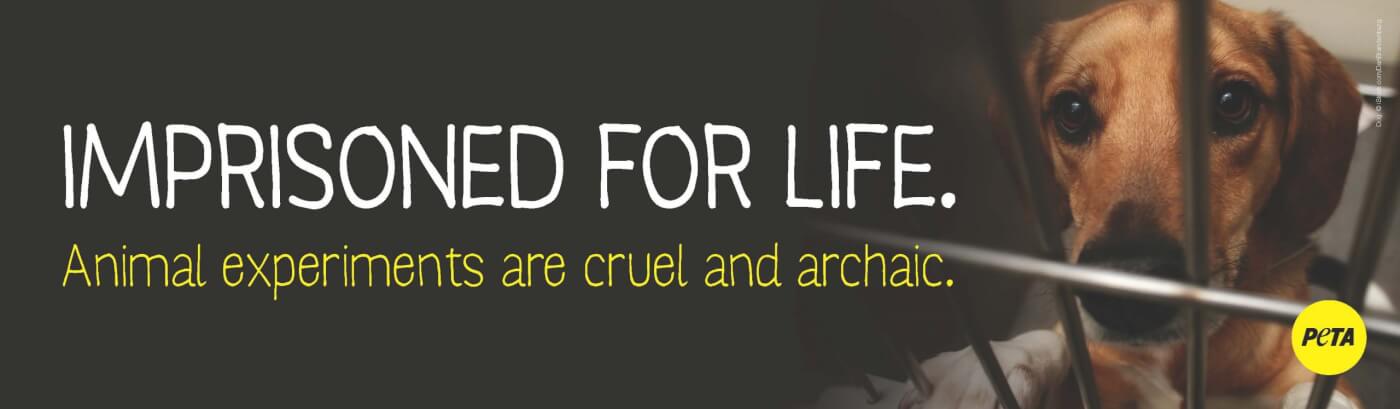
Imprisoned For Life.
The post Imprisoned For Life. appeared first on PETA.