House in ‘Nightmare on Elm Street’ to Become PETA Empathy Museum?

Known fictionally as “1428 Elm St.,” the Los Angeles house whose facade appears in the 1984 horror classic A Nightmare on Elm Street is up for sale, with offers due by Halloween. So today, PETA sent a letter to Heather T. Roy and Learka Bosnak of Douglas Elliman Real Estate, urging the agents to give the home another turn in the spotlight—this time as a pop-up empathy museum to honor the hundreds of animals tortured in “monkey fright” experiments that have been conducted for decades using taxpayer funds from the National Institutes of Health and are still going on today.

While the film’s villain, Freddy Krueger, uses a razor-clawed glove to torture his victims in their sleep, real-life tormenter and government experimenter Elisabeth Murray cuts into monkeys’ heads, saws off a portion of their skulls to expose the brain, and then injects toxins into it. Afterward, the monkeys are placed alone in a small metal cage and experimenters set out to scare them with fake but realistic-looking snakes and spiders. Eventually, they’re killed.

“Krueger’s torment was fictional, but monkey fright experiments take place in a real-life house of horror,” says PETA President Ingrid Newkirk. “PETA’s pop-up museum would foster empathy for animals used in fear experiments that no doubt give them nightmares until they’re killed.”

PETA—whose motto reads, in part, that “animals are not ours to use in experiments”—opposes speciesism, a human-supremacist worldview. For more information, please visit PETA.org or follow the group on Twitter, Facebook, or Instagram.

PETA’s letter to Roy and Bosnak follows.

October 25, 2021

Heather T. Roy and Learka Bosnak

Real Estate Agents

Douglas Elliman

Dear Ms. Roy and Ms. Bosnak:

PETA entities have more than 9 million members and supporters globally, including hundreds of thousands across California. I’m writing to you on behalf of PETA U.S., the largest animal rights organization in the world, to learn more about the property located at 1428 N. Genesee Ave. in Spaulding Square. Given that this is the home known for appearing in the horror classic A Nightmare on Elm Street, we’re interested in exploring the possibility of converting it into a pop-up empathy museum for the hundreds of monkeys tortured over the years in “monkey fright” experiments.

You may already be familiar with Freddy Krueger, who sadistically terrorizes, tortures, and kills his victims while they sleep using a razor-claw glove. Although he’s a fictional character, in real life, many victims undergo similar painful, frightening experiences in Elisabeth Murray’s “money fright” experiments conducted at the National Institutes of Health. She cuts into monkeys’ heads, saws off a portion of their skulls, chemically burns parts of their brains, confines them to a metal box, and then terrorizes them with realistic-looking rubber snakes and spiders. Afterward, she leaves the monkeys inside a stainless steel cage while she goes home to her expensive condominium.

We’re always looking for ways to call attention to the violence inherent in crude and cruel experiments, and this pop-up empathy museum would shed light on the way monkeys—who dream just as humans do—must relive the horror of their frightening and painful experiences every night. And during the day, they never know when new horrors will be inflicted on them. Our museum would also expose the cruel irony that an individual supposedly studying neuropsychiatric disorders engages in acts demonstrating a complete lack of empathy, much like Krueger.

Turning the Nightmare on Elm Street house into an empathy museum for these victims would help people remember that, just like humans, all animals are made of flesh and blood and are capable of experiencing fear and suffering as well as joy and love. Please let us know if this house could serve as a local pop-up museum to inspire visitors to oppose horrific, unnecessary tests on animals, at least until you sell it. Thank you for your consideration.

Very truly yours,

Ingrid Newkirk

President

The post House in ‘Nightmare on Elm Street’ to Become PETA Empathy Museum? appeared first on PETA.
Ringling’s Animal-Free Comeback Sends a Powerful Industry Message: Cruelty Has No Place in Circuses

BREAKING: Nearly five years after PETA’s triumph over Ringling Bros. and Barnum & Bailey Circus, the shuttered show is reportedly planning its return to the big top—without elephants, tigers, or any other nonconsenting animals! The exciting announcement sends a powerful message to the entire industry, something that PETA’s been saying for decades: Cruelty doesn’t belong in the circus or in any other form of entertainment.

Feld Entertainment Chair and CEO Kenneth Feld and Chief Operating Officer Juliette Feld Grossman apparently declared the show’s 2023 animal exploitation–free comeback yesterday during a conference in Seattle, with a formal announcement reportedly slated for next year. (Feld Entertainment, which is Ringling Bros.’ parent company, has canceled its federal Animal Welfare Act license.) The announcement comes after PETA wrote to Grossman in 2020, after learning of the circus’s potential return, urging her and the company to employ only willing human talent in future productions.

“We looked at our company like a 50-year-old startup,” Feld told the audience.

Feld’s forward-thinking revolution proves that circuses can dazzle audiences with willing human performers and that no animal need ever be exploited in the process. The company’s other animal-free productions are already brimming with creativity and consenting talent that transform arenas into entirely new worlds: They immerse audiences in the jungles of Jurassic World, where they encounter realistic dinosaurs, and they bring superheroes to life in Marvel Universe Live! We’re sure Ringling Bros.’ return—featuring human aerialists, clowns, and daredevils who are free to go home at the end of the day and to choose when they retire—will similarly wow spectators, all while leaving elephants and other animals in peace.

A Sign of Changing Times

Ringling Bros.’ announcement perfectly reflects our society’s intolerance of the practices of carting elephants and other nonconsenting animals across the country and bullying them into performing stupid tricks. Fifty years ago, less-informed audiences may have felt wonder at seeing a tiger jump through a hoop or laughed at a pig spinning on a pedestal. But times and tastes have changed: More people now understand that animals are sensitive individuals who deserve respect and protection. When it comes to today’s savvy consumers, the only wonder is how anyone could still find it entertaining to see an animal caged and taunted with a whip.

Ringling Bros. Could Actually Become ‘The Greatest Show on Earth’

From our inception, we were determined to end Ringling’s abuse of animals, because it truly was the saddest show on Earth. PETA and our supporters protested in nearly every city, published eyewitness footage showing elephants being beaten backstage, and worked with whistleblowers who showed the world that baby elephants are tied down and jabbed with bullhooks during training. As a result, ticket sales plummeted, cities started banning animal acts, and Ringling was forced out of the business of exploiting animals.

The Return of Ringling: How PETA Helped Shape the Circus’s Animal-Free Comeback

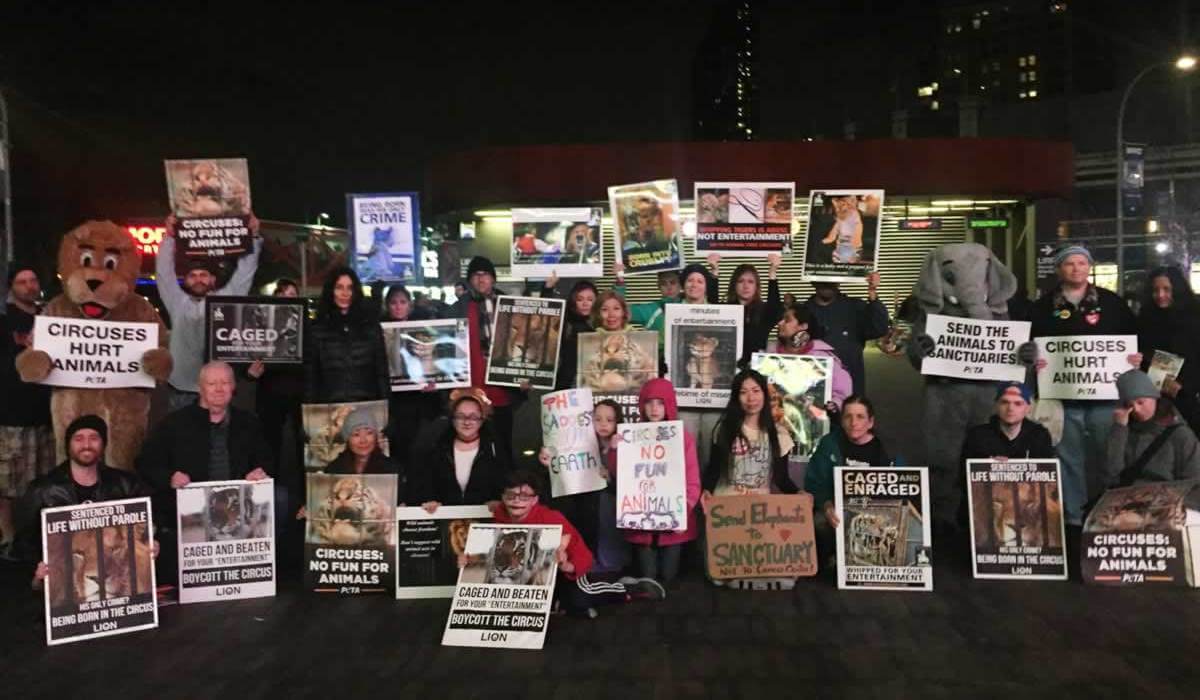
Members of PETA and other groups gathered outside Brooklyn’s Barclays Center on February 23, 2017, in New York City for Ringling Bros. circus’s final animal-abusing opening show, sending the exploitative circus off the best way we know how: with protest signs still held high and tissues in our hands to catch the tears of joy.

In 2020, White Oak Conservation—an organization certified by the Association of Zoos & Aquariums—took over Ringling’s former notorious Florida elephant-breeding and -training center, and it was announced that all elephants healthy enough to move to White Oak would be transferred to the vast, reputable facility. Earlier this year, the first group of elephants was indeed moved to White Oak, where they live in a herd and spend their days exploring an expansive natural habitat.

PETA hopes the animal-free version of Ringling will inspire any remaining animal-abusing circuses—like the Carden Circus, which is still exploiting elephants, tigers, camels, and others—to let only talented human performers shine under the big top. Click below to join the more than 73,000 PETA supporters who have already urged Carden to nix its cruel acts and send the animals to reputable sanctuaries:

Tell Carden Circus to Learn From Ringling’s Lessons

The post Ringling’s Animal-Free Comeback Sends a Powerful Industry Message: Cruelty Has No Place in Circuses appeared first on PETA.

One Person’s ‘Trash’ Could Be Your Treasure

Oscar the Grouch may like living in a trash can (as much as he’s capable of liking anything), but for Oscar the cat, a garbage bin was hardly his preferred home—rather, it was simply the closest thing to shelter he could find.

PETA fieldworkers stumbled upon Oscar’s malodorous domicile when they stopped to use the restroom at a gas station in rural Virginia. Upon spotting the PETA logo on the fieldworkers’ van/T-shirts, an employee told them that s/he was worried about a skinny kitten who had been hanging out around the dumpster after being abandoned there several days earlier. Sure enough, that’s where the fieldworkers found Oscar, a 5-month-old copper-colored tabby, whom they scooped up like a lucky penny and brought back to the Sam Simon Center—PETA’s Norfolk, Virginia, headquarters.

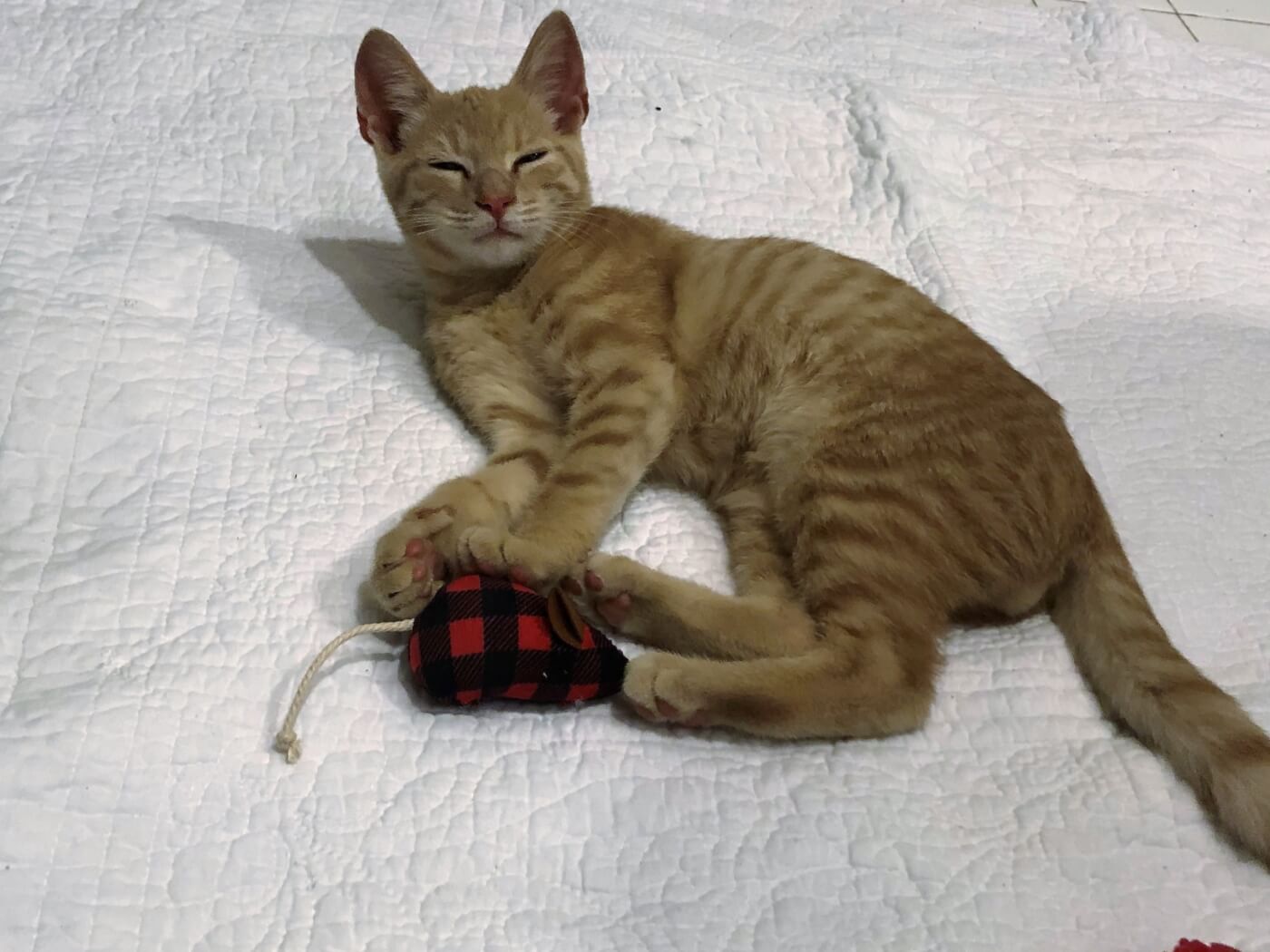
Oscar, a PETA rescued kitten, is adoptable

Unlike his Muppet namesake, Oscar the kitten is no grouch. On the contrary, his foster parents report that he’s as mild-mannered as Ernie, as ticklish as Elmo, as goofy as Grover, and as fearless as Gonzo.

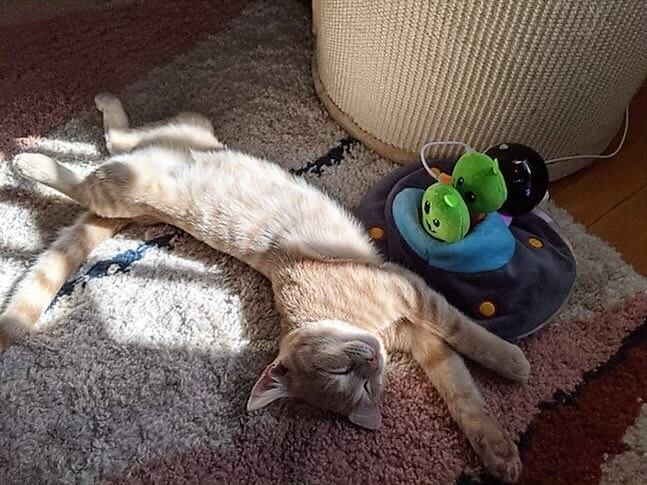
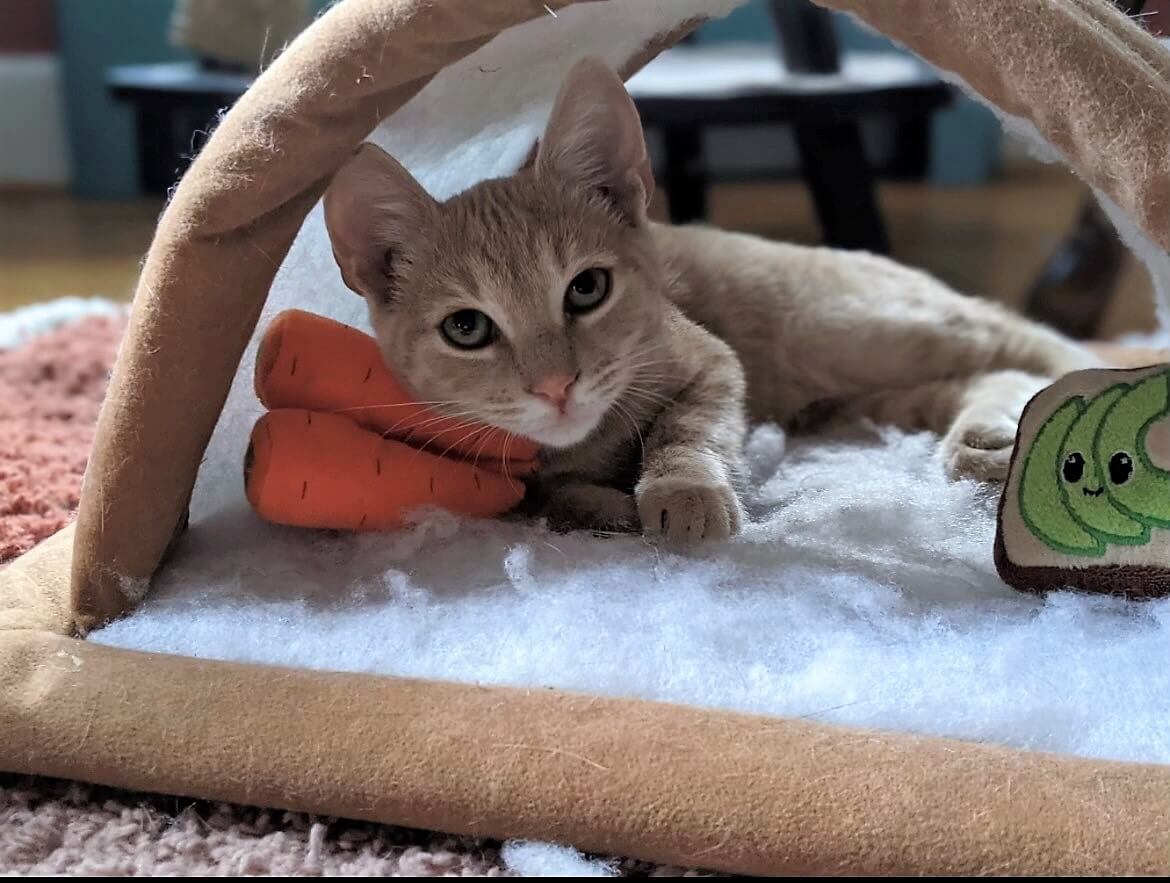
Oscar playing with toy

One thing Oscar the kitten does have in common with Oscar the trash can denizen is his love of repurposing found objects as toys or hiding spots.

Adoptable kitten Oscar

If you want to feel like you’ve won a major award, e-mail Adopt@PETA.org to find out how this Oscar could be yours.

Get to Know Oscar and Other Adoptable Animals

The post One Person’s ‘Trash’ Could Be Your Treasure appeared first on PETA.

DIY ‘Squid Game’ Costumes Get a Vegan Twist With PETA Prop

The record-breaking Squid Game is sure to inspire a lot of DIY Halloween costumes this year—so to give those ensembles an animal rights spin, PETA is now taking orders for its limited-edition “Red Light, Green Light” costume prop, which reminds everyone that going vegan is the most effective way to avoid “elimination.”

“Studies show that, on average, vegans live about 15 years longer than meat-eaters do, so anyone who wants to stay in the game in real life should stop eating animals,” says PETA President Ingrid Newkirk. “PETA offers free vegan starter kits, delicious recipes, and more to help give anyone the green light for a longer, healthier life.”

In addition to saving the lives of nearly 200 animals per year each person who goes vegan reduces their risk of suffering from heart disease, cancer, strokes, and diabetes and helps prevent widespread “elimination.” Animal agriculture is responsible for nearly one-fifth of human-induced greenhouse-gas emissions, and SARS, swine flu, bird flu, and COVID-19 all stemmed from confining and killing animals for food.

PETA suggests completing the costume by pairing the “Red Light, Green Light” prop with a yellow button-up short-sleeve shirt, an orange dress, white socks, and black flats—plus a pack of vegan starter kits to give to curious partygoers and trick-or-treaters.

PETA—whose motto reads, in part, that “animals are not ours to eat”—opposes speciesism, a human-supremacist worldview. For more information, please visit PETA.org or follow the group on Twitter, Facebook, or Instagram.

The post DIY ‘Squid Game’ Costumes Get a Vegan Twist With PETA Prop appeared first on PETA.

California Law Shields Wildland Arsonists From Cruelty-to-Animals Charges

In California, if an arsonist sets fire to a home knowing that there are animals inside, they could rightfully face cruelty-to-animals charges. But if an arsonist sets fire to a forest—which is home to all kinds of wildlife—the same law likely wouldn’t apply to them. Why on scorched earth wouldn’t cruelty-to-animals laws in California apply to wildfire arsonists, whose actions have undoubtedly caused countless animals to suffer and die painfully? Here are the facts.

Hundreds of wildfires are intentionally set by arsonists each year, killing and injuring countless victims. But unlike in Oregon, where the alleged arsonist responsible for the destructive Alameda fire was also charged with eight misdemeanor counts of first-degree animal abuse following a petition from PETA, wildfire arsonists in California aren’t being held accountable for animal suffering.

According to California law, to charge someone with cruelty to animals, they have to have acted maliciously with intent to injure or kill other animals or they must have had custody of the animals. In most wildland arson cases—like the Hopkins fire, which leveled dozens of homes and killed birds, cats, and dogs left inside, or the Dersch fire, which killed finches, parakeets, parrots, dogs, and cats—neither of these conditions is met.

However, California law also states that any person who causes an animal “unnecessary or unjustifiable physical pain or suffering” is guilty of cruelty to animals. Contributing to a wildfire in which animals suffer and die from severe burns and smoke inhalation should qualify.

Hold Wildland Arsonists Accountable for Animal Suffering

Wildland arson painfully kills countless animals—there’s no reason it shouldn’t count as cruelty to animals under California law. If you want to push for reforms that will hold wildland arsonists accountable for animal suffering, contact your state legislators and ask that they propose legislation that would include “collateral” animal victims of deliberately set fires. If you hear of a fire in your state, please encourage prosecutors to file cruelty-to-animals charges whenever they can be interpreted to apply.

You Don’t Have to Be a Firefighter to Fight Fires—Just Go Vegan

Scientists have established a link between climate change and the country’s intensifying wildfires, and a leading cause of climate change is animal agriculture. You can do your part by not eating or wearing animals. Go vegan for the planet today:

Go Vegan to Fight Climate Change!

The post California Law Shields Wildland Arsonists From Cruelty-to-Animals Charges appeared first on PETA.