
Spider-Man Is an Animal Rights Activist: PETA and Superheroes Unite

A superhero’s job is to protect people from those intent on causing harm. So what happens when an entire population’s suffering is legal and the “good guys” are those breaking the law? A 1990 Spider-Man comic, titled “Liberty and Justice for All” (in Marvel Comics Presents #39)—or, as the back cover aptly phrases it, “The Amazing Spider-Man vs. Vivisectionists”—addresses this very issue and shows that Spidey is unafraid to take action for all people, regardless of species.

Spider-Man vs. Vivisectionists

When Spider-Man gets word that criminals are stealing from a university, he’s outraged. However, he’s in for a shock when the “crooks” turn out to be students intent on liberating animals the university planned to torment in cruel experiments.

Spider-Man: Haven’t you heard? It’s not nice to steal from the university! Student 1: Hurry Up! Spider-Man: I float through the air with the greatest of ease… Student 2: Start the van! Let’s go!

The students explain that dyes and chemicals will be applied to rabbits’ sensitive eyes to test cosmetics and that a monkey’s head will repeatedly be bashed to test the limits of head trauma.
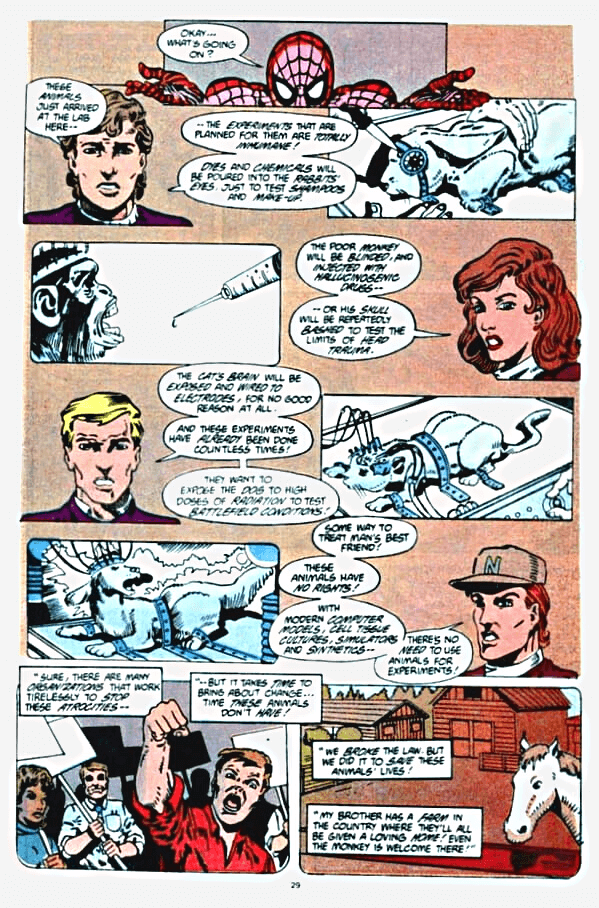
Spider-Man learns how the university plans to use the animals in experiments

Spider-Man: Okay… What’s going on? Student 1: These animals just arrived at the lab here. The experiments that are planned for them are totally inhumane! Dyes and chemicals will be poured into the rabbits’ eyes. Just to test shampoos and make-up. Student 2: The poor monkey will be blinded and injected with hallucinogenic drugs or his skull will be repeatedly banged to test the limits of head trauma. Student 3: The cats brain will be exposed and wired to electrodes, for no good reason at all. And these experiments have already been done countless times! They want to expose the dog to high doses of radiation to test battlefield conditions! Student 4: Some way to treat man’s best friend! These animals have no rights! With modern computer models, cell tissue cultures, simulators and synthetics… there’s no need to use animals for experiments!

Moved by the animals’ plight, Spider-Man has a difficult choice: uphold the law or allow the students to escape with the animals. With only moments to decide, he accepts the students’ ethical argument and allows them to free the animals. Spidey acknowledges that while he failed to capture the “crooks,” he has never felt better in his life.

Although the scenario in “Liberty and Justice for All” is obviously fictional, the experiments that the students prevent the animals from being used in are, of course, based on reality. More than 161,000 rabbits are tormented in laboratories every year, and many of them are subjected to the Draize eye irritancy test described in the comic, in which substances—such as personal-care products, household cleaning products, or their ingredients—are applied to their eyes, often causing redness, swelling, discharge, and sometimes blindness. After the tests, the rabbits are either killed or subjected to more experiments, despite the availability of humane and effective animal-free methods.

Monkeys also suffer in university laboratories. For example, experimenters led by Agnès Lacreuse perform invasive surgeries on female marmosets at the University of Massachusetts–Amherst (UMass), implanting electrodes in holes that they drill into the animals’ skulls. Then they cut into their necks and thread electrode leads from their scalp and neck through their abdomen. The marmosets are routinely zip-tied into a restraining device to immobilize them, and then they are shoved into a plastic cylinder that’s screwed in place and are subjected to the noise of an MRI machine. It’s a frightening and confusing experience. In some tests, these sensitive, social animals are left in solitary confinement—which United Nations officials have compared to torture when it’s done to humans—just to see how they react.

Take Action for Monkeys Tortured at UMass

Do You Want to Defend the Rights of All, Like Spider-Man? Read Free the Animals

We can’t all be superheroes like Spider-Man, but we can all be heroes to animals who are suffering in laboratories. For the story of a real-life hero, check out Free the Animals by PETA President Ingrid Newkirk. In the book, “Valerie”—a young woman on the cusp of a promising career in law enforcement—changes her life when she witnesses the abuse of animals in laboratories. Like Spider-Man, Valerie finds her world turned upside down when she learns that abiding by the law is not always the ethically sound choice. She decides that if no one else is going to help free the animals from abuse, she will.

If comics aren’t your thing or you’re just looking for your next book, pre-order Free the Animals today:

Order Your Copy of ‘Free the Animals’ Today

As an Amazon Associate, PETA earns from qualifying purchases. If you buy something after clicking the Amazon Smile links on this page, a percentage of the qualifying purchase will be donated to PETA and help us protect more animals from exploitation.

The post Spider-Man Is an Animal Rights Activist: PETA and Superheroes Unite appeared first on PETA.

Braves Under Fire as Iditarod Punishes Mushers Who Stopped Dogs From Freezing to Death

Braves President Derek Schiller was hit with a letter from PETA this morning calling on him to pressure the team’s owner, Liberty Media—which also owns Iditarod sponsor GCI—to cut ties with the Alaskan dog-sled race after officials demoted and imposed fines on mushers who brought dogs indoors during a potentially fatal storm.

“No one with a heart wants to be associated with an event that actually punishes people for trying to prevent dogs from freezing to death,” says PETA Executive Vice President Tracy Reiman. “PETA is calling on the Braves to take a stand and help stop Liberty Media from condoning this deeply disturbing, cruel race.”

PETA notes that this year’s nearly 1,000-mile race through wind and ice was saturated with chaos and cruelty. Two dogs went missing—one of whom has still not been found and whom the Iditarod is failing to help search for—a musher was apparently forced out of the race after dogs he used were found in poor condition, and dogs were attacked and one was killed during training before the race even began. Nearly 250 dogs were pulled from the trail due to exhaustion, illness, or injury, leaving the remaining ones to work even harder to pull the mushers.

Just this year, Millennium Hotels and Resorts and Nutanix cut ties with the Iditarod, joining former sponsors ExxonMobil—once a major sponsor to the tune of $250,000 a year—Jack Daniel’s, Coca-Cola, Wells Fargo, Alaska Airlines, and 14 other companies. PETA’s campaign to push Liberty Media to join the pack has included howling supporters in husky masks haunting the company’s headquarters in Colorado, purchasing stock to exert pressure at Liberty’s annual meetings, and sending the company’s CEO 150 “bloody” dog collars representing the dogs run to death in the race’s history.

PETA—whose motto reads, in part, that “animals are not ours to use for entertainment”—opposes speciesism, a human-supremacist worldview. For more information on PETA’s investigative newsgathering and reporting, please visit PETA.org or follow the group on Twitter, Facebook, or Instagram.

The post Braves Under Fire as Iditarod Punishes Mushers Who Stopped Dogs From Freezing to Death appeared first on PETA.

Urge Uplift to End Its Partnership With SeaWorld

It’s hard to understand why any company would trash its reputation by associating with SeaWorld. Yet payment plan company Uplift is offering “Buy Now, Pay Later” options for booking packages for the abusement parks.

[Photo of an animal at SeaWorld]

More than 40 orcas and over 300 other dolphins and whales have died at SeaWorld, many far short of their natural life expectancy. Public condemnation prompted the company to end its reckless orca-breeding program, but it continues to churn out bottlenose dolphins and beluga whales who will spend the rest of their lives in cramped, barren tanks. These animals are forced to perform tricks day in and day out and are sometimes given anti-anxiety drugs to combat the stress of extreme captivity and the endless monotony of swimming in circles.

In their natural homes, dolphins can recognize the whistles of others they haven’t seen in 20 years just as easily as those of friends they saw six months ago. Belugas have been called “sea canaries” because they seem to sing to each other. Forcing these keenly social and intelligent animals to perform tricks for the public is a form of speciesism, a human-supremacist worldview.

Change is taking place. The National Aquarium in Baltimore is building a seaside sanctuary for the dolphins in its care, two whales have been moved from a marine park in China to a seaside sanctuary in Iceland, and The Whale Sanctuary Project announced plans for such a sanctuary in Canada. Airbnb, Delta Air Lines, Mattel, Mott’s, Tripadvisor, and many other companies have dropped their partnerships with SeaWorld.

As the world is turning away from the cruelty of cetacean captivity, please urge Uplift to follow suit and rethink its partnership with SeaWorld.

The post Urge Uplift to End Its Partnership With SeaWorld appeared first on PETA.

University of Delaware Cited by Feds in Experimental Use of Prairie Voles: PETA Statement

Please see the following statement from PETA Vice President Dr. Alka Chandna concerning U.S. Department of Agriculture documents showing that the University of Delaware was cited for violating the federal Animal Welfare Act:

The University of Delaware should lose is license to imprison and harm animals. Just-released government documents obtained by PETA reveal that an experimenter went rogue and subjected more prairie voles than had been approved to an invasive surgery in which a recording device was implanted into their bodies. It appears that these small, complex animals are being used in curiosity-driven experiments to study the relationship between social behavior and hormones—in voles, not humans. Voles are known to be intelligent, sensitive, and empathetic, but the same cannot be said about University of Delaware experimenters.

Last year, the University of Delaware received $45,756,039 from the National Institutes of Health—and about half of that money went to pointless experiments on animals. The university must redirect its resources toward modern, non-animal research methods that will actually help humans, and we urge officials there to adopt PETA’s Research Modernization Deal.

For more information on PETA’s investigative newsgathering and reporting, please visit PETA.org or follow the group on Twitter, Facebook, or Instagram.

The post University of Delaware Cited by Feds in Experimental Use of Prairie Voles: PETA Statement appeared first on PETA.

PETA Files NIH Complaint Against Virginia Tech After USDA Violations

Please see the following statement from PETA Senior Vice President Kathy Guillermo regarding citations posted by the U.S. Department of Agriculture against Virginia Tech for its violations of federal animal welfare regulations. 

It’s disgraceful that Virginia Tech failed to maintain its animal experimentation oversight committee properly. These committees are the last line of defense for animals in laboratories, and as federal records obtained by PETA prove, this violation puts animals at risk: Virginia Tech’s veterinarian should have been able to relieve the suffering of a very ill calf but didn’t have access to euthanasia solution. Dogs in the university’s laboratories had no regular program of veterinary care, and bats were transported across the country in containers without proper ventilation. PETA filed a complaint with the National Institutes of Health, urging it to suspend all funding to Virginia Tech until the school proves that it can abide by animal protection laws and regulations.

Virginia Tech must redirect its resources toward modern, non-animal research methods that will actually help humans, and we urge its officials to adopt PETA’s Research Modernization Deal.

For more information on PETA’s investigative newsgathering and reporting, please visit PETA.org or follow the group on Twitter, Facebook, or Instagram.

The post PETA Files NIH Complaint Against Virginia Tech After USDA Violations appeared first on PETA.